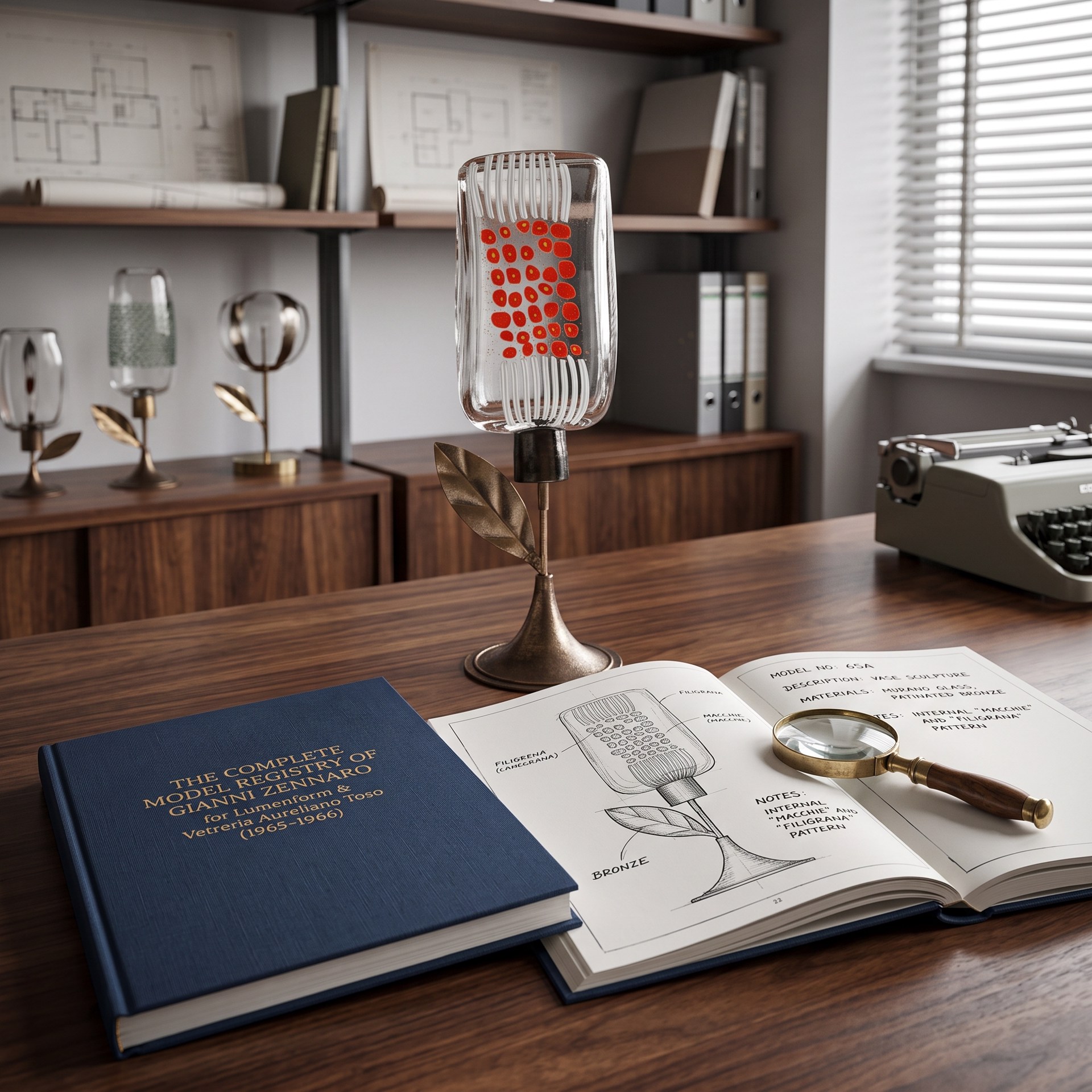
The Complete Model Registry of Gianni Zennaro for Lumenform & Vetreria Aureliano Toso (1965–1966)
The mid-1960s was an era of intense, structural restructuring across the island of Murano. Faced with rising fuel and labor costs, the major furnaces recognized that the traditional studio-craft model—which relied on blowing labor-intensive, one-of-a-kind art vases—had to adapt or risk commercial obsolescence. The solution was a highly strategic shift toward architectural, high-end lighting.
This transition was fueled by the emergence of specialized mid-century lighting consultancies, most notably Lumenform. Founded in Venice, Lumenform operated as an elite design studio, commissioning prominent modern architects and industrial designers—such as Alessandro Pianon and the Venetian architect Gianni Zennaro—to develop avant-garde lighting glass.
Initially, Lumenform acted as an external contractor, utilizing the unparalleled furnace capabilities of Vetri Decorativi Rag. Aureliano Toso to blow their high-concept glass elements. This partnership was so commercially successful and structurally aligned that Vetreria Aureliano Toso officially acquired Lumenform around 1970.
Through this acquisition, Gianni Zennaro's landmark collaborative designs were brought directly into the factory’s permanent catalog. Following the monumental recovery of the company's internal archives by glass historian Marc Heiremans, collectors, appraisers, and design historians can finally identify, date, and authenticate Zennaro's verified works, documented with the official "GZ" archival prefix.
The Masterwork Vanguard: In-Depth Analyses of Key Flagship Designs
Gianni Zennaro’s output is concentrated in a highly restricted, museum-grade run that perfectly illustrates the mid-century intersection of organic design and architectural functionality.
                  Zennaro "Flower" Design Architecture
+-------------------------------------------------------------------------+
| Silhouette: Highly stylized, biomorphic flora profiles                  |
| + Material: Blown, satin-finished, or cased glass elements              |
| + Function: Integrated structural diffuser for Lumenform fixtures       |
| + Proportion: Standardized scale (H 19.5 cm to 26 cm) for contract use  |
+-------------------------------------------------------------------------+
The Flower (or Fiori) Series (Models 10182 GZ to 10187 GZ)
- Historical Significance: Designed between 1965 and 1966, this highly cohesive series represents the absolute core of Zennaro’s portfolio. It was developed as a flagship collection for Lumenform to showcase how hand-blown glass could be treated as a sculptural, modular diffuser for high-end residential and commercial lighting systems.
- Aesthetic & Form: Rejecting traditional, historical lighting patterns, Zennaro abstracted the natural contours of blooming flora into stylized, biomorphic glass silhouettes. The vessels feature elegant, flared rims and organic, fluid bodies that modulate and soften direct electrical light.
- Technical Execution: Executed without the aid of industrial molds, these delicate pieces required extreme physical balance on the blowpipe. To maintain the consistent thickness necessary for even light dispersion, Toso's master glassblowers had to carefully rotate and shape the cooling parison to prevent thermal stress fractures.
Section 1: The Lumenform & Architectural Glass Catalog (1965–1966)
Because Gianni Zennaro’s tenure was a concentrated, specialized run focused on architectural lighting, his verified designs are highly unified in technique and format.
- Model 10182 GZ: "Flower" – Hand-blown stylized glass diffuser element executed for Lumenform; Height: 23 cm.
- Model 10183 GZ: "Flower" – Hand-blown stylized glass diffuser element executed for Lumenform; Height: 23 cm.
- Model 10184 GZ: "Flower" – Hand-blown glass diffuser element with slightly elongated neck profile executed for Lumenform; Height: 24.5 cm.
- Model 10185 GZ: "Flower" – Monumental hand-blown glass diffuser element executed for Lumenform; Height: 26 cm.
- Model 10186 GZ: "Flower" – Hand-blown glass diffuser element executed for Lumenform; Height: 23.5 cm.
- Model 10187 GZ: "Flower" – Low-profile hand-blown glass diffuser element executed for Lumenform; Height: 19.5 cm.
Section 2: Forensic Checklist for Serious Collectors
Due to the overlap in physical infrastructure between mid-century lighting brands, unsigned Gianni Zennaro pieces are frequently misattributed. Collectors should apply this strict forensic checklist to verify authenticity:
                  +-----------------------------------------+
                  |     GZ-ERA FORENSIC CHECKLIST          |
                  +-----------------------------------------+
                                       |
         +-----------------------------+-----------------------------+
         |                                                           |
         v                                                           v
+--------------------------+                               +--------------------------+
|  LIGHT DIFFUSION CHECK   |                               |  THE MATERIAL DENSITY    |
+--------------------------+                               +--------------------------+
| Glass thickness is       |                               | Blown in Toso's lead-    |
| exceptionally uniform    |                               | free sodic-calcic glass  |
| to prevent uneven light  |                               | (70/15/9), making even   |
| "spots" or heat shock.   |                               | massive diffusers light. |
+--------------------------+                               +--------------------------+
- Uniform Glass Wall Thickness: Commercial "Murano-style" reproductions are usually characterized by uneven glass distribution and crude, heavy bases. A genuine Gianni Zennaro diffuser was engineered with highly uniform wall thickness. This precise physical calibration was vital to ensure even light diffusion and prevent localized heat-shock cracking from high-wattage incandescent bulbs.
- Sodic-Calcic Glass Quality: Like all premier mid-century Aureliano Toso designs, these diffusers were blown using the factory's legendary, lead-free sodic-calcic formula (70% Silica, 15% Soda, 9% Lime). This specific batch chemistry allowed the glass to remain ductile longer and resulted in a finished product that is surprisingly lightweight and vibrant compared to dense, heavy lead-crystal counterfeits.
- The Base Finish: Look closely at the base opening of the diffuser. It must show a meticulously ground, flat-polished, and bevel-edged rim. This cold-grinding process was performed in the moleria to ensure the glass component seated flush and securely within the Lumenform metal mounting collars. Raw, rough, or unground edges are clear signs of an inauthentic piece.
- Archival Model Numbers: Since the recovery of the company's internal model registries, collectors can verify Zennaro's attributions with absolute certainty. His documented designs fall strictly into the 10182 to 10187 model range of the 1965–1966 catalog. Matching the physical height (such as the exact 24.5 cm of the 10184 model) to the archive provides definitive proof of pedigree.
Section 3: Summary Profile for Appraisers & Historians
+-------------------+----------------------------------------------------------+
| Attribute         | Archival & Visual Specification                          |
+-------------------+----------------------------------------------------------+
| Model Numbers     | 10182 GZ to 10187 GZ (Aureliano Toso Model Register)     |
| Designer          | Gianni Zennaro (Venetian Architect)                      |
| Primary Client    | Lumenform (Venice, Italy)                                |
| Manufacturing site| Vetri Decorativi Rag. Aureliano Toso                     |
| Production Era    | 1965–1966                                                |
| Primary Series    | The Flower (or Fiori) Series                             |
| Style Profile     | Mid-Century Modernism & Biomorphic Abstraction           |
| Primary Purpose   | Hand-blown sculptural glass diffusers for lighting       |
| Literature Proof  | Heiremans, M. (2016). Vetreria Aureliano Toso, p. 355    |
+-------------------+----------------------------------------------------------+
Join The Group Facebook Group Leading The Way On Murano Glass Research - Murano Glass Animals