A Legacy of Silica and Fire: Vincenzo Zanetti’s 1881 Manifesto and the Rebirth of Murano
The Phoenix of the Lagoons: A Definitive Scholarly Guide to Vincenzo Zanetti’s 1881 Monograph and the Murano Civic Glass Museum
For art historians, glass collectors, and scholars of Venetian heritage, the island of Murano is not merely a geographic point in the Venetian lagoon—it is a sacred site where fire, silica, and human breath have combined for over a millennium to produce the world’s most sublime decorative art. Yet, the global supremacy that Murano glass enjoys today was nearly lost to history. By the mid-nineteenth century, the island’s furnaces were growing cold, its ancient chemical secrets were dying with the last master glass blowers, and its precious historical documents were being systematically sold to foreign speculators.
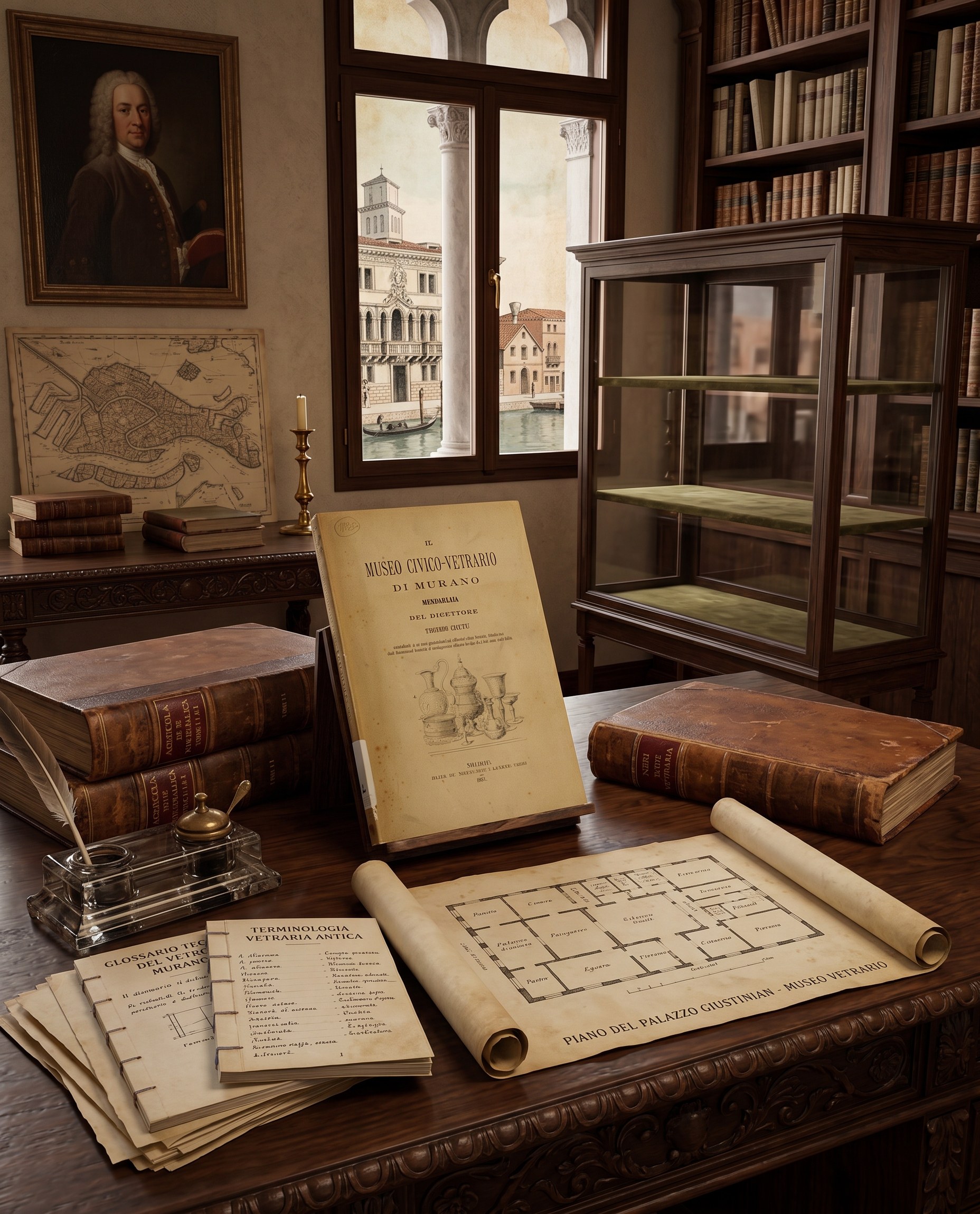
In 1881, a monumental volume was published in Venice from the municipal press of Gaetano Longo: Il Museo Civico-Vetrario di Murano, penned by the museum’s founder and director, Abbot Vincenzo Zanetti. This document was far more than a simple curatorial catalog; it was an industrial manifesto, a historical defense, and a blueprint for the total artistic and economic resurrection of Venetian craftsmanship, prepared specifically for the National Industrial Exhibition of Milan of 1881.
This definitive scholarly guide provides a comprehensive analysis of Zanetti’s landmark monograph. Below, we trace the history, the architectural spaces, the chemical treatises, and the human lives that formed the backbone of the Murano Glass Museum and rescued Venetian glassmaking from the brink of extinction.
I. Abbot Vincenzo Zanetti: The Crusading Priest of Murano
To understand the 1881 monograph and the museum itself, one must understand the man who spent his life—and gave his entire personal fortune—to build them. Abbot Vincenzo Zanetti (1824–1883) was a figure of singular civic devotion: a priest, a brilliant historian, an educator, and the founder of the island's industrial newspaper, La Voce di Murano. Born into a family of glassworkers, Zanetti witnessed firsthand the tragic decline of the island’s traditional furnaces in his youth. He recognized that if Murano's unique heritage was swept away by the tide of modern mass production, the cultural identity of the lagoon would perish with it.
Operating as the honorary, unpaid director of the Civic Glass Museum from its formal inception in 1861, Zanetti waged a relentless, lifelong crusade to preserve the technical masterworks of the past. He spent his meager ecclesiastical funds purchasing rare glassware, retrieving scattered municipal charters, and establishing a festive Drawing School (Scuola del Vetro) attached directly to the museum. For Zanetti, the museum was not a static, silent graveyard of the past intended only for the curious traveler; it was an active, living "academic laboratory" designed to place the physical masterpieces of the Renaissance directly before the eyes of contemporary apprentice glass blowers, teaching them the fundamental laws of classical proportion and elegant design. When Zanetti passed away almost suddenly in December 1883, he left his entire library, his rare collections of gold and silver oselle, and his personal glass holdings directly to the museum he loved.
II. A Millennium of Molten Magic: Lagoon History (982–1881)
In Chapter I of the monograph, Zanetti traces the deep historical roots of the lagoon’s glass industry to establish an unassailable lineage of craftsmanship.
The Medieval Foundations
The earliest historical record of glassmaking in the Venetian lagoons is grounded in a document dated 982 AD, which explicitly mentions a certain Dominicus, designated with the prestigious title of phiolarius (a maker of glass vials and bottles). For three centuries, individual furnaces operated throughout the city of Venice. However, on May 28, 1291, the Great Council of Venice issued a historic decree ordering the immediate demolition of all active glass furnaces within the city proper and their permanent relocation to the island of Murano. This strategic concentration served a dual purpose: it protected Venice's dense wooden architecture from the devastating fires caused by the intense heat of the furnaces, and it allowed the state inquisitors to guard the technical secrets of glass chemistry under strict maritime surveillance.
The Golden Age and the Libro d'Oro
Once concentrated on Murano, the glassmakers organized themselves into powerful, self-governing corporations under specialized statutes. The Republic of Venice recognized the industry's economic supremacy by granting the citizens of Murano extraordinary civil and legal privileges. The names of the island's traditional glassmaking dynasties—such as the Toso, Seguso, Ferro, Fuga, Barovier, and Radi families—were inscribed in the sacred Libro d'Oro di Murano (the Golden Book of Murano). Only those inscribed in this registry possessed the legal right to own and operate a glass furnace. Furthermore, the glassmakers of Murano enjoyed:
- Complete immunity from municipal taxes and import duties on raw materials.
- The legal right to bear arms throughout the territories of the Republic.
- The highly prestigious privilege of marrying their daughters directly into the Venetian nobility, with their offspring retaining full noble status.
The Tragic 18th-Century and Post-1797 Decline
During the Renaissance, Murano's thin, hand-blown cristallo vessels were sought after by every royal court in Europe. However, the eighteenth century brought a severe crisis. The emergence of heavy, cut lead glass from Bohemia and coal-fired decorative glass from France and England captured the global market.
Following the catastrophic fall of the Venetian Republic to Napoleonic forces in 1797, the old guild systems were dismantled, and the island’s protective trade agreements were permanently lost. Left to navigate unregulated commercial markets, local manufacturers abandoned traditional artistic techniques to produce low-quality, cheap utilitarian glass. By the 1850s, the art of blowing delicate enameled glass, complex filigree, and shimmering avventurina was considered virtually extinct.
III. The Renaissance of the 19th Century: A Phoenix from the Ashes
Murano's miraculous recovery was driven by a brilliant combination of civic passion, technical genius, and international capital.
The Seminal 1861 Proposal
In May 1861, Abbot Vincenzo Zanetti read a passionate, deeply reasoned proposal before the Municipal Council of Murano, entitled On the Institution of a Municipal Archive and a Civic Glass Museum. Zanetti argued that the only way to rescue the island's dying trade was to collect the surviving physical models of the past into a centralized public safe-haven before they were completely dispersed. On May 28, 1861, the council passed a unanimous resolution accepting the proposal, allocating the eastern galleries of the Municipal Palace to house the collection, and appointing Zanetti as the honorary director.
The Festive Drawing School (Scuola del Vetro)
Zanetti understood that "design is the essential mortar that binds artistic form to industrial utility". In 1862, he annexed the festive Drawing School to the museum. Under the instruction of dedicated masters like Bernardo Toso and Isidoro Seguso, young apprentice glass blowers received free Sunday lessons in geometric proportion, classical design, and historical techniques. The school did not seek to impose modern industrial templates, but to train the artisan's hand and eye to replicate the elegant, weightless curves of their ancestors' work.
The Modern Revivalists and the Venice and Murano Company
The technical and historical preparations laid by Zanetti's museum soon attracted visionary figures who possessed the capital to scale the revival. In 1859, Commendatore Antonio Salviati, an entrepreneurial lawyer from Vicenza, established a workshop dedicated to restoring the mosaic decorations of Saint Mark's Basilica. Recognizing the massive global potential of hand-blown glass, Salviati joined forces in 1866 with prominent British diplomats and scholars, including Sir Henry Austen Layard and Sir William Richard Drake, to establish the Venice and Murano Glass and Mosaic Company (Limited).
The company gathered Murano's finest surviving master blowers—including Francesco Giovanni and Lorenzo Radi—and tasked them exclusively with reproducing the classical Roman, Greek, and Renaissance specimens preserved in the museum. The company's triumphant displays at the international exhibitions of Paris (1867, 1878), Vienna (1873), and Turin (1880) proved to the world that the artistic genius of Murano had officially returned to its ancient throne.
IV. The Architectural and Gallery Walkthrough of the Civic Glass Museum
In Chapter V of the monograph, Zanetti guides the reader through the physical architecture and curated galleries of the museum.
                THE CIVIC GLASS MUSEUM - PHYSICAL LAYOUT
               ==========================================

                      [ UPPER FLOORS: ANCIENT EPOCHS ]
               +--------------------------------------------+
               |  STANZA I: Archaeological & Roman Glass    |
               |  (Augusto Castellani's 781-piece collection)|
               +--------------------------------------------+

                     [ FIRST FLOOR: HISTORICAL GALLERIES ]
               +--------------------------------------------+
               |  STANZA II: Colored Glass & Beads (Conterie)|
               |  (Saint Nicholas Tapestry, 1640 Embroidery)|
               +--------------------------------------------+
                                     |
               +--------------------------------------------+
               |  STANZA III: Modern Glass Revivals         |
               |  (Exhibition Masterpieces for Milan 1881)  |
               +--------------------------------------------+
                                     |
               +--------------------------------------------+
               |  STANZA IV: Enameled, Engraved, & Hardstone|
               |  (Giuseppe Briati Portrait & Rare Treatises)|
               +--------------------------------------------+
                                     |
               +--------------------------------------------+
               |  THE GREAT HALL OF HONOR (Sala Manin Entry) |
               |  (Francesco Zugno Ceiling Frescoes,        |
               |   Colossal 60-branch Barbini Chandelier)   |
               +--------------------------------------------+

                        [ GROUND FLOOR: SHOWROOMS ]
               +--------------------------------------------+
               |  GALLERIA MANIN: Permanent Showrooms       |
               |  (Connecting international buyers & furnaces)|
               +--------------------------------------------+
               |  THE ATRIUM: Ancient Sculptures & Urns     |
               |  (1383 Guild Statute, 1341 Inscription)    |
               +--------------------------------------------+
The Historic Palace: From Episcopio to Municipio
The museum is housed in the grand Municipal Palace of Murano, an architectural gem built in 1689 by Bishop Marco Giustiniani as the official residence for the Bishops of Torcello. Following the reorganization of the diocese in 1818, the palace was acquired by the Commune of Murano in 1840 to serve as the seat of the local government. In 1861, the western and northern wings were retained for municipal offices, while the magnificent eastern galleries on the first floor were dedicated entirely to the Civic Glass Museum.
The Atrium: Sculptures, Urns, and Ancient Inscriptions
The journey begins on the ground floor, where the atrium displays monumental Istrian stone carvings and ancient archaeological relics:
- Urna I: A stone sarcophagus discovered north of the Basilica of Santi Maria e Donato, containing the graves of two children and displaying an early Latin inscription:
+ IC REQVIESCE VITALES ET PETRVS. - Urna III: A hollow sarcophagus displaying a carved Greek cross and the inscription
+ IOHANNEc/2 MASSERAALVS. - The Balastro Inscription (1445): A gothic-inscribed stone slab commemorating a decree by Podestà Nicolò Balastro under the Venetian Republic, granting every Muranese glassmaker the privilege of bringing a pig onto the island tax-free.
- The Sign of the Golden Lion (Leon d'Oro) & Three Crowns (Tre Corone): Massive, carved stone factory signs from the island's famous Renaissance furnaces.
- A historical 1341 Latin inscription commemorating Marco, the earliest recorded fiolario of the fourteenth century.
The Great Hall of Honor (Sala di Rappresentanza)
Ascending the grand staircase, visitors enter the colossal Great Hall, a room of breathtaking artistic majesty. The ceiling features a magnificent fresco painted in the mid-eighteenth century by Francesco Zugno and framed with decorative perspectives by Zanchi (both celebrated disciples of Giambattista Tiepolo). The fresco depicts the apotheosis of Saint Lorenzo Giustinian, the first Patriarch of Venice.
The walls are decorated with monumental commemorative plaques, including one celebrating King Vittorio Emanuele II’s enthusiastic reception in this very hall on November 12, 1876. Two stunning mosaic portraits hang in the room: one of King Vittorio Emanuele II, executed by the Venice and Murano Company, and one of Dante Alighieri, crafted and donated by the Salviati furnace in 1865.
The Colossal 60-Branch Chandelier
Suspended from the center of the Zugno ceiling is the crown jewel of nineteenth-century glass engineering: a colossal crystal chandelier containing 60 branches, standing 4.0 meters high and weighing a massive 330 kilograms. Crafted in 1854 by master glassmaker Giorgio Barbini utilizing a highly complex glass paste formulated by technician Isidoro Barbon, this monumental chandelier is composed of 356 individual pieces of pure, hand-blown crystal and contains absolutely no structural metal components except for its central iron support screw. It was awarded the Gold Medal of Honor at the first Murano Glass Exhibition of 1864 and remains the ultimate historical symbol of the island's technical revival.
Stanza I: Ancient and Archaeological Glass
This upper gallery contains over 1,000 pieces of ancient glassware. The centerpiece is the legendary Augusto Castellani Collection, comprising 781 ancient Roman, Etruscan, and Phoenician glass fragments donated by the celebrated Roman jeweler and archaeologist in 1873. These pieces include delicate cobalt-blue Roman bowls, iridescent tear-bottles (lacrimatori), and ancient mosaic millefiori segments. This collection provided contemporary chemists and master blowers with their primary models to study the fusion methods of antiquity.
Stanza II: Colored Glass and the Conterie (Bead) Collection
Stanza II highlights the technical mastery of colored glass and the history of Murano’s famous bead industry (conterie):
- Cabinet I: Displays 120 pieces of crystal and colored glass crafted by the Fratelli Toso furnace.
- Cabinet II: Houses 105 colored vessels with complex fire-applied enamels and gold avventurina from the Fratelli Ferro workshop.
- The Tapestry of Saint Nicholas: A magnificent 17th-century silk needlework piece executed in 1640 by a Muranese nun, depicting Saint Nicholas, the patron saint and protector of the glassmakers.
- The Bead Collection: An extraordinary display of Phoenician mosaic beads, ancient Egyptian tomb beads, and the celebrated Chevron Beads (perle a rosetta)—including a massive, multi-layered star-patterned specimen measuring 45 millimeters in diameter from the 16th century.
Stanza III: Modern Glass Revivals and Exhibition Showcases
This room showcases the modern masterpieces prepared by the leading island furnaces for the great National Industrial Exhibition of Milan of 1881:
- The Venice and Murano Company Showcase: Displays a monumental 24-light crystal candelabro standing 2.5 meters high, alongside flawless reproductions of the famous 15th-century Correr enameled chalice, and modern murrhine vases composed of fused multicolored glass canes.
- The Ditta Dr. Antonio Salviati Showcase: Highlights highly intricate architectural mosaic panels, fluted crystal goblets with serpentine dragon stems, and opaque red "coral glass" (vetro corallino) crafted in imitation of antique Chinese lacquered vessels.
Stanza IV: Enameled, Engraved, and Hard-stone Glass
This gallery preserves the most delicate decorative techniques of the 15th through the 18th centuries, displayed upon a massive walnut cabinet carved in 1863 according to the design of Professor Giuseppe Zanetti:
- Giuseppe Briati Memorial: Above the central cabinet hangs a miniature enamel portrait of the legendary 18th-century glassmaker Giuseppe Briati, set within a frame of delicate glass rods.
- The Enameled Cabinet: Contains 15th-century cobalt-blue goblets painted with classical mythological triumphs in imitation of the famous Barovier nuptial cup, and a clear plate decorated with enameled scales and gold leaf gilding bearing the coat of arms of the noble Mocenigo family.
- The Engraved Cabinet: Displays 16th-century Venetian mirrors meticulously engraved with a diamond point, featuring depictions of Saint Mark's Lion and classical foliage.
Ground Floor: Galleria Manin (The Permanent Showrooms)
Established in March 1868 and dedicated to the memory of the Venetian patriot Daniele Manin, this grand ground-floor showroom was designed as a permanent industrial bridge between the island's active furnaces and international buyers. The gallery was organized into fourteen distinct compartments, allowing leading firms like the Fratelli Toso, B. Barbini, Dr. Antonio Salviati, and the Società delle Fabbriche Unite to display their latest commercial patterns, prices, and factory addresses to visiting global collectors.
V. The Intellectual Fortress: Library, Archives, and Chemical Treatises
For Abbot Vincenzo Zanetti, the museum's specialized library and archives were not merely dusty repositories of the past—they were the active "intellectual engine" of the modern glass renaissance.
                  THE SCIENTIFIC AND LEGAL TREATISES
                 ====================================

       [ CODES & TREATISES ]                  [ GUILD STATUTES (MARIEGOLE) ]
   +---------------------------+          +-------------------------------------+
   | Antonio Neri (1612)       |          | Glassmakers' Guild Statute (1383)   |
   | "L'Arte Vetraria"         |          | (Written by Brother Giovanni)       |
   +---------------------------+          +-------------------------------------+
                 |                                           |
   +---------------------------+          +-------------------------------------+
   | Christopher Merret (1662) |          | Mirror-makers' Guild (Specchiai)    |
   | (English Annotations)     |          | (Grinding & Silvering Standards)    |
   +---------------------------+          +-------------------------------------+
                 |                                           |
   +---------------------------+          +-------------------------------------+
   | Georgius Agricola (1556)  |          | Beadmakers' Guild (Margari)         |
   | "De Re Metallica"         |          | (Solid & Hollow bead regulations)   |
   +---------------------------+          +-------------------------------------+
                 |                                           |
   +---------------------------+          +-------------------------------------+
   | Vannoccio Biringuccio     |          | Glass Painters' Guild               |
   | "Pyrotechnia" (1540)      |          | (Fire-enameled decoration codes)    |
   +---------------------------+          +-------------------------------------+
The Scientific Treatises on Glass Chemistry
The archive preserves the earliest published scientific works on glass chemistry and metallurgical fusions in Europe:
- L'Arte Vetraria by Antonio Neri (Florence, 1612): The primary and most famous treatise on glass chemistry published in Europe, containing the secret chemical formulas for melting crystal, coloring glass with metallic oxides, and preparing lead glass.
- L'Arte Vetraria with annotations by Christopher Merret (London, 1662): The English translation of Neri's work, which added critical practical chapters on the construction and operation of coal-fired furnaces.
- De Re Metallica by Georgius Agricola (Basel, 1556): A foundational work on mining and geology, containing early chapters detailing the chemical composition of silica sands, soda ashes, and furnace construction.
- Pyrotechnia by Vannoccio Biringuccio (Venice, 1540): A classic treatise on chemical fusions, with detailed descriptions of the raw materials used in Venetian glasshouses.
It was precisely through the exhaustive study of Neri’s 1612 volume preserved in this library that Lorenzo Radi was able to successfully reconstruct the lost chemical formula for gold-and-silver avventurina glass, which had been completely lost to the industry for over a century.
The Ancient Guild Statutes (Mariegole)
The archives preserve the original regulation codes (mariegole) of the island's medieval guilds, written in clear gothic hands on heavy parchment scrolls:
- The Mariegola of the Glassmakers’ Guild (1383): Written by Brother Giovanni, this historic scroll contains the oldest administrative regulations, apprenticeship requirements, and strict technical standards of the glassmakers' corporation.
- The Mariegola of the Beadmakers (Margari) Guild: Documenting the statutes and quality controls for the manufacture of solid and hollow-blown glass beads.
- The Mariegola of the Mirror-Makers (Specchiai) Guild: Detailing the regulations for grinding, polishing, and silvering crystal mirrors.
- The Mariegola of the Glass-Painters Guild: Regulating the fire-application of enamels and gold leaf gilding.
Espionage and the Council of Ten
Historically, the Republic of Venice fiercely guarded its glass monopoly. The archive preserves the dark legal history of this protectionism, including the decrees of the Council of Ten (Consiglio dei Dieci). These documents reveal that any master glassmaker who attempted to emigrate, export raw materials, or teach the secrets of the craft to foreigners faced severe state penalties—including the immediate confiscation of all family properties, the arrest of their relatives, and, in extreme cases, targeted state-sanctioned execution by professional assassins. The records include the official files of 16th-century state trials against several Muranese glass blowers who fled to England and Germany, tracking the diplomatic maneuvers utilized by the Venetian Republic to force their return.
VI. Comprehensive Biographical Registry of Patrons and Master Craftsmen
The monograph preserves a dense network of historical figures who shaped Murano’s destiny. Below is a complete, alphabetical directory of every individual mentioned across your sources and translations, detailing their direct contribution to the museum and the glass art:
Sponsors, Benefactors, and Scholars
- Adda (D') Marchese Girolamo, di Milano: An eminent Italian nobleman, scholar, and collector of rare books. He generously donated several rare Renaissance manuscripts and historical treaties on the decorative arts to the museum’s library.
- Alberici Abate D. Matteo: A local Muranese clergyman who dedicated his administrative career to cataloging, indexing, and preserving the early parish registers and guild documents of Murano, preventing their dispersion during the chaotic Napoleonic era.
- Alberici Giovanni, di Milano: Contributed a valuable collection of early nineteenth-century Italian industrial publications and technical catalogs on glass manufacturing.
- Ambrosio Cav. Antonio, di Torino: Coordinator for the National Italian Exhibition who supported the museum's presence and provided critical space for our attached Drawing School.
- Andreini Monsignor Gio. Batta: Chancellor of the Torcello Cathedral Archive, who assisted Abbot Vincenzo Zanetti in locating and retrieving early medieval documents and mosaic glass fragments from the ruins of the lagoon's older churches.
- Berganzo (De) Monsig. Maria, di Venezia: Provided critical financial support for the restoration of the Municipal Palace's east wing, which now houses the primary galleries of the Civic Museum.
- Bologna Dott. Jacopo: A dedicated local medical officer and scholar of municipal history, who volunteered his time to catalog the early archaeological collections of Room I.
- Bonaldi Domenico, di Venezia: Gifted several rare, beautifully preserved sixteenth-century enameled glass cups and plates from his family's private estate.
- Bortolussi Cav. Augusto: Prominent municipal counselor who championed the annual budget allocations for the maintenance of our festive Drawing School.
- Bortolussi Antonio: Highly respected local administrator who managed the early finances of the Drawing School.
- Bortolussi Vincenzo: An early municipal treasurer who secured the funding for the acquisition of the former episcopio.
- Bragadin Monsig. Gio. Batta: Patriarchal vicar who mediated the acquisition of several historical church glass ornaments, ensuring their preservation in the museum.
- Brandolin (Count): Count of Ceneda who commissioned the grand seawater glass cross to stand on the peak of the new church of Miane.
- Castellani Signor Augusto, di Roma: The internationally celebrated jeweler and archaeologist, who donated an extraordinary collection of 781 ancient Roman and Etruscan glass fragments. This collection forms the bedrock of our archaeological section in Room I, providing essential models for our modern color and shape revivals.
- Cicogna Cav. Emanuele: Prominent Venetian historian and bibliophile whose rare collections of historical documents were consulted by Zanetti.
- Drake Sir William Richard: British scholar and diplomat who partnered with Antonio Salviati to establish the Venice and Murano Glass Company.
- Fol Walter (di Ginevra): Celebrated Swiss collector who donated 46 rare pieces of Roman glass to the museum in 1875.
- Layard S. E. Sir Henry Austen: British diplomat, archaeologist, and close friend of Murano, who served as a crucial patron of our modern glass renaissance. He donated a highly important collection of sixteenth-century Spanish glassware worked in the Venetian style at the royal glasshouses of Spain, which is preserved in Cabinet II of the main hall.
- Minghetti S. E. Marco: Celebrated Minister of Agriculture, Industry, and Commerce who personally presided over the inauguration of the second Murano Glass Exhibition in 1869.
- Moro Monsig. Vincenzo: Highly respected prelate of Torcello who preserved the early cathedral archives.
- Nesbitt Signor Alessandro: British scholar and author of the celebrated Slade Collection of Ancient Glass, who donated a rare, colored glass mosaic inlay segment that formerly adorned the Roman villa of Emperor Lucius Verus.
- Nichetti Monsig. Gio.: Torcello prelate who supported the early civic foundation of the archive.
- Santi Sebastiano: Distinguished Venetian painter whose collection of original drawings and sketchbooks was acquired by the museum.
- Tosi Monsig. Stefano: Prelate who cataloged the early liturgical glass collections of the island's churches.
Master Glassmakers and Artisans
- Barbaria Giorgio: An innovative eighteenth-century industrialist who established specialized workshops to produce heavy, black glass bottles in the English style.
- Barbon Signor Isidoro: Distinguished technical director of the unified bead factories (Società delle Fabbriche Unite de Conterie), who formulated the specialized glass paste for our giant 60-branch chandelier.
- Barbini Giorgio: Legendary 18th-century master builder and glassmaker who constructed the monumental 60-branch crystal chandelier.
- Briati Giuseppe: The ultimate master glassmaker of the eighteenth century, who successfully challenged Bohemian supremacy by inventing a highly pure, clear lead crystal. He established a celebrated furnace on Murano and was noted for his magnificent, multi-tiered crystal chandeliers decorated with hand-sculpted flowers and leaves.
- Brussa Osvaldo: Celebrated Renaissance glass painter noted for his incredibly detailed fire-enameled decorations on clear crystal.
- Ferro (Fratelli - late Pietro): Leading glassmaking brothers who excelled in colored glass chemistry and classical Greek-style amphorae.
- Fuga Giovanni & Pietro: Innovators who developed the modern bead (conterie) and mosaic glass industries.
- Fuga (Fratelli): Master mirror-makers who successfully revived the art of diamond-point engraving on large crystal sheets.
- Giovanni Francesco: Master glassmaker of exceptional genius, who executed the word-for-word reproduction of the historical Correr chalice.
- Mazzola Domenico: Early industrialist who expanded the furnace designs of Murano.
- Radi Lorenzo: The celebrated glassmaker and chemist who successfully rediscovered the lost 17th-century chemical formulas for gold-and-silver avventurina and variegated chalcedony glass (calcedonio).
- Seguso Antonio: Unrivaled master blower of the Venice and Murano Company, who successfully executed the monumental seawater glass cross.
- Seguso Angelo: Master artisan and primary instructor in the application of design to glass.
- Seguso Isidoro: Master glassmaker who served as the primary technical instructor at the festive Drawing School.
- Seguso Luigi: Celebrated blower awarded numerous international medals for blown glass.
- Seguso Marco: Noted for his technical mastery of enameled glass and filigree.
- Toso Francesco & Bernardo: Dedicated instructors at the Drawing School who preserved the geometric principles of classical design.
- Toso (Fratelli - late Pietro): Legendary glassmaking brothers who established a highly successful furnace noted for its grand Louis XV style lampadari and delicate filigree stemware.
VII. The Unified Study Guide for Collectors and Scholars
This study guide serves as a technical and historical reference to help scholars and collectors analyze and identify classical Muranese glass styles.
1. Deep Technical Glossary of Glass Styles
                           GLASSMAKING TECHNIQUES
                          ========================

       [ FILIGREE STYLES ]                             [ CHEMICAL FUSIONS ]
  +---------------------------+                   +---------------------------+
  | Reticello                 |                   | Avventurina               |
  | (Intersecting net pattern |                   | (Shimmering copper        |
  |  with trapped air bubbles)|                   |  crystals in clear glass) |
  +---------------------------+                   +---------------------------+
                |                                               |
  +---------------------------+                   +---------------------------+
  | A Fili                    |                   | Calcedonio                |
  | (Parallel white threads   |                   | (Swirling metallic oxides |
  |  mimicking delicate lace) |                   |  mimicking natural agate) |
  +---------------------------+                   +---------------------------+
                |                                               |
  +---------------------------+                   +---------------------------+
  | A Retortoli               |                   | Lattimo                   |
  | (Twisted glass canes      |                   | (Opaque white glass       |
  |  fused in dynamic spirals)|                   |  colored with tin oxide)  |
  +---------------------------+                   +---------------------------+
- Lattimo (Milk Glass): An opaque white glass created by introducing tin oxide and lead calcination into the molten glass batch. Originally developed in the 15th century to mimic the highly prized Chinese porcelain arriving in Venice, lattimo was frequently decorated with delicate fire-enameled scrollwork and gold leaf gilding.
- Reticello Filigree: A highly complex, double-layered filigree technique. It is constructed by fusing parallel canes of clear glass containing internal white lattimo threads, which are then twisted in opposite directions to form a perfectly symmetrical intersecting net pattern. The master blower must manipulate the breath to ensure that each tiny mesh of the net traps a single, microscopic air bubble.
- Avventurina (Aventurine Glass): A highly brilliant, shimmering glass containing dense, suspended copper crystals. The process requires an incredibly difficult chemical fusion: metallic copper must be dissolved into the molten glass batch under a reducing atmosphere, followed by a slow, controlled cooling process (annealing) that allows the copper to crystalize into tiny, glittering flakes. Because the slightest chemical or thermal error will ruin the crystallization, the formula was historically considered one of Murano's most closely guarded secrets.
- Calcedonio (Chalcedony Glass): A variegated, opaque glass that mimics the swirling, multi-colored layers of natural semi-precious hard stones—such as agate, chalcedony, jasper, and lapis lazuli. It is achieved by blending different metallic oxides (such as copper, iron, cobalt, and silver) into the molten glass batch at highly specific intervals without allowing them to fully mix. It is often finished with applied handles in gold-flecked crystal.
- Vetro a Ghiaccio (Ice Glass): A glass characterized by a rough, crackled exterior surface resembling frozen water. It is achieved by plunging the hot, partially blown glass vessel momentarily into cold water during the working process. The sudden thermal shock causes the exterior surface to fracture into thousands of tiny cracks; the vessel is then quickly reheated and blown to its final shape, sealing the crackled pattern without fracturing the wall.
- Murrina (Mosaic / Murrhine Glass): A technique composed of fusing thousands of multicolored mosaic glass canes (murrine) together under heat to form intricate, highly detailed patterns. Once fused, the hot mass is shaped, ground, and polished to a smooth finish, mimicking the famous ancient Roman murrhine vases.
- Conterie (Glass Beads): The delicate, small glass beads manufactured in Murano through the drawing of hollow glass tubes, which were subsequently cut, rounded in rotating drums, and threaded for global trade.
2. Chronological Timeline of Lagoon Glassmaking
  982 AD       1291 AD         1383 AD         1450 AD         1612 AD         1797 AD         1861 AD         1881 AD
----+------------+---------------+---------------+---------------+---------------+---------------+---------------+----
    |            |               |               |               |               |               |               |
Dominicus      Relocation      Oldest Guild    Angelo Barovier Antonio Neri     Fall of the    Founding of     Milan
"phiolarius"   to Murano       Statute         invents pure    publishes        Venetian        Civic Glass     Exhibition
document decree    "mariegola" *cristallo*     "L'Arte          Republic        Museum    Triumph
                                               glass     Vetraria"  decline
- 982 AD: The earliest recorded mention of a Venetian glassmaker, Dominicus the phiolarius.
- 1268: The first public exhibition of Venetian glass occurs during the ducal procession of Lorenzo Tiepolo, as recorded by the chronicler Martino da Canal.
- 1291: The Great Council of Venice decrees the permanent relocation of all glass furnaces to the island of Murano to protect Venice from fire.
- 1383: Brother Giovanni writes the oldest surviving guild statute (mariegola) of the glassmakers.
- 1450: The Golden Age begins. Angelo Barovier invents pure, colorless cristallo glass, and Murano vessels become the ultimate luxury item throughout Europe and Constantinople.
- 1612: Priest and chemist Antonio Neri publishes his landmark chemical treatise, L'Arte Vetraria.
- 1797: The fall of the Venetian Republic to Napoleonic forces; the dismantling of the guilds leads to a dark, half-century decline.
- 1854: Giorgio Barbini and Isidoro Barbon construct the colossal 60-branch crystal chandelier.
- 1861: Abbot Vincenzo Zanetti presents his historic proposal to the council; the Civic Glass Museum is formally established.
- 1862: The festive Drawing School is formally annexed to the museum.
- 1866: Antonio Salviati, Sir Henry Austen Layard, and Sir William Richard Drake establish the Venice and Murano Glass Company, launching the modern revival.
- 1881: The museum displays its historical catalogs and watercolors at the National Industrial Exhibition of Milan; Abbot Zanetti publishes his landmark monograph, cementing the triumph of the Muranese renaissance.
3. Collector's Diagnostic Key for Identifying Authentic Classical Styles
When evaluating antique or revival Muranese glassware, scholars and serious collectors must utilize a rigorous diagnostic protocol based on the physical characteristics of the glass:
                          COLLECTOR'S DIAGNOSTIC KEY
                         ============================

       [ 1. WEIGHT & CRISPNESS ]                      [ 2. PONTIL MARK ]
  +---------------------------------+           +---------------------------------+
  | Extremely light weight, almost  |           | Look for the hand-broken, rough |
  | weightless in the hand.         |           | pontil scar at the base.        |
  +---------------------------------+           +---------------------------------+
                  |                                             |
       [ 3. DESIGN GEOMETRY ]                         [ 4. IMPERFECTIONS ]
  +---------------------------------+           +---------------------------------+
  | Symmetrical net patterns, each  |           | Tiny, elongated air bubbles and |
  | mesh trapping a single bubble.  |           | minute inclusions in crystal.   |
  +---------------------------------+           +---------------------------------+
Diagnostic Step 1: Weight and Crispness
- Blown Crystal (Cristallo): Genuine Renaissance and 19th-century Murano crystal is characterized by its extraordinary lightness—it should feel almost weightless in the hand. This is because the glass was blown paper-thin, utilizing a soda-lime composition rather than heavy lead silicate.
- Acoustics: When tapped lightly, lead crystal produces a clear, ringing bell-like chime. In contrast, Venetian soda-lime glass produces a much shorter, higher-pitched "clink."
Diagnostic Step 2: The Pontil Mark (Puntello)
- Hand-blown vs. Molded: Always inspect the base of the vessel. Hand-blown glass must be supported during its final shaping by a solid iron rod (pontil). When the rod is broken off, it leaves a rough, circular pontil scar at the base of the piece.
- Revival Authenticity: While modern replicas are often ground smooth or polished, authentic 19th-century revivals typically preserve this hand-broken pontil mark as a badge of traditional hand-blown craftsmanship.
Diagnostic Step 3: Design Geometry and Breath Control
- Filigree Alignment: In authentic reticello filigree, the intersecting white lattimo lines must display perfect geometric symmetry. The internal air bubbles trapped within each mesh must be uniform in size, demonstrating the master blower's incredible breath control and rhythmic manipulation.
- Handles and Trails: Look closely at the applied ornaments (such as colored wings or flowers). They should showcase fine, detailed tool marks (pincered trailings) executed with rapid speed while the glass was molten. If the ornaments look heavy, rounded, or molded, the piece is likely a cheap modern imitation.
Diagnostic Step 4: Microscopic Imperfections
- The Crystal Batch: Unlike modern industrial glass, which is perfectly uniform and flawless, historical Murano crystal was melted in small clay crucibles. It often contains minute microscopic imperfections—such as tiny, elongated air bubbles (seed) and minute, dust-like inclusions of un-melted raw materials. These imperfections do not detract from the piece's value; rather, they serve as historical proof of hand-melted chemistry and artisan craftsmanship.
Want to Learn more join our facebook community - Murano Glass Animals