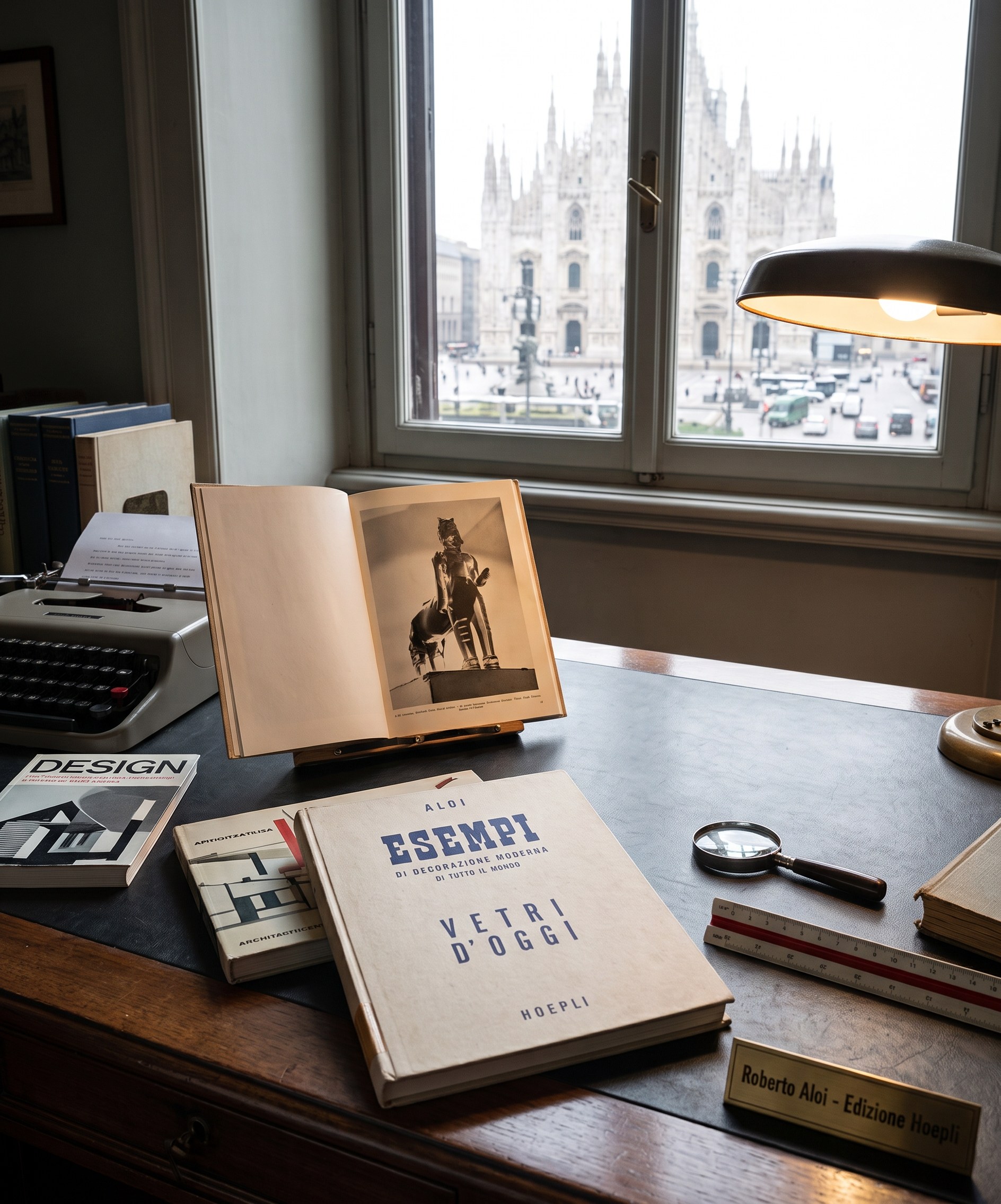
The Glass of Tomorrow: A Definitive Scholarly Guide to Roberto Aloi’s 1955 "Esempi 11" and the Mid-Century Modern Glass Revolution
When the legendary art critic and historian Professor Giorgio Nicodemi penned the introduction to Roberto Aloi’s landmark 1955 modern glass anthology, Esempi 11 - Vetri D'oggi, he chose to define glass not merely as an industrial material, but as a poetic marvel. Glass, Nicodemi wrote, is "the new substance that seems to have given consistency to air and water". It is a medium born of fire and human breath, capable of transforming its own structural fragility and lightness into an element of pure grace.
If Abbot Vincenzo Zanetti’s 1881 monograph documented a classical revival—a period dedicated to the painstaking replication of historic Roman, enameled, and filigree models—Roberto Aloi’s 1955 volume captures a radical, post-war aesthetic revolution. On the tables and shelves of the mid-twentieth century, the weightless, historicist mimicry of the nineteenth century was swept aside. In its place arose a daring, international golden age of design. The traditional furnaces of Murano, in a profound dialogue with the leading avant-garde painters and sculptors of the age, transformed the medium. No longer restricted to functional domestic tableware, glass was recast as a supreme medium of abstract, sculptural fine art.
This comprehensive, publication-quality scholarly guide and unified study guide analyzes the technical, historical, and aesthetic content of the 1955 Esempi 11 volume. Written for glass collectors, curators, and historians of modern design, it details the post-war modern movement, profiles every major designer and furnace of the era, documents the legendary fine art collaborations of Venice, and provides a diagnostic key for identifying authentic mid-century masterworks.
I. The Post-War Renaissance and the Modernist Manifesto (1945–1955)
The decade leading up to 1955 witnessed a spectacular rebuilding of the European decorative arts. In the wake of World War II, the industrial reconstruction of Italy was paired with a fierce desire for artistic renewal. This renaissance was anchored by the Triennale di Milano, the prestigious Milan Triennial exhibition, which served as a global stage where the boundaries between fine art, architecture, and industrial design were dismantled.
A unique synergy developed between avant-garde architects, painters, and the traditional, family-run furnaces of the Murano lagoons. Designers realized that the centuries-old, manual glassmaking techniques of the Venetian master blowers—including chemical color fusions, complex cane manipulation, and hot-sculpting—possessed an extraordinary potential for plastic expression. The master blowers, in turn, were pushed by these designers to abandon the static symmetry of the past. They embraced asymmetric, organic, and free-form geometries that captured the dynamic, space-age optimism of the 1950s.
Roberto Aloi’s Esempi 11 stands as the definitive, bilingual document of this golden age. It captures a moment of intense, international dialogue, where the organic, hot-worked glass of Murano was juxtaposed with the cool, geometric, and sand-carved crystal of Scandinavia and the absolute clarity of American lead glass.
II. Master Designers and Furnaces of the Muranese Golden Age
At the heart of the 1955 revolution were the legendary Muranese furnaces, each defined by a distinct aesthetic philosophy and a roster of visionary designers.
1. Flavio Poli and Seguso Vetri d’Arte
- The Aesthetic: Flavio Poli (1900–1984) championed a philosophy of organic, minimalist plasticism. Rejecting surface enameis and intricate details, Poli utilized the inherent weight, refractive index, and fluid density of the glass to dictate form. His vessels are defined by clean, sweeping curves, thick walls (grosso spessore), and polished surfaces that resemble water-worn river stones or open oceanic shells.
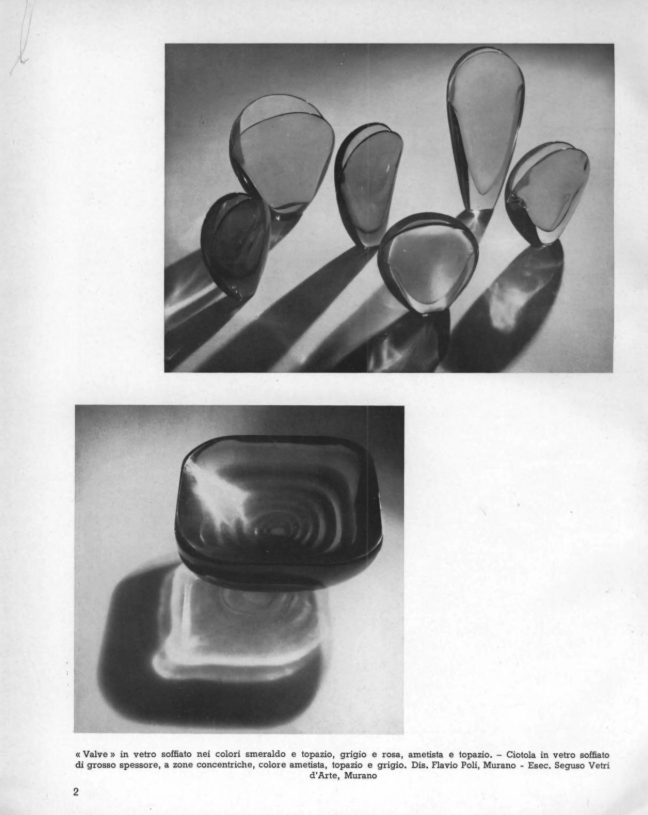
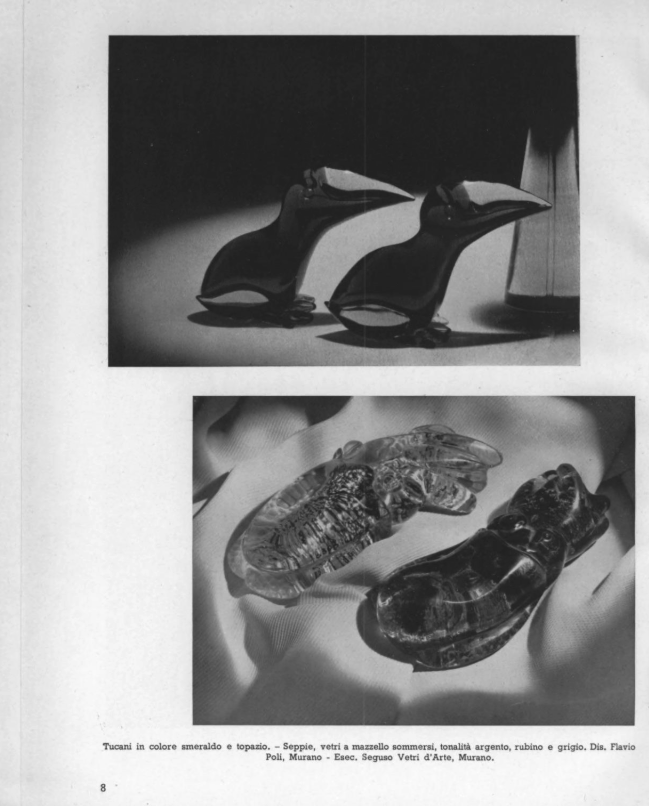
- The Plates: Poli’s genius is captured in Plates 1 through 11. These include his celebrated « Valve » (Valves) in emerald and topaz, grey and pink, and amethyst and topaz fusions (Plate 2), alongside free-form, acid-corroded, and translucent rosy-grey vessels (Plate 6) and massive submerged glass cuttle-fish (Plate 8).
- The Furnace: Seguso Vetri d’Arte, founded by the historic Seguso dynasty, was the primary workshop where Poli’s thick, multi-layered block designs were executed by master blowers under strict technical guidelines.
Here is the complete bilingual curatorial registry for Plates 1 through 11 from Roberto Aloi's 1955 anthology, Esempi 11 - Vetri D'oggi, representing the landmark "Organic Minimalism" period of designer Flavio Poli executed by the furnace of Seguso Vetri d’Arte in Murano.
PLATES 1–11: THE ORGANIC MINIMALISM OF FLAVIO POLI
Furnace: Seguso Vetri d’Arte, Murano
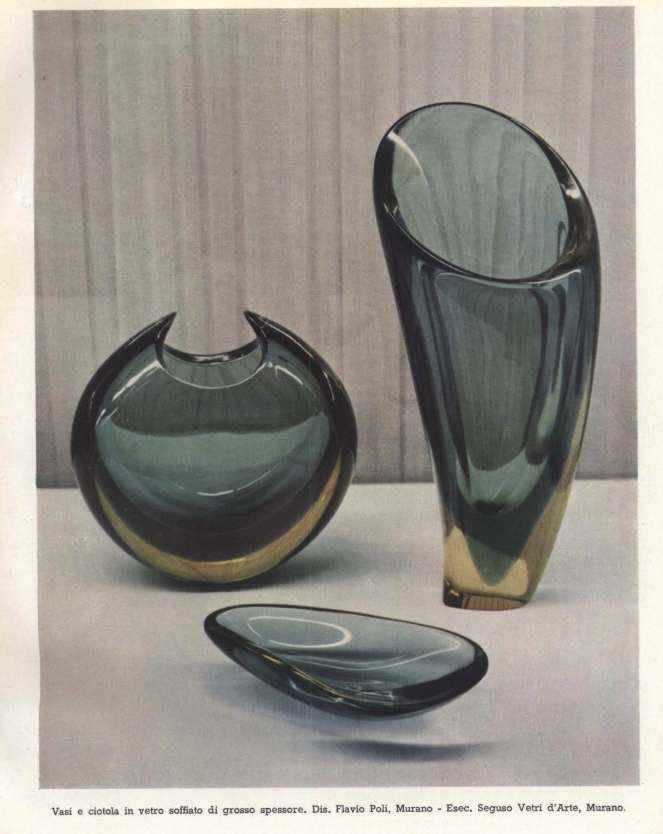
- PLATE 1:
- Italian: Vasi e ciotola in vetro soffiato di grosso spessore. Dis. Flavio Poli, Murano - Esec. Seguso Vetri d’Arte, Murano.
- English: Vases and bowl of blown glass of heavy thickness. Designed by Flavio Poli, Murano - Executed by Seguso Vetri d’Arte, Murano.
- PLATE 2:
- Italian: « Valve » in vetro soffiato nei colori smeraldo e topazio, grigio e rosa, ametista e topazio. — Ciotola in vetro soffiato di grosso spessore, a zone concentriche, colore ametista, topazio e grigio.
- English: « clam-shell profile » of blown glass in emerald and topaz, grey and pink, amethyst and topaz. — Thick blown glass bowl, with amethyst, topaz, and grey concentric zones.
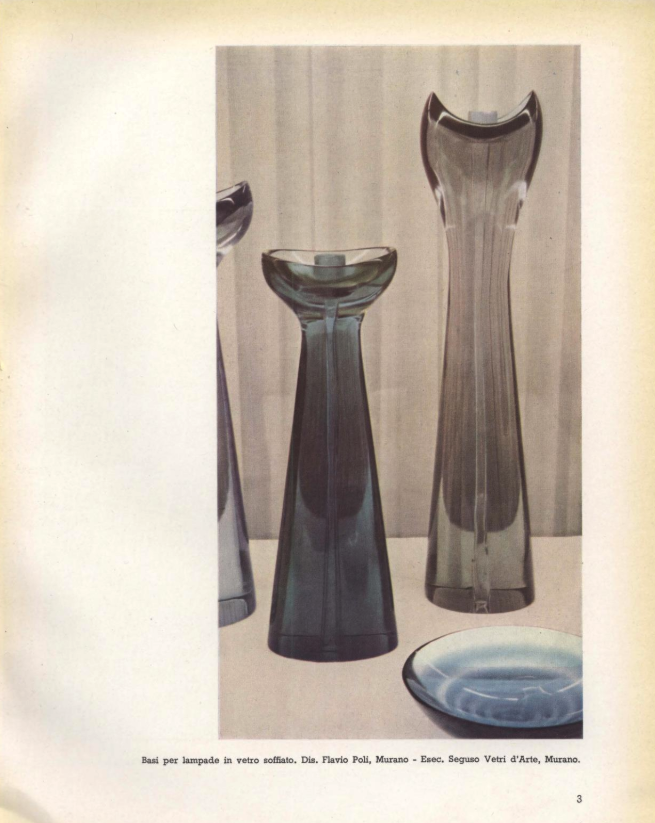
- PLATE 3:
- Italian: Basi per lampade in vetro soffiato.
- English: candlestick base, of blown glass.
- PLATE 4:
- Italian: Vasi e ciotola in vetro soffiato, corroso e translucido di colore grigio-roseo.
- English: Blown glass vases and bowl, worn away (corroso) and translucid, of rosy-grey colour.
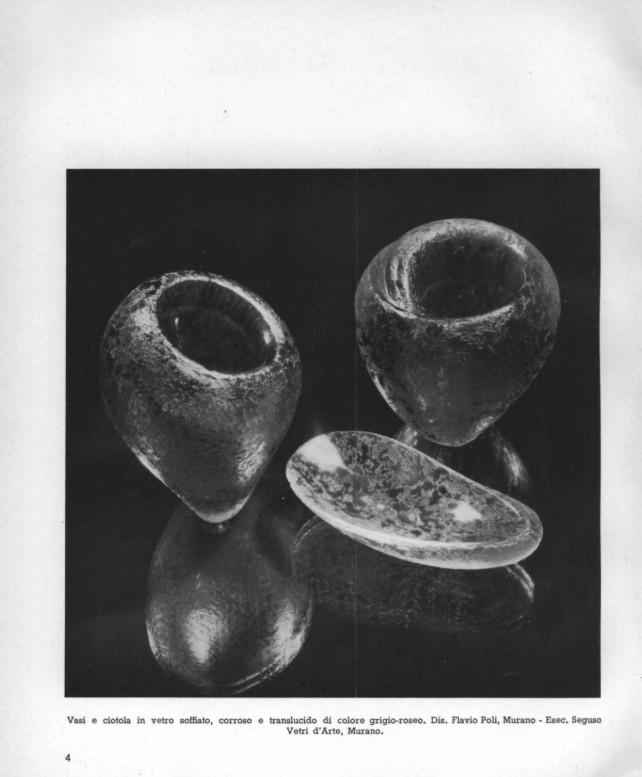
- PLATE 5:
- Italian: Soprammobili in vetro soffiato di grosso spessore.
- English: Thick blown glass bowl and fish.
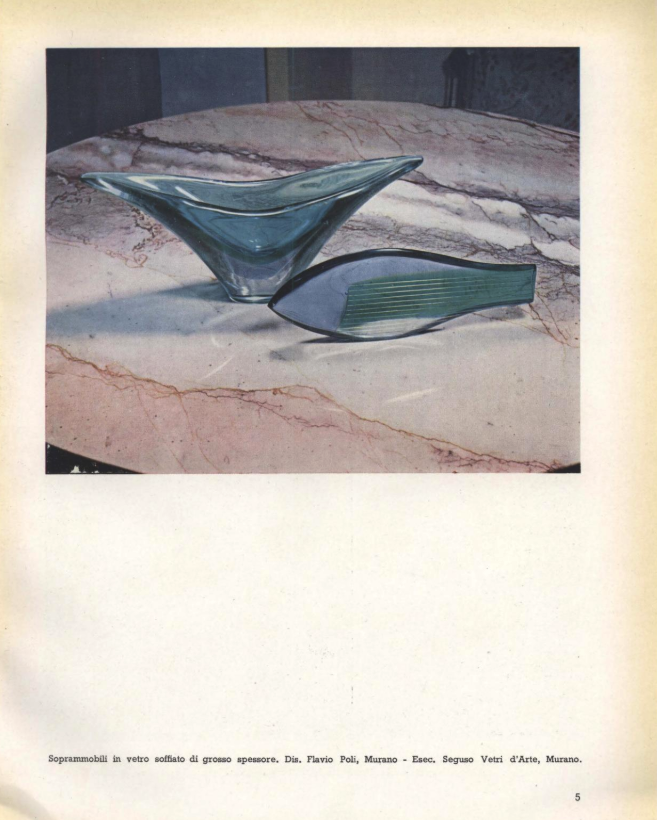
- PLATE 6:
- Italian: Coppe in vetro soffiato color verde smeraldo e topazio. — Vasi a forma libera, in vetro soffiato, translucido e corroso, nelle tonalità grigio, topazio e rosa.
- English: Blown glass bowls, of emerald green and topaz colour. — Blown glass vases, free-form, worn away and translucid, of rosy, grey, and topaz colour.
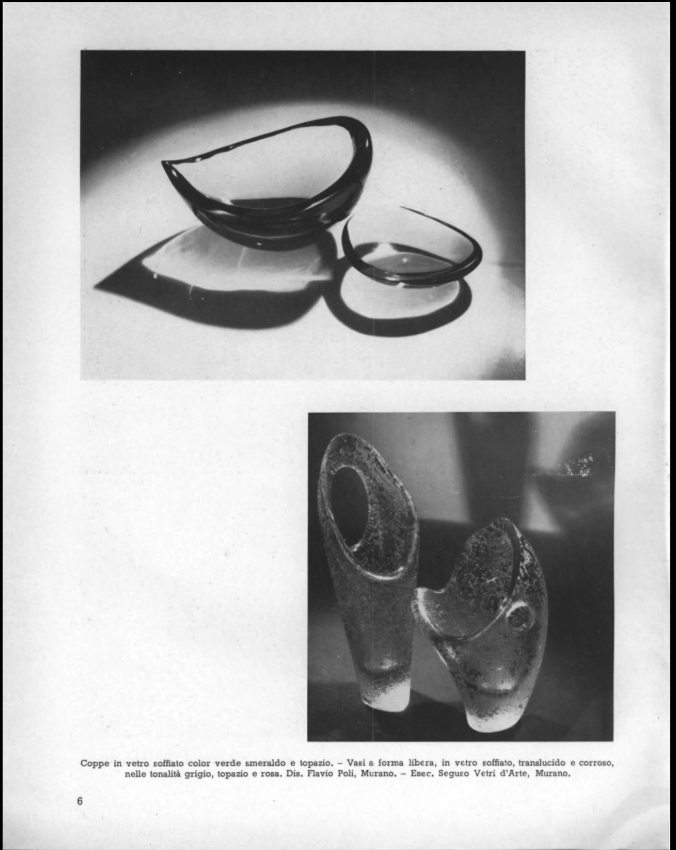
- PLATE 7:
- Italian: Vaso e ciotola in vetro soffiato a zone concentriche, colori verde, topazio e bianco.
- English: Blown glass vase and bowl, with concentric zones in green, topaz, and white.
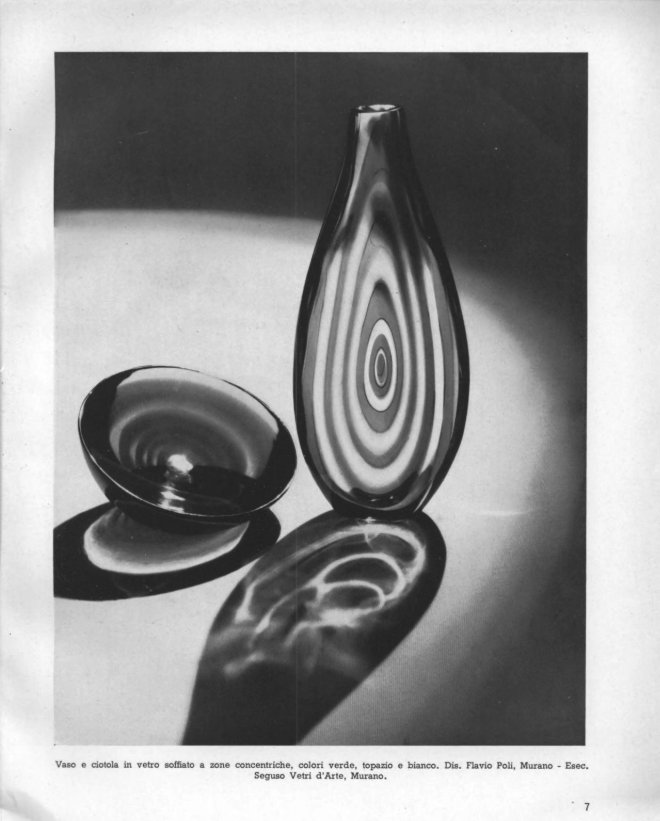
- PLATE 8:
- Italian: Tucani in colore smeraldo e topazio. — Seppie, vetri a mazzello sommersi, tonalità argento, rubino e grigio.
- English: Emerald and topaz toucans. — Cuttle-fish, silver, ruby, and grey submerged ("a mazzello") glass pieces.
- PLATE 9:
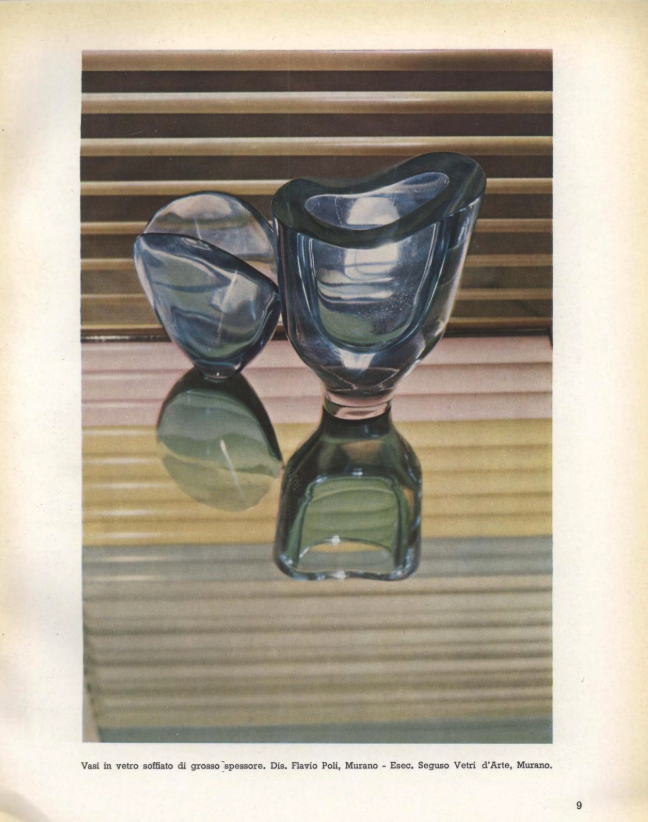
- Italian: Vasi in vetro soffiato di grosso spessore.
- English: Thick blown glass vases.
- PLATE 10:
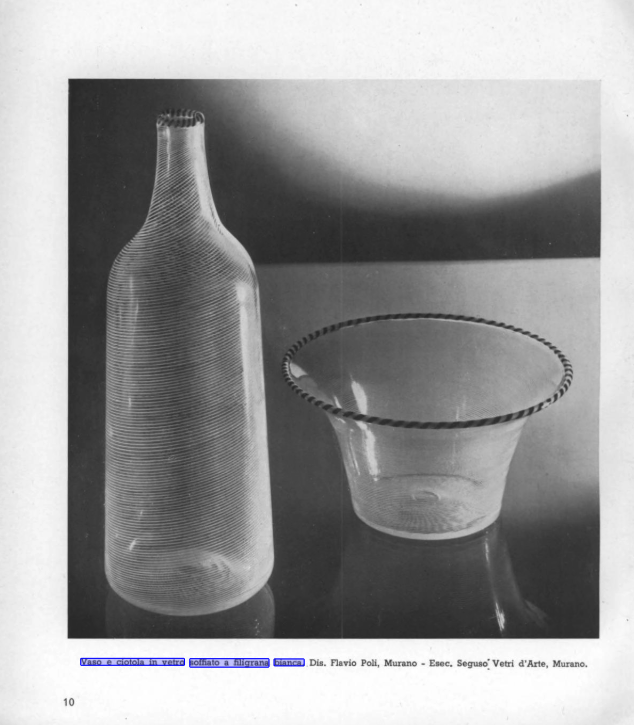
- Italian: Vaso e ciotola in vetro soffiato a filigrana bianca.
- English: White filigree blown glass vase and bowl.
- PLATE 11:
- Italian: Vasi e ciotola in vetro soffiato a filigrana.
- English: Filigree blown glass vases and cup.
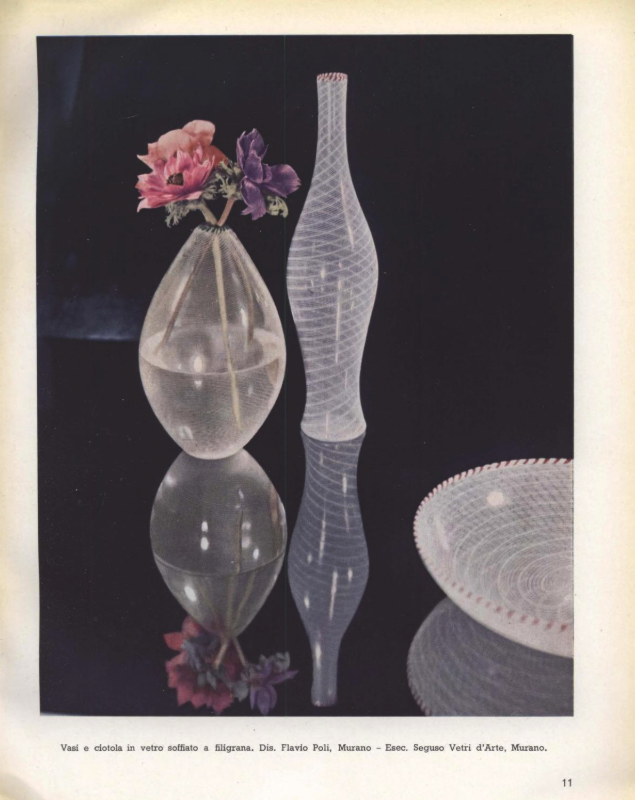
These eleven plates illustrate Flavio Poli’s post-war mastery of heavy, multi-layered color encasement (sommerso) paired with organic forms that mimic nature—such as hollowed valves, ocean-worn corals (corroso), and stylized animal figures like toucans and cuttle-fish.
2. Paolo Venini and Fulvio Bianconi
- The Aesthetic: The collaboration between the entrepreneurial Milanese lawyer Paolo Venini (1895–1959) and the brilliant, eccentric graphic artist Fulvio Bianconi (1915–1996) at the Venini furnace sparked a chromatic and technical revolution. Bianconi introduced a whimsical, highly expressive, and painterly approach to glass, utilizing bright, saturated color blocks, thin-blown structures, and kinetic movement.
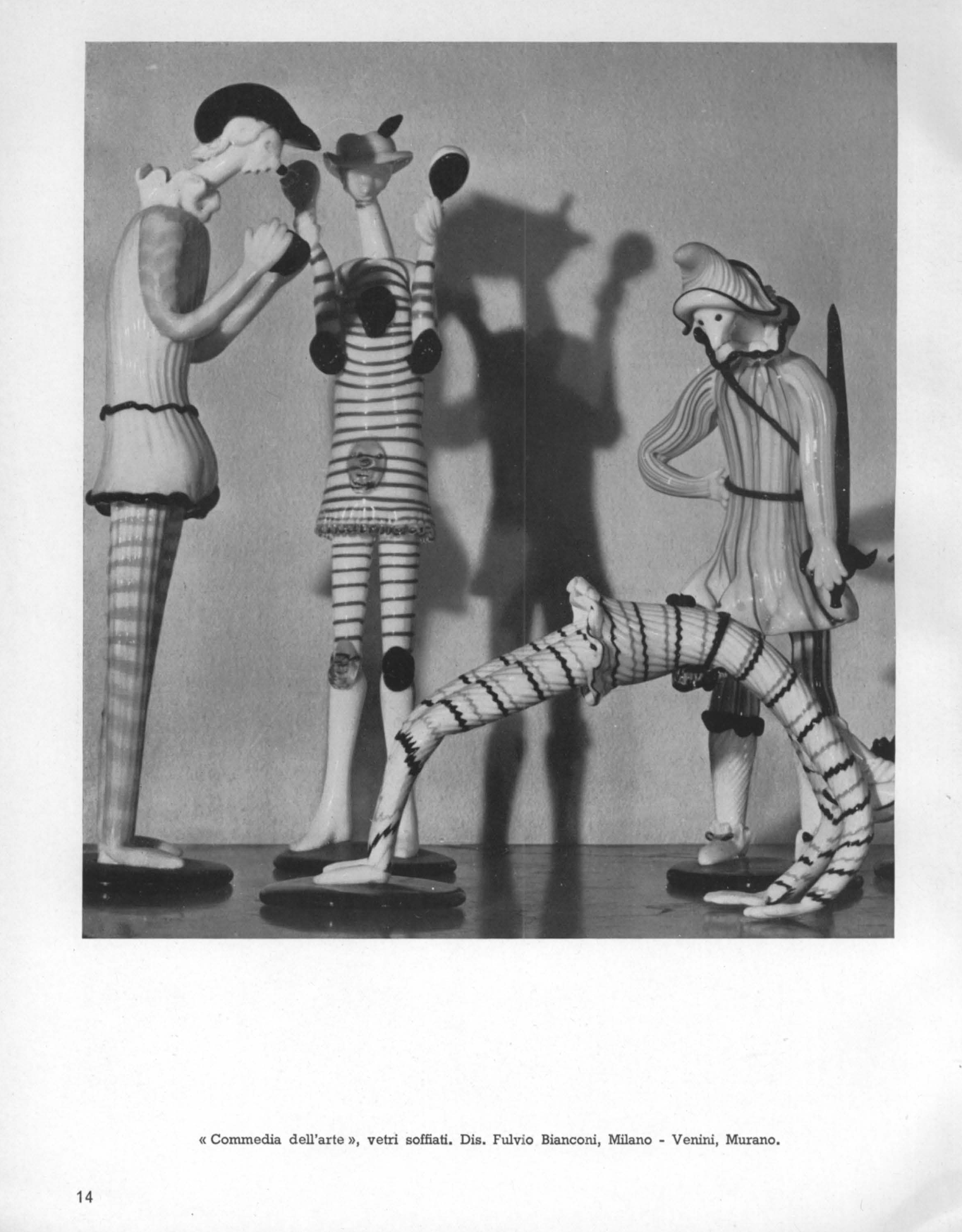
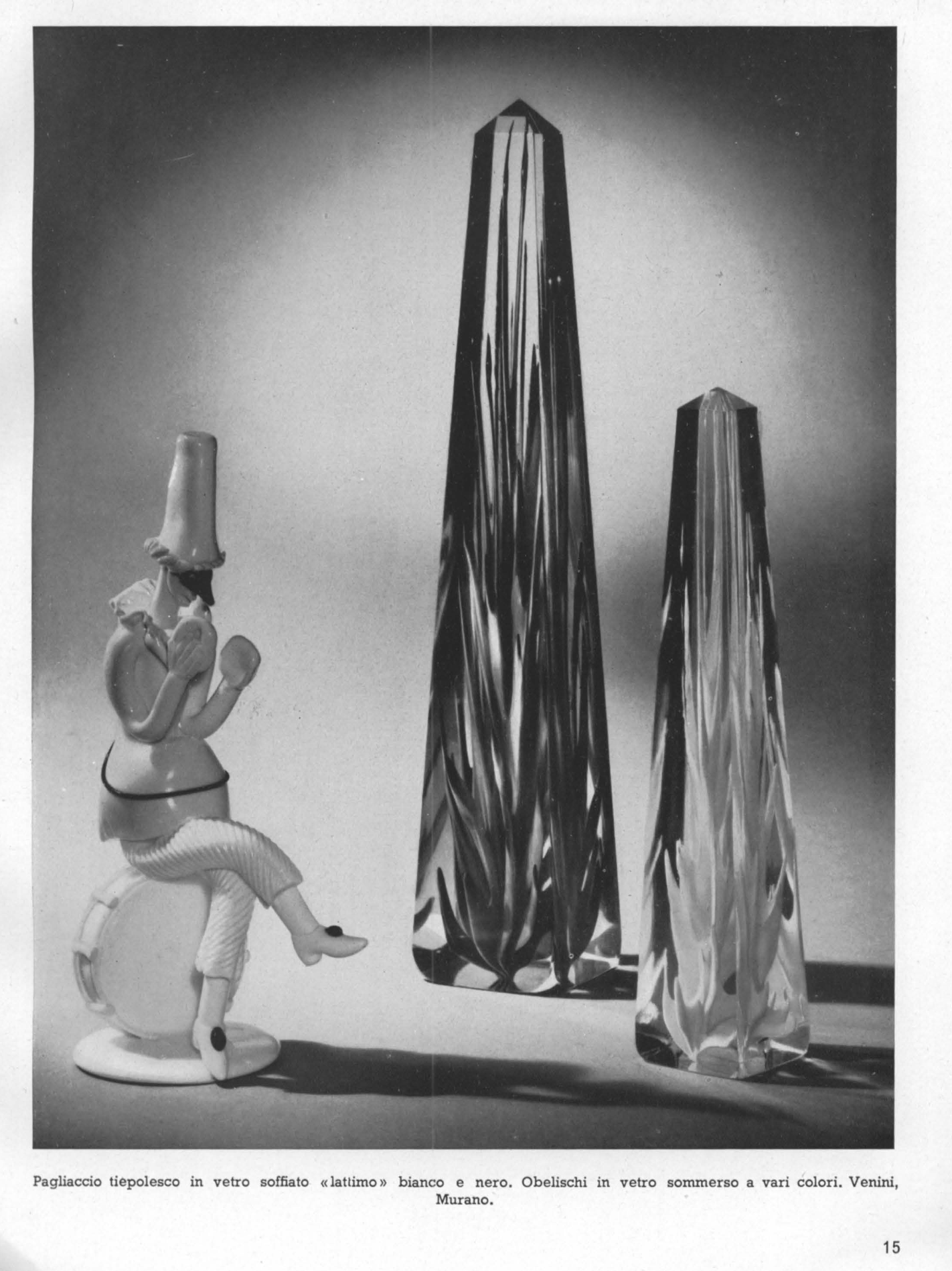
- The Plates: This partnership is beautifully documented in Plates 12 through 27. It features Bianconi's legendary hand-blown « La commedia dell'arte » figures (Plate 14), his Tiepolo-style clowns crafted in bold black and white lattimo (Plate 15), and the globally celebrated « Pezzati » (patchwork) spotted vases (Plate 19).
- The Furnace: Venini, established in 1921, was the intellectual powerhouse of Murano, noted for its constant experimentation with ancient techniques like murrina and filigrana, and its ability to attract the world's leading modern architects.
This section covers the vibrant post-war chromatic revolution at Venini under Paolo Venini and Fulvio Bianconi, followed by the linear, lace, and chemical masterpieces of Ermanno Toso, Archimede Seguso, Dino Martens, and Ercole Barovier.
PLATES 12–27: THE CHROMATIC REVOLUTION OF PAOLO VENINI & FULVIO BIANCONI
Furnace: Venini, Murano
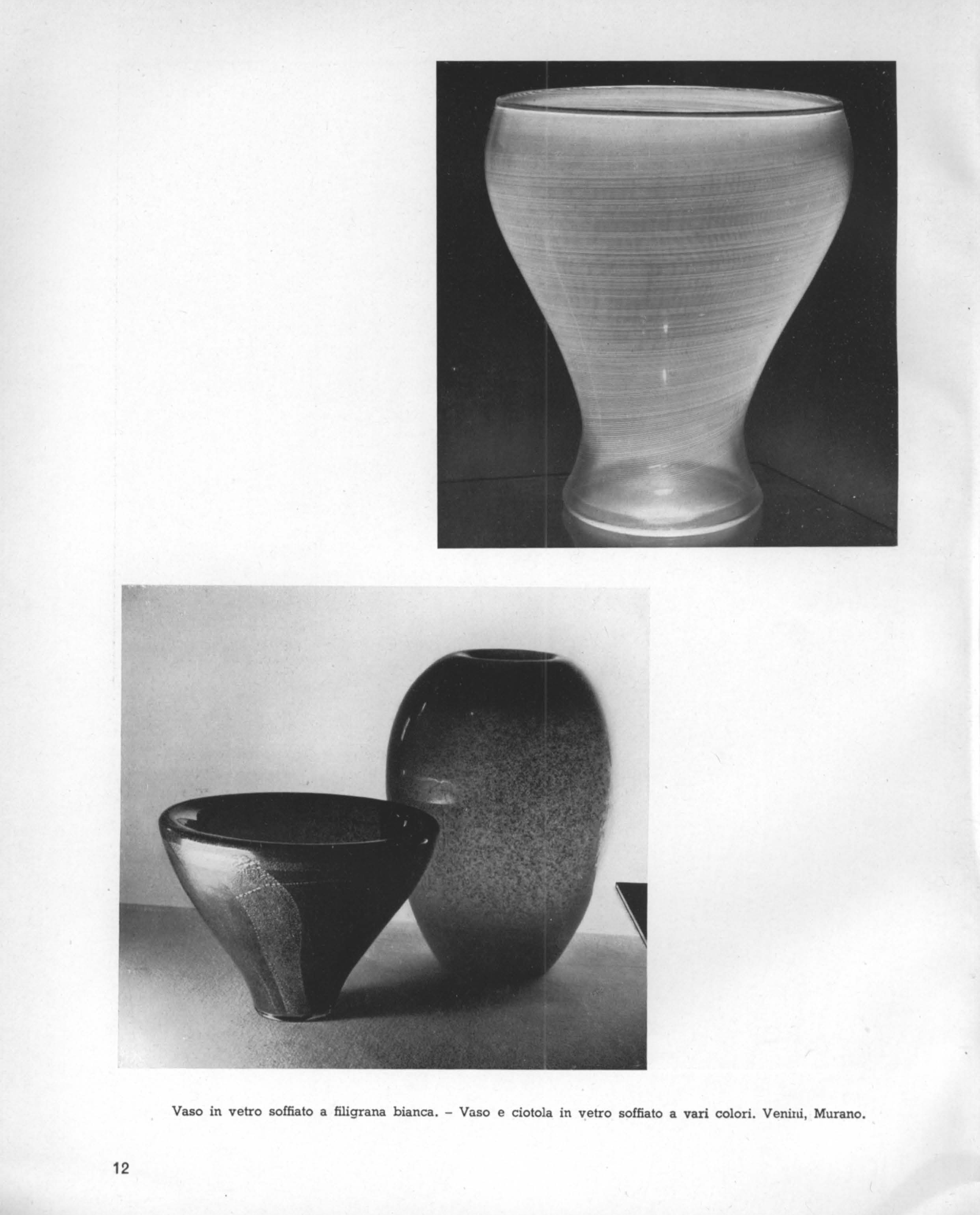
- PLATE 12:
- Italian: Vaso in vetro soffiato a filigrana bianca. — Vaso e ciotola in vetro soffiato a vari colori. Venini, Murano.
- English: White filigree blown glass vase. — Blown glass vase and bowl in various colors. Venini, Murano.
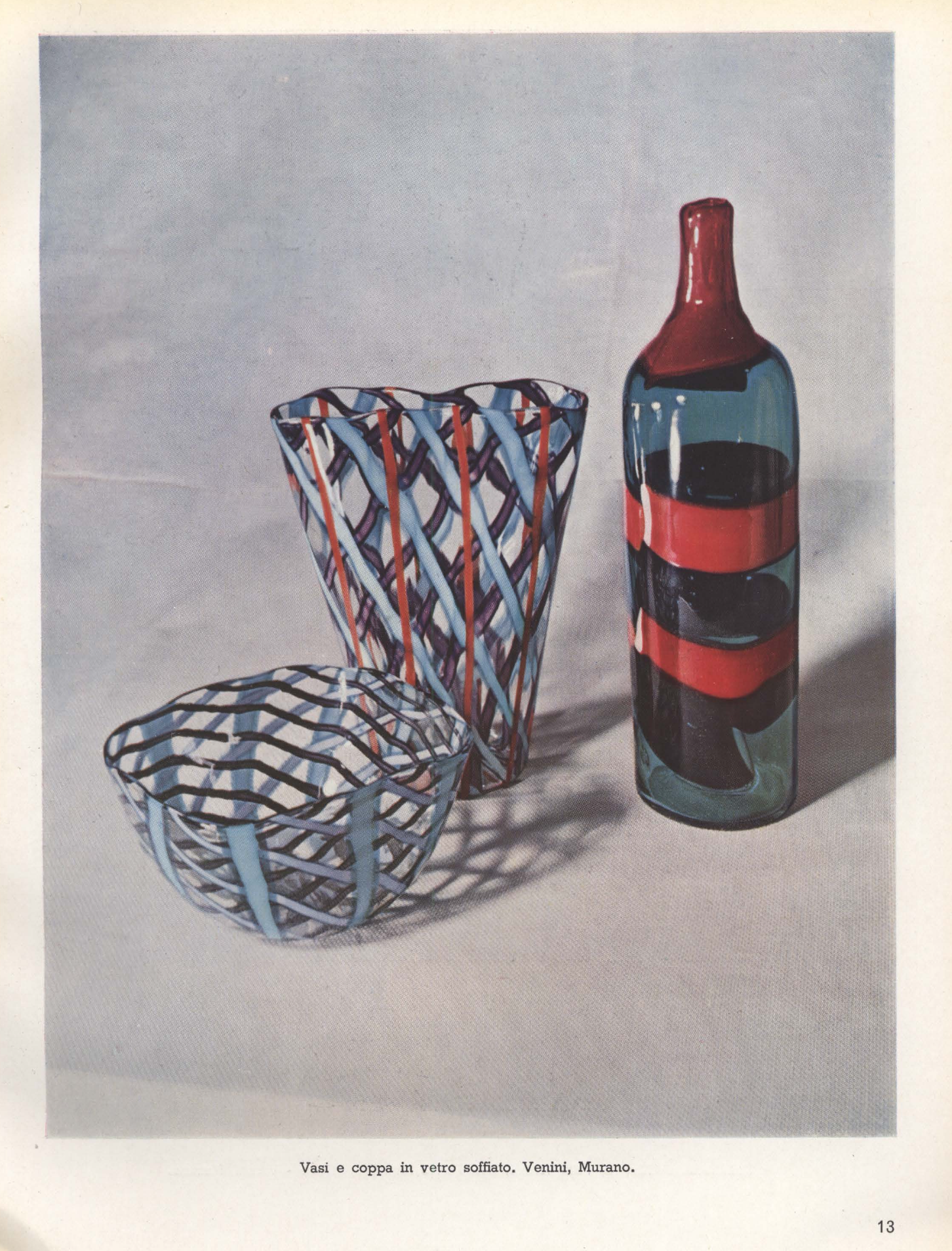
- PLATE 13:
- Italian: Vasi e coppa in vetro soffiato.
- English: Blown glass vases and bowl Venini Murano.
- PLATE 14:
- Italian: « La commedia dell'arte », vetri soffiati. Dis. Fulvio Bianconi, Milano - Esec. Venini, Murano.
- English: « The comedy of art (Italian theatre figures characterized by masks)», blown glass figures. Designed by Fulvio Bianconi, Milan - Executed by Venini, Murano.
- PLATE 15:
- Italian: Pagliaccio tiepolesco in vetro soffiato « lattimo » bianco e nero. — Obelischi in vetro sommerso a vari colori.
- English: Blown glass clown after Tiepolo's style in white and black lattimo. — Polychromous submerged glass obelisks.
- PLATE 16:
- Italian: Animali acquatici in vetro soffiato a filigrana bianca. — Animali da cortile in vetro soffiato a vari colori. Dis. Fulvio Bianconi, Milano.
- English: Water animals of white filigree blown glass. — Yard animals of blown glass, in various colours. Designed by Fulvio Bianconi, Milan.
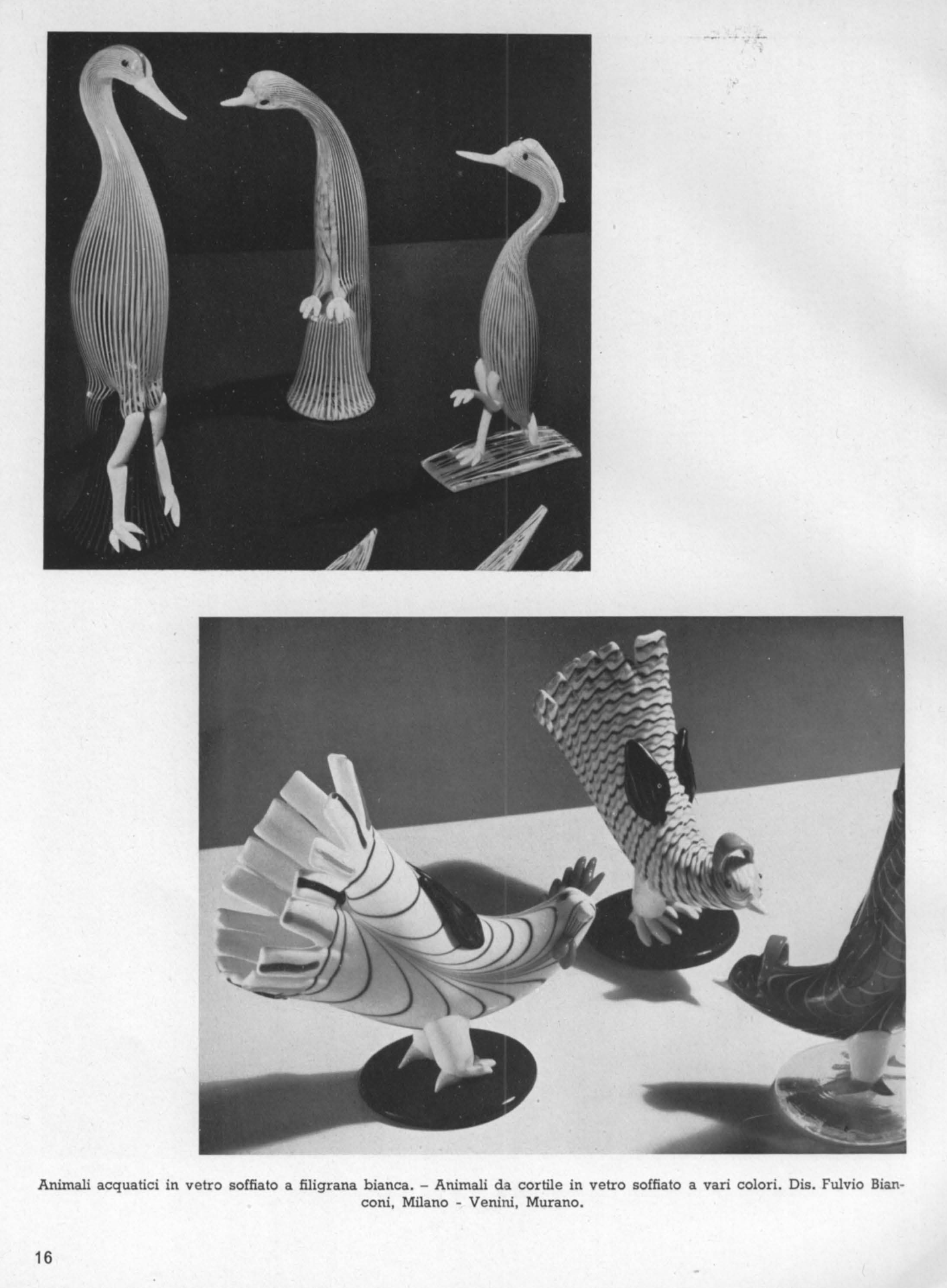
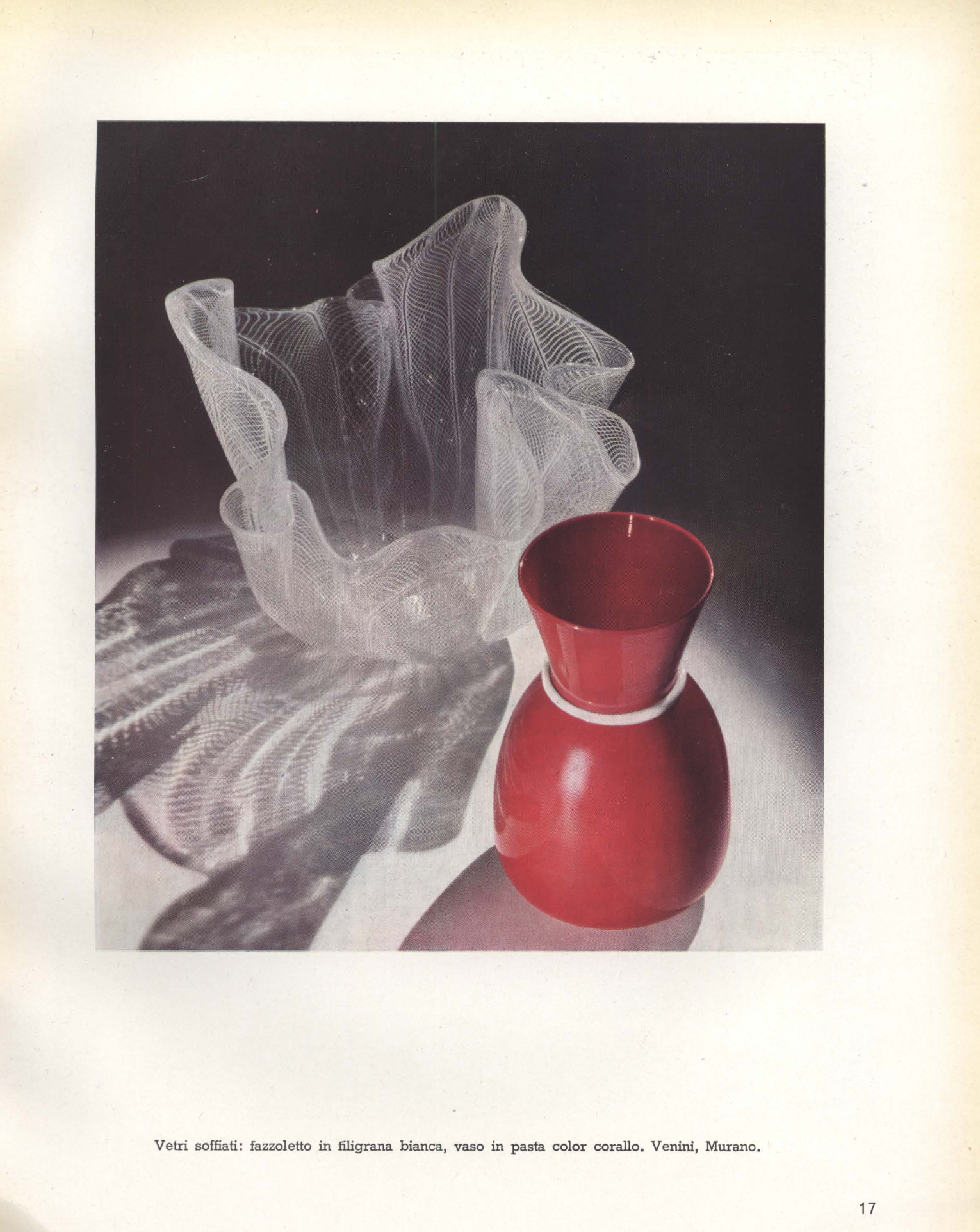
- PLATE 17:
- Italian: Vetri soffiati: fazzoletto in filigrana bianca, vaso in pasta color corallo.
- English: Blown glass pieces: white filigree handkerchief (fazzoletto), vase of coral coloured paste.
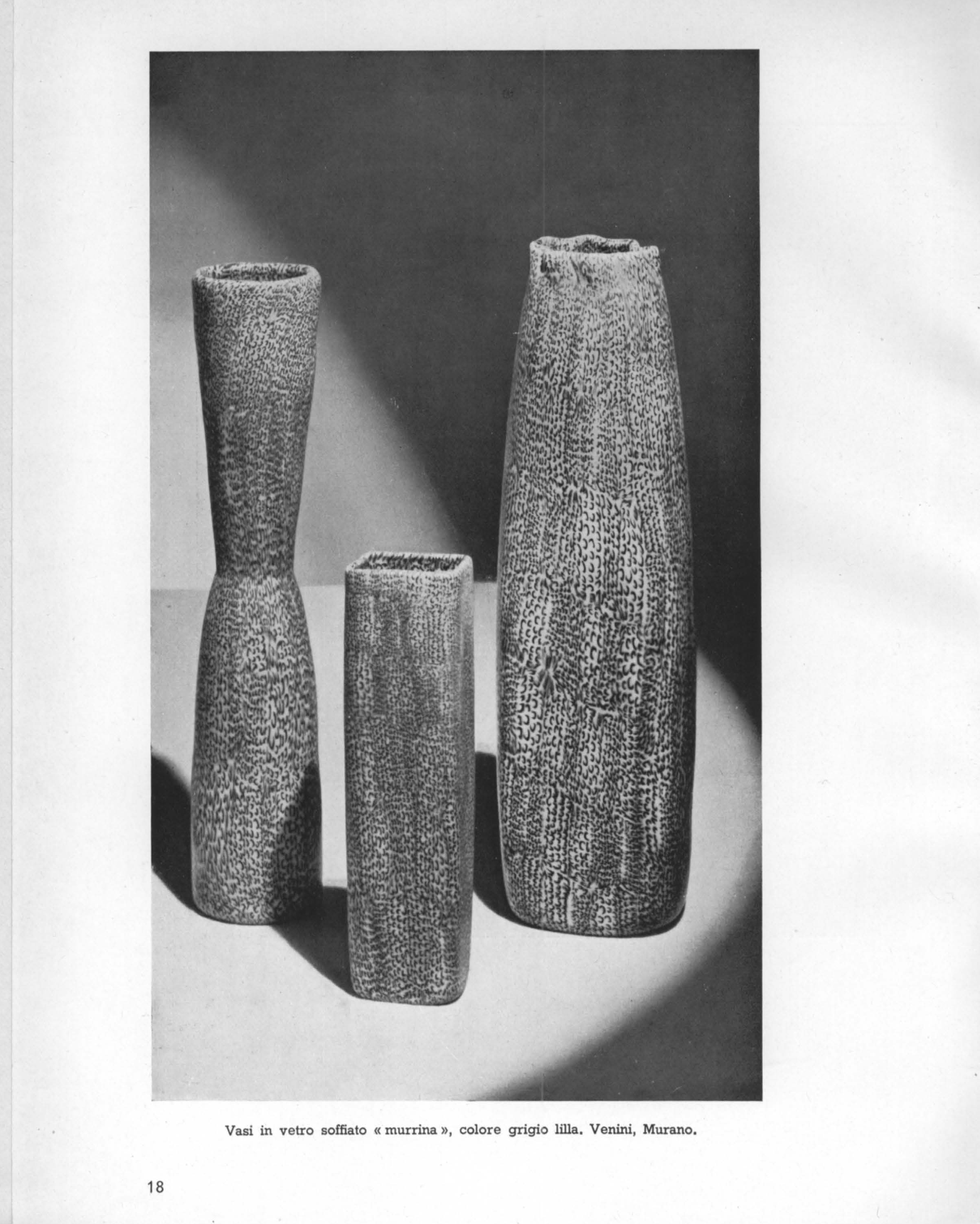
- PLATE 18:
- Italian: Vasi in vetro soffiato « murrina », colore grigio lilla.
- English: « Murrina » blown glass vases, violet-grey.
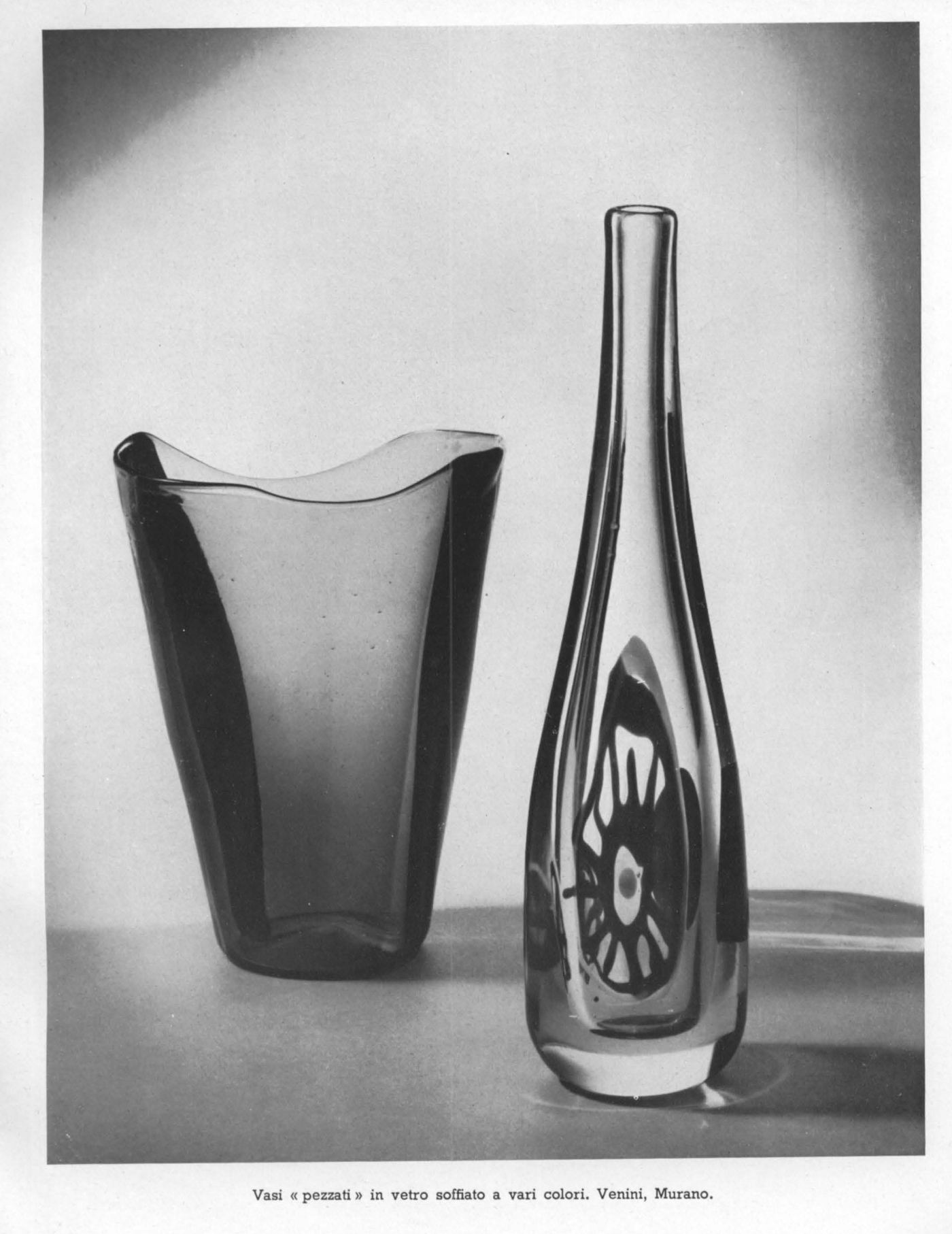
- PLATE 19:
- Italian: Vasi « pezzati » in vetro soffiato a vari colori.
- English: Spotted patchwork ("pezzati") vases of blown glass, in various colours.
- PLATE 20:
- Italian: Piatto e vasi in vetro soffiato a filigrana bianca. — Bottiglia e vasi « pezzati » a vari colori.
- English: White filigree blown glass vases and dishes. — Bottle and vases spotted with various colours (patchwork style).
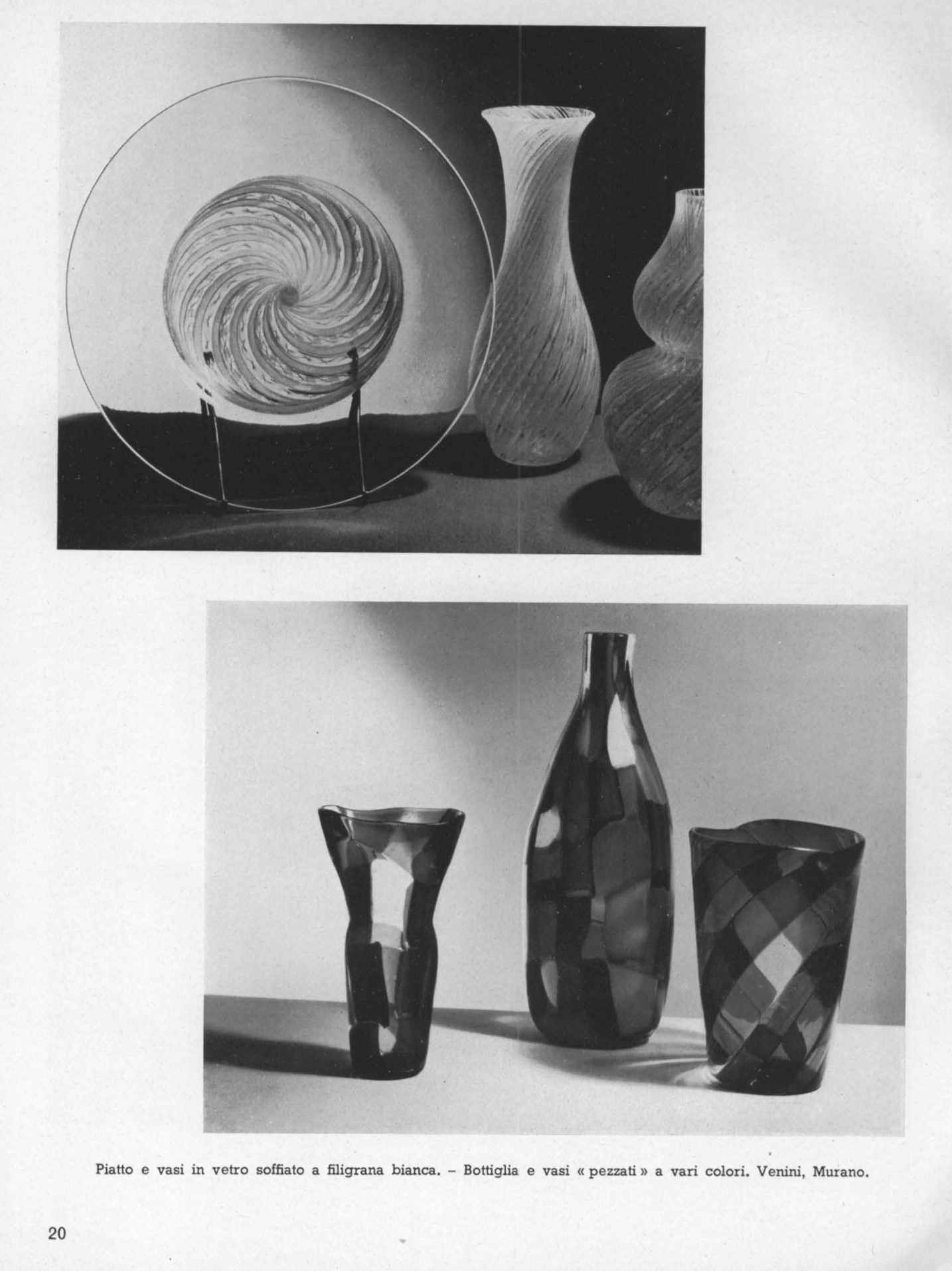
- PLATE 21:
- Italian: Vasi in vetro soffiato Venini Murano.
- English: Blown glass vases Venini Murano.
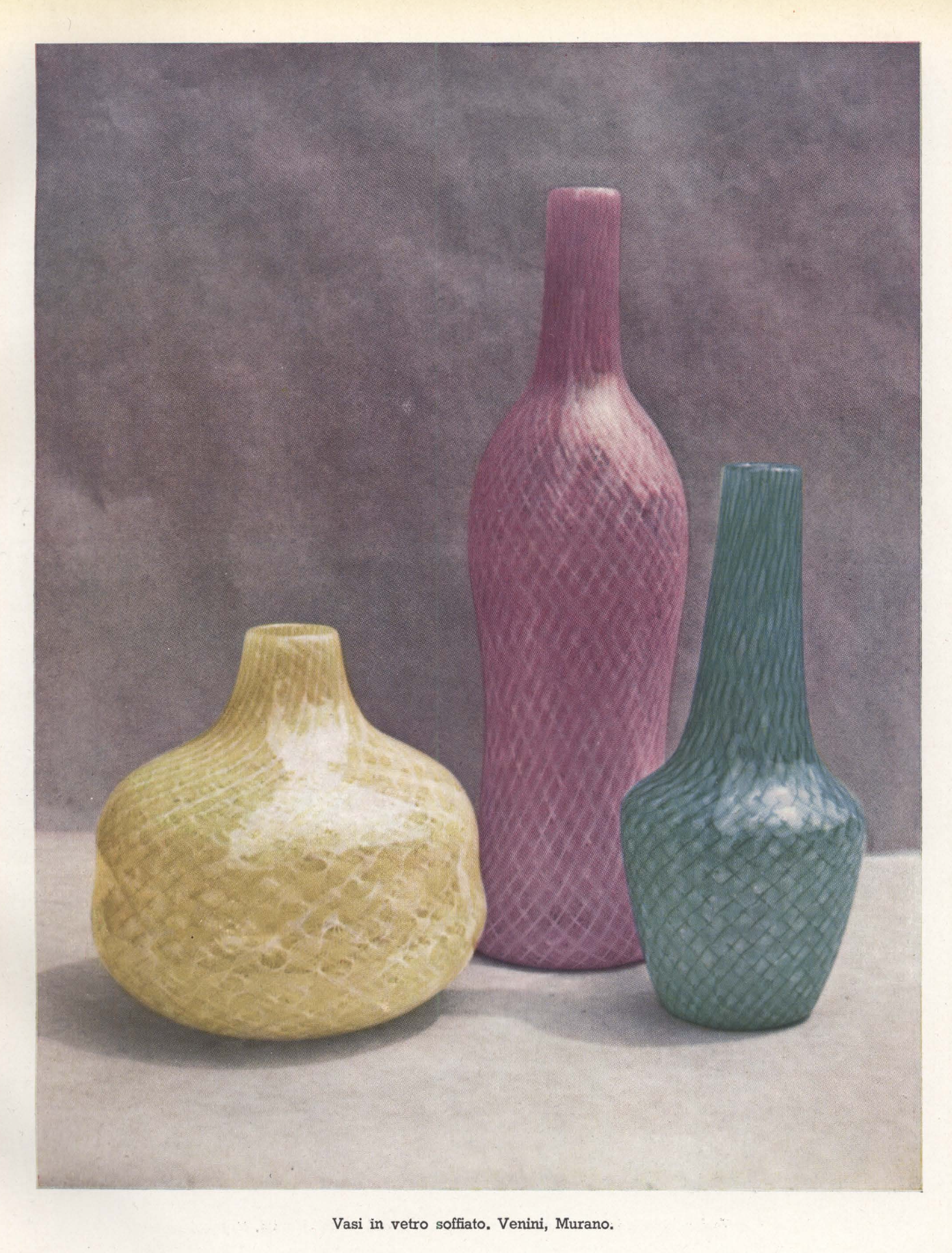
- PLATE 22:
- Italian: Vasi e ciatole in vetro soffiato « murrina » a vari colori.
- English: « Murrina » blown vases and bowls, in various colours.
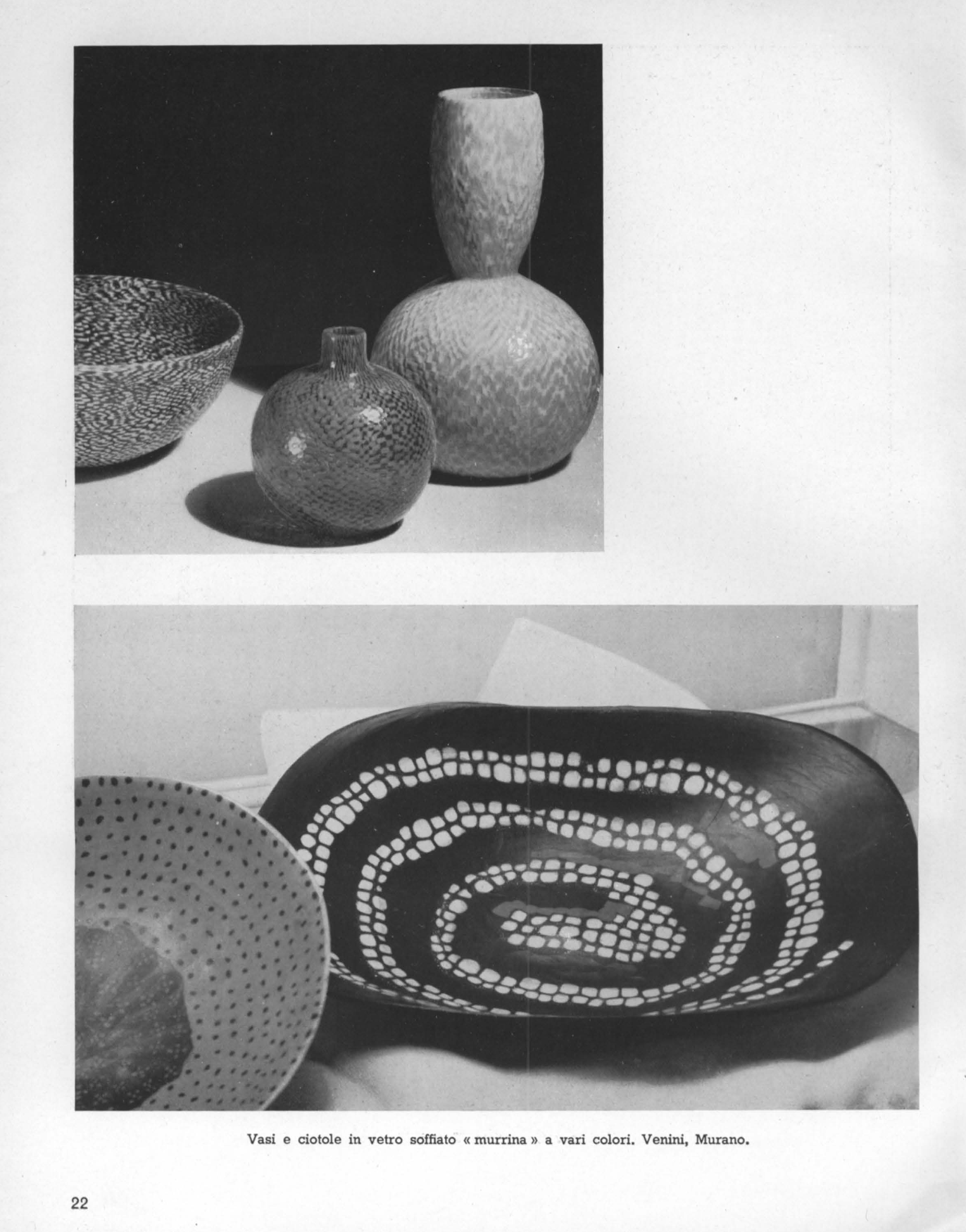
- PLATE 23:
- Italian: Soprammobili in vetro soffiato « lattimo ».
- English: Blown glass nick-nacks shell, hand holding bowl, and hand sculpture in milk-white lattimo glass.
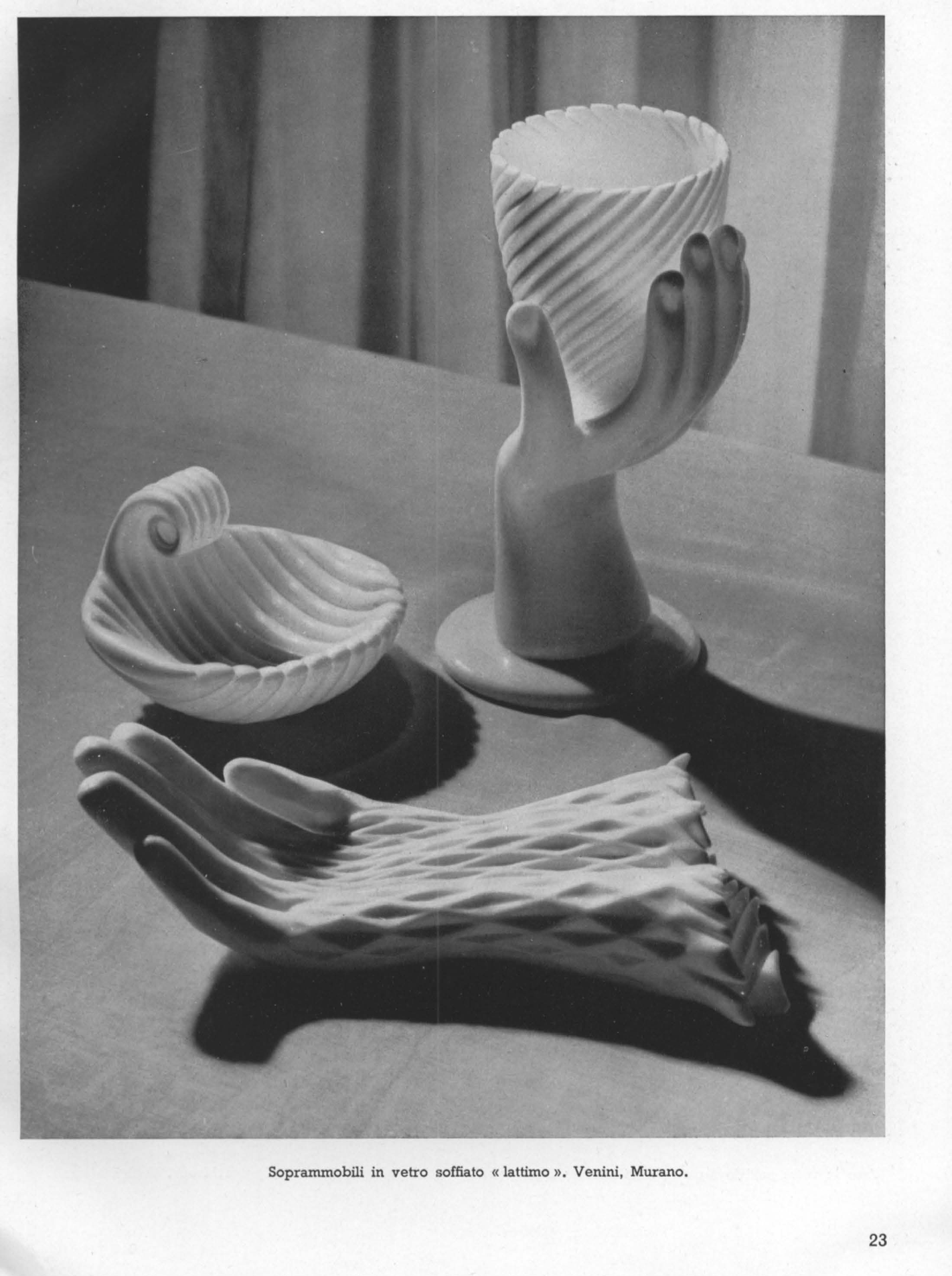
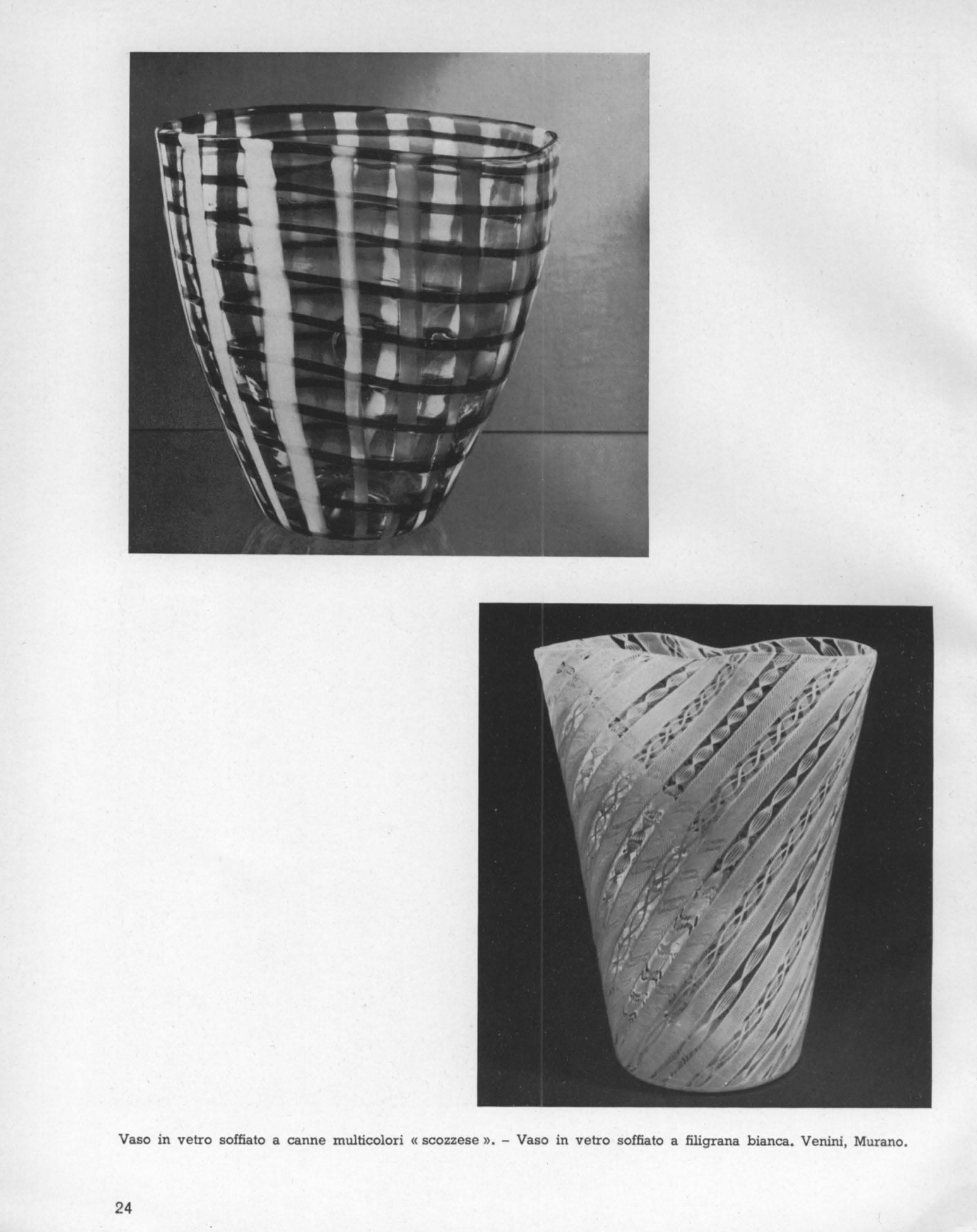
- PLATE 24:
- Italian: Vaso in vetro soffiato a canne multicolori « scozzese ». — Vaso in vetro soffiato a filigrana bianca.
- English: Blown glass vase, decorated with plaid polychromous stripes ("scozzese"). — White filigree blown vase
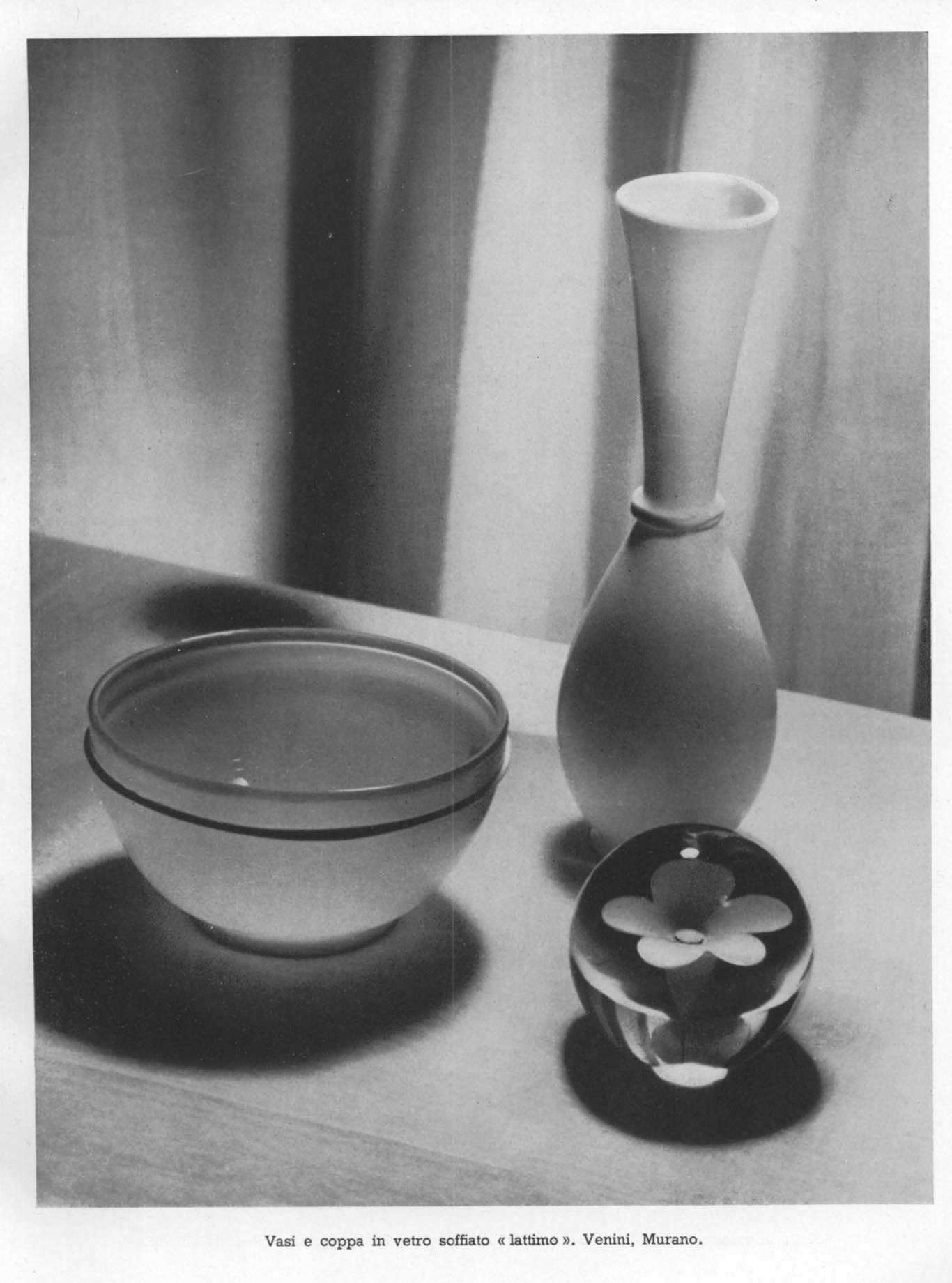
- PLATE 25:
- Italian: Vasi e coppa in vetro soffiato « lattimo ».
- English: « Lattimo » blown glass vase and bowl, floral paperweight.
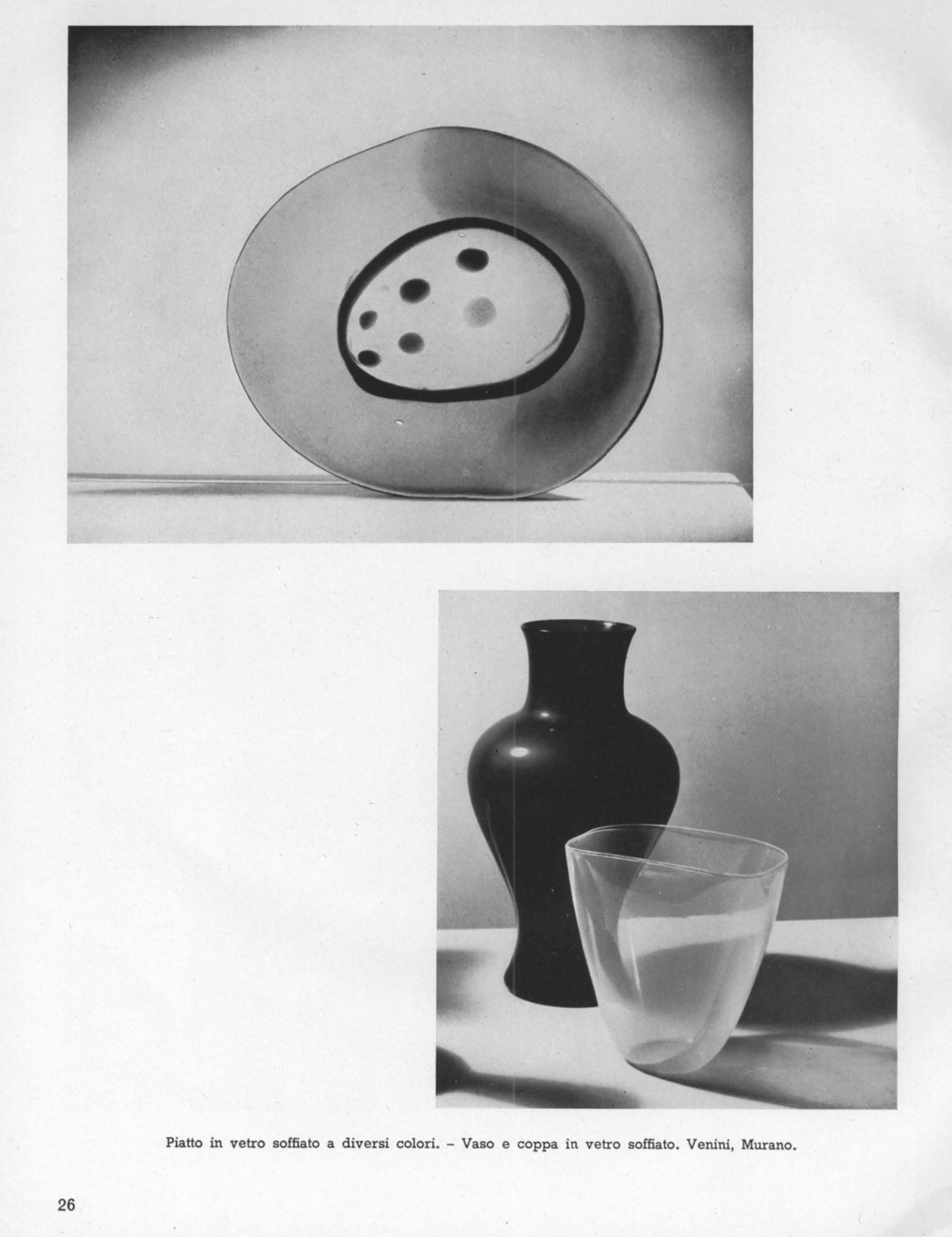
- PLATE 26:
- Italian: Piatto in vetro soffiato a diversi colori. — Vaso e coppa in vetro soffiato.
- English: A dish of blown glass in various colours. — Blown glass vase and bowl.
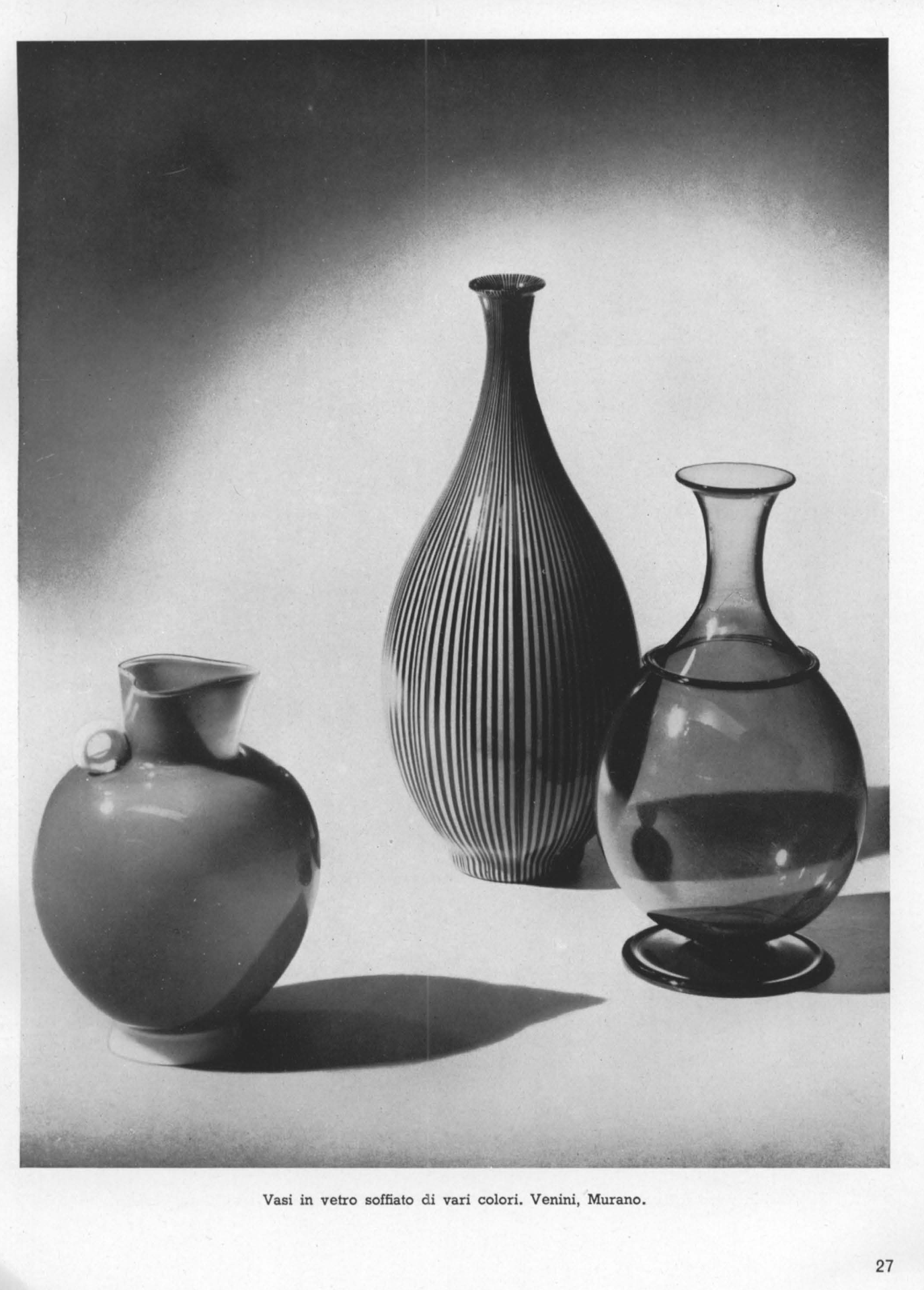
- PLATE 27:
- Italian: Vasi in vetro soffiato di vari colori.
- English: Vases of blown glass, in various colours.
3. Ercole Barovier and Barovier & Toso
- The Aesthetic: Ercole Barovier (1889–1974) was a self-taught technical genius who spent his life experimenting with chemical formulations, color fusions, and volcanic surface textures. Barovier sought to bring a raw, sculptural, and tactile quality to glass. His works frequently display deep crackled surfaces, thick trapped air bubbles, and metallic, iridescent sheens that resemble archaeological relics.
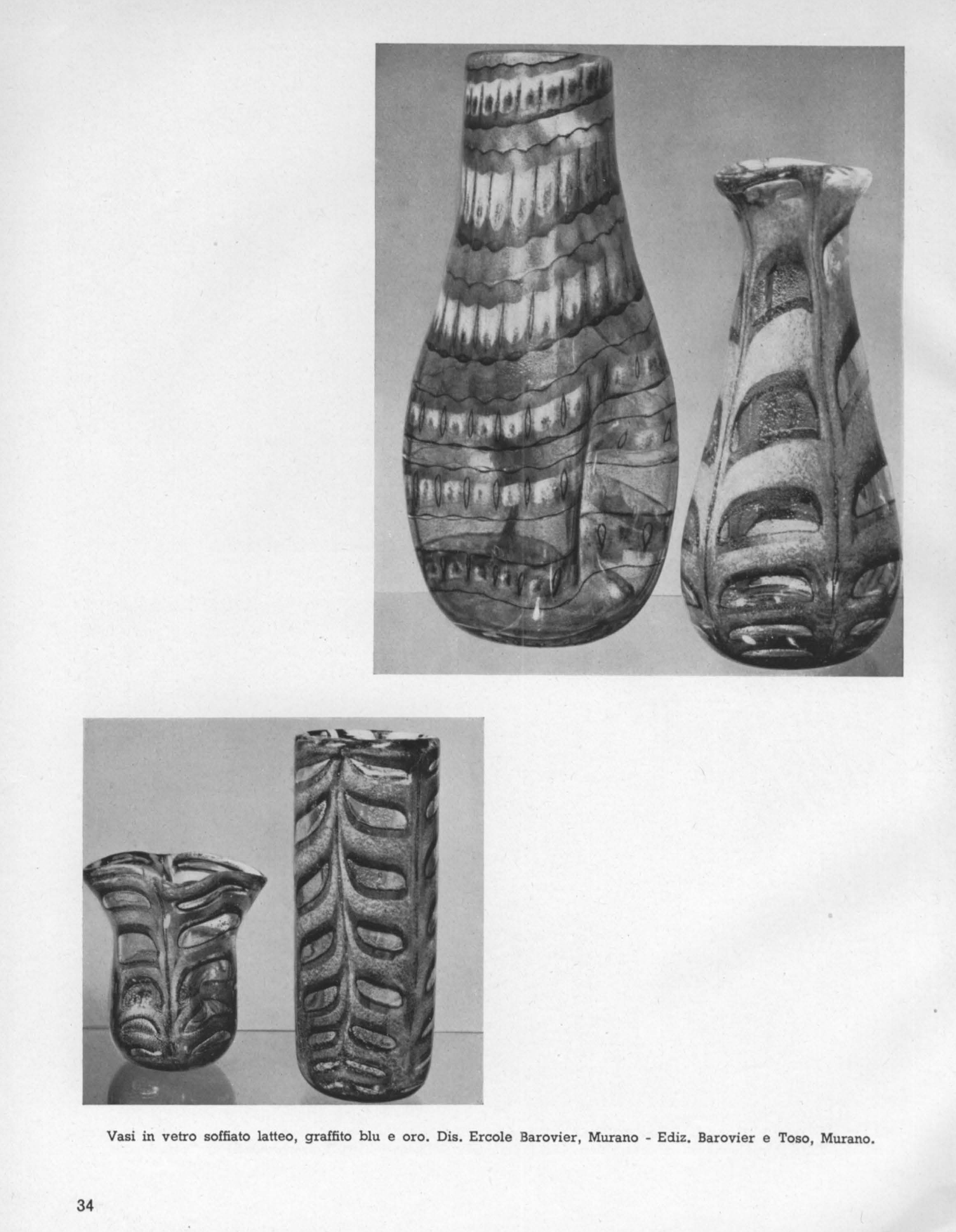
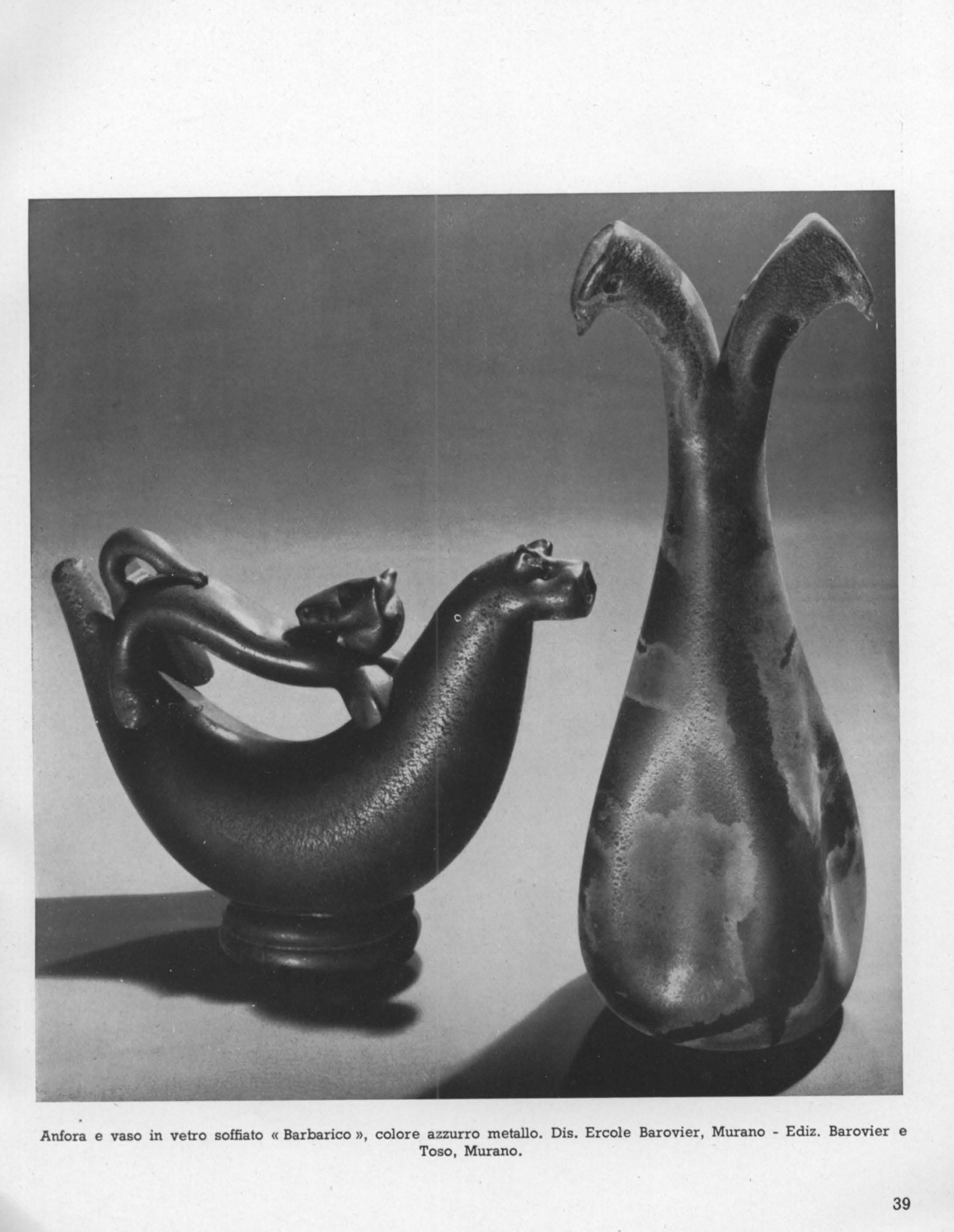
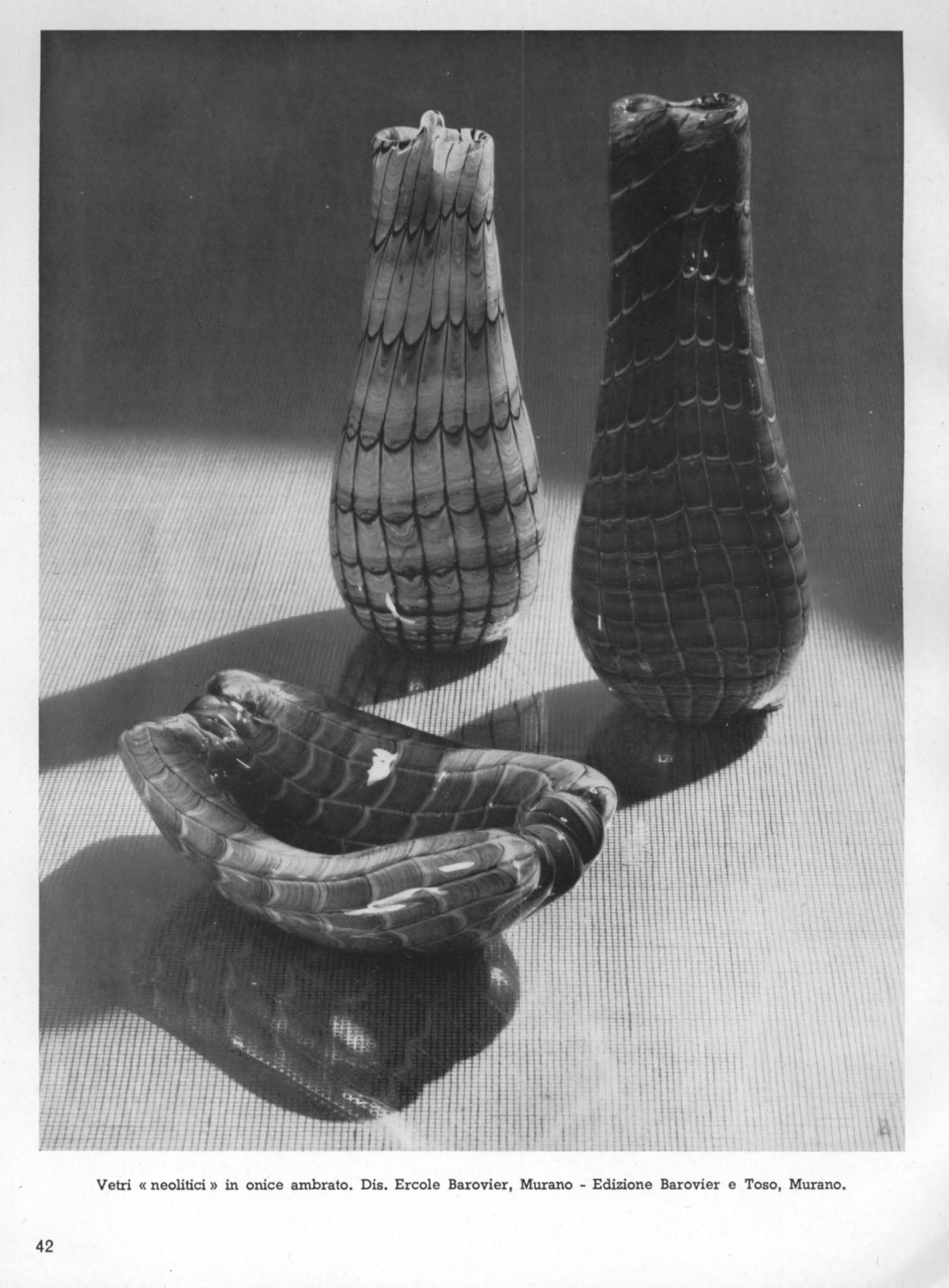
- The Plates: Barovier's brilliant experiments are cataloged in Plates 34 through 42. Key masterworks include his milk-white glass vases scratched with blue and gold leaf (graffito, Plate 34), his intense emerald and amethyst fusions on a gold leaf ground (Plate 36), his volcanic, metal-blue « Barbarico » vases (Plate 39), and his rich, amber-colored onyx « Neolithic » vessels (Plate 42).
- The Furnace: Barovier & Toso, operating under Barovier's direct artistic control, was one of the oldest glasshouses on the island, combining centuries of artisanal knowledge with avant-garde chemical exploration.
PLATES 34–42: THE MAGISTERIAL RE-INVENTIONS OF ERCOLE BAROVIER
Furnace: Barovier & Toso, Murano
- PLATE 34:
- Italian: Vasi in vetro soffiato latteo, graffito blu e oro. Dis. Ercole Barovier, Murano - Ediz. Barovier e Toso, Murano.
- English: Milky blown glass, scratched blue and gold. Designed by Ercole Barovier, Murano - Executed by Barovier and Toso, Murano.
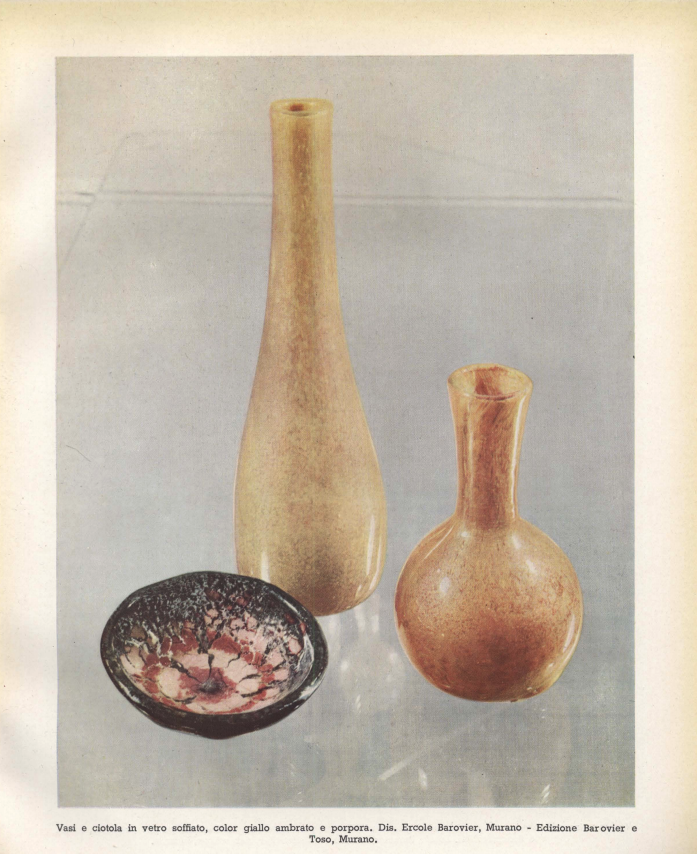
- PLATE 35:
- Italian: Vasi e ciotola in vetro soffiato, color giallo ambrato e porpora. Dis. Ercole Barovier, Murano - Edizione Barovier e Toso, Murano.
- English: Blown glass vases and bowl, purple and amber coloured. Designed by Ercole Barovier, Murano - Made by Barovier and Toso, Murano.
- PLATE 36:
- Italian: Vasi in vetro soffiato a incroci ametista e cristallo con fondo aurato. — Ciotole in vetro soffiato porpora, ramarro, ambra e azzurrato.
- English: Blown glass vases featuring intersecting amethyst and crystal [clear glass] pattern with a gilded base. — Blown glass bowls in purple, lizard green, amber, and light blue
![Blown glass vases featuring intersecting amethyst and crystal [clear glass] pattern with a gilded base. — Blown glass bowls in purple, lizard green, amber, and light blue Designed by Ercole Barovier, Murano - Made by Barovier and Toso, Murano](https://media.exclusivedropshq.com/harmoney-media-public/display/blog_inline/2026/08/0b8e5bd4-c01e-4f13-ae02-4a5fb77b20e3.png)
- PLATE 37:
- Italian: Vasi in vetro soffiato « ramarro ».
- English: « Lizard Green» ("ramarro") blown glass vases. Designed by Ercole Barovier, Murano - Made by Barovier and Toso, Murano.
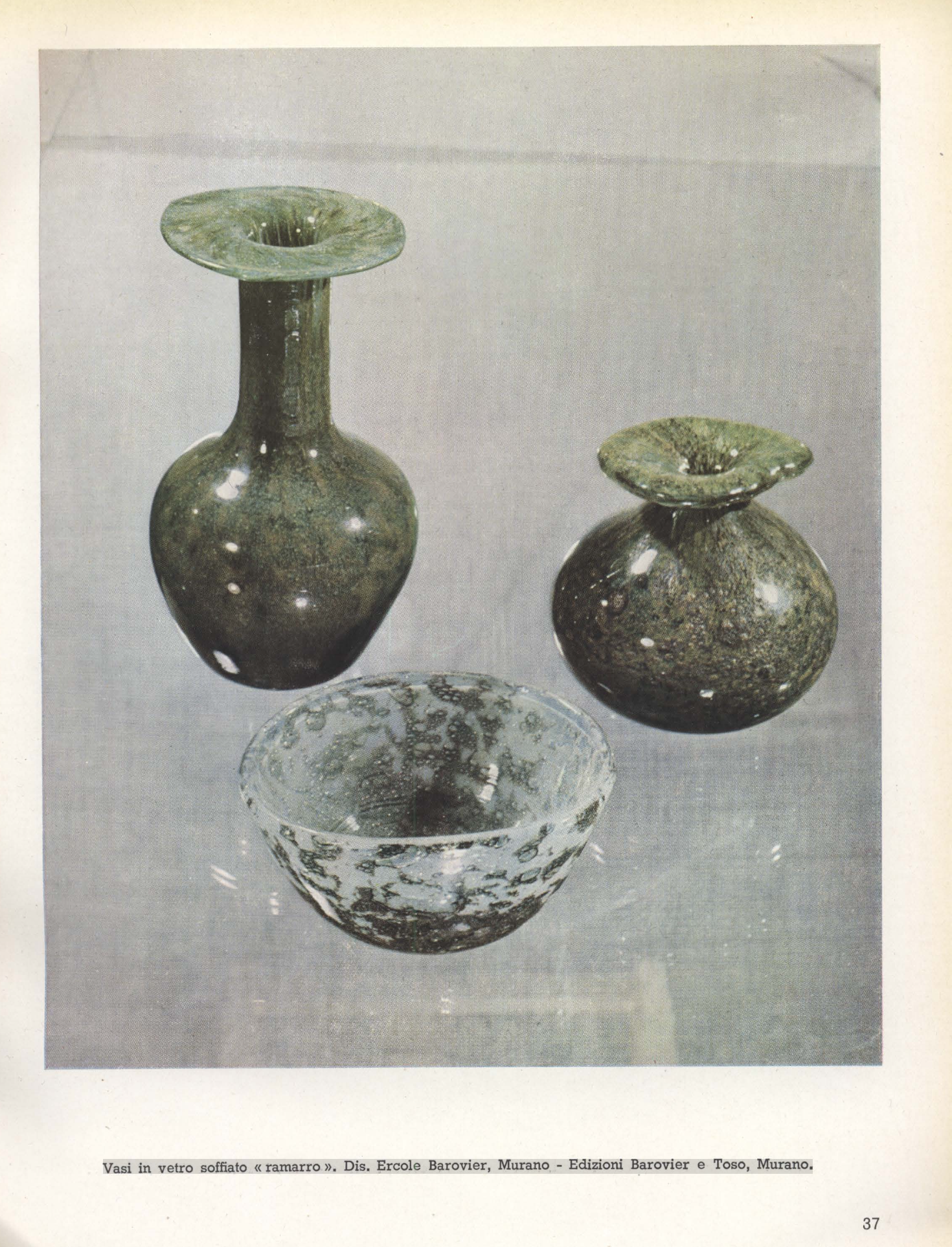
- PLATE 38:
- Italian: Vasi in vetro translucido a colori tenui. Dis. Angelo Barovier, Murano - Ediz. Barovier e Toso, Murano.
- English: Translucid glass vases, of delicate shades. Designed by Angelo Barovier, Murano - Made by Barovier and Toso, Murano.
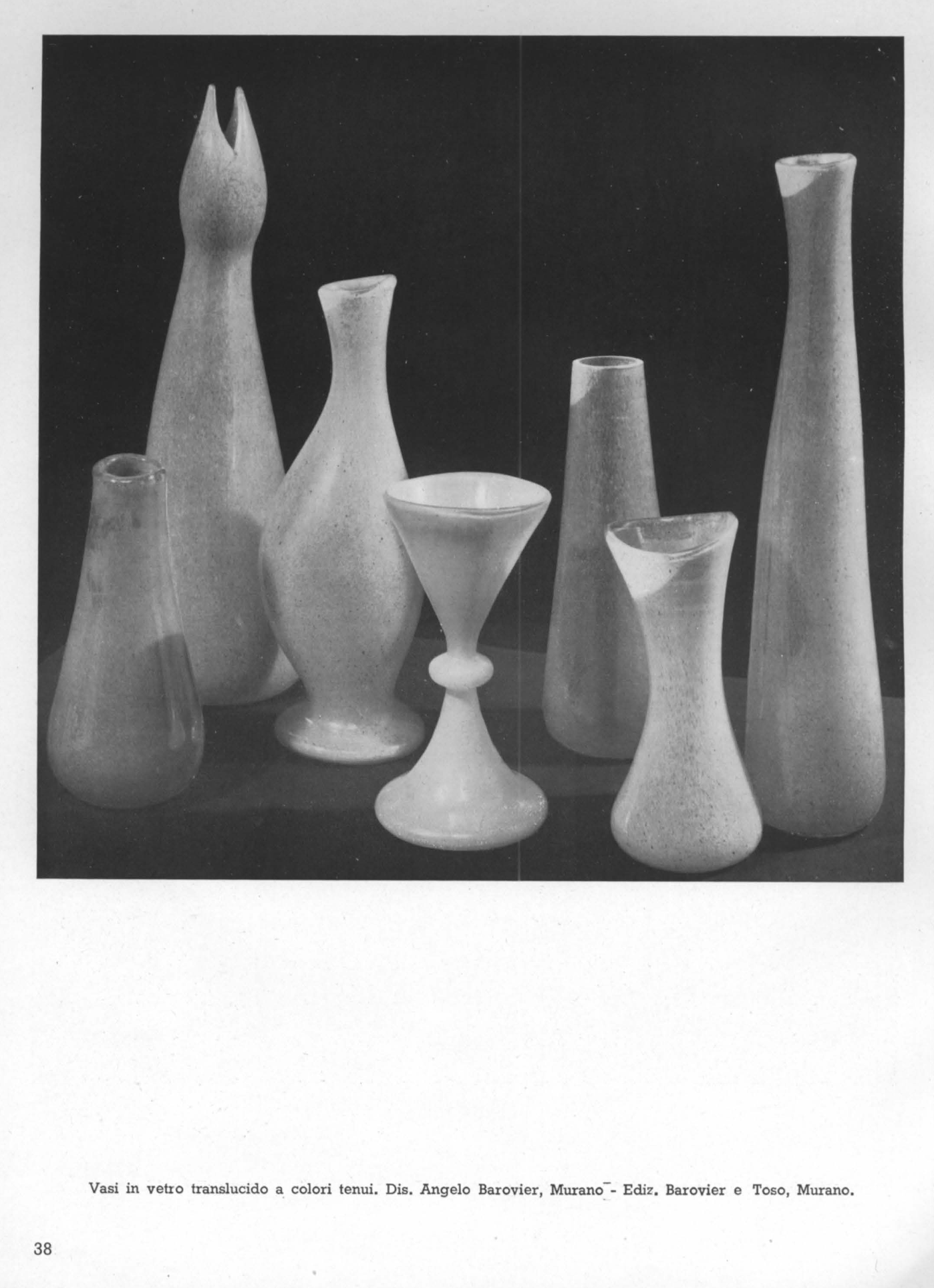
- PLATE 39:
- Italian: Anfora e vaso in vetro soffiato « Barbarico », colore azzurro metallo.
- English: « Barbarico » blown glass amphora and vase, metalic-blue coloured. Designed by Ercole Barovier, Murano - Executed by Barovier and Toso, Murano.
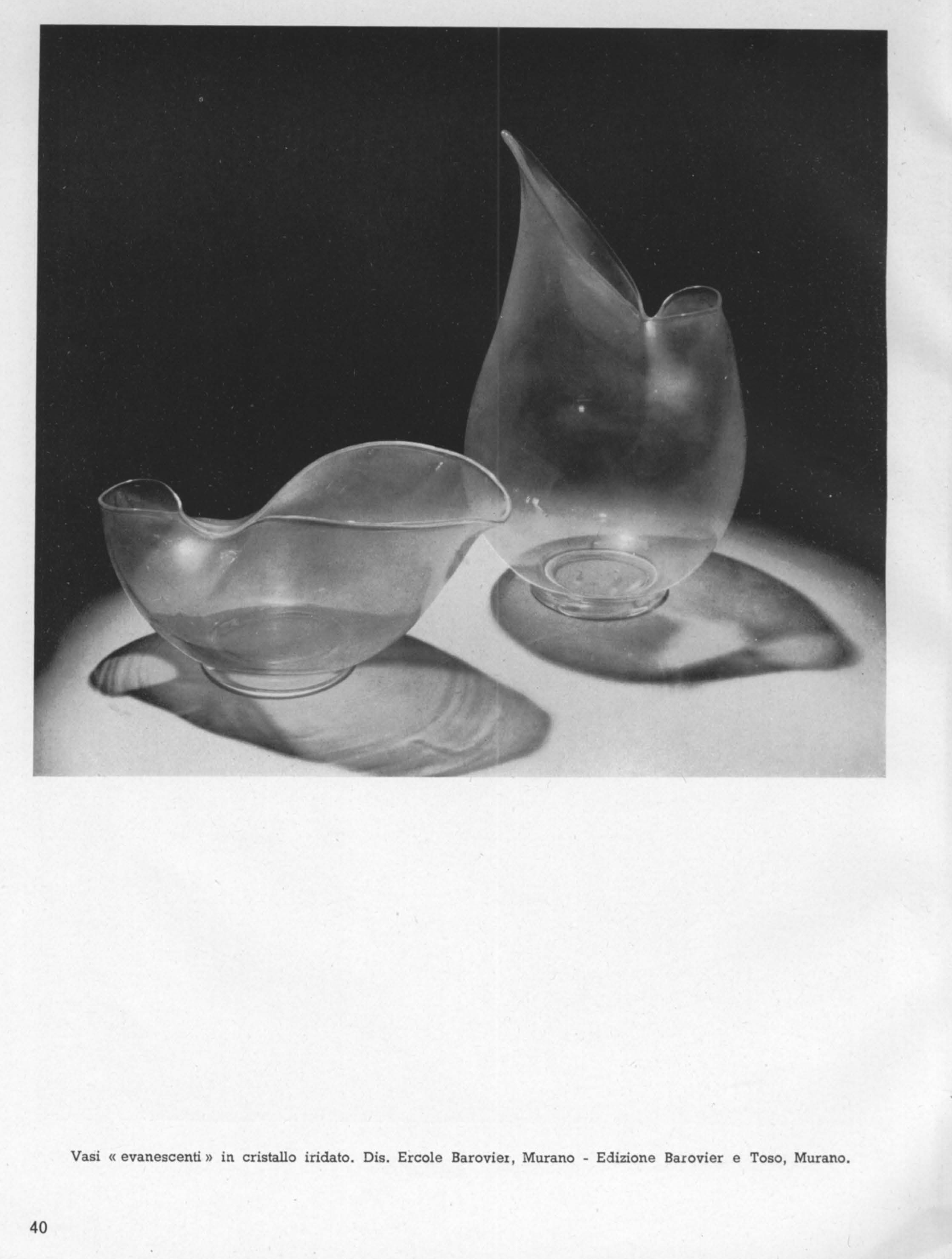
- PLATE 40:
- Italian: Vasi « evanescenti » in cristallo iridato.
- English: « Evanescent glass », Vases iridescent crystal. Designed by Ercole Barovier, Murano - Made by Barovier and Toso, Murano.
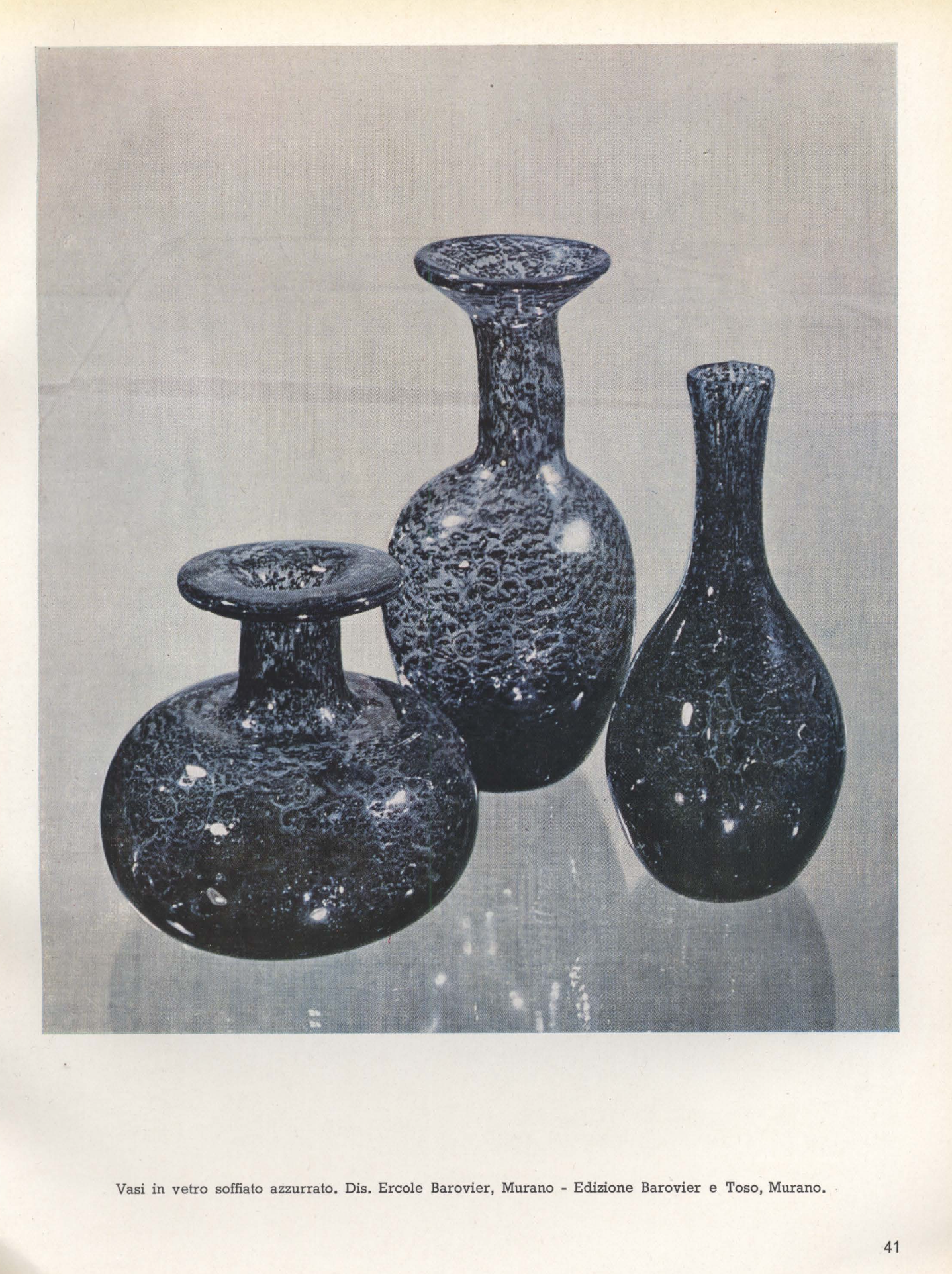
- PLATE 41:
- Italian: Vasi in vetro soffiato azzurrato.
- English: Blue blown glass vases. Designed by Ercole Barovier, Murano - Made by Barovier and Toso, Murano.
- PLATE 42:
- Italian: Vetri « neolitici » in onice ambrato.
- English: « Neolithic » glasses, amber coloured onyx. Designed by Ercole Barovier, Murano - Made by Barovier and Toso, Murano.
4. Archimede Seguso
- The Aesthetic: Recognized as the supreme master glassblower of his generation, Archimede Seguso (1909–1999) possessed an unparalleled manual dexterity. Operating as both designer and master craftsman at his private furnace, Seguso focused on reviving and re-imagining the most complex filigree and lace-making methods of the Renaissance. He succeeded in creating complex, weightless patterns of microscopic white and colored threads suspended inside transparent crystal.
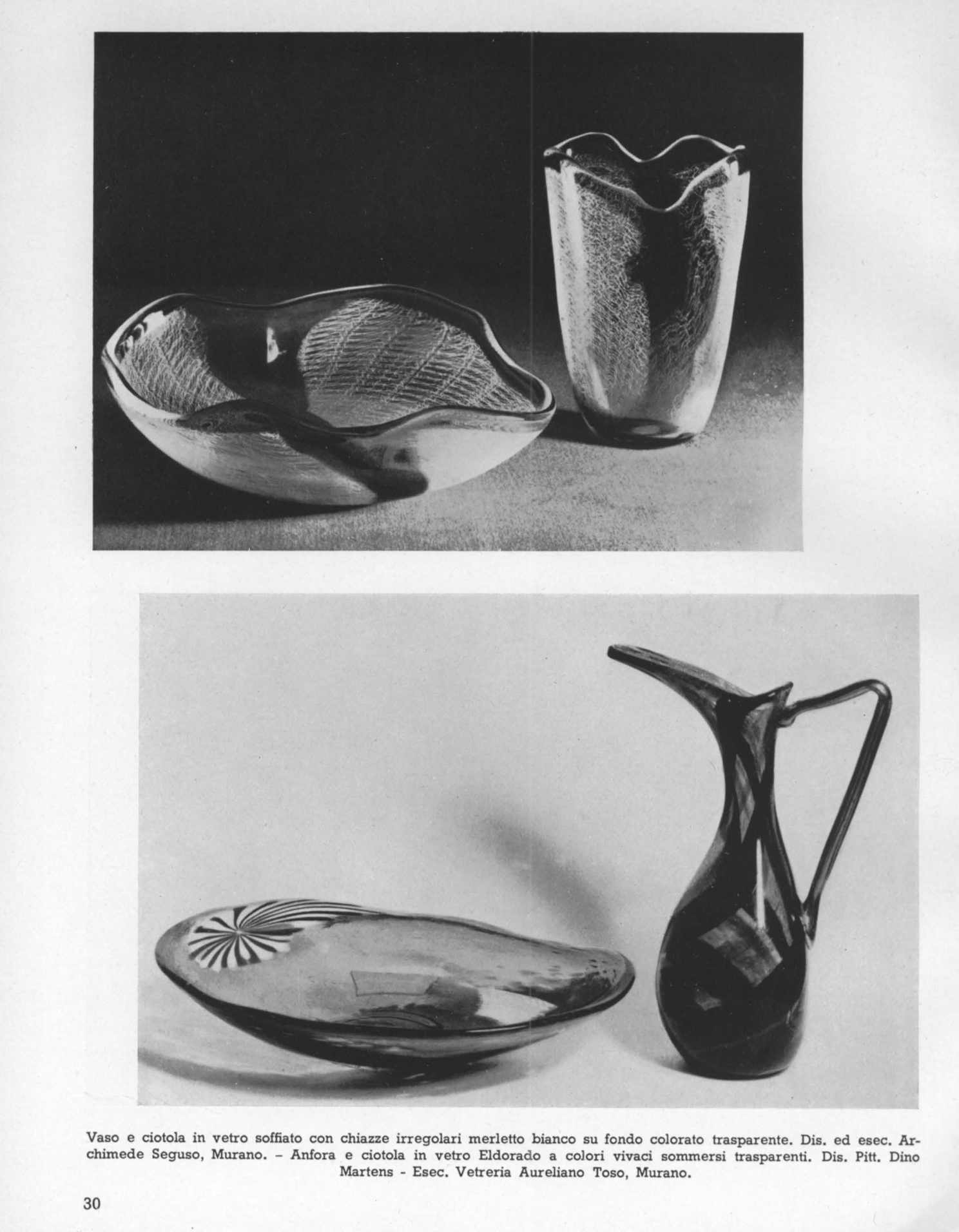
- The Plates: Seguso’s masterworks are represented in Plate 30, highlighting his revolutionary « Merletto » (lace) technique. These hand-blown vessels feature irregular, suspended patches of delicate white lace threads floating effortlessly within a clear, colored ground.
PLATE 30: THE LACE REVELATION OF ARCHIMEDE SEGUSO
Furnace: Archimede Seguso, Murano
- PLATE 30:
- Italian: Vaso e ciotola in vetro soffiato con chiazze irregolari merletto bianco su fondo colorato trasparente. Dis. ed esec. Archimede Seguso, Murano.
- English: Vases and bowl of blown glass, irregularly spotted with white lace decoration ("merletto") on coloured transparent ground. Designed and executed by Archimede Seguso, Murano.
7. Alfredo Barbini, Gino Cenedese, and Vinicio Vianello
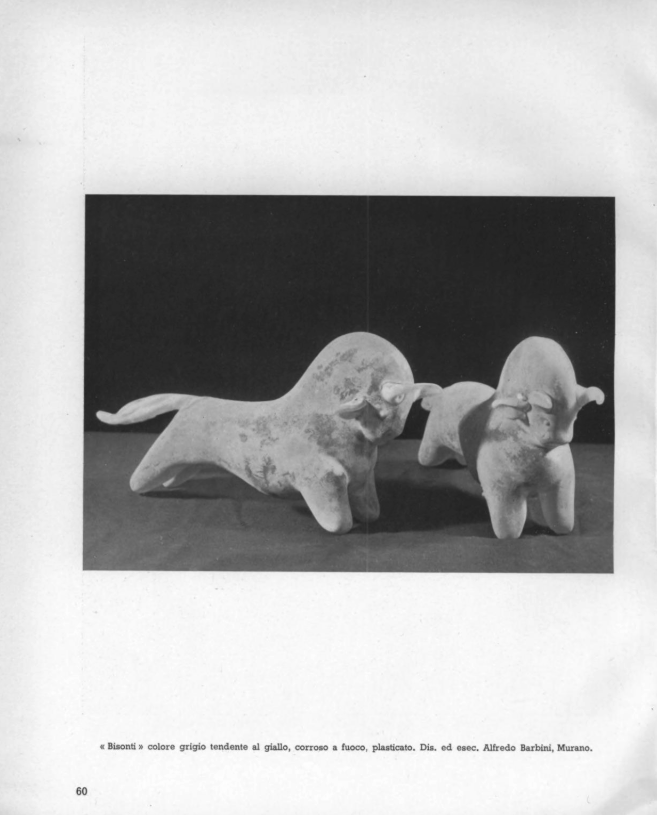
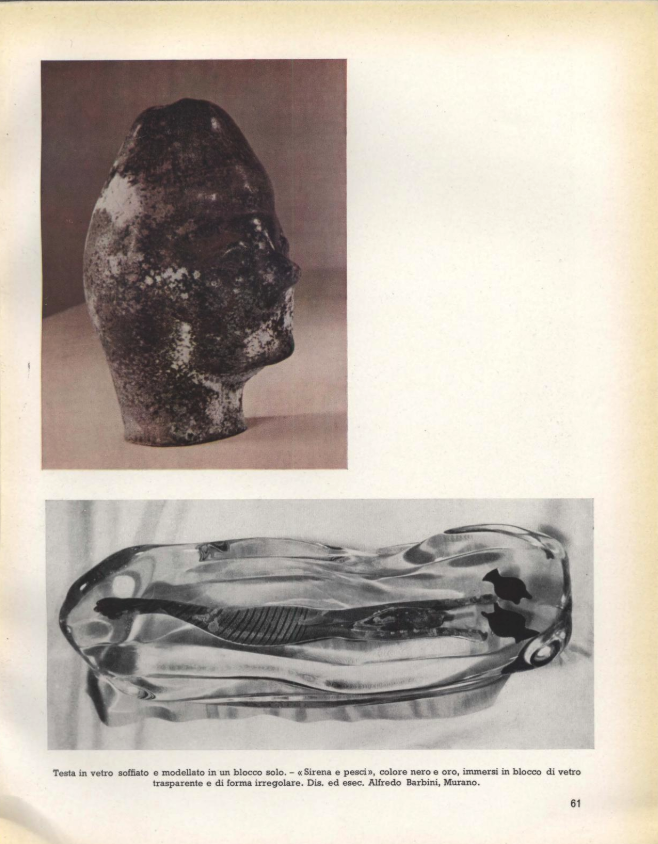
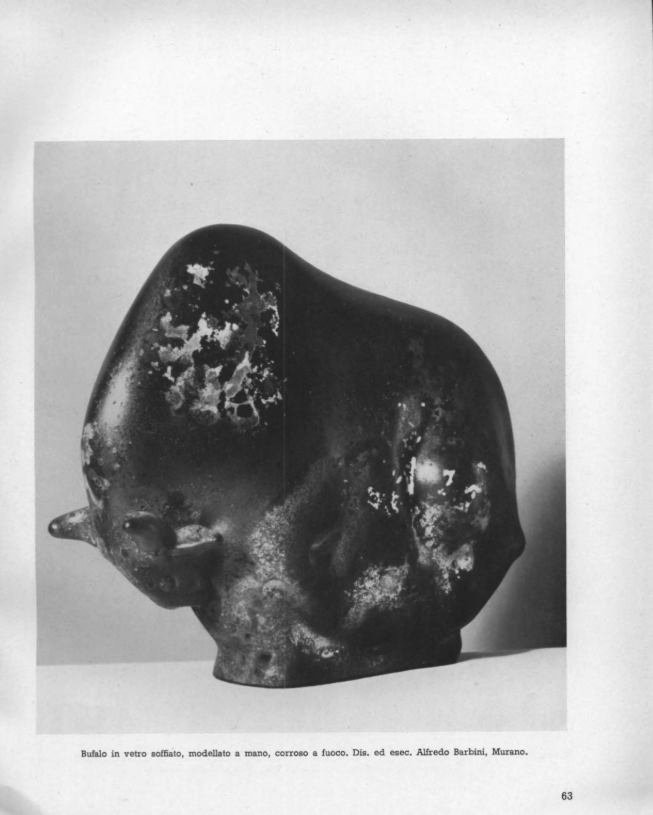
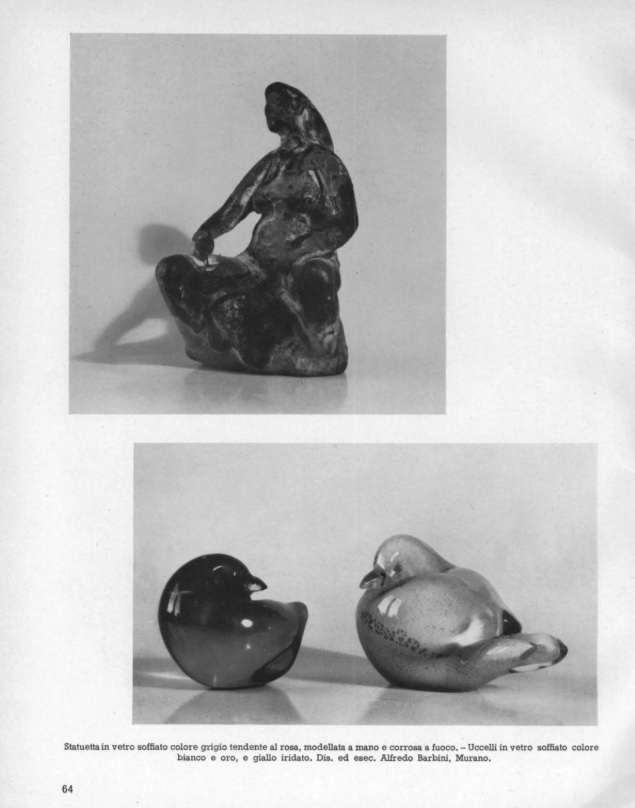
- Alfredo Barbini (1912–2007) was a master of the plastic sculpting of hot glass (massello). Rather than blowing thin vessels, Barbini sculpted heavy, solid blocks of molten glass into detailed animal figures. His Plates 60 through 64 display hand-sculpted, fire-corroded bisons (Plate 60), heavy black and gold sirens submerged within solid crystal blocks (Plate 61), and hand-molded buffaloes (Plate 63).
PLATES 60–64: THE PLASTIC SCULPTING OF ALFREDO BARBINI
Furnace: Alfredo Barbini, Murano
- PLATE 60:
- Italian: « Bisonti » colore grigio tendente al giallo, corroso a fuoco, plasticato. Dis. ed esec. Alfredo Barbini, Murano.
- English: « Bisons »,smoky, grayish-yellow tone with an acid-etched, frosted, and tactile surface finish. Designed and made by Alfredo Barbini, Murano.
- PLATE 61:
- Italian: Testa in vetro soffiato e modellato in un blocco solo. — « Sirena e pesci », colore nero e oro, immersi in blocco di vetro trasparente e di forma irregolare. Dis. ed esec. Alfredo Barbini, Murano.
- English: A head of blown glass, made from one block only. — « Siren and fish » black and gold, in a block of irregularly shaped transparent glass. Designed and made by Alfredo Barbini, Murano.
- PLATE 62:
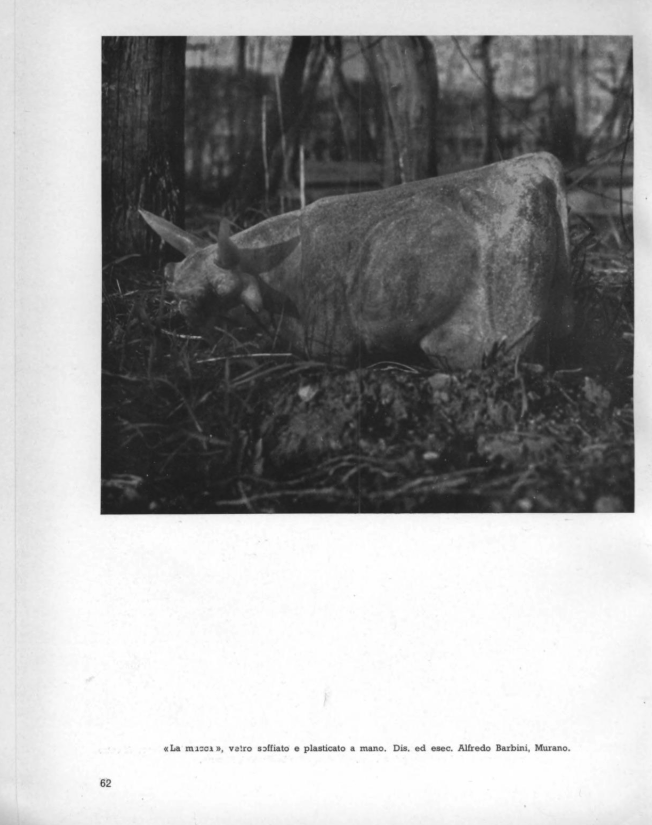
- Italian: « La mucca », vetro soffiato e plasticato a mano. Dis. ed esec. Alfredo Barbini, Murano.
- English: « The cow », hand moulded blown glass. Designed and executed by Alfredo Barbini, Murano.
- PLATE 63:
- Italian: Bufalo in vetro soffiato, modellato a mano, corroso a fuoco. Dis. ed esec. Alfredo Barbini, Murano.
- English: Buffalo of blown glass, hand moulded. Designed and made by Alfredo Barbini, Murano.
- PLATE 64:
- Italian: Statuetta in vetro soffiato colore grigio tendente al rosa, modellata a mano e corrosa a fuoco. — Uccelli in vetro soffiato colore bianco - oro e giallo iridato. Dis. ed esec. Alfredo Barbini, Murano.
- English: Hand moulded blown glass statuette of grey-rose colour. — Blown glass birds of white-gold iridescent yellow colours. Designed and executed by Alfredo Barbini, Murano.
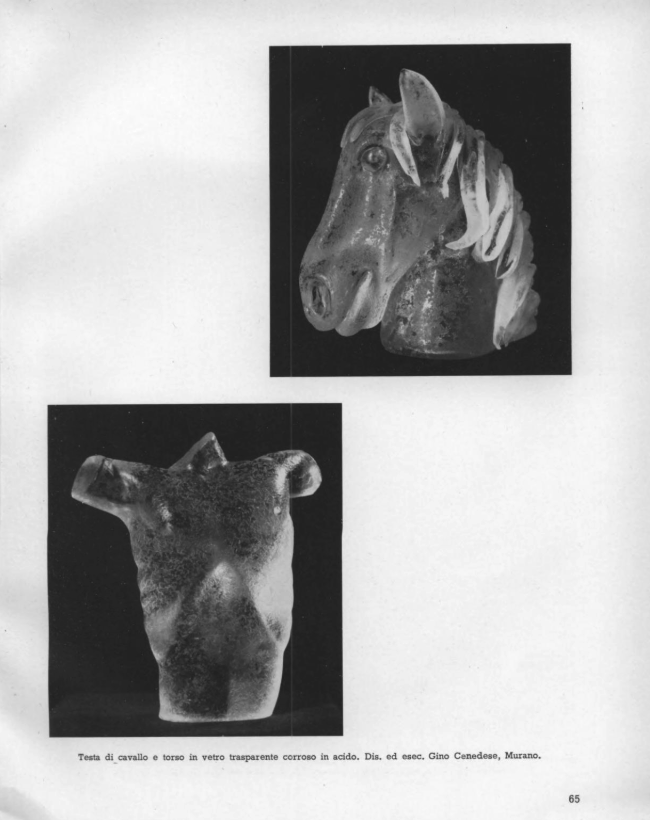
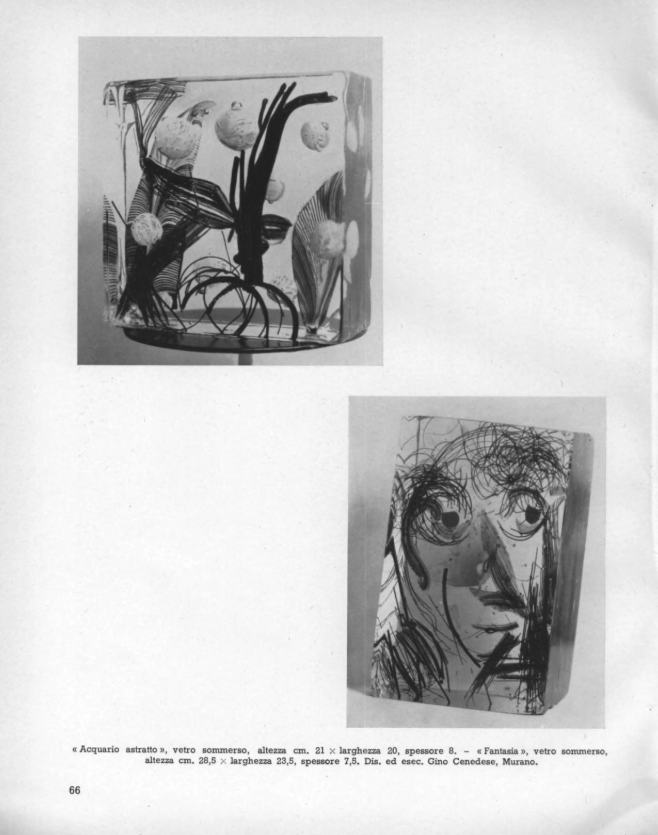
- Gino Cenedese (1907–1973) specialized in massive, block-like solid glass fusions. His Plates 65 and 66 showcase heavy horse heads and torsos etched with acid (Plate 65) and his famous, highly dense submerged « Acquari astratti » (abstract aquariums) which trap colored fish, plants, and air bubbles within a solid block of thick crystal (Plate 66).
PLATES 65–66: THE SOLID GLASS MONOLITHS OF GINO CENEDESE
Furnace: Gino Cenedese, Murano
- PLATE 65:
- Italian: Testa di cavallo e torso in vetro trasparente corroso in acido. Dis. ed esec. Gino Cenedese, Murano.
- English: Horse’s head and torso of transparent glass worn away with acid. Designed and made by Gino Cenedese, Murano.
- PLATE 66:
- Italian: « Acquario astratto », vetro sommerso, altezza cm. 21 x larghezza 20, spessore 8. — « Fantasia », vetro sommerso, altezza cm. 28,5 x larghezza 23,5, spessore 7,5. Dis. ed esec. Gino Cenedese, Murano.
- English: « Abstract aquarium », glass piece height cm. 21x20 width, cm. 8 thickness. — « Fantasy », glass piece height cm. 28,5x 23,5 width, cm. 7,5 thickness. Designed and executed by Gino Cenedese, Murano.
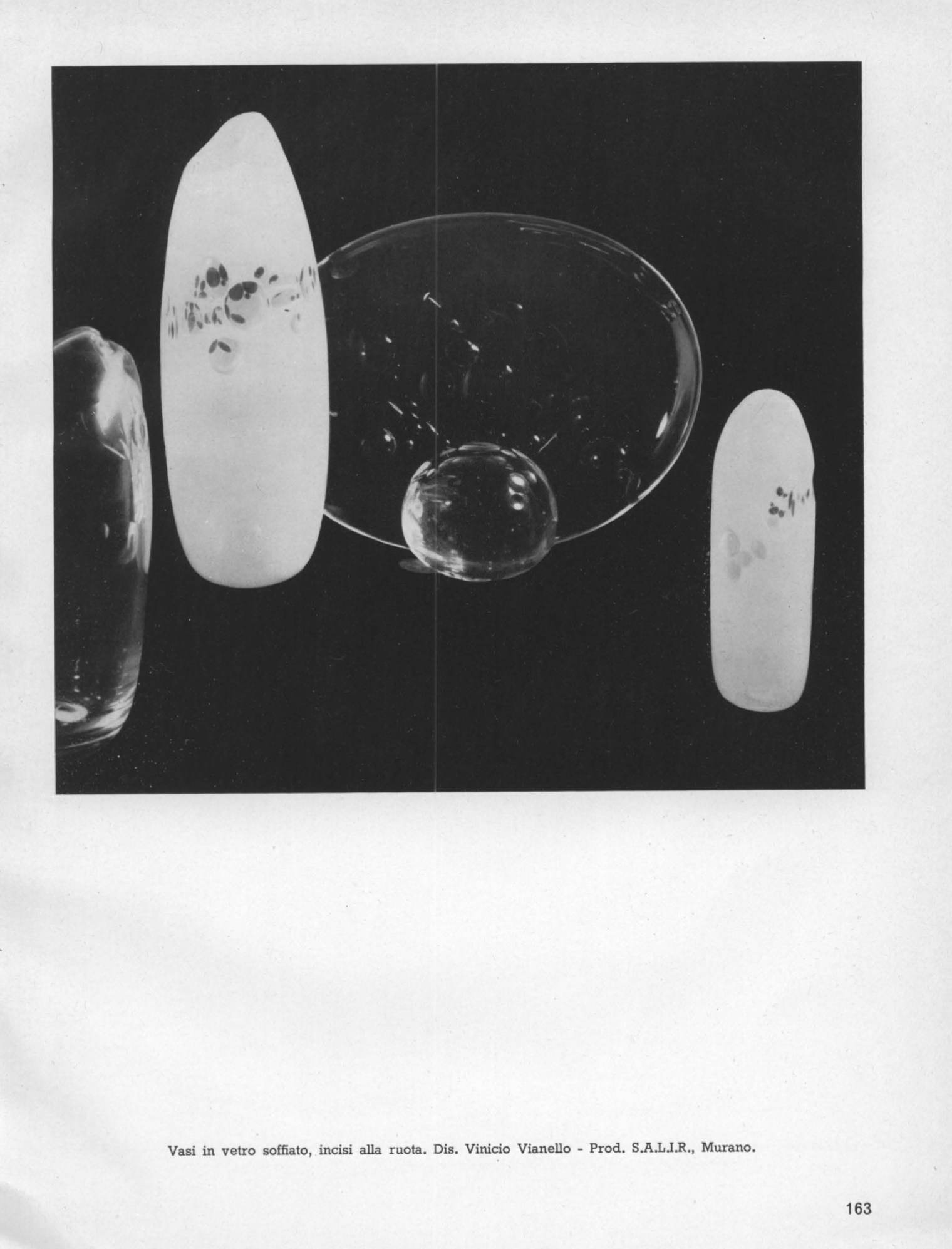
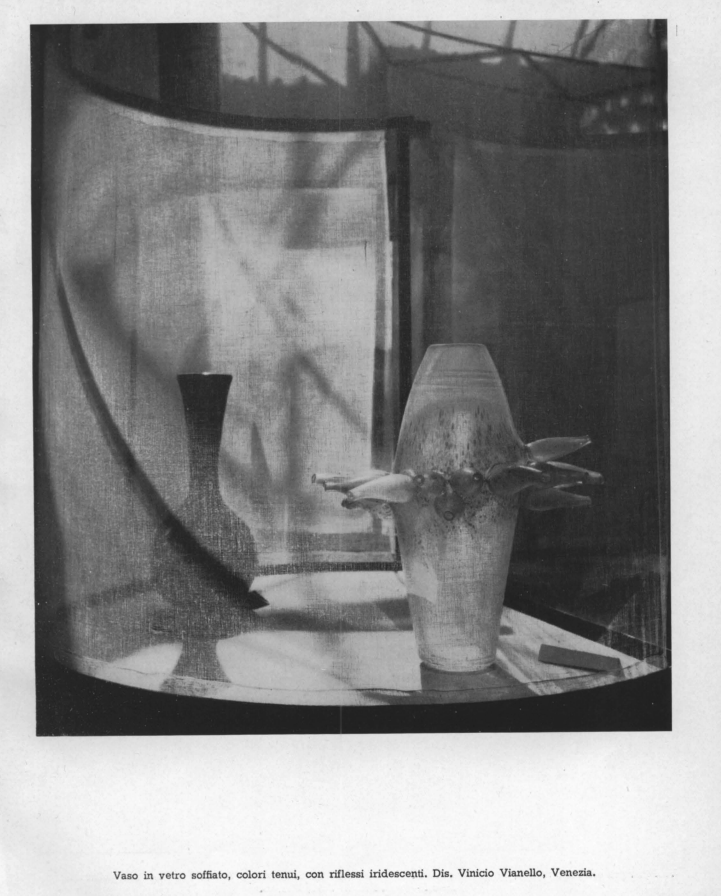
- Vinicio Vianello (1923–1999) was an avant-garde painter who brought an experimental, space-age kineticism to glass. His Plates 160 and 164 highlight his thin-blown, iridescent, and asymmetrical vessels decorated with deep, abstract wheel-engravings.
THE MASTERWORKS OF VINICIO VIANELLO
- PLATE 160:
- Italian: Vasi in vetro soffiato, incisi alla ruota. Dis. Vinicio Vianello - Prod. S.A.L.I.R., Murano.
- English: Wheel engraved blown glass vases designed by Vinicio Vianello - Produced by S.A.L.I.R., Murano.
- PLATE 164:
- Italian: Vaso in vetro soffiato, colori tenui, con riflessi iridescenti. Dis. Vinicio Vianello, Venezia.
- English: Blown glass vase, of iridescent colours. Designed by Prof. Vinicio Vianello, Venice.
5. Dino Martens and Vetreria Aureliano Toso
- The Aesthetic: The painter Dino Martens (1894–1970) brought a highly dramatic, almost chaotic expressionist sensibility to Murano glass. Working for the Aureliano Toso furnace, Martens designed works that combined multiple, seemingly incompatible techniques into a single vessel. His designs are characterized by asymmetrical, organic shapes, bulging necks, and dense, complex fusions of colored pinwheels, zanfirico ribbons, aventurine flakes, and opaque glass fragments.
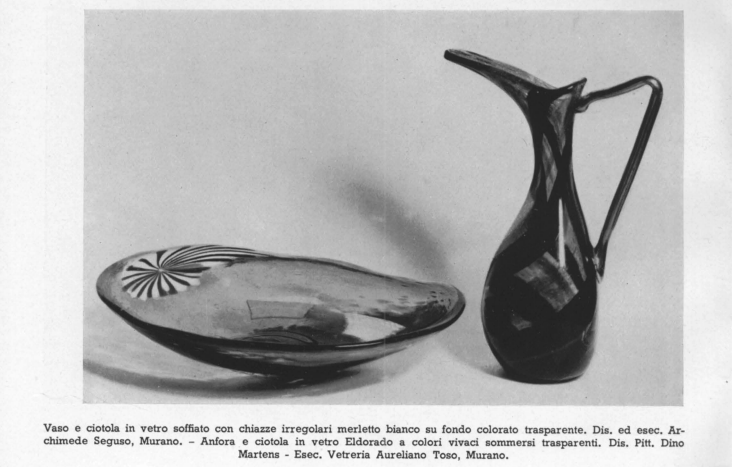
- The Plates: Martens’ expressive works are captured in Plates 31 through 33. These include his famous « Eldorado » series (Plate 31), which are characterized by large, asymmetrical vases containing thick, submerged, transparent bright colors, metallic copper inclusions, and bold filigree threads.
Here are the complete bilingual curatorial entries for Plates 31, 32, and 33 grouped together, showcasing Dino Martens’ expressionist collaborations with the Aureliano Toso furnace:
THE MASTERWORKS OF DINO MARTENS
Furnaces: Vetreria Aureliano Toso & Alberto Toso e C.
- PLATE 31:
- Italian: Anfora e ciotola in vetro « Eldorado » a colori vivaci sommersi trasparenti. Dis. Pitt. Dino Martens - Esec. Vetreria Aureliano Toso, Murano.
- English: « Eldorado » blown glass amphora and bowl, submerged transparent bright colours. Designed by the Painter Dino Martens and produced by Vetreria Aureliano Toso, Murano.
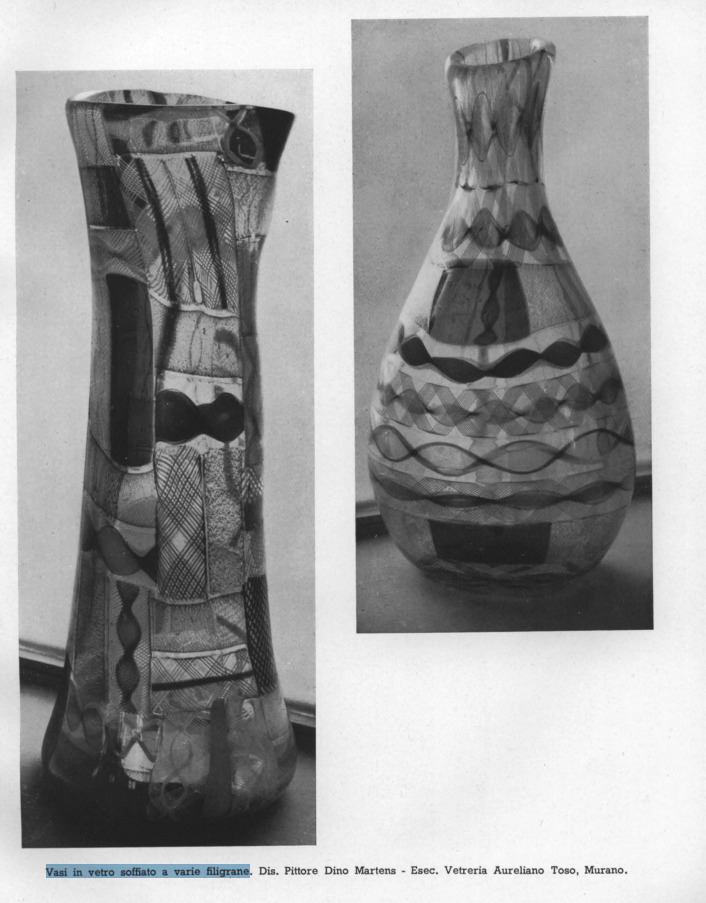
- PLATE 32:
- Italian: Vasi in vetro soffiato a varie filigrane. Dis. Pittore Dino Martens - Esec. Vetreria Aureliano Toso, Murano. — Vasi in vetro soffiato lavorato a canne multicolori. Dis. ed esec. Alberto Toso e C., Murano.
- English: Filigree of threads on blown vases. Designed by the Painter Dino Martens - Executed by Vetreria Aureliano Toso, Murano. — Blown glass vases decorated with stripes of various colours. Designed and executed by Alberto Toso & C., Murano.
- PLATE 33:
- Italian: Vasi e ciotola in vetro soffiato, filigrana a fili rilevati bianchi e neri. Dis. Pittore Dino Martens - Esec. Vetreria Aureliano Toso, Murano.
- English: Blown glass, relief white-and-black filigree threaded vases and bowl. Designed by the painter Dino Martens - Executed by Aureliano Toso, Murano.
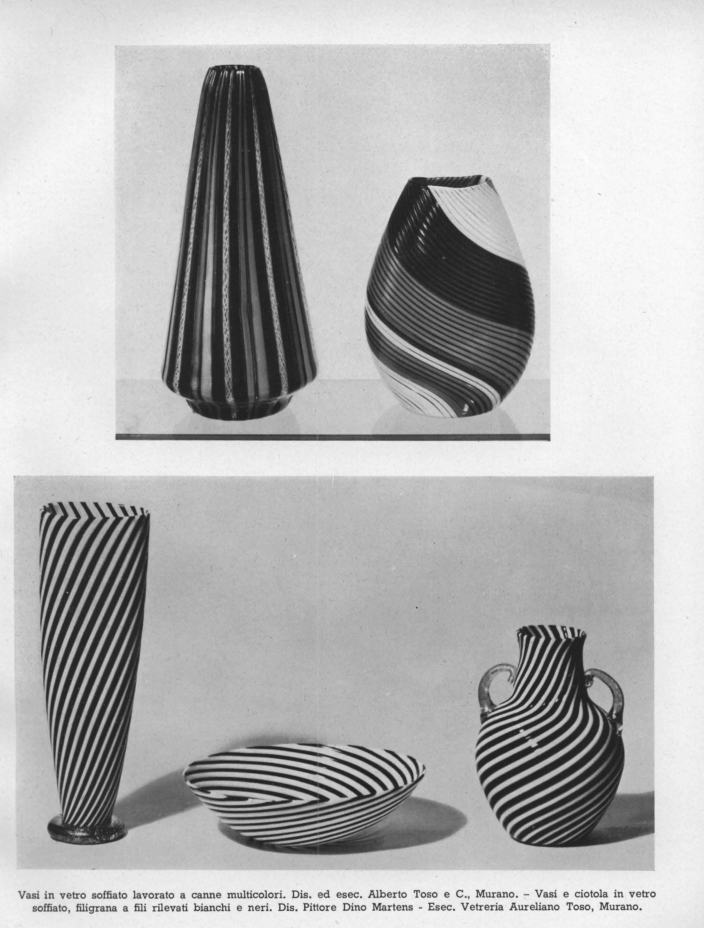
These descriptions illustrate Martens' unique "painterly" signature—particularly his legendary Eldorado fusions (Plate 31) and asymmetrical relief filigrees (Plate 33)—which juxtaposed contrasting stripes, coarse inclusions, and chaotic patches into highly unified, kinetic silhouettes.
6. Ermanno Toso and Fratelli Toso
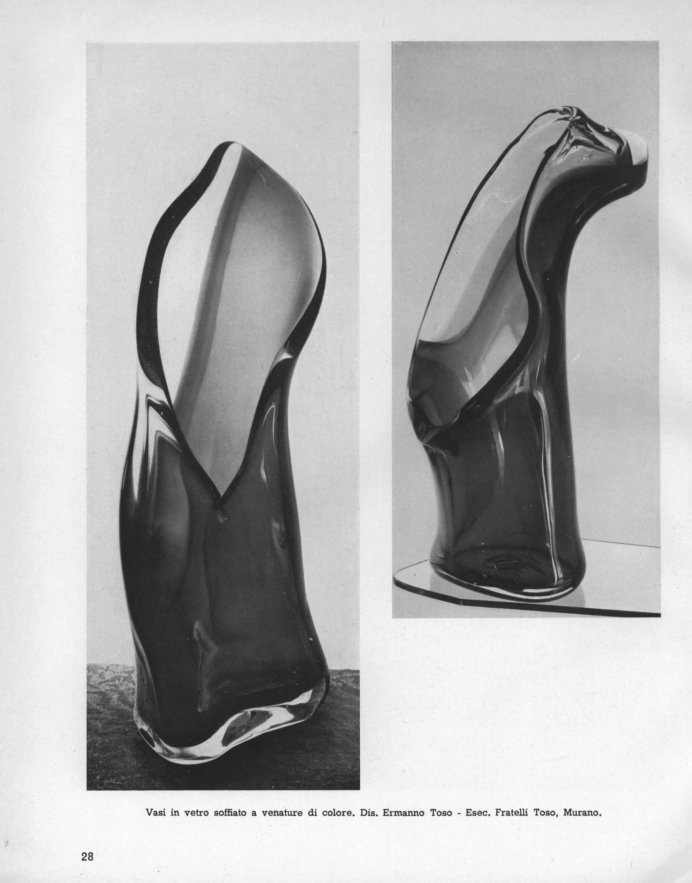
- The Aesthetic: Ermanno Toso focused on a highly sophisticated, linear, and geometric approach to post-war glass design. His works rely on the precise, rhythmic distribution of delicate colored threads and canes across simple, stable shapes.
- The Plates: His works are documented in Plates 28 and 29, showcasing his elegant color-threaded (venature di colore) blown vases and clear, structured filigree bottles.
- The Furnace: Fratelli Toso, founded in 1854, maintained a stellar reputation for its production of high-quality classical filigree tableware and modern lighting installations.
THE MASTERWORKS OF ERMANNO TOSO
Furnace: Fratelli Toso, Murano
- PLATE 28:
- Italian: Vasi in vetro soffiato a venature di colore. Dis. Ermanno Toso - Esec. Fratelli Toso, Murano.
- English: Color-threaded blown vase. Designed by Ermanno Toso - Executed by Fratelli Toso, Murano.
- PLATE 29:
- Italian: Vetri soffiati a venature di colore. — Vasi in vetro soffiato a filigrana. Dis. Ermanno Toso - Esec. Fratelli Toso, Murano.
- English: Colour threaded blown glass pieces. — Filigree blown vases. Designed by Ermanno Toso - Executed by Toso Brothers, Murano.
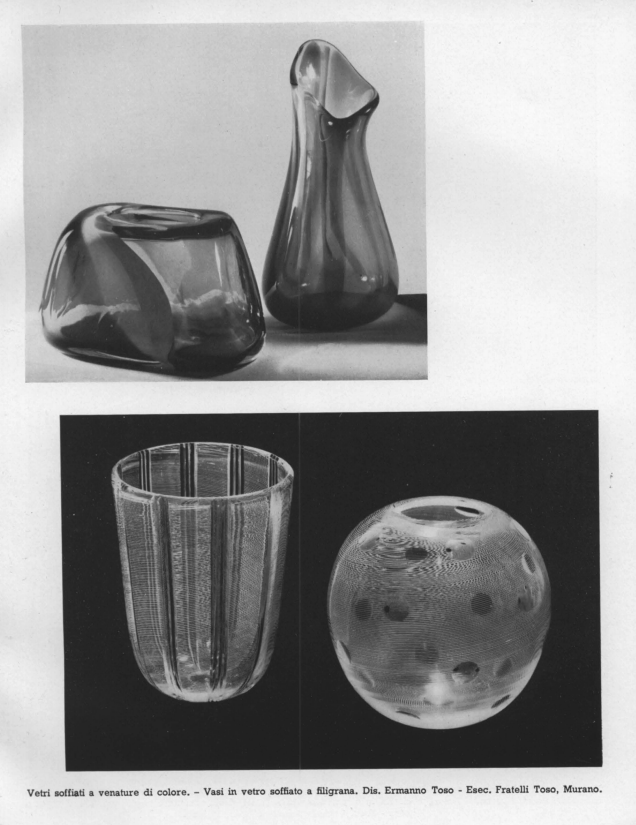
Note: While Ermanno Toso's principal design showcase focuses on the delicate color-threading of Plates 28 and 29, the Fratelli Toso furnace also executed the striking, heavy-walled "Submerged polychromous glass vases" shown in Plate 165 near the end of the monograph.
III. "Fusi con il Fuoco": The Avant-Garde Fine Art Collaborations
One of the most extraordinary and historically significant sections of Roberto Aloi’s 1955 anthology is the documentation of the "Fusi con il Fuoco" (Fused with Fire) movement. During the early 1950s, a visionary group of artists, led by Egidio Costantini, conceived the idea of inviting the world’s most celebrated modern painters and sculptors to submit designs to be executed in glass by Murano's finest master blowers. This historic collaboration elevated glass from a decorative craft to a legitimate medium of fine art.
                     "FUSI CON IL FUOCO" COLLABORATIONS
                    ====================================

         [ THE DESIGNERS ]                             [ THE FURNACES ]
    +-------------------------+                   +---------------------------+
    | Pablo Picasso           |                   | Dalla Venezia & Martinuzzi|
    | Marc Chagall            |                   | (Francesco Martinuzzi)    |
    | Georges Braque          |                   |                           |
    | Alexander Calder        |                   +---------------------------+
    | Le Corbusier            |                                 |
    | Gio Ponti               |                   +---------------------------+
    | Bruno Saetti            |                   | I.V.R. di Mazzega         |
    |                         |                   | (Ermanno Nason)           |
    +-------------------------+                   |                           |
                 |                                +---------------------------+
                 |                                              |
                 +----------------------------------------------+
                                         |
                                         v
                            [ THE HISTORIC PLATES ]
                     - Picasso: "The Centaur" (Plate 150)
                     - Picasso: "Water Bearer" (Plate 151)
                     - Chagall: "King David" (Plate 153)
                     - Braque: "Sweethearts" (Plate 153)
                     - Le Corbusier: "Harmonies" (Plate 154)
                     - Calder: "Flying Dove" (Plate 159)
                     - Ponti: "Lights" (Plate 157)
The 1955 catalog documents these historic collaborations in Plates 149 through 163:
1. Pablo Picasso and Master Blowers Francesco Martinuzzi & Ermanno Nason
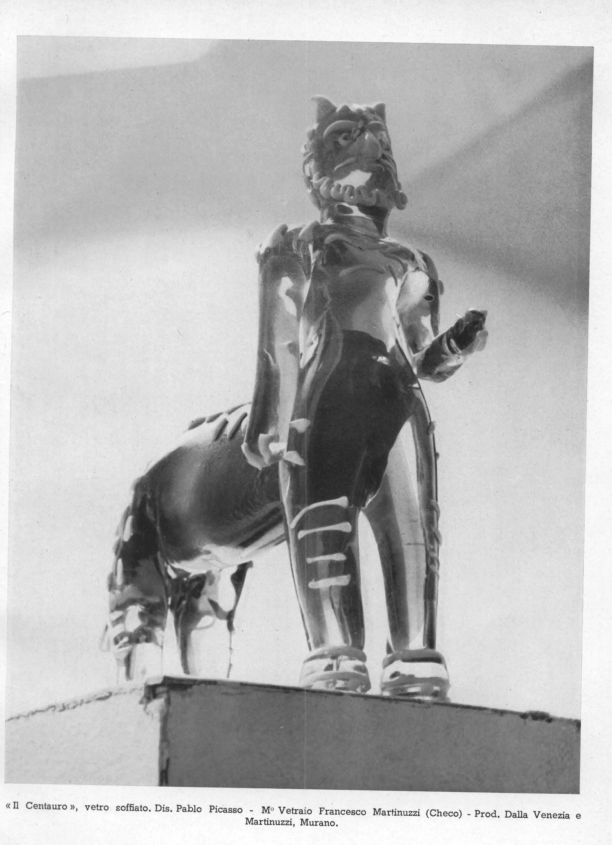
- The Centaur (Plate 150): Designed by Pablo Picasso and executed by master glassmaker Francesco Martinuzzi (nicknamed Checo) at the furnace of Dalla Venezia e Martinuzzi. This work is a tour-de-force of hot-sculpted glass, translating Picasso’s cubist, animalistic line into a three-dimensional monument of black and gold-flecked glass.
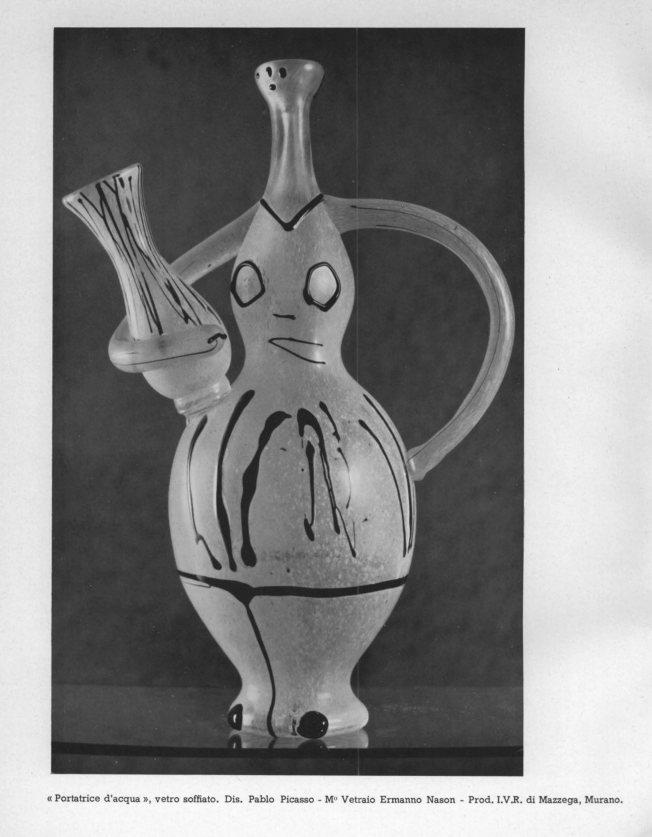
- Water Bearer (Plate 151): Designed by Picasso and executed by the legendary master blower Ermanno Nason at the I.V.R. di Mazzega furnace. This work features an abstract, hollow-blown female form carrying a water jug, demonstrating an extraordinary control of glass wall thickness and shape.
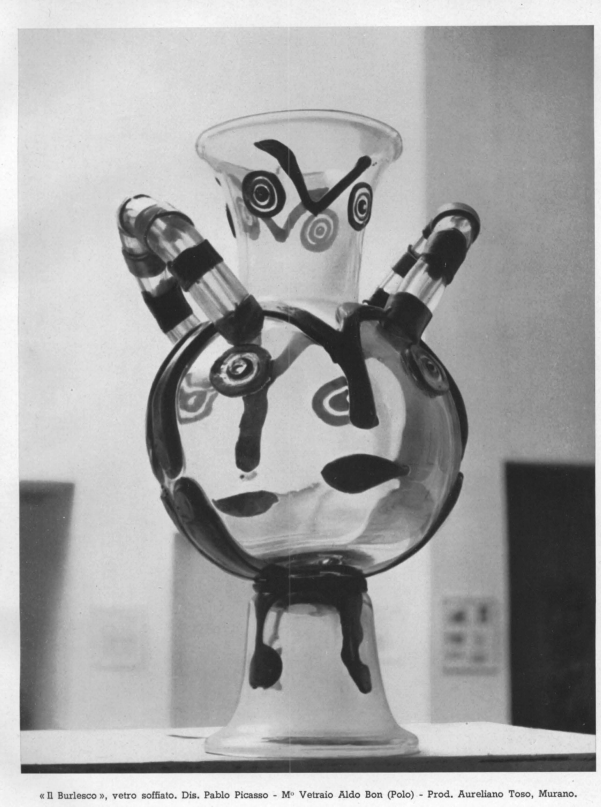
- Burlesque (Plate 152): Designed by Picasso and executed by master glassmaker Aldo Bon (nicknamed Polo) at the Vetreria Aureliano Toso. A highly expressive, satirical figure composed of fused, multicolored glass segments.
THE GLASS SCULPTURES OF PABLO PICASSO (PLATES 150–152)
Furnaces: Dalla Venezia e Martinuzzi, I.V.R. di Mazzega, and Vetreria Aureliano Toso
- PLATE 150:
- Italian: « Il Centauro », vetro soffiato. Dis. Pablo Picasso - M° Vetraio Francesco Martinuzzi (Checo) - Prod. Dalla Venezia e Martinuzzi, Murano.
- English: « The Centaur » of blown glass designed by Pablo Picasso - Blown by Francesco Martinuzzi (Checo) - Produced by Dalla Venezia and Martinuzzi, Murano.
- PLATE 151:
- Italian: « Portatrice d'acqua », vetro soffiato. Dis. Pablo Picasso - M° Vetraio Ermanno Nason - Prod. I.V.R. di Mazzega, Murano.
- English: « Water bearer » of blown glass designed by Pablo Picasso - Blown by Ermanno Nason - Produced by I.V.R. di Mazzega, Murano.
- PLATE 152:
- Italian: « Il Burlesco », vetro soffiato. Dis. Pablo Picasso - M° Vetraio Aldo Bon (Polo) - Prod. Aureliano Toso, Murano.
- English: « Burlesque » of blown glass designed by Pablo Picasso - Blown by Aldo Bon (Polo) - Produced by Aureliano Toso, Murano.
2. Marc Chagall & Georges Braque and Master Blower Ermanno Nason
- King David Plate (Plate 153): Designed by Marc Chagall and blown by Ermanno Nason at I.V.R. di Mazzega. The surface of this flat, clear glass plate is decorated with a highly expressive, hand-painted and enameled biblical depiction of King David, capturing the floating, lyrical dreamscapes characteristic of Chagall's paintings.
- Sweethearts Plate (Plate 153): Designed by Georges Braque and executed by Ermanno Nason at I.V.R. di Mazzega. A stunning clear glass dish featuring Braque’s iconic, minimalist profile of two kissing birds, executed in a deep, opaque black enamel.
THE GLASS MASTERWORKS OF MARC CHAGALL & GEORGES BRAQUE (PLATE 153)
Furnace: I.V.R. di Mazzega, Murano
Master Blower: Ermanno Nason
- PLATE 153:
-
Italian: « Re David », piatto in vetro soffiato. Dis. Marc Chagall - M° Vetraio Ermanno Nason - Prod. I.V.R. di Mazzega, Murano. — « Innamorati », piatto in vetro soffiato. Dis. Georges Braque - M° Vetraio Ermanno Nason - Prod. I.V.R. di Mazzega, Murano.
-
English: « King David », dish of blown glass designed by Marc Chagall - Blown by Ermanno Nason - Produced by I.V.R. di Mazzega, Murano. — « Sweethearts », dish of blown glass designed by Georges Braque - Blown by Ermanno Nason - Produced by I.V.R. di Mazzega, Murano.
-
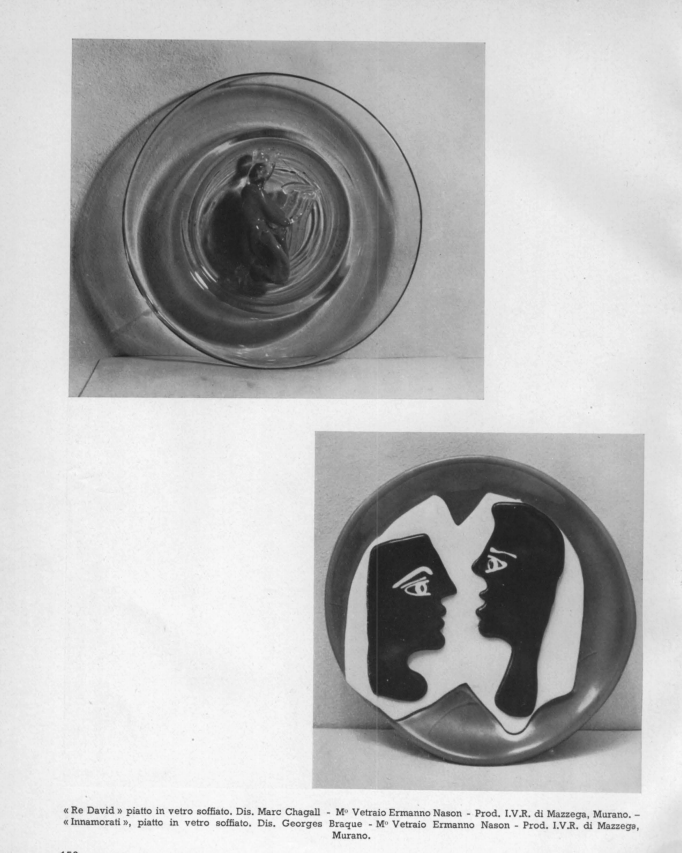
This beautiful, shared plate entry showcases how master blower Ermanno Nason served as the primary technical conduit for these legendary French modernists, capturing both Chagall's lyrical painting style and Braque's minimalist, flat-profile cubist geometries on clear blown glass dishes.
3. Le Corbusier, Alexander Calder, and Oskar Kokoschka
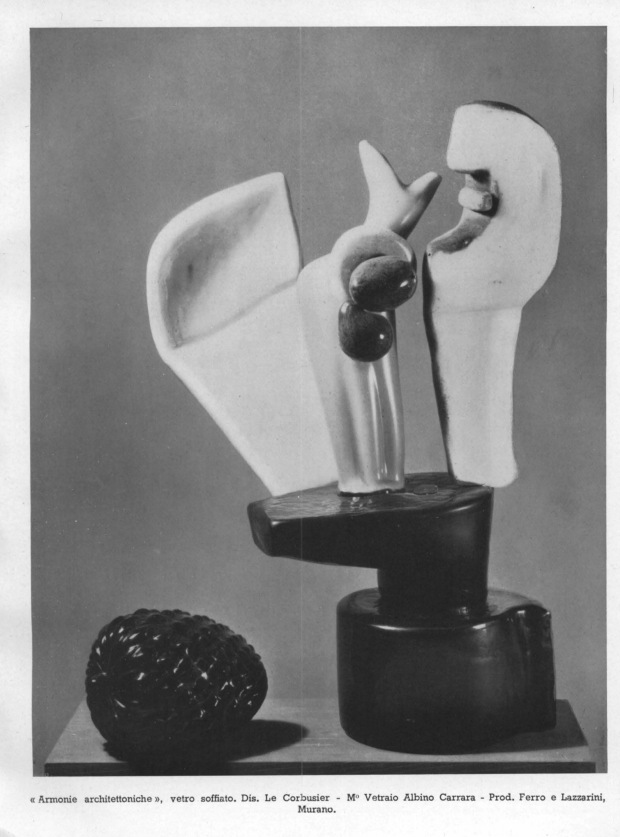
- Architectonic Harmonies (Plate 154): Designed by the father of modern architecture, Le Corbusier, and executed by master blower Albino Carrara at the furnace of Ferro e Lazzarini. This work is an abstract, geometric composition of intersecting solid glass blocks and hollow tubes, reflecting Le Corbusier’s modernist theories of architectural proportion.
- Flying Dove (Plate 159): Designed by the American kinetic sculptor Alexander Calder and executed by Albino Carrara at Ferro e Lazzarini. Calder’s design is translated into a weightless, flowing bird of clear and white lattimo glass that appears to capture the very essence of flight.
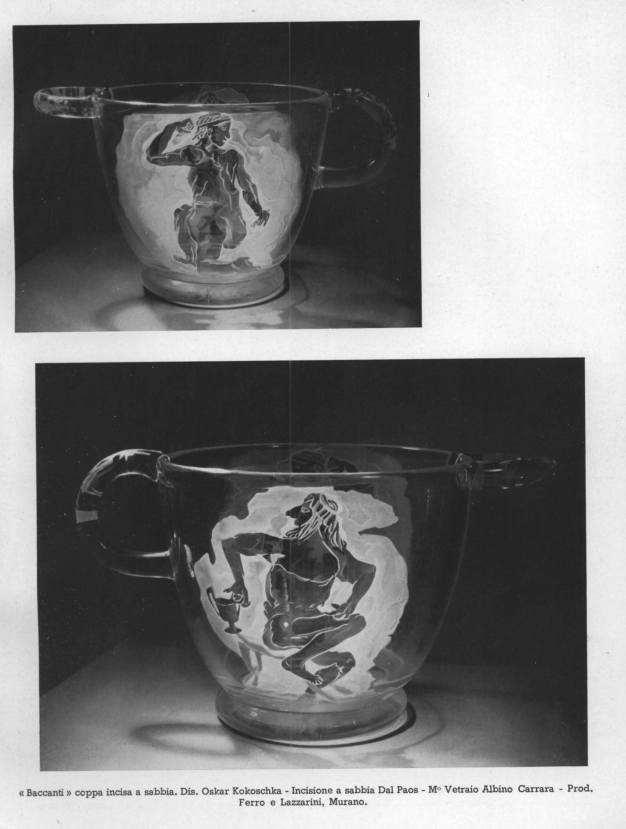
- Bacchantes (Plate 156): Designed by the Austrian expressionist painter Oskar Kokoschka. This work is a massive, hand-blown crystal bowl featuring a deep, abstract sand-engraving (incisione a sabbia) executed by the master craftsman Dal Paos and blown by Albino Carrara at Ferro e Lazzarini.
THE MODERNIST MASTERWORKS OF LE CORBUSIER, OSKAR KOKOSCHKA, & ALEXANDER CALDER (PLATES 154, 156, & 159)
Furnace: Ferro e Lazzarini, Murano
Master Blower: Albino Carrara
- PLATE 154:
- Italian: « Armonie architettoniche », vetro soffiato. Dis. Le Corbusier - M° Vetraio Albino Carrara - Prod. Ferro e Lazzarini, Murano.
- English: « Architectural Harmonies » of blown glass designed by Le Corbusier - Blown by Albino Carrara - Produced by Ferro and Lazzarini, Murano.
- PLATE 156:
- Italian: « Baccanti », coppa incisa a sabbia. Dis. Oskar Kokoschka - Incisione a sabbia Dal Paos - M° Vetraio Albino Carrara - Prod. Ferro e Lazzarini, Murano.
- English: « Bacchantes », sand engraved bowl designed by Oskar Kokoschka - Sand engraved by Dal Paos - Blown by Albino Carrara - Produced by Ferro and Lazzarini, Murano.
- PLATE 159:
- Italian: « Colomba volante », vetro soffiato. Dis. Alexander Calder - M° Vetraio Albino Carrara - Prod. Ferro e Lazzarini, Murano.
- English: « Flying dove » of blown glass designed by Alexander Calder - Blown by Albino Carrara - Produced by Ferro and Lazzarini, Murano.
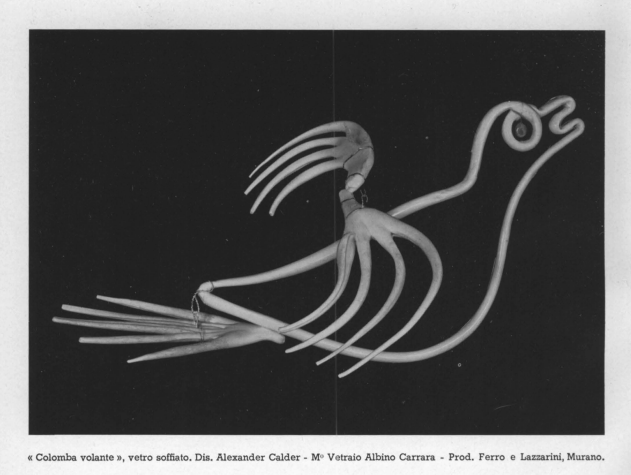
This extraordinary group highlights Albino Carrara as the principal master blower for these complex conceptual fusions. Under his hands, Le Corbusier's architectural geometry, Kokoschka's expressive sand-engraved line (carved by Dal Paos), and Calder's kinetic weightlessness were seamlessly realized in clear, hot-worked crystal and lattimo glass.
4. Gio Ponti, Bruno Saetti, and Virgilio Guidi
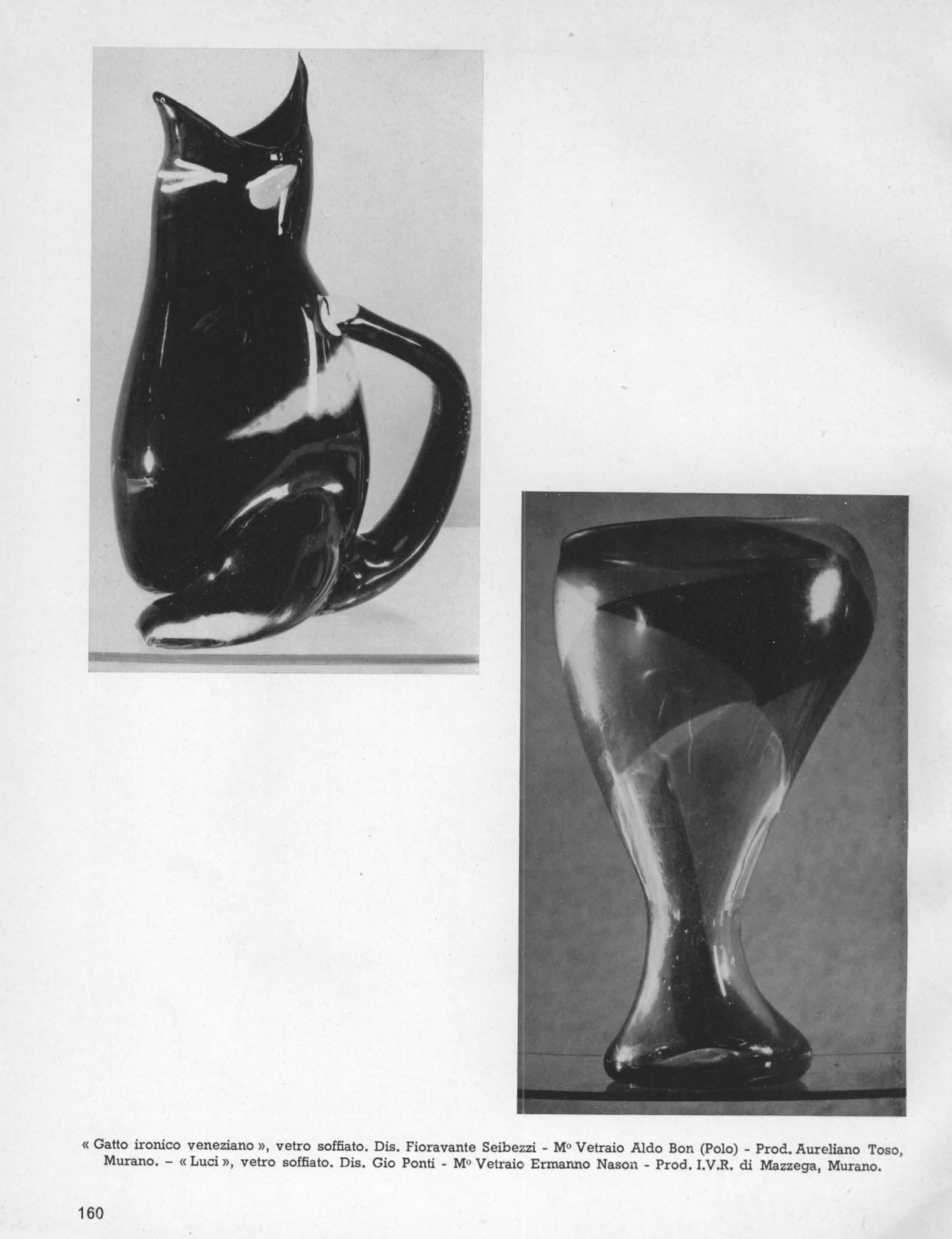
- Lights (Plate 157): Designed by the legendary Milanese architect Gio Ponti and executed by Ermanno Nason at I.V.R. di Mazzega. A highly innovative, futuristic lighting sculpture composed of intersecting colorful glass tubes and rods.
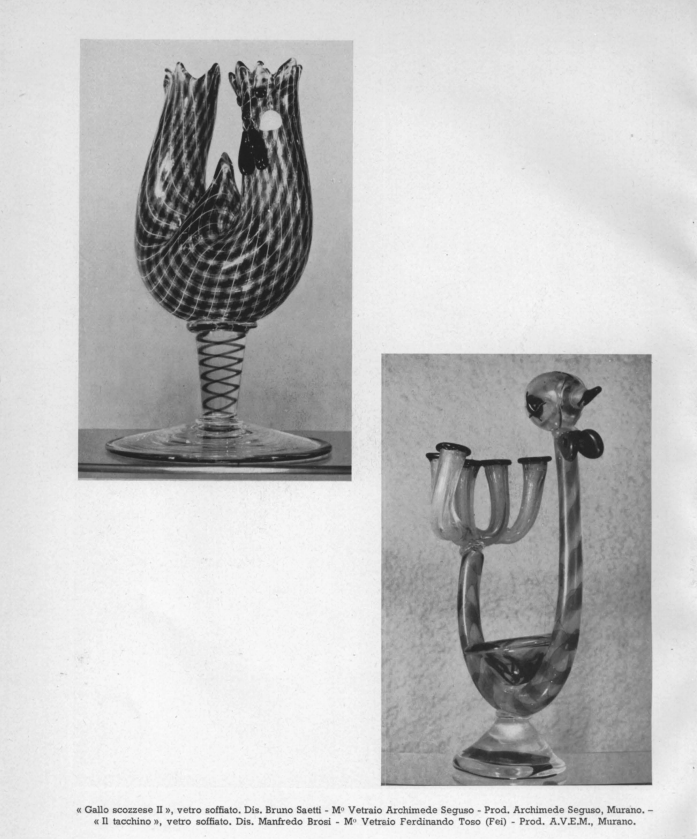
- Scotch Cock II (Plate 155): Designed by the painter Bruno Saetti and executed by Archimede Seguso. An abstract, colorful bird composition demonstrating Seguso's absolute mastery of hot-sculpted cane fusions.
- Screen (Plate 163): Designed by the Venetian painter Virgilio Guidi and executed by Albino Carrara at Ferro e Lazzarini. An abstract spatial screen of blown, multicolored glass panels designed to diffuse light in interior spaces.
THE AVANT-GARDE DESIGNS OF GIO PONTI, BRUNO SAETTI, & VIRGILIO GUIDI (PLATES 155, 157, & 163)
Furnaces: Archimede Seguso, I.V.R. di Mazzega, and Ferro e Lazzarini
- PLATE 155:
- Italian: « Gallo scozzese II », vetro soffiato. Dis. Bruno Saetti - M° Vetraio Archimede Seguso - Prod. Archimede Seguso, Murano. — « Il tacchino », vetro soffiato. Dis. Manfredo Brosi - M° Vetraio Ferdinando Toso (Fei) - Prod. A.V.E.M., Murano.
- English: « Scotch Cock II » of blown glass designed by Bruno Saetti - Blown by Archimede Seguso - Produced by Archimede Seguso, Murano. — « Turkey-cock » of blown glass designed by Manfredo Brosi - Blown by Ferdinando Toso (Fei) - Produced by A.V.E.M., Murano.
- PLATE 157:
- Italian: « Gatto iconico veneziano », vetro soffiato. Dis. Fioravante Seibezzi - M° Vetraio Aldo Bon (Polo) - Prod. Aureliano Toso, Murano. — « Luci », vetro soffiato. Dis. Gio Ponti - M° Vetraio Ermanno Nason - Prod. I.V.R. di Mazzega, Murano.
- English: « Ironic Venetian cat » of blown glass designed by Fioravante Seibezzi - Blown by Aldo Bon (Polo) - Produced by Aureliano Toso, Murano. — « Lights » blown glass piece designed by Gio Ponti - Blown by Ermanno Nason - Produced by I.V.R. di Mazzega, Murano.
- PLATE 163:
- Italian: Brocca in vetro soffiato. Dis. Aldo Bergamini - M° Vetraio Albino Carrara — « Schermo spaziale », vetro soffiato. Dis. Virgilio Guidi - M° Vetraio Albino Carrara - Prod. Ferro e Lazzarini, Murano.
- English: Blown glass jug designed by Aldo Bergamini - Blown by Albino Carrara — « Screen » of blown glass designed by Virgilio Guidi - Blown by Albino Carrara - Produced by Ferro and Lazzarini, Murano.
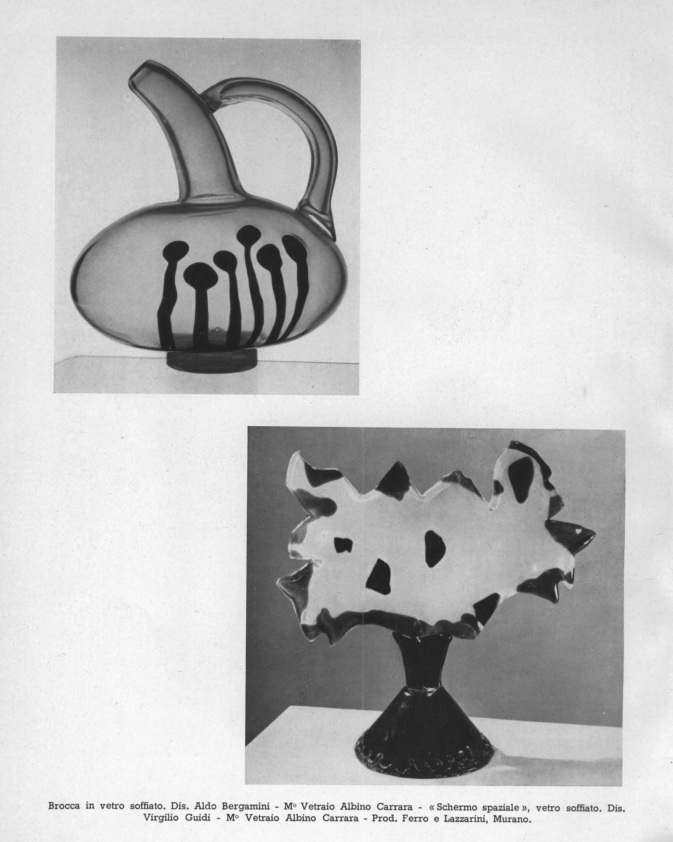
This final group celebrates the spatial and structural explorations of Italy's leading mid-century visionaries. Gio Ponti’s futuristic glass-tube lighting installation, Bruno Saetti’s abstract, highly chromatic bird composition, and Virgilio Guidi’s light-diffusing spatial screen show how these artists collaborated with Murano's elite master blowers—Archimede Seguso, Ermanno Nason, and Albino Carrara—to redefine how glass interacts with light and modern interiors.
IV. The Global Dialogue: Scandinavian and American Masters
While Murano was the undisputed capital of hot-worked, colored, and sculptural glass, the 1955 anthology documents a highly refined, international dialogue with Northern European and American design houses.
1. Tapio Wirkkala and Timo Sarpaneva (Finland)
- The Aesthetic: Working for the legendary Karhula-Iittala furnace, Tapio Wirkkala (1915–1985) and Timo Sarpaneva (1926–2006) pioneered a highly poetic, organic, and minimalist approach to glass. Inspired by the freezing landscapes, ice formations, and native flora of Finland, they designed vessels in pure, colorless crystal that featured thick, heavy bases, organic textures, and microscopic, hand-carved details.
- The Plates: Their Finnish masterworks are documented in Plates 75–76 and 99–105. These include Wirkkala's celebrated « Meduse » (Medusae) opaque crystal bowls (Plate 100) and his delicate, hand-carved crystal leaf vessels showing trapped water drops (Plate 99). Sarpaneva is represented by his monumental, opaque, asymmetrical glass vases (Plate 101) and his iconic, clear crystal vessels utilizing a revolutionary "steam-blowing" technique to create organic internal cavities (Plate 116).
2. Edvin Öhrström, Sven Palmqvist, and Nils Landberg (Sweden)
- The Aesthetic: Working for the world-renowned Orrefors Glasbruk, these Swedish masters specialized in combining pure, geometric shapes with complex, multi-layered color fusions and precise wheel-cutting.
- The Plates: Their designs are cataloged in Plates 67–70 and 92–98. Key works include Öhrström's famous « Northern Light » dark red crystal bowls (Plate 95) and his green and yellow crystal vase, « Madonna of Pacific Isles » (Plate 96). Sven Palmqvist is represented by his Ariel and Kraka vessels featuring internal, double-walled color fusions and trapped air-bubble networks (Plate 96).
3. Steuben Glass (United States)
- The Aesthetic: Representing the pinnacle of American luxury glassmaking, Steuben Glass of New York focused exclusively on utilizing a highly pure, heavy lead crystal batch that possessed an exceptionally high refractive index. Steuben vessels are defined by their absolute, water-like clarity, thick-faceted bases, and highly detailed, classical copper-wheel engravings.
- The Plates: Steuben's works are displayed in Plates 74, 84, and 135–136. These include « Susanna », a magnificent crystal vase designed by Bruce Moore featuring a delicate, wheel-engraved classical figure (Plate 74), alongside elegant, heavy-based crystal decanters and cigarette boxes (Plate 136).
V. Technical Mastery: Walkthrough of Mid-Century Murano Styles
The post-war Muranese renaissance was built upon the daring, modern re-interpretation of historical furnace techniques. Below, we systematically analyze the chemistry, furnace methods, and visual results behind the era's signature styles:
                          MID-CENTURY FURNACE STYLES
                         ============================

       [ 1. PEZZATI ]                                 [ 2. MERLETTO ]
  +---------------------------------+           +---------------------------------+
  | Multi-colored glass tiles fused |           | Suspended lace-like networks of |
  | and blown into modern shapes.   |           | microscopic white glass threads.|
  +---------------------------------+           +---------------------------------+
                  |                                             |
       [ 3. SOMMERSO ]                                [ 4. BARBARICI ]
  +---------------------------------+           +---------------------------------+
  | Thick layers of contrasting     |           | Volcanic, rough glass containing|
  | colored glass encased in crystal|           | un-melted chemical impurities.  |
  +---------------------------------+           +---------------------------------+
1. Pezzati (Patchwork Glass)
- The Technique: Designed primarily by Fulvio Bianconi for Venini, Pezzati vessels are composed of a colorful, patchwork mosaic. The process requires the master glassmaker to lay out dozens of small, pre-cut squares of colored glass (tessere) on a metal plate (marver). The tiles are carefully heated until they begin to soften; they are then rolled up onto a central blowpipe, fused under intense heat, and blown into modern, asymmetrical shapes.
- The Result: A vibrant, multi-colored patchwork garment of glass that allows light to filter through contrasting translucent squares of amber, blue, red, and green.
2. Merletto (Lace Glass)
- The Technique: Perfected and patented by Archimede Seguso, Merletto is an extraordinary evolution of Renaissance filigree. The blower uses parallel cane rods containing microscopic internal threads of white lattimo glass. During the blowing process, the hot vessel is twisted and manipulated with metal pincers in an irregular, organic manner. This breaks the rigid parallel lines of traditional filigree into flowing, floating patches.
- The Result: The surface of the glass appears to be draped in an irregular, delicate web of handmade Venetian lace, suspended within a transparent, colorful crystal wall.
3. Sommerso (Submerged Glass)
- The Technique: The signature technique of Flavio Poli for Seguso Vetri d’Arte and Gino Cenedese. The blower gathers a bubble of colored glass (such as deep amethyst or ruby red), cools it slightly, and then plunges it directly into a crucible containing a completely different color of molten glass (such as topaz or cobalt blue). The combined gather is finally encased in a thick, outer layer of exceptionally pure, colorless crystal.
- The Result: A heavy, thick-walled vessel displaying distinct, sharply defined layers of contrasting colors that float suspended inside the clear crystal, creating complex optical refractions.
4. Barbarici (Barbaric Glass)
- The Technique: Invented by Ercole Barovier, the Barbarico technique sought to mimic the volcanic, un-melted textures of ancient excavations. The hot, semi-blown glass vessel is rolled in a coarse powder of un-melted chemical oxides and metallic compounds. It is then quickly reheated at the mouth of the furnace (gloria hole) without allowing the impurities to fully melt or fuse into a smooth surface.
- The Result: A rough, heavily textured, and volcanic surface containing deep metallic sheens and un-melted inclusions, contrasting sharply with the smooth clarity of traditional crystal.
VI. The Unified Technical Study Guide and Timeline
This study guide serves as a technical and historical reference for collectors, curators, and scholars to analyze and evaluate mid-century modern glass design.
1. Glossary of Mid-Century Glassmaking Terms
- Corroso (Corrosive Glass): A technique where the surface of a finished glass vessel is treated with hydrofluoric acid fumes or liquid baths. The acid eats away the outer surface, producing a soft, translucent, and frosted texture that resembles water-worn river stones or satin fabric.
- Eldorado: A highly complex, experimental fusion designed by Dino Martens. It combines multiple pre-prepared decorative elements—including twisted zanfirico ribbons, colored glass fragments, gold leaf inclusions, and large opaque spots—into a single, highly dramatic expressionist vessel.
- Zanfirico: A Renaissance technique revived with immense vigor in the 1950s. It utilizes glass cane rods containing intricate, internal spirals of white lattimo or colored glass. These canes are aligned, fused, and twisted by the blower to create dynamic, striped patterns.
- Fazzoletto (Handkerchief Glass): A thin-blown, flared bowl pioneered by Paolo Venini and Fulvio Bianconi. The hot, thin-blown glass cylinder is held upside down on the blowpipe and spun rapidly; centrifugal force flings the edges outward, creating natural, organic folds that resemble a draped silk handkerchief frozen in mid-air.
- Lattimo (Milk Glass): An opaque white glass colored with tin oxide, utilized in the 1950s in a highly minimalist manner to create stark, sculptural figures (such as Bianconi’s Tiepolo clowns) or thin, elegant table services.
- Mazzello Sommerso: A specialized submerged technique pioneered by Flavio Poli to sculpt realistic, solid glass animal figures (such as birds and fish) containing shimmering internal silver and ruby sheens.
2. Chronological Timeline of Mid-Century Modern Glass Fusions
 1945           1948           1950           1951           1952           1954           1955
---+------------+------------+------------+------------+------------+------------+------------+---
   |            |            |            |            |            |            |            |
Post-war      Triennale     Picasso visits Archimede    Egidio       Colossal       Publication
Furnace       di Milano     Venice       Seguso         Costantini   Barbini        of Roberto
Rebuilding    Resurgence    Exhibition   patents        fuses modern chandelier     Aloi's
begins        begins        Models       *Merletto*     art & glass  awarded gold   "Esempi 11"
- 1945: Post-war reconstruction of the Murano furnaces begins. Master blowers return to the island, and family-run workshops seek to rebuild international trade.
- 1948: The VIII Triennale di Milano opens, launching the resurgence of Italian modern design. Muranese furnaces display early organic, free-form glass vessels.
- 1950: Pablo Picasso visits the Venice Biennial, sparking an intense interest among Venetian artists to fuse modern painting with traditional glassmaking.
- 1951: Archimede Seguso patents and displays his revolutionary « Merletto » (lace) glass at the IX Triennale di Milano. Flavio Poli displays his early « Sommerso » designs for Seguso Vetri d'Arte.
- 1952: Egidio Costantini establishes the Fucina degli Angeli (Forge of the Angels), formalizing the historic collaborations between modern artists (Picasso, Chagall, Braque, Calder, Le Corbusier) and Murano's master blowers.
- 1954: The X Triennale di Milano opens. Tapio Wirkkala and Timo Sarpaneva win prestigious Grand Prix awards for their Finnish glass designs, solidifying the global dominance of Nordic functionalism.
- 1955: Roberto Aloi publishes Esempi 11 - Vetri D'oggi through the Milanese house of Ulrico Hoepli, capturing the dazzling peak of the mid-century modern glass movement.
3. Collector's Diagnostic Key for Identifying Authentic 1950s Murano Glass
To evaluate mid-century modern glassware, scholars and serious collectors must utilize a rigorous diagnostic protocol based on physical and visual characteristics:
                          COLLECTOR'S DIAGNOSTIC KEY
                         ============================

       [ 1. THE PONTIL SCAR ]                         [ 2. COLOR LAYERING ]
  +---------------------------------+           +---------------------------------+
  | Look for the hand-broken pontil |           | In Sommerso pieces, verify that |
  | scar at the base of the vessel. |           | color layers are razor-sharp.   |
  +---------------------------------+           +---------------------------------+
                  |                                             |
       [ 3. CHEMICAL IRIDESCENCE ]                    [ 4. WEIGHT & DENSITY ]
  +---------------------------------+           +---------------------------------+
  | Authentic corroso should feel   |           | Sculpted massello pieces must   |
  | satiny-smooth, not rough/chalky.|           | feel incredibly dense and heavy.|
  +---------------------------------+           +---------------------------------+
Diagnostic Step 1: The Pontil Scar (Puntello)
- The Mark of Handcraft: Every authentic 1950s Murano glass piece was hand-blown or hand-sculpted. Look closely at the base. There must be a pontil mark—a rough, circular scar where the solid iron rod (pontil) was snapped off after the glass was finished.
- Ground Bases: While some modern industrial copies are completely flat and polished, authentic 1950s masterworks (especially those by Venini and Seguso Vetri d’Arte) frequently feature a pontil scar that has been lightly ground or hollowed out into a smooth, circular depression using a wheel, leaving a matte, concave ring.
Diagnostic Step 2: Color Layering and Boundaries
- Sommerso Sharpness: When evaluating a Flavio Poli or Gino Cenedese Sommerso piece, inspect the boundaries between the colored layers. In an authentic 1950s masterwork, the boundaries between the sapphire blue, amethyst, or topaz layers must be razor-sharp and perfectly defined. If the colors appear to bleed, smudge, or blend into one another, the piece is a low-quality imitation.
- Casing Thickness: Mid-century cased glass displays a highly consistent wall thickness, demonstrating the master blower's absolute control over centrifugal force.
Diagnostic Step 3: Chemical Iridescence and Acid Treatment
- Corroso Satin Finish: Authentic 1950s corroso glass must feel satiny-smooth and soft to the touch, resembling a water-worn stone. Cheap modern imitations often utilize coarse sandblasting or industrial acid sprays that leave a rough, chalky, and dry residue on the glass.
- Aventurine Distribution: In pieces containing avventurina (such as Dino Martens’ Eldorado), the copper crystals should be suspended in irregular, swirling patterns within the clear glass, showcasing a highly natural, organic distribution rather than a uniform, mechanical coating.
Diagnostic Step 4: Weight, Density, and Tool Marks
- Massello Density: Hand-sculpted massello pieces (such as Alfredo Barbini’s bisons or Gino Cenedese’s aquariums) must feel incredibly heavy, solid, and dense in the hand. There should be absolutely no hollow spaces or internal air pockets except for those intentionally designed (such as trapped bubbles).
- Pincer and Tool Marks: Look closely at the edges, ears, and fins of animal figures. Under a magnifying lens, you should be able to identify fine, microscopic tool lines left by the master blower's heavy iron shears (tagianti) and pincers (borselle). These hand-worked tool marks are the authentic "brushstrokes" of the glassmaker, confirming that the work was sculpted entirely by hand while molten.
This complete technical database and curatorial guide bridges the classical recovery of the nineteenth century with the absolute, daring modernism of the mid-twentieth century. By preserving these physical masterpieces of the past, Roberto Aloi's Esempi 11 continues to serve as an invaluable, timeless reference for scholars, curators, and collectors of modern decorative art.
Join The Group Facebook Group Leading The Way On Murano Glass Research - Murano Glass Animals