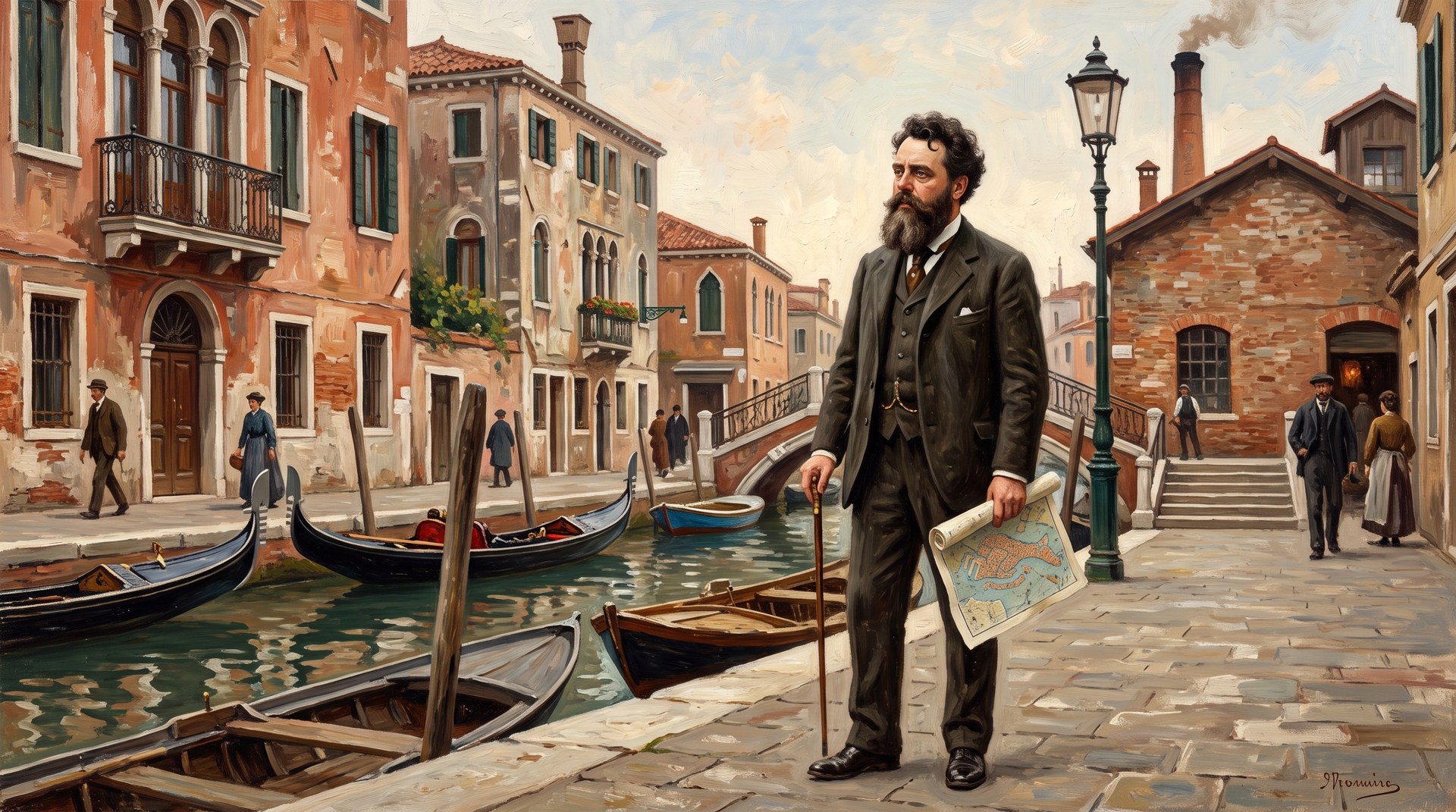
Vittorio Zecchin Murano Glass: The Ultimate Purist's Identification Guide
The Visionary Designers: A Collector's Guide
Vittorio Zecchin — The Purist of Classical Lines
Artist Key: Vittorio Zecchin
- Role: Painter / Designer / Educator (The Father of Modern Murano Minimalism)
- Life/Dates: Murano, 21 May 1878 – Venice, 1947
- Primary Furnaces/Associations: Artisti Barovier (1913–1914, Ca' Pesaro murrine) | V.S.M. Cappellin Venini & C. (Artistic Director, 1921–1925) | M.V.M. Cappellin & C. (Artistic Director, 1925–1926) | S.A.I.A.R. Ferro Toso (1930) | A.V.E.M. (1932) | Seguso Vetri d'Arte (1933–1934) | Fratelli Toso (1938) | S.A.L.I.R. (1930s, copper-wheel engraving drawings)
- Signature Techniques: Soffiati Leggerissimi (Ultra-light transparent blown glass) | Zanfirico & Filigrana | Classical painting-inspired forms (Veronese, Holbein, Tintoretto) | Polychrome mosaic murrine (interwar Ca' Pesaro era) | Fired enamel decoration
- Market Price Tier: High-End Investment Grade (specifically 1913–1914 Artisti Barovier murrine vessels, 1920s Cappellin-Venini Trasparenti, "Veronese" vases, and "Libellula" dragonfly vases)
- Key Collaborators: Teodoro Wolf-Ferrari | Giacomo Cappellin | Paolo Venini | Giovanni Seguso ("Nane Patare") | Francesco Zecchin | Napoleone Martinuzzi | Ermanno Nason (as student) | Archimede Seguso
Summary:
Discover the secrets to identifying, dating, and collecting the exquisite, feather-light glassware designed by Vittorio Zecchin, the legendary father of modern Murano minimalism. This comprehensive guide explores his transition from secessionist Ca' Pesaro paintings to his appointment as the first Artistic Director of V.S.M. Cappellin Venini & C. and M.V.M. Cappellin, detailing the physics behind his iconic Veronese and Libellula dragonfly vases. Learn how to verify authentic diagnostic markers—including feather-light glass weights, smooth fire-polished pontil scars, rare M.V.M. Cappellin acid stamps, and the Seguso 9000-series pre-war crossover models—to confidently identify his creations and spot true investment-grade masterworks on the secondary market.
⏳ Visual Career Timeline
              ┌──────────────────────────────────────────────────────────┐
              │                     VITTORIO ZECCHIN                     │
              │             - THE PURIST OF CLASSICAL LINES -            │
              └──────────────────────────┬───────────────────────────────┘
                                         │
     ┌───────┐                           ▼
     │ 1878  │ ──► Born on Murano, son of a glasswork technician; studies painting at Venice Accademia.
     └───────┘                           │
     ┌───────┐                           ▼
     │ 1913  │ ──► Ca' Pesaro Revolt: collaborates with Wolf-Ferrari and Artisti Barovier on Klimt-like murrine.
     └───────┘                           │
     ┌───────┐                           ▼
     │ 1921  │ ──► Appointed the first Artistic Director of V.S.M. Cappellin Venini & C., launching the modern reform.
     └───────┘                           │
     ┌───────┐                           ▼
     │ 1921  │ ──► Designs the iconic Veronese vase, restoring historical Renaissance lines in transparent glass.
     └───────┘                           │
     ┌───────┐                           ▼
     │ 1925  │ ──► Corporate Split: Zecchin becomes Artistic Director of Giacomo Cappellin's M.V.M. Cappellin.
     └───────┘                           │
     ┌───────┐                           ▼
     │ 1925  │ ──► Mentors young draftsman Carlo Scarpa, teaching him classical drawing and geometric form.
     └───────┘                           │
     ┌───────┐                           ▼
     │ 1926  │ ──► Departs M.V.M. Cappellin; begins freelancing, designing tapestries, ceramics, and mosaics.
     └───────┘                           │
     ┌───────┐                           ▼
     │ 1930s │ ──► Designs refined copper-wheel engravings for S.A.L.I.R. and classical soffiati for A.V.E.M.
     └───────┘                           │
     ┌───────┐                           ▼
     │ 1938  │ ──► Francesco Zecchin transfers Vittorio's drawings to Seguso Vetri d'Arte; cataloged as 9000-series.
     └───────┘                           │
     ┌───────┐                           ▼
     │ 1938  │ ──► Designs paper-thin, transparent, multi-handled "leggerissimi" goblets for Fratelli Toso.
     └───────┘                           │
     ┌───────┐                           ▼
     │ 1940s │ ──► Teaches drawing and glass technology at the Abate Zanetti Apprenticeship School in Murano.
     └───────┘                           │
     ┌───────┐                           ▼
     │ 1947  │ ──► Passes away in Venice, leaving a legacy as the primary architect of modern Murano glass.
     └───────┘
1. The Legend & Legacy: The Architect of Modern Minimalism
In the seven-century chronicle of Venetian glassmaking, Vittorio Zecchin stands as the revolutionary pivot who dragged Murano out of its fussy, nineteenth-century historicism and into the light of modern minimalism. Born in Murano on May 21, 1878, Zecchin was the son of a local glasswork technician, meaning he grew up surrounded by the intense heat and rhythmic manual speed of the furnace floor. However, his path was not that of a blower. Blessed with a refined artistic sensibility, Zecchin completed formal studies in classical painting and decoration at the Accademia di Belle Arti di Venezia, qualifying in 1901.
Zecchin's early career was defined by rebellion. He joined the avant-garde secessionist painters of the Ca' Pesaro group, who stood in fierce opposition to the conservative Venetian academic establishment. Influenced heavily by the highly decorative, Byzantine-mosaic textures of Viennese master Gustav Klimt, Zecchin sought to translate the flat, glowing geometries of modern painting directly into the medium of glass. This led to a brief, brilliant partnership with his painter friend Teodoro Wolf-Ferrari in 1913. Together, they designed a series of highly expressive, polychrome mosaic murrine glassworks which were executed at the Artisti Barovier kiln and exhibited in Munich (1913) and at the Venice Biennale (1914), representing the first genuine attempt to introduce secessionist modernism to Murano glass.
The defining moment of Zecchin's life—and of modern Murano history—came in the autumn of 1921. The visionary Venetian antiquarian Giacomo Cappellin and the young, ambitious Milanese lawyer Paolo Venini founded a new furnace called Vetri Soffiati Muranesi Cappellin Venini & C. (V.S.M.). Seeking to establish a completely sophisticated, sober aesthetic for the refined upper-middle-class of Milan, the partners appointed Vittorio Zecchin as the firm's first Artistic Director.
This appointment was unprecedented. It established the modern practice of a professional, non-blowing outside artist directing the furnace floor, stripping away the superfluous, over-decorated late-nineteenth-century virtuosities of the local masters. Zecchin demanded a courageous modern reform based on simple, classical, and perfectly symmetrical shapes. His creations won instant international acclaim at the 1923 and 1925 Monza Triennales and the Venice Biennales, establishing Zecchin as the master of transparent, monochrome glass.
When Giacomo Cappellin and paper-maker Paolo Venini suffered an acrimonious split in 1925, Zecchin remained with Cappellin as Artistic Director of the newly established Maestri Vetrai Muranesi Cappellin & C. (M.V.M.). During this transitional period, Zecchin designed beautifully draped, lightweight compotes and served as a crucial mentor to a young draftsman named Carlo Scarpa, who succeeded him as Artistic Director following Zecchin's departure in late 1926. Zecchin spent his later years freelancing for A.V.E.M. and Seguso, designing exquisite glass engraving drawings for S.A.L.I.R., and teaching drawing at the Abate Zanetti Apprenticeship School, where his students included a young Ermanno Nason. He passed away in Venice in 1947, recognized as the premier purist of modern Italian glass design.
2. The Design Philosophy of the Trasparenti (Ultra-Light Sophistication)
The launch of the Trasparenti (Transparent) series in 1921 represented a profound, paradigm-shifting departure from nineteenth-century Murano glass, which had become cluttered with heavy gold leaf, applied flowers, and historicist over-decorations. Under Zecchin’s purist direction, Vetri Soffiati Muranesi Cappellin Venini & C. introduced the concept of soffiati leggerissimi—blown vessels of such extreme lightness and delicacy that they seemed to be composed of frozen air.
Rather than inventing modern forms from scratch, Zecchin conducted an exhaustive, curatorial search through Venice’s museums and historical paintings. He recognized that the ultimate heights of glass design had already been reached during the sixteenth century. By studying the masterpieces of painters like Paolo Veronese, Hans Holbein, and Tintoretto, Zecchin resurrected classical, Renaissance silhouettes—such as balusters, pedestal bowls, and long-necked beakers—stripping away any unnecessary applied ornaments to let the pure, unadorned geometry of the line speak for itself.
Working with monochrome transparent glass of incredible clarity, Zecchin proved that the true soul of Venetian glassmaking lay not in excessive technical tricks, but in the perfect, harmonious proportion of the blown form. These vessels did not rely on physical weight or complex surface textures to command space; instead, their ethereal silhouettes captured and refracted light with a quiet, classical majesty that perfectly complemented the emerging spirit of modern Italian architecture.
3. The "Fingerprint" Masterpieces
Vittorio Zecchin's modern reform was defined by three historic, technically supreme designs in transparent, paper-thin blown glass:
- The Veronese Vase (Model 1633 CV / 5184 MVM, c. 1921): The absolute icon of modern Murano glass. Seeking a return to classical purity, Zecchin was inspired by the elegant, double-handled transparent glass vase depicted in Paolo Veronese's Renaissance masterpiece The Annunciation (c. 1580), housed in Venice's Gallerie dell'Accademia. The design is characterized by an ovoid, balloon-shaped body resting on a flared disk foot, with a neck that cinches tightly before splaying out into a clean, flat rim. The stem features a delicate, flattened ribbed knot (nodo costolato). It was executed in shades of amethyst, amber, smoke, and iridescent straw-yellow (pagliesco), becoming the celebrated trademark and logo of the Venini workshop.
- The Libellula (Dragonfly) Vase (Model 1432 CV, c. 1921): A breathtaking exercise in weightless physics. This paper-thin, transparent blown art glass features a bulbous, delicate base and an extremely long, thin neck. Its defining "fingerprint" is the presence of two disproportionately large, high-looping lateral handles made of delicate transparent glass threads that attach at the shoulder and loop high above the rim, resembling the weightless wings of a resting dragonfly. Only the absolute swiftest, most precise master glassblowers could pull these massive handles without collapsing the paper-thin body of the vase.
- The Holbein Vase (Model 1924, c. 1921–1925): Similar to the Veronese, this monochrome transparent vessel was adapted from the clean-cut, symmetrical glass vessels depicted in the Renaissance portrait paintings of Hans Holbein the Younger. It features a wide, double-bellied profile, a flared rim, and a flat-ground pontil, demonstrating Zecchin's belief that classical geometry is the ultimate form of modernism.
4. The Secret V.S.M. / Cappellin Crossover Models at Seguso
One of the most fascinating, highly guarded secrets of mid-century Murano glass is the 9000-series crossover models produced by Seguso Vetri d'Arte in the late 1930s and 1940s.
In 1932, the engineer Francesco Zecchin (Vittorio’s cousin and Paolo Venini's former administrative partner) and the celebrated sculptor Napoleone Martinuzzi withdrew from Venini & C. to establish their own independent company, Zecchin Martinuzzi Vetri Artistici e Mosaici. When this firm collapsed in 1936, Francesco Zecchin transferred all operations and their entire drawing archive to the premises of Seguso Vetri d'Arte, formally entering the Seguso company as a full administrative partner in 1938.
With Francesco Zecchin's entry, his personal archive—which contained original, hand-drawn paper blueprints designed by Vittorio Zecchin for Cappellin-Venini and M.V.M.—became the contractual property of Seguso Vetri d'Arte. Seguso made a highly selective curatorial choice, taking Vittorio Zecchin’s iconic, paper-thin transparent designs and renumbering them into a separate sequence running from Model 9000 to Model 9917.
These classic crossover models, blown directly at the Seguso furnaces by chief maestro Archimede Seguso and his brother Angelo, are highly prized by collectors for their historical hybridity:
- Model 9176 (originally Venini Model 3088): A beautiful, historicist transparent beaker vase with a splayed splay-rim, a pinched neck, and a bulbous ribbed body, ground completely flat on the pontil base.
- Model 9200: A perfectly spherical, urn-shaped transparent vase cased in clear glass, decorated with two small, vertical ribbed loop handles applied at the base of the neck.
- Model 9201: A wide, low pedestal bowl featuring a diagonal swirled optical rib pattern blown into a specialized optical mold.
- Model 9214 (originally MVM Model 2355): A tall, classical baluster vase cased in monochrome transparent glass, supported by a paper-thin applied disk foot and flared splay-rim.
- Model 9230: A wide, double-handled amphora vase in transparent glass, supported by a thin foot ring, with two high, loop-like side-applied handles.
5. Famous Collaborations
Though Vittorio designed these weightless, classical forms in his mind, they required the most swift, thermal-intuitive master glassblowers of Murano to physically blow them:
- Giovanni Seguso ("Nane Patare"): The legendary master blower of Cappellin-Venini. Nane Patare possessed the exceptional speed and breath control required to blow Zecchin's designs to their paper-thin, soot-free, and perfectly symmetrical limits, co-creating the original Veronese and Libellula vases.
- Archimede Seguso: During his early tenure at Seguso Vetri d'Arte in the 1930s, the young Archimede was the chief master who executed Zecchin's classical transparent designs, including the newly cataloged 9000-series crossover models, before the factory shifted to Poli's heavy sommerso style.
- Licio Zuffi: The elite master blower of Fratelli Toso who worked with Zecchin in 1938 to blow his delicate, paper-thin leggerissimi goblets with multi-handled stems.
6. Scholarly Context: Luigi Zecchin’s Archival Revolution
To provide collectors, curators, and historians with a complete understanding of the Zecchin name, one must link Vittorio’s artistic purification of glass with the monumental intellectual purification of his relative, Luigi Zecchin (1905–1984).
Luigi Zecchin, a brilliant mathematician and scholar, was the preeminent historian of Murano glass whose decades of research in Venetian State Archives established the factual foundation of modern glass studies. His landmark 1969 study, Un decoratore di vetri a Murano alla fine del Duecento (A Glass Decorator in Murano at the End of the Thirteenth Century), completely rewrote medieval glass history.
Before Luigi's research, historians believed that Western Europe did not know how to paint glass with fusible enamels before the 15th century, attributing all early enameled glass found in European collections to Islamic or Oriental imports. By mining the late-13th-century municipal litigation records of the Podestà di Murano, Luigi Zecchin proved that a master named Gregorio of Naples (tintor de moiolis, or painter of beakers) was operating a highly lucrative, mass-scale glass decorating workshop in Murano as early as March 31, 1280.
Luigi's mathematical analysis of a 1287 contract between Gregorio and the master glassmaker Geraldo revealed that Gregorio was hired to paint over 4,400 beakers (mozolos) at a rate of 13 grossi per hundred. Most crucially, Luigi cross-checked contemporary price lists and established that the cost of Gregorio’s enameled decoration was two and a half times the value of the raw glass vessel itself!
This archival breakthrough proved that Murano possessed a highly sophisticated, commercially dominant glass decoration and enameling industry more than two centuries earlier than previously believed, forever challenging the Near Eastern monopoly on medieval enameled glass development.
7. The Collector's Diagnostic Checklist
- Analyzing Glass Weight and Thickness: Authentic Vittorio Zecchin soffiati transparents from the 1920s are breathtakingly thin, light, and delicate. They are often described as leggerissimi (feather-light). If a vase feels heavy in the hand, has thick glass walls, or displays a clumsy, uneven rim, it is a modern tourist-factory reproduction—never an original 1920s Cappellin-Venini creation.
- The Pontil Scar Finish: Original Zecchin transparents are characterized by their immaculate finishing. The underside of the base ring must feature a tiny, perfectly smooth, circular fire-polished or ground-flat pontil scar. Modern counterfeits are betrayed by their use of rough, jagged, or poorly ground pontil scars.
- Inspecting the Handle Attachments: In authentic Libellula or double-handled vases, the attachment points where the molten glass handles fuse to the body of the vase are flawless, clean, and completely seamless. There should be no messy globs of glass, stress fractures, or trapped ash deposits at the joins.
- Color Diagnostics: Zecchin's original transparent colorways are soft, muted, and highly sophisticated. Look for his signature amethyst (ametista), warm amber (ambra), light blue (azzurino), and smoky grey (fumo). The glass matrix must be completely limpid, with no visible soot, seed bubbles, or furnace debris.
8. Market Realities & Markings Guide
- The Price Tiers:
- High-Art Investment Grade: Original 1913–1914 Ca' Pesaro-era polychrome mosaic murrine vases executed by Artisti Barovier (signed "AB" with a crown); original 1921 Libellula dragonfly vases with large looping handles; and large-scale 1920s Veronese vases in desirable amethyst or ioridized straw-yellow.
- Mid-Range: Standard-sized Cappellin-Venini Trasparenti vases; M.V.M. Cappellin footed bowls; and Seguso 9000-series crossover models from the late 1930s.
- Accessible: Small transparent cups, plates, and decanters from 1920s tableware services.
- Verifying the Markings:
- The V.S.M. Cappellin Venini Era (1921–1925): Original transparent vessels designed by Zecchin during this golden era were completely unsigned and un-stamped. The factory did not employ acid stamps, engravings, or sandblasting for markings during these founding years. Identification of these pieces relies strictly on matching their specific proportions and dimensions to the factory’s historical model registries, such as the famous Quaderno Nero (Black Book) or the Venini model records (e.g., Model 1633 or 1432).
- Fragile Paper Labels and Decals: Wares from this era originally carried fragile, rectangular paper labels reading
V.S.M. Cappellin Venini & C. / Muranoor circular paper decals with the factory splayed-foot spherical vase logo printed in red or blue ink. Because these paper stickers were easily washed off or deteriorated over time, surviving examples with intact paper labels are exceptionally rare and highly coveted. - The M.V.M. Cappellin & C. Era (1925–1926): Following the 1925 corporate split, pieces executed during Zecchin's final administrative year under Giacomo Cappellin carry a highly distinct, circular acid-etched factory stamp on the underside of the base ring reading:
M.V.M. / CAPPELLIN / MURANOarranged in concentric circles. This stamp represents a definitive, historically verified marking for his late-tenure designs. - The Seguso 9000-Series Crossover Markings (Post-1938): The Vittorio Zecchin designs renumbered by Seguso Vetri d'Arte (Models 9000 to 9917) carry the period-correct Seguso markings of the late 1930s and 1940s. Because these pieces were executed posthumously or after Zecchin's departure from Cappellin and Venini, they were never signed or authorized by Vittorio himself. Instead, collectors must look for the highly specific Seguso Vetri d'Arte showroom markings of this era:
- The Pre-War Seguso Vetri d'Arte Factory Label (1937–1945): A rectangular paper sticker reading
SEGUSO VETRI D'ARTE / Muranodivided horizontally by a thin line, beneath which the specific 9000-series model number (e.g.,9176or9214) was written in blue or black ink. - The Circular Paper Showroom Decal: Round paper stickers reading
SEGUSO VETRI D'ARTEplaced on the body or near the base. - The Antonio Seguso Signature Stamp (1937–1945): To designate high-art and exhibition-grade executions of Zecchin's designs (blown by chief maestro Archimede Seguso), the factory applied a delicate acid stamp replicating the cursive script signature of co-founding master blower
Antonio Segusoon the polished base ring. - The Two-Line Block Capital Acid Stamp (Post-1936): Many crossover pieces carry a small, horizontal two-line acid stamp on the base reading
Made in / ItalyorMADE IN ITALYin sans-serif block letters. - The Veronese Parisian Export Stamp: For crossover models exported to the French retailer Marcel Barbier in Paris, Seguso applied a combined horizontal acid-etched signature reading
Veronese Seguso MuranoorVeronese Seguso Italieon the base. - Post-War Restructuring Marks (Post-1946): For Zecchin crossover models blown in the post-war era, collectors must look for the rectangular paper label reading
SEGUSO Vetri d'Arte MURANO(introduced in 1946) or the delicate, hand-guided cursive diamond-point engraving readingSeguso Muranoon the ground base.
- The Pre-War Seguso Vetri d'Arte Factory Label (1937–1945): A rectangular paper sticker reading
- Differentiating the Reissues: Because of the immense, enduring popularity of the Veronese and Holbein vases, Venini continued to produce these models throughout the twentieth century under subsequent designers (and they continue to be produced today). An original 1920s Veronese is distinguished by its astonishing, almost weightless lightness, subtle color irregularities, a completely smooth fire-polished base ring, and the absolute absence of any acid stamp or signature. Post-war reissues carry the standard three-line linear acid stamps (
VENINI / MURANO / ITALIA) or the hand-guidedvenini italiavibro-engravings, and are constructed from significantly thicker, heavier, and more standardized modern glass batches.
9. Attribution & Authenticity
In the Murano glassmaking tradition, the difference between a fake and a copy rests entirely on intent, origin, and transparent attribution. A fake is a deceptive counterfeit manufactured outside of Murano—often in mass production factories in Asia or Eastern Europe—that utilizes cheap materials and carries forged signatures or illicit trademark stickers to intentionally defraud collectors. Conversely, a copy is a legitimate artistic homage (omaggio) handcrafted by a skilled master using authentic Murano techniques and materials; it serves as a tribute to honor a legendary artisan's legacy and is openly signed by the modern creator, preserving the lineage of Venetian glassblowing rather than exploiting it.
Join Our Facebook Group Identify Your Murano - Murano Glass Animals