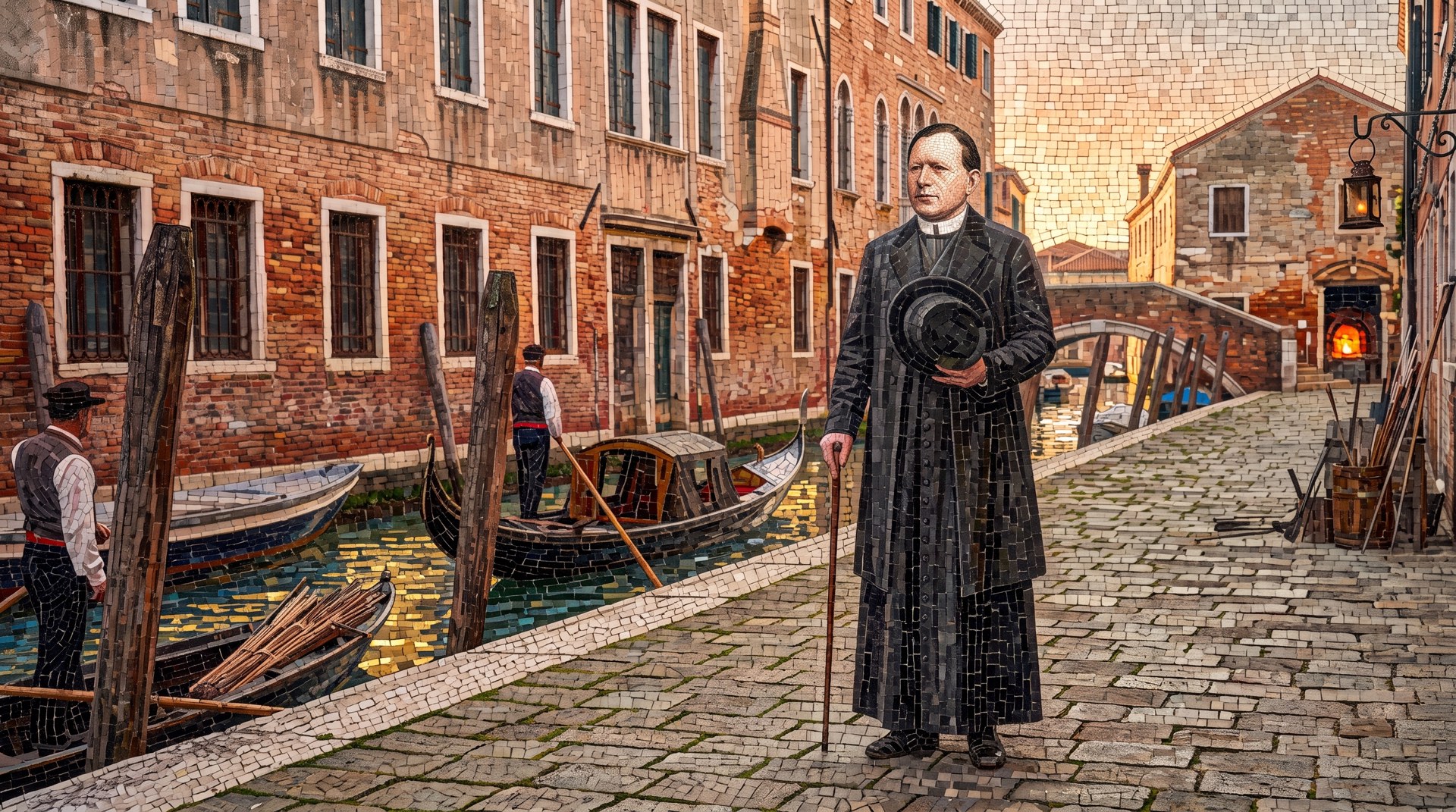
Vincenzo Zanetti and the Murano Glass Museum: The 19th-Century Renaissance
The Visionary Facilitators: A Collector's Guide
Abbot Vincenzo Zanetti — The Father of the Glass Museum
Facilitator Key: Abbot Vincenzo Zanetti
- Role: Priest / Historian / Municipal Archivist / Curator / Educator (The Intellectual Father of the Renaissance)
- Life/Dates: Murano, Italy, April 17, 1824 – Murano, Italy, December 1883
- Primary Associations: Municipal Archive of Murano (Honorary Archivist, 1861–1883) | Museo Civic-Vetrario di Murano (Founder and Honorary Director, 1861–1883) | Scuola Serale di Disegno per Vetrai "Abate Zanetti" (Founder and Chief Instructor, 1862–1883) | La Voce di Murano (Founder, Publisher, and Editor-in-Chief, 1867–1883)
- Aesthetic/Mission Focus: Anti-industrial preservationism | Civic and municipal restoration | Pedagogy of historical replication | Cataloging of ancestral alchemical formulas | Eradication of technical and design illiteracy among furnace apprentices
- Key Collaborators: Podestà (Mayor) Antonio Colleoni | Tommaso Da Luca | Francesco Tagliapietra | Abbot G. B. Gaggio | Dr. Angelo Zanetti (brother) | Augusto Castellani | Commendatore Antonio Salviati | Sir Henry Austen Layard | Sir William Richard Drake
Visual Timeline of the Civic Crusade
              ┌──────────────────────────────────────────────────────────┐
              │                 ABBOT VINCENZO ZANETTI                   │
              │         - THE INTELLECTUAL FORTRESS OF MURANO -          │
              └──────────────────────────┬───────────────────────────────┘
                                         │
     ┌───────┐                           ▼
     │ 1824  │ ──► Born on Murano into an ancient glassmaking family.
     └───────┘                           │
     ┌───────┐                           ▼
     │ 1861  │ ──► Reads "On the Institution of a Municipal Archive and Civic Glass Museum" in May.
     └───────┘                           │
     │                                   ├─► May 28: Municipal Council unanimously approves the proposal.
     │                                   └─► Appointed Honorary, Unpaid Director of the new museum.
     │                                   │
     ┌───────┐                           ▼
     │ 1862  │ ──► Founds the festive Drawing School (Scuola del Vetro) annexed to the museum.
     └───────┘                           │
     │                                   └─► Offers free Sunday drawing and geometry classes to furnace boys.
     │                                   │
     ┌───────┐                           ▼
     │ 1864  │ ──► Curates the first Murano Glass Exhibition with prize competitions to spur innovation.
     └───────┘                           │
     ┌───────┐                           ▼
     │ 1867  │ ──► Establishes the bi-weekly industrial newspaper "La Voce di Murano."
     └───────┘                           │
     │                                   └─► Wages public print wars against foreign fakes and tourist-diverting camorristi.
     │                                   │
     ┌───────┐                           ▼
     │ 1876  │ ──► Welcomes King Vittorio Emanuele II to the museum's Great Hall of Honor.
     └───────┘                           │
     ┌───────┐                           ▼
     │ 1881  │ ──► Peak Literary Zenith: Publishes "Il Museo Civic-Vetrario di Murano."
     └───────┘                           │
     │                                   └─► Frames the monograph as a manifesto for the Milan Exhibition.
     │                                   │
     ┌───────┐                           ▼
     │ 1883  │ ──► Passes away in Murano, bequeathing his entire library and personal collection to the museum.
     └───────┘
1. The Cradle of Muranese Identity: The May 1861 Proposal
In the nineteenth-century history of Venetian art, the name of Abbot Vincenzo Zanetti represents the ultimate, unyielding fortress of local preservation and cultural defense. Born on Murano in 1824 into a multi-generational lineage of glassmakers, Zanetti spent his youth witnessing a tragic, heartbreaking decline. Following the fall of the Venetian Republic to Napoleonic forces in 1797 and the subsequent Austrian occupation, the island's seven-hundred-year-old guild structures were dismantled, scattering administrative secrets, extinguishing furnaces, and leaving the once-noble Murano glassmaking industry in ruins. By the 1850s, Murano’s trade had devolved into a low-volume, self-referential world of cheap glass beads and basic utilitarian wares. Foreign competitors in Bohemia, France, and England, utilizing modern chemical methods and large-scale industrial machinery, flooded the global markets with cheap, uniform glassware, robbing Murano of its traditional trade and threatening the very survival of its craftsmen.
Zanetti arrived at a profound, revolutionary realization: if Murano’s unique heritage was swept away by the tide of modern mass production, the cultural identity of the lagoon would perish with it. To halt this decline and prepare a true, lasting renaissance, the island had to look back to its own history. In May 1861, Abbot Vincenzo Zanetti read a passionate, deeply reasoned, and highly historic proposal before the Municipal Council of Murano, entitled On the Institution of a Municipal Archive and a Civic Glass Museum on the Island of Murano (Dell'Istituzione di un Archivio Comunale e di un Museo dell'Isola di Murano). Zanetti argued that the island’s ancient legal and artistic heritage was currently scattered, neglected, and exposed to grave danger. Foreign dealers and collectors, recognizing the severe economic crisis on the island, were systematically purchasing rare family glass heirlooms, ancient guild records (mariegole), and ducal decrees, carrying them away to enrich foreign museums and private collections.
Zanetti proposed the immediate establishment of a centralized public safe-haven within the Municipal Palace of Murano (Palazzo Giustinian). By gathering these scattered treasures under municipal guardianship, the island would secure its history, prevent the further dispersion of its heritage, and provide its contemporary artisans with a physical, technical library of form and technique. On May 28, 1861, under the leadership of Mayor (Podestà) Antonio Colleoni, the Municipal Council passed a unanimous, historic resolution accepting the proposal. The council formally allocated the eastern galleries of the palace to house the new collections and appointed Abbot Vincenzo Zanetti as the honorary, completely unpaid Director of the Civic Glass Museum, granting him full administrative authority to curate, catalog, and develop the collections.
2. Pedagogy of the Hot Bench: The Festive Drawing School (1862)
For Abbot Vincenzo Zanetti, the newly established Glass Museum was not a static, silent graveyard of the past intended only for the curious traveler or tourist. It was an active, living "academic laboratory" designed for the application of art to industry. Zanetti understood that "design is the essential mortar that binds artistic form to industrial utility." Bypassing modern industrial templates, he believed that the renaissance of Muranese glass could succeed only by training the artisan's hand and eye to replicate the elegant, weightless curves of their ancestors' work.
To realize this educational vision, Zanetti founded and formally annexed the festive Drawing School (Scuola di Disegno per Vetrai "Abate Zanetti") to the museum in 1862. The school was academically structured but tailored specifically to the difficult, physical realities of furnace labor. Operating entirely on Sundays and festive holidays so as not to disrupt the apprentices' daily work schedules, the school provided free, systematic instruction to young furnace boys in geometric proportion, classical design, and decorative harmony.
Under the dedicated, hands-on instruction of masters like Bernardo Toso and Isidoro Seguso, the students did not draw from modern commercial catalogs. Instead, they studied and copied historical glass models directly from the museum's galleries. Furthermore, Zanetti financed the acquisition of professional gypsum reproductions of the great classical sculptural works of the past from the Gipsoteca in Florence. The young apprentices were instructed to study and draw these physical plaster human forms, learning the laws of organic symmetry and muscle structure. This training was directly designed to teach the students how to design and shape the human body in glowing, incandescent glass at the active furnace mouth.
To incentivize the students during the rigorous school year, the leading furnaces of the island agreed to let their employees attend classes during paid working hours. At the end of each school year, the best glassmasters on Murano would physically execute the students’ most convincing designs in glass, transforming paper blueprints into three-dimensional masterpieces. Under Zanetti's leadership, the school became the prime engine of the nineteenth-century revival, turning illiterate furnace boys into elite, culturally literate artist-craftsmen.
3. The Voice of the Island: La Voce di Murano
To complement his museum and school, Zanetti recognized that the modern Murano renaissance required a public, highly defensive, and commercially aggressive mouthpiece. In 1867, he founded, published, and edited the fortnightly industrial newspaper, La Voce di Murano (The Voice of Murano). The paper served as a primary cultural and commercial journal for the island, reflecting the technical achievements, labor organization debates, and aesthetic priorities of Murano's middle class and intellectuals.
La Voce di Murano was fiercely polemical and acted as a protective shield for the local glass industry. Zanetti used its pages to wage public wars on multiple fronts:
- The War Against Counterfeits: Zanetti exposed the influx of foreign glass counterfeits, particularly cheap "Venetian" historicist glass manufactured in Bohemia and sold in Venice as original Murano wares.
- The Campaign Against the "Battitori": The paper relentlessly attacked the local system of battitori (shady, unregulated tour guides and middlemen). These individuals approached tourists in Venice’s squares and hotels, directing them to complicit showrooms on Murano in exchange for a massive cut of the sales, causing severe economic damage to the independent, high-art furnaces.
- The Promotion of the Maestri: Simultaneously, the paper celebrated the manual triumphs of local glassmasters, detailing new technical recoveries in the industrial sector, documenting labor disputes, and advocating for full employment. Through La Voce, Zanetti kept the global spotlight locked on the artistic and technical supremacy of Murano, ensuring that the local craft was never commoditized.
4. The Architectural Sanctuary & Gallery Walkthrough
To house his intellectual and artistic fortress, Zanetti selected a building that was itself a monument to Venetian history. The Palazzo Giustinian (historically Palazzo Marco Giustiniani) was originally a magnificent fifteenth-century Gothic palace. Restored in the seventeenth century, the building was erected as an episcopio (the majestic seat of the Bishop of Torcello) in 1689 by Bishop Marco Giustiniani, before being converted into the Murano Town Hall and Municipal Palace in the nineteenth century.
Upon ascending the palace's grand stone staircase, visitors entered the colossal Great Hall of Honor (Sala di Rappresentanza), a room of breathtaking artistic majesty. The hall’s ceiling is dominated by a grand, eighteenth-century fresco painted by Francesco Zugno with decorative perspective framing by Zanchi (both celebrated disciples of Giambattista Tiepolo), depicting the Apotheosis of Saint Lorenzo Giustinian, the first Patriarch of Venice. The walls are decorated with monumental commemorative plaques, including one celebrating King Vittorio Emanuele II’s visit on November 12, 1876, alongside stunning mosaic portraits of the King and Dante Alighieri.
Suspended from the center of the Zugno ceiling hangs the ultimate physical symbol of nineteenth-century Murano glass engineering: a colossal crystal chandelier containing 60 branches, standing 4.0 meters high and weighing a massive 330 kilograms. Crafted in 1854 by master glassmaker Giorgio Barbini utilizing a highly complex, brilliantly clear glass paste formulated by the chemist-technician Isidoro Barbon, this monumental chandelier is composed of 356 individual pieces of pure, hand-blown crystal. Incredibly, the chandelier contains absolutely no structural metal components except for its central iron support screw, utilizing self-supporting, single-piece branches that interlock to bear the extreme weight. It was awarded the Gold Medal of Honor at the first Murano Glass Exhibition of 1864 and remains an immortal testament to Muranese manual virtuosity.
Beyond the Great Hall, Zanetti's room-by-room curatorial tour was designed to show the historical progression of glass:
- Stanza I (The Ancient Foundations): Housed the museum’s extensive archaeological collections, including a magnificent 781-piece ancient Roman glass collection donated by the Roman antiquarian Augusto Castellani.
- Stanza II & IV (The Medieval & Renaissance Treasures): Preserved the rare, surviving monuments of Murano's golden age, including the celebrated blue-enameled Barovier Wedding Cup (Coppa Barovier, c. 1450) and a massive, sumptuous eighteenth-century sectional centerpiece reproducing a formal Italian garden in miniature blown glass.
- Stanza III (The Modern Revivals): Showcased the contemporary masterpieces of the nineteenth-century revival, including the delicate, lightweight transparent blown glass and mosaics executed by Antonio Salviati’s Venice and Murano Glass Company.
5. The Intellectual Fortress: Library & Guild Archives
For Abbot Vincenzo Zanetti, the Glass Museum’s specialized library and archives were not merely dusty repositories of the past; they were the active, central "intellectual engine" of the modern glass renaissance. He recognized that by consulting ancient legal and chemical documents, the modern manufacturer, chemist, and artist could find the exact formulas and artistic inspiration needed to lead Murano into the future.
The archive's most precious holdings included the original mariegole (the historic guild statutes) of the Muranese glassmakers, mirror-makers, beadmakers (conterie), and glass painters. These medieval and Renaissance legal documents preserved the strict codes of labor, the noble marriage privileges of the Libro d'Oro (Golden Book) families, and the severe Council of Ten secrecy decrees that had protected Murano's monopoly for centuries.
Alongside the legal codes, the library preserved Europe's earliest published scientific and chemical treatises on glass metallurgy, which Zanetti used to train contemporary glassblowers in the science of their materials:
- Antonio Neri’s L'Arte Vetraria (1612): The legendary chemical manual written by the Florentine priest and alchemist, detailing the exact metallic oxides needed to produce copper-red, cobalt-blue, and pure, purified cristallo.
- Christopher Merret’s Annotations (1662): The rare English edition containing Merret's extensive notes on coal-fired furnace chemistry and the development of heavy lead glass.
- Vannoccio Biringuccio’s Pyrotechnia (1540) & Georgius Agricola’s De Re Metallica (1556): Classical treatises documenting the engineering of high-temperature wood-fired furnaces, the purification of marine ashes (soda), and the metallurgy of crucibles.
6. The Milan Exhibition of 1881: The Monograph as a Manifesto
In the summer of 1881, the city of Milan hosted the grand National Industrial Exhibition, designed to showcase the industrial and artistic awakening of the newly unified Kingdom of Italy. For Abbot Vincenzo Zanetti, this exhibition was the ultimate stage to prove to the world that Murano had successfully reclaimed its historical crown. \n\nTo accompany the magnificent displays sent by Murano’s leading furnaces (including the Venice and Murano Glass and Mosaic Company), Zanetti published his monumental monograph, Il Museo Civic-Vetrario di Murano, printed in Venice by Gaetano Longo in March 1881. This document was far more than a simple curatorial catalog; it was a defiant industrial manifesto. Written as an official address to the exhibition's jury, the monograph tracked the history, the technical recoveries, and the educational achievements of the island.
Zanetti used the volume to argue that the festive Drawing School and the Glass Museum had succeeded in training a new, brilliant generation of young artisans. He declared that the magnificent modern displays in Milan proved beyond any doubt that Murano's contemporary workshops had not only equaled, but in some instances surpassed, the artistic heights achieved during the Golden Age of the Renaissance. The monograph cemented the triumph of the Muranese renaissance, positioning traditional manual labor as a superior force capable of defeating modern machine industrialism.
7. The Collector's Diagnostic Checklist: Zanetti-Era Glass
To confidently identify, date, and value original glass objects produced during the nineteenth-century Zanetti revival period (c. 1860–1885), collectors must utilize the following diagnostic criteria:
- Verifying Lightweight Soda-Lime Glass: Unlike heavy, cold-carved lead crystal produced in Bohemia or England during the nineteenth century, authentic Zanetti-era Murano glass is extraordinarily light, warm to the touch, and thin-walled. It is blown using traditional, sodium-based soda-lime glass, which allows the blower to pull paper-thin, delicate curves.
- Inspecting for Manual Irregularities: Authentic revival glass is handcrafted entirely without modern machine molds. The vessel must exhibit microscopic manual irregularities—including tiny, elongated air bubbles (seed), slight variations in wall thickness, and subtle asymmetry along the splayed rims.
- Analyzing the Pontil Scar: The base of any authentic Zanetti-era blown vessel must show a cleanly snapped, fire-polished, or meticulously ground pontil scar. Modern counterfeits often utilize uniform, machine-cut bases that lack this manual, physical connection to the blowpipe.
- Identifying Historical Techniques: Wares of this period are defined by a faithful, highly technical replication of classical Renaissance styles. Look for complex, hand-worked fusions of zanfirico (twisted filigree threads), cased calcedonio (chalcedony glass simulating natural hard-stones), and delicate smalto (hot-applied enamel painting) depicting stylized Renaissance figures.
8. The Passing of the Abbot (1883)
Following a lifetime of tireless civic labor, Abbot Vincenzo Zanetti passed away almost suddenly on December 1883, on his beloved island of Murano. He had spent his entire personal fortune and ecclesiastical stipend on the museum, leaving behind no personal wealth.
However, in his final will, he executed one last, monumental act of civic generosity: he bequeathed his entire personal library, his rare collections of gold and silver Venice-Murano oselle coins (which had been issued by the Magnifica Comunità di Murano since 1521), and his private glass holdings directly to the Glass Museum. Today, his portrait hangs in the Great Hall of Honor, and his name is immortalized on the island's premier school of glass design, recognized as the brilliant priest-scholar who rescued the art of Murano from the ashes of history.
Join Our Facebook Group Identify Your Murano - Murano Glass Animals