Toso Dynasty — Masters of Murrina, Filigree, and the Great Cooperatives
The Toso Dynasty — Masters of Murrina, Filigree, and the Great Cooperatives
Dynasty Key: The Toso Dynasty
- Active Dynasty Window: 1854–Present (documented glassmaking and furnace ownership on Murano across five generations)
- Ancestral Seat & Primary Kilns: Fondamenta Colleoni 7, Murano (former Scuola Grande di San Giovanni dei Battuti) | Fondamenta Vetrai (Vetri Decorativi Rag. Aureliano Toso, 1938–1968)
- Hereditary Master Gaffers & Directors: Pietro Toso (1798–1862) | Angelo Toso (1823–1892) | Carlo Francesco Nicolò Toso (1831–1881) | Ferdinando Toso (1830–1902) | Giovanni Toso (1826–1888) | Gregorio Toso (1835–1897) | Liberato Toso (1837–1890) | Nicolò Toso (d. 1915) | Lorenzo Toso "Teto" (1867–1940) | Arnoldo Toso "Roldo" (1866–1938) | Archimede Toso | Ermanno Toso (1903–1973) | Michele Toso (1902–1946) | Aldo Toso | Licio Zuffi (1921–1973) | Giusto Toso (b. 1939) | Renato Toso (b. 1940) | Rosanna Toso (1941–2011) | Arnoldo Toso (1939–2017) | Caterina Toso
- Signature Technical & Material Inventions: Nerox / Nero Ossidato (Oxidized Black Metallic Surface, 1948–1950) | Stellato (Star-Burst Murrine, 1950–1954) | Cattedrale (Layered Geometric Murrine, 1952–1956) | Kiku (Chrysanthemum Petal Murrine, 1956–1958) | Farfalle and Redentore (Polychrome Micro-Mosaic Casing, 1955–1962) | Spinati, Spirali & Contrasto (Twisted Linear Canes, 1972–1979) | Venetian Liberty Murrine (Hans Stoltenberg-Lerche collaborations, 1911–1920) | Signature FT Murrina (1950s–1960s)
- Market Price Tier: High-End Investment Grade (specifically 1911–1920 Hans Stoltenberg-Lerche and Umberto Bellotto Art Nouveau murrine vessels, 1950s Pollio Perelda Stellato, Cattedrale, and Nerox vases, and 1950s Commedia dell'arte figurines) to Mid-Range (1960s Rosanna Toso Spirali vessels, Robert Willson collaborations, and mid-century Millefiori bowls)
- Key Collaborators: Hans Stoltenberg-Lerche | Umberto Bellotto | Pollio Perelda | Licio Zuffi | Robert Willson | Eugene Berman | Giusto Toso | Renato Toso | Rosanna Toso
Summary:
Explore the magnificent five generation history and mosaic glass innovations of Fratelli Toso, one of Murano's foundational glassmaking dynasties since 1854. This comprehensive collector's guide details their 19th-century revival under Pietro Toso, Art Nouveau collaborations with Hans Stoltenberg-Lerche and Umberto Bellotto, and the mid-century modern revolution spearheaded by Ermanno Toso and Pollio Perelda. Learn how to verify authentic diagnostic markers—including Stellato and Cattedrale murrine, metallic Nerox surface finishes, paper factory decals, and crucial distinction guidelines between Fratelli Toso and Aureliano Toso—to navigate the international art market with absolute curatorial confidence.
Genealogical Lineage Map
┌────────────────────────────────────────────────────────────────────────┐
│                         THE TOSO DYNASTY                               │
│                   - ANCESTRY & GENEALOGICAL DESCENT -                  │
└───────────────────────────────────┬────────────────────────────────────┘
                                    │
                                 Pietro
                               (1798–1862)
                       (Founder of S. Giovanni Kiln)
                                    │
     ┌──────────┬──────────┬────────┼──────────┬──────────┐
     │          │          │        │          │          │
   Angelo     Carlo    Ferdinando Giovanni  Gregorio   Liberato
 (1854 Founder Cohort - Reclaimed Renaissance Murrine & Filigree)
                            │
            ┌───────────────┴───────────────┐
            │                               │
          Nicolò                         Lorenzo
       (1901 Reorg)                     "Teto"
            │                        (1901 Director)
            │                               │
     ┌──────┴──────┐                 ┌──────┴──────┐
     │             │                 │             │
  Arnoldo       Michele           Ermanno       Giusto
 "Roldo"      (SVDA Co)        (1903–1973)   (Designer)
                            (Artistic Director)
                                     │
                    ┌────────────────┼────────────────┐
                    │                │                │
                 Giusto           Renato           Rosanna
             (Leucos Co)       (Leucos Co)     (1973 Director)
                    │                │
             [1980 Split into Fratelli Toso 1854 International
                  & Antica Vetreria Fratelli Toso]
                                     │
                             Arnoldo & Caterina
                        (Archival Reacquisition, 2000s)
1. The 1854 Foundations & Nineteenth-Century Revival
The history of the Toso family represents one of the most resilient, structurally organized, and technically influential sagas in Venetian glassmaking. Unlike dynasties built around the solitary charisma of a single master craftsman, the Toso legacy was forged through a formidable collective structure: a hereditary family cooperative capable of organizing dozens of specialized craftsmen, furnace technicians, and color chemists under unified direction.
The family's modern manufacturing history began in the wake of the Austrian occupation, an era during which Murano's traditional furnace industry had suffered devastating economic decline. In 1854, Pietro Toso (1798–1862), a veteran Muranese glass artisan who had manufactured pharmaceutical bottles and utilitarian wares, rallied his six sons—Angelo (1823–1892), Carlo Francesco Nicolò (1831–1881), Ferdinando (1830–1902), Giovanni (1826–1888), Gregorio (1835–1897), and Liberato (1837–1890)—to establish an independent glassworks. Trading initially under the name Pietro Toso all'insegna di S. Giovanni, the family secured the historic premises at Fondamenta Colleoni 7, the former site of the Renaissance Scuola Grande di San Giovanni dei Battuti.
Gregorio Toso assumed administrative leadership as the firm's first Managing Director (1854–1897), while Carlo Francesco Nicolò Toso took charge of artistic design and pattern composition until 1881. The brothers recognized that restoring Murano's global prominence required recovering the complex hot-glass techniques of the XV and XVI centuries, particularly filigrana, reticello, zanfirico, and multi-colored mosaic glass (murrine).
A pivotal breakthrough occurred at the landmark 1864 Murano Glass Exposition—the first competitive exhibition organized by municipal historian Abbot Vincenzo Zanetti and the newly founded Glass Museum. While the museum's Great Hall ceiling featured the famous 1854 60 branch crystal chandelier constructed by Giorgio Barbini and technician Isidoro Barbon, the Fratelli Toso furnace presented its own monumental blown crystal chandelier executed by master glassblower Giovanni Toso with the technical collaboration of Lorenzo Santi, Giovanni Barovier, and Giovanni Fuga. Decorated with delicate polychrome floral applications and filigree sleeves, Fratelli Toso's chandelier earned the furnace the Gold Medal from the Italian Ministry of Industry and Commerce.
When Dr. Antonio Salviati organized the Venice and Murano Glass and Mosaic Company in 1866, the Toso brothers maintained close technical relations with the new enterprise while preserving their own manufacturing autonomy at Fondamenta Colleoni. Throughout the 1870s and 1880s, Fratelli Toso became the primary producer of complex millefiori (thousand flowers) vessels, revived Renaissance filigree goblets, and elaborate ecclesiastical lighting fixtures for the global export market. Upon Gregorio's passing in 1897, his brother Ferdinando Toso assumed direction of the firm, preparing the way for the second generation.
2. Turn-of-the-Century Modernism & Art Nouveau Collaborations (1901–1936)
As the nineteenth century drew to a close, the second generation of the Toso family recognized the necessity of evolving beyond historicist replication toward the emerging international languages of Art Nouveau and Jugendstil. On October 12, 1901, the surviving family members formally reorganized the enterprise as a joint-stock corporation under the title Vetreria Artistica Fratelli Toso (also trading as Antica Vetreria Fratelli Toso).
Management passed to Lorenzo Toso (1867–1940), universally known within the lagoon as "Teto," who served as Managing Director jointly with his cousin Nicolò Toso (d. 1915). Lorenzo Teto Toso introduced an enlightened policy of opening the traditional furnace floor to avant-garde foreign sculptors, Venetian painters, and decorative artists. Following Nicolò's passing in 1915, Lorenzo Teto Toso continued as sole Managing Director until 1924, when his nephew Archimede Toso (grandson of co-founder Giovanni Toso) assumed the post (1924–1936).
The most decisive collaboration of this early modernist era occurred between 1911 and 1920 with the Norwegian painter and sculptor Hans Stoltenberg-Lerche (1867–1920). Working directly alongside master blowers Vittorio Toso ("Bognolo") and his team at Fondamenta Colleoni, Stoltenberg-Lerche used Fratelli Toso's rich mosaic cane inventories to create organic, fluid vessels that integrated distorted murrine with hand-modeled bronze, silver, and iron mounts. These vessels featured heavy, asymmetrical bodies where iridized glass surfaces were fused with abstract floral cross-sections, marking a total departure from traditional Venetian symmetry and winning critical acclaim at the 1912 and 1914 Venice Biennales.
Concurrently, Fratelli Toso established a prolific partnership with the celebrated Venetian ironworker and designer Umberto Bellotto (1882–1940). Beginning at the IX Venice Biennale in 1914, Bellotto designed a series of groundbreaking hybrid objects in which thick-walled, polychrome murrine glass vessels blown by Fratelli Toso were hot-fitted and clamped directly into wrought-iron cages and geometric stands.
When World War I threatened the Venetian lagoon in 1915, the Italian military command ordered the evacuation of Murano's essential glass inventories and skilled personnel. Fratelli Toso temporarily relocated its furnace operations to Livorno and subsequently to Naples. Despite these hardships, Lorenzo Teto Toso maintained the workforce intact, returning to Fondamenta Colleoni in 1919 to rebuild the kilns and resume production for the 1920s Venice Biennales.
3. Ermanno Toso & The Mid-Century Murrina Revolution (1936–1960)
The golden age of Fratelli Toso’s twentieth-century production opened in 1936 with a comprehensive corporate restructuring. The enterprise reorganized as a limited partnership under the name Vetreria Fratelli Toso S.a.s., with Ermanno Toso (1903–1973) appointed as Artistic Director and his cousin Michele Toso (1902–1946) managing commercial distribution. Following Michele's early death in 1946, his brother Aldo Toso (1909–1999) took his place as Co-Managing Director alongside Ermanno.
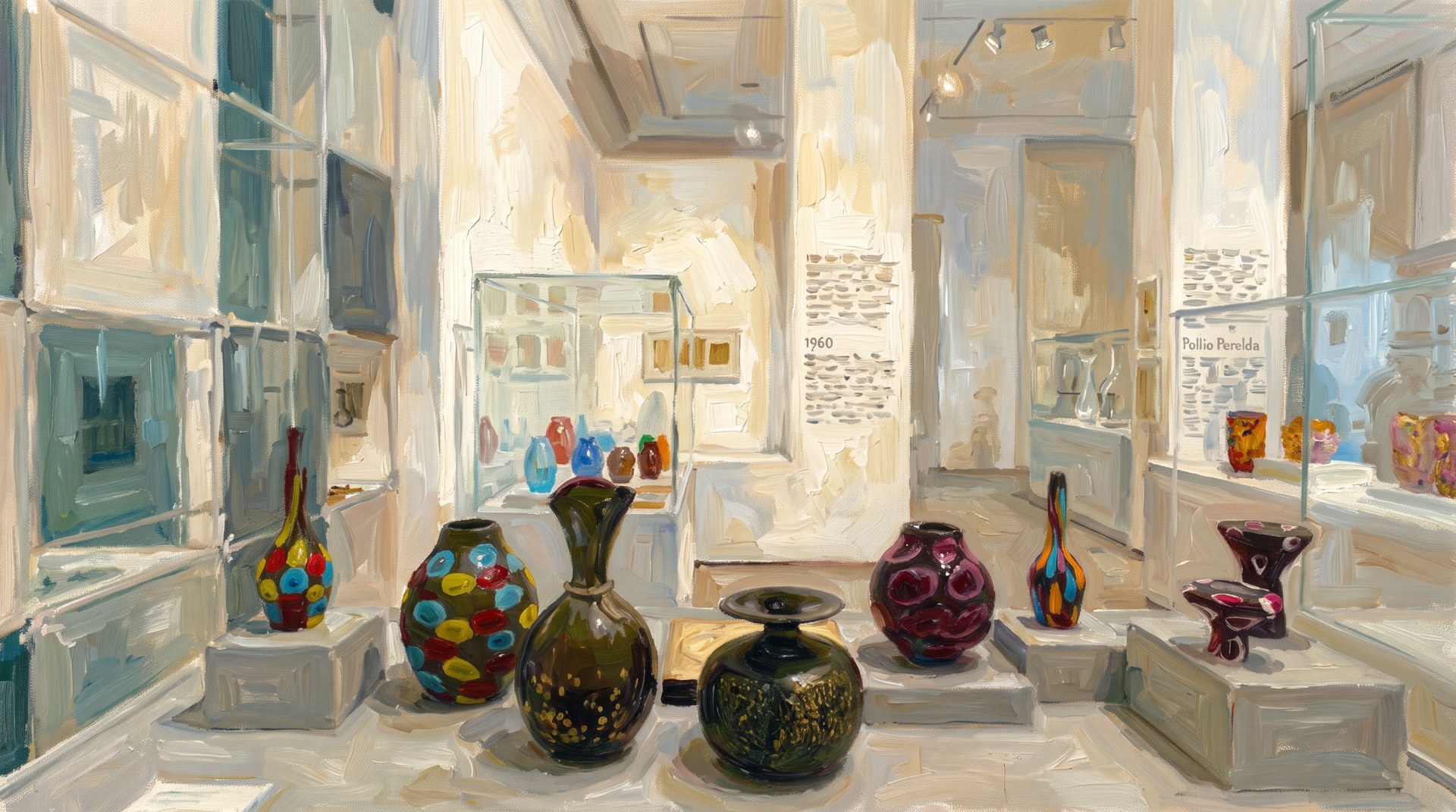
Ermanno Toso possessed a visionary understanding of the graphic and optical potential of murrine (cross-sectional glass canes). Rather than using murrine as decorative surface elements, Ermanno treated them as structural building blocks for abstract, mid-century modern art glass. To realize his ambitious geometric concepts, Ermanno forged a historic creative partnership in 1948 with the Venetian painter Pollio Perelda (1915–1984), who served as senior staff designer at Fratelli Toso until 1964.
Working in total synergy with chief master blower Licio Zuffi (1921–1973, great-grandson of co-founder Ferdinando Toso) and senior gaffers Armando Zuffi, Vittorio Ferro, and Umberto Moretti, Ermanno Toso and Pollio Perelda created several of the most iconic glass collections of the post-war era:
- Vetro Nerox / Nero Ossidato (1948–1950): Derived from the Crespi technique, this dramatic material innovation utilized an opaque, dense black glass batch treated at hot furnace temperatures with metallic reduction fumes and sulfur compounds. This produced a velvety, frosted, micro-iridescent metallic skin that absorbed light, providing a stark contrast when combined with bright polychrome murrine elements (Nerox a chiazze).
- The Stellato (Star-Burst) Series (1950–1954): Complex vessels constructed by meticulously arranging thousands of star-shaped, multi-layered lattimo and cobalt cane cross-sections on a flat refractory plate. When gathered and blown by Licio Zuffi, these canes expanded into vibrant, exploding optical grids suspended inside crystal walls.
- The Cattedrale (Cathedral) Series (1952–1956): Architectural, heavy-walled vessels composed of large, square and rectangular geometric murrine with dark amethyst and amber borders, evoking the stained-glass leaded windows of Gothic cathedrals.
- The Kiku (Chrysanthemum) Collection (1956–1958): Fine, floral-patterned vessels created using micro-canes with delicate, radiated petal cross-sections, generating a soft, organic tapestry of colors.
- Redentore and Farfalle (1955–1962): Dynamic, sweeping compositions where irregular, ribbon-like zanfirico cane fragments were fused adjacent to dense clusters of polychrome murrine, creating shimmering wave patterns across asymmetric vase forms.
- Commedia dell'Arte Figurines: A celebrated series of hot-modeled, stylized carnival figures—including Arlecchino, Pulcinella, and Pantalone—crafted from dense massiccio glass clad in vibrant patchwork (pezzato) and murrine costumes.
- The Robert Willson Collaborations (1959–1972): Between 1959 and 1972, the prominent American sculptor Robert Willson (1912–2000) executed a series of unique, hand-modeled glass totems and abstract sculptures at Fratelli Toso, working directly in tandem at the furnace bench with master blower Licio Zuffi.
These mid-century masterpieces captured critical acclaim at successive Triennali di Milano and Venice Biennales, cementing Fratelli Toso's reputation as the supreme masters of 20th-century mosaic glass.
4. Architectural Avant-Garde, Final Divisions & Brand Return (1960s–Present)
By the mid-1960s, a third generation of the Toso family entered the furnace floor, bringing fresh perspectives derived from modern industrial design and architecture. Ermanno's sons, Giusto Toso (b. 1939) and Renato Toso (b. 1940), alongside their sister Rosanna Toso (1941–2011), initiated a series of avant-garde lighting and sculptural experiments.
In 1962, Giusto and Renato Toso, in collaboration with fellow designers, established Leucos in Scorzè, an independent lighting company that revolutionized architectural illumination by fusing Muranese hand-blown glass diffusers with modern industrial metal fixtures. Despite their involvement with Leucos, the siblings continued to contribute groundbreaking designs to the family's core glassworks at Fondamenta Colleoni.
Following Ermanno Toso’s passing in September 1973, Rosanna Toso was appointed Artistic Director of Vetreria Fratelli Toso. Rosanna introduced a refined, minimalist design aesthetic that highlighted line division and monochrome optics:
- The Spirali and Contrasto Collections (1972–1979): Striking, sculptural blown glass decorated with dense, thread-like parallel white or black spiral canes (zanfirico) that traced the flowing contours of asymmetric forms, departing from dense polychrome murrine.
By the late 1970s, economic pressures, rising fuel costs, and differing strategic visions among the numerous family shareholders led to structural changes. In 1979–1980, the historic firm divided into two separate commercial entities:
- Fratelli Toso 1854 International S.r.l.: Founded in November 1980 by Aldo Toso, his son Michele, and cousins Massimo and Ugo Zuffi, focusing on commercial showrooms and lighting (liquidated in 1982).
- Antica Vetreria Fratelli Toso S.n.c.: Founded in December 1980 by Arnoldo Toso (1939–2017) and his sister Rosanna Toso, preserving the ancestral kilns at Fondamenta Colleoni 7, the historic archive of over 20,000 drawings and photographs, and the production of limited-edition traditional murrine art glass.
Following the bankruptcy of Fratelli Toso 1854 International in 1982, Arnoldo Toso reacquired the sole ownership of the original Fondamenta Colleoni factory premises in 1983, resuming limited production in 1987. In the 2000s, Arnoldo Toso and his daughter Caterina Toso (a prominent glass historian and curator) undertook a monumental archival preservation project. They consolidated the family's historic collection, cataloged thousands of original working drawings, and established the official Fratelli Toso Archive, ensuring that the historical legacy of the 1854 furnace remains fully documented and protected.
5. The Collector's Diagnostic Checklist & Market Realities
To confidently identify, date, and value original art glass produced by Fratelli Toso (1854–Present), collectors and curators must analyze specific technical and material diagnostic markers:
- Evaluating Murrine Density and Alignment: Authentic 1950s Fratelli Toso murrine glass (Stellato, Cattedrale, Kiku) is distinguished by the exceptional density, sharpness, and flawless fusion of its cane cross-sections. In genuine pieces executed by Licio Zuffi, individual murrine are perfectly fused without gaps, air traps, or thermal stress fractures along the borders. Cheaper modern imitations display distorted, stretched, or unevenly spaced canes with heavy clear glass gaps.
- Analyzing Nerox Surface Finish: Genuine Nerox pieces from 1948–1955 exhibit a velvety, matte-black metallic surface with microscopic iridescence achieved through hot reduction fumes. It should feel smooth and warm to the touch. Counterfeits or modern cold-etched imitations often show harsh acid-frosting marks, uneven gray blotches, or artificial lacquered coatings.
- Pontil Ring Polishing: Mid-century Fratelli Toso vessels feature neatly ground, hand-polished base rings with a slightly concave, mirror-polished pontil scar. Unfinished, sharp, or roughly broken pontil scars are clear indicators of cheap commercial production.
- Crucial Attribution Distinction (Aureliano Toso vs. Fratelli Toso): Collectors must strictly distinguish between Vetreria Fratelli Toso (Fondamenta Colleoni 7) and Vetri Decorativi Rag. Aureliano Toso (Fondamenta Vetrai). Aureliano Toso was founded in 1938 by Aureliano Toso (grandson of Ferdinando Toso) and is celebrated for Dino Martens' painterly Oriente, Mezza Filigrana, and A Macchie designs. The two furnaces were entirely separate corporate and creative entities with completely distinct catalog systems and markings.
- The Price Tiers:
- Ultra-Premium Investment Grade: Original 1911–1920 Hans Stoltenberg-Lerche and Umberto Bellotto Art Nouveau murrine vessels; 1950s Pollio Perelda Stellato, Cattedrale, and Nerox masterworks; and complete, verified 1950s Commedia dell'Arte figurines. These regularly realize high five-figure sums at international design auctions.
- Mid-Range: 1950s Redentore and Farfalle vases, 1970s Rosanna Toso Spirali vessels, Robert Willson collaborative sculptures, and signed 1960s architectural lighting.
- Accessible: Small post-war millefiori bowls, commercial paperweights, and late-century production tablewares.
6. Forensic Chronology of Base Markings, Paper Labels & Decals
Because Fratelli Toso rarely applied hand-engraved signatures during its primary mid-century production, verifying paper labels, factory tags, importer decals, and signature murrine is essential for authentication:
I. The Nineteenth-Century & Historicist Era (1854–1900)
- The Anonymous Rule: Wares produced during the 19th century were almost entirely unsigned, relying on retailer paper tags when sold through luxury houses like Pauly & C. or C.V.M.
- Exhibition Tags: Pieces exhibited at international fairs carried hand-annotated paper tags reading
Pietro Toso all'insegna di S. Giovanni / MuranoorFratelli Toso / Murano.
II. The Early Twentieth-Century & Art Nouveau Era (1901–1936)
- The Circular Factory Decal: A round paper label with a red or blue printed border reading
VETRERIA ARTISTICA / FRATELLI TOSO / MURANOsurrounding a central view of the Vivarini bridge or the family emblem. - E.N.A.P.I. Exhibition Stamps: Exhibition glass from the 1920s and 1930s frequently carries the official lead seal or paper decal of the
E.N.A.P.I.(Ente Nazionale Artigianato e Piccole Industrie), stamped with inventory serial numbers. - Stoltenberg-Lerche / Bellotto Markings: Rare collaborative pieces may carry the hand-incised initials
H.S.L.(Hans Stoltenberg-Lerche) or the stamped iron mark ofU. Bellotto / Veneziaon the wrought-iron cage mounts.
III. The Mid-Century Golden Era (1936–1979)
- The Classic Rectangular Paper Decal: The standard mid-century factory label is a rectangular white paper sticker with a blue or black printed border reading:
VETRERIA / FRATELLI TOSO / MURANO / MADE IN ITALYbeneath which clerks wrote hand-annotated model numbers (such as 2145, 3890, or 4210) in blue ink on the back or margin. - The Stylized FT Silver Foil Label: A rectangular silver foil label with a black stylized
FTlogo surrounded byMade in Italy Murano Glass, used on both commercial production and designer art glass. - The Circular Blue Export Foil Decal: A circular blue foil sticker with silver lettering reading
Murano Glass Made in Italy. This specific export decal is virtually diagnostic for Fratelli Toso mid-century production. - The Scalloped Foil Labels (1950s): Gold or silver foil labels with serrated/scalloped edges reading
FRATELLI TOSO / MURANO. - Importer / Retailer Export Labels:
- The "Castle" Label: An importer decal featuring a stylized castle emblem used by American importers.
- The "ER" Label: Rectangular importer label of Ebeling & Reuss (Philadelphia).
- The "KB" Label: Importer label used by Jordan's Importing Co. (New York).
- The Signature FT Murrina: On select high-art exhibition pieces from the 1950s and 1960s, a specialized, micro-mosaic signature murrina incorporating the stylized
FTmonogram was fused directly into the outer glass wall near the base ring. - The Hand-Engraved Exception: High-art exhibition pieces displayed at the XXVI–XXX Venice Biennales occasionally carry fine diamond-point base script reading
Fratelli Toso / Biennale [Year].
IV. The Modern & Antica Vetreria Era (Post-1980)
- Antica Vetreria Fratelli Toso Stamps: Contemporary limited editions produced at Fondamenta Colleoni 7 carry a sandblasted or acid-etched base seal reading
Antica Vetreria Fratelli Tosoor a diamond-point signatureFratelli Toso / [Year]. - Arnoldo Toso Foil Decals: Rectangular silver foil labels reading
Antica Vetreria Fratelli Toso s.n.c. / Murano Italy.
7. Attribution & Authenticity
In the Murano glassmaking tradition, the difference between a fake and a copy rests entirely on intent, origin, and transparent attribution. A fake is a deceptive counterfeit manufactured outside of Murano—often in mass production factories in Asia or Eastern Europe—that utilizes cheap materials and carries forged signatures or illicit trademark stickers to intentionally defraud collectors. Conversely, a copy is a legitimate artistic homage (omaggio) handcrafted by a skilled master using authentic Murano techniques and materials; it serves as a tribute to honor a legendary artisan's legacy and is openly signed by the modern creator, preserving the lineage of Venetian glassblowing rather than exploiting it.
Join Our Facebook Group Identify Your Murano - Murano Glass Animals