Tomaso Buzzi Murano Glass: The Collector's Guide to Alba, Alga & Laguna
The Visionary Designers: A Collector's Guide
Tomaso Buzzi — The Neoclassical Dreamer
Artist Key: Tomaso Buzzi
- Role: Architect / Interior Designer / Artistic Director / Painter / Landscape Artist (The Neoclassical Dreamer)
- Life/Dates: Sondrio, September 30, 1900 – Rapallo, October 31, 1981
- Primary Furnaces/Associations: Vetri Soffiati Muranesi Cappellin Venini & C. / Venini & C. (Artistic Director, 1932–1934) | Il Labirinto (Co-founder & Designer, 1927–1930s)
- Signature Techniques: Incamiciatura con Foglia d'Oro (Multi-layered casing with gold-foil inclusions) | Alba, Laguna, Alga, Tramonto, & Sera (Specialized polychromatic cased series) | A Pelle d'Uovo (Eggshell-thin gilded ivory glass) | Turchese e Nero (Turquoise glass with hot-applied black details) | Filigrana con Pasta Vitrea (Filigree-blown fauna with opaque paste detailing) | Oxidized Silver-Leaf Fusions
- Market Price Tier: Ultra-Premium Investment Grade (specifically 1932 Laguna zoomorphic vases with applied reptiles/molluscs, 1933 Alba heart-mouthed pitchers, Alga footed bowls, and original 1933 mezza filigrana cockerels/hens) to Mid-Range (early Turchese e nero table wares, a pelle d'uovo gilded cups, and standard gold-cased incamiciato bowls)
- Key Collaborators: Paolo Venini | Gio Ponti | Pietro Chiesa | Emilio Lancia | Carla Visconti di Modrone | Michele Marelli | Giovanni Seguso ("Nane Patare") | Arturo Biasutto ("Boboli") | Carlo Scarpa
SEO Article Summary:
Discover the secrets to identifying and collecting the magnificent interwar modern glassware designed by Tomaso Buzzi, Venini’s legendary architect of neoclassical glass. This collector's guide covers his brief but revolutionary tenure as Artistic Director of Venini & C. (1932–1934), detailing the physical chemistry behind his celebrated Alba, Alga, Laguna, and Sera cased incamiciato series with gold-foil inclusions. Learn how to verify authentic diagnostic markers—including feather-light glass weights, uniform gold leaf dispersion, seamless hot-applied elements, and lowercase cursive Venini acid stamps—to confidently identify his creations, spot true investment-grade masterworks, and navigate the secondary market.
Visual Career Timeline
              ┌──────────────────────────────────────────────────────────┐
              │                      TOMASO BUZZI                        │
              │             - THE NEOCLASSICAL DREAMER -                 │
              └──────────────────────────┬───────────────────────────────┘
                                         │
     ┌───────┐                           ▼
     │ 1900  │ ──► Born September 30 in Sondrio; studies architecture at Milan Politecnico.
     └───────┘                           │
     ┌───────┐                           ▼
     │ 1927  │ ──► Co-founds Il Labirinto with Gio Ponti and Paolo Venini, promoting modern decorative arts.
     └───────┘                           │
     ┌───────┐                           ▼
     │ 1930  │ ──► Wins critical acclaim at the Monza Triennale, establishing his name in interior design.
     └───────┘                           │
     ┌───────┐                           ▼
     │ 1932  │ ──► Appointed Artistic Director at Venini & C., succeeding Napoleone Martinuzzi.
     └───────┘                           │
     │                                   ├─► Invents the Laguna zoomorphic line with applied opaline reptiles.
     │                                   └─► Bypasses Martinuzzi's heavy pulegoso with delicate, multi-layered cased glass.
     │                                   │
     ┌───────┐                           ▼
     │ 1933  │ ──► Launches the Alba, Alga, and Sera series at the Vth Triennale di Milano.
     └───────┘                           │
     │                                   ├─► Designs the mezza filigrana farmyard cockerels, hens, and geese.
     │                                   └─► Introduces the eggshell-thin gilded ivory "a pelle d'uovo" texture.
     │                                   │
     ┌───────┐                           ▼
     │ 1934  │ ──► Departs Venini & C.; succeeded by the young architect Carlo Scarpa.
     └───────┘                           │
     ┌───────┐                           ▼
     │ Post- │ ──► Restores Palladio's Villa Barbaro at Maser; focuses on high-society interiors and painting.
     │ War   │ ──► Acquires the Scarzuola convent in Umbria, building his surrealist, neoclassical dream city.
     └───────┘                           │
     ┌───────┐                           ▼
     │ 1981  │ ──► Passes away October 31 in Rapallo, leaving an immortal legacy of architectural fantasy.
     └───────┘
1. The Legend & Legacy: The Architectural Ephemeral
In the history of twentieth-century Murano glass, Tomaso Buzzi represents the brief, brilliant neoclassical episode that permanently transitioned the Venini workshop from the heavy, primitive sculptural mass of the interwar years into the refined, multi-layered lightness of mid-century Italian modernism. Born in Sondrio on September 30, 1900, Buzzi was an intellectual aristocrat of design. He graduated in Architecture from the prestigious Politecnico di Milano, working in Milan alongside the legendary Giovanni Muzio and quickly establishing himself as a premier designer of high-society interiors, furniture, graphics, and theatrical set designs.
Buzzi's formal relationship with Murano glass was forged through a shared cultural crusade. In 1927, he co-founded Il Labirinto—an elite association of Milanese designers and architects including Gio Ponti, Paolo Venini, Pietro Chiesa, Emilio Lancia, Michele Marelli, and Carla Visconti di Modrone. Founded with the explicit mission to "promote the spreading of modern decorative arts in the home," Il Labirinto sought to replace the cluttered eclecticism of historicist interiors with a cohesive, elegant, and modern Italian aesthetic.
When Napoleone Martinuzzi departed Venini & C. in early 1932 to establish an independent furnace, Paolo Venini turned to Buzzi to assume the mantle of Artistic Director. Although Buzzi's tenure at the furnace was brief—spanning only from 1932 to early 1934—his impact was revolutionary. He looked at Martinuzzi's thick-walled, highly bubbled, and monumentally heavy vetro pulegoso and saw a medium that was too crude, too dark, and too heavy for the luminous, airy rooms of modern Milanese apartment buildings.
Buzzi staged a quiet, aristocratic rebellion. He rejected Martinuzzi's thick, sculptural volumes, returning instead to the paper-thin, delicate blowing techniques pioneered by Vittorio Zecchin. However, rather than repeating Zecchin’s monochrome transparencies, Buzzi treated the glass surface as a canvas for complex, multi-layered chromatic fusions, combining ancient Roman incamiciatura casing with delicate applications of gold and silver leaf. His designs, debuted at the 1932 Venice Biennale and the 1933 Milan Triennale, won instant critical acclaim and redefined luxury glass.
Following his departure in 1934—when he was succeeded by his brilliant young assistant, Carlo Scarpa—Buzzi withdrew from full-time glass design to focus on painting and architecture. Post-war, he executed legendary interior commissions for Italy's industrial nobility, oversaw the delicate restoration of Andrea Palladio's historic Villa Barbaro at Maser, and spent the final decades of his life constructing La Scarzuola in Umbria—a surrealist, theatrical "dream city" carved from tufa stone that stands as a monumental testament to his neoclassical, ruins-obsessed imagination. He passed away in Rapallo on October 31, 1981, leaving behind a legacy as the master who proved that fire could capture the fleeting, pastel-colored mist of the Venetian lagoon.
2. The Alchemy of the Trasparenti & Incamiciati: Alba, Laguna, Alga, and Sera
Tomaso Buzzi's technical genius lies in his revolutionary formulation of the Trasparenti e Incamiciati series, designed between 1932 and 1933. Rather than relying on simple, single-colored glass batches, Buzzi worked in close collaboration with Venini's chemists to develop a series of highly complex, multi-layered casing techniques that utilized physical metallurgy to alter the light refraction of the glass wall:
- The Physics of the Cased Opaque Layer: The core of Buzzi's cased series is a highly sophisticated, three-layer sand sandwich (incamiciatura). To achieve the soft, dense, and glowing pastel colors that defined his palettes, the master glassmaker began by blowing a core bubble of dense, opaque white lattimo (milk-white) glass. While this white core was still hot, it was submerged into a second crucible containing a highly saturated, colored transparent glass batch—such as a copper-infused turquoise or a manganese-rich pink. Finally, this bicolored parison was cased in an outer, protective sheath of pure, colorless cristallo glass. The opaque white core acted as a physical reflector, bouncing light back through the colored transparent layers to give the vessel walls a soft, dense, and velvety interior glow that completely eliminated the cold, glassy reflections of standard industrial glass.
- The Chemistry of Gilded Inclusions: To elevate these cased vessels into luxurious art objects, Buzzi integrated precious metals into the hot casing process. While the inner core bubble was white-hot, the master glassblower rolled the parison across a steel plate (marver) layered with sheets of pure, twenty-four-karat gold leaf or silver leaf. The immense heat caused the metallic foil to instantly adhere and fracture into millions of microscopic, shimmering flecks (pulviscolo d'oro). This gilded skin was then immediately cased in the final outer layer of clear crystal. Buzzi worked closely with the furnace masters to ensure that the gold leaf was applied with absolute, uniform consistency, preventing the foil from burning or clumping during inflation.
- The Specialized Chromatic Series (1932–1933):
- Alga (Seaweed): A highly coveted series featuring an inner core of opaque white lattimo, cased in several successive layers of rich, bluish-green transparent glass, completely covered in shimmering gold-leaf applications, and supported by a delicate applied lattimo foot.
- Alba (Dawn): A spectacular, ethereal colorway composed of a lattimo core cased in a light, sky-blue transparent glass layer, decorated with a brilliant dusting of gold-leaf inclusions, and finished with a heart-shaped mouth and an applied foot and prunted collar in clear cristallo glass.
- Laguna (Lagoon): A poetic, misty colorway featuring a white lattimo core cased in a soft, greyish-pink transparent glass layer, finished with a final outer sheath of clear crystal embedded with gold-leaf inclusions.
- Tramonto (Sunset): A warm, highly evocative colorway combining a lattimo core cased in a deep, transparent amber-grey or golden-orange glass layer with extensive gold-leaf applications.
- Sera (Evening): A cool, somber colorway utilizing a lattimo core cased in a deep, smoky grey transparent glass layer cased in gold-leaf.
3. The Whimsical Bestiary & Novecento Geometries
While Buzzi was a master of abstract classical vessel profiles, he also brought a highly personal, playful, and graphic sensibility to Venini’s hot-sculpting benches. He designed a spectacular menagerie of stylized farmyard animals and stylized botanical centerpieces that represent the first genuine attempt to combine the light weight of Art Deco illustration with traditional Venetian hot-modeling techniques:
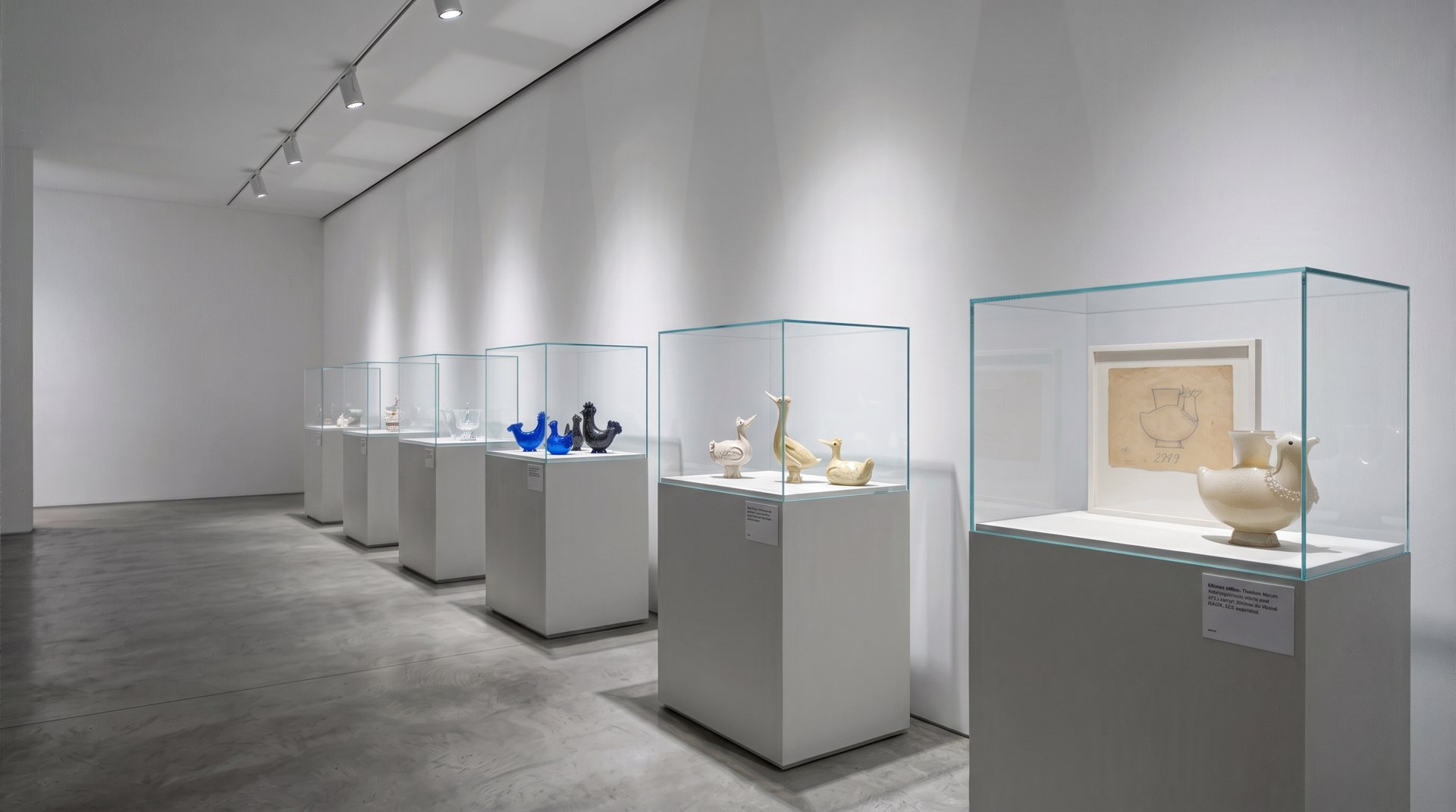
- The Filigree Cockerel & Hen (Model 2590, c. 1933): Buzzi's ultimate sculptural masterpiece. Unlike Napoleone Martinuzzi's solid, heavy animal figures, Buzzi designed his iconic Gallo e gallina (Cocks and hens) as hollow-blown, weightless vessels of extreme graphic lightness.
- The Technical Execution: The bodies of the birds were blown from a specialized mezza filigrana parison, composed of parallel, ultra-thin white lattimo glass threads embedded in clear crystal. While the hollow, filigree-patterned body was held at working temperature, the master glassmaker utilized jacks and iron shears to pull the tail feathers and shape the neck.
- Hot-Applied Detailing: To complete the bird's profile, Buzzi designed a series of highly stylized, contrastingly colored details modeled in dense, opaque glass paste (pasta vitrea). The comb and wattle were formed by applying small dabs of hot coral-red pasta vitrea, which were immediately drawn back and pinched using iron pincers to form wavy, naturalistic ridges. The beak was formed by a single, sharp conical point of hot glass, while the eyes were created by applying small, round concentric dabs of white and dark pasta vitrea that remained mobile and highly expressive.
- The Oxidized Silver Geese & Ducks (c. 1933): Buzzi designed a series of highly stylized, smooth-walled geese and ducks (such as Models 42 and 44) that showcase his fascination with metallic degradation. The bodies of the birds were blown from dense, opaque white lattimo glass cased in an outer layer of clear crystal. However, during the rolling phase, the parison was coated in sheets of pure silver leaf. When subjected to the oxidizing atmosphere of the furnace mouth, the silver leaf reacted chemically with the sulfur gases, turning a highly sophisticated, smoky-grey and yellowish-antique tone. The heads of the birds were detailed with hot-applied, tiny eyes of transparent cobalt-blue glass.
- The Laguna Snail & Seahorse Vases (c. 1932): The most complex and highly sought-after collector pieces of Buzzi's entire catalog. Designed as zoomorphic tabletop centerpieces, these classic cased sommerso vases in Laguna or Alga glass are characterized by the presence of miniature, highly detailed reptiles, molluscs, seahorses, and snails modeled in solid, semi-opaque opaline glass and fused directly onto the bodies of the vases near the splayed rims and handles. These figures bridged the gap between classical Renaissance grotesques and modern surrealism.
- The Turchese e Nero Series (c. 1932): Representing a stark, dramatic departure from his soft pastel tones, this minimalist series was designed for modern interwar apartments. The vessels are cased in a highly saturated, opaque turquoise glass paste (pasta vitrea turchese). The rims, splayed necks, feet, and handles are dramatically contrasted with hot-applied, high-gloss black glass ribbons and decorative collars, demonstrating Buzzi's mastery of the bold, geometric Novecento style.
4. The Elite Furnace Collaborations: The Minds of Glass
Tomaso Buzzi was an architect who designed strictly on paper; he did not blow glass himself. To translate his highly refined, delicate drawings into physical form, he relied on the supreme manual dexterity and speed of Murano's premier post-war masters:
- Giovanni Seguso ("Nane Patare"): The undisputed champion of the Venini furnace floor. Having co-executed Vittorio Zecchin's paper-thin soffiati in the 1920s, Nane Patare possessed the exceptional breath control and micro-precision required to blow Buzzi's delicate mezza filigrana cockerels and hens, maintaining perfect linear symmetry of the filigree canes across the asymmetrical contours of the bird's bodies.
- Arturo Biasutto ("Boboli"): Venini’s legendary powerhouse who physically blew Buzzi’s heaviest cased incamiciato vases, managing the difficult, multi-layered color overlays and ensuring that the gold leaf remained perfectly and evenly dispersed between the glass layers.
- Paolo Venini: The founder-director of Venini & C. Venini's strict, demanding eye for classical proportions acted as the perfect focusing lens for Buzzi's whimsical, ruins-obsessed architectural imagination, resulting in the shared patents and registrations for the Alba and Laguna series.
5. Post-Glass Legacy: La Scarzuola & The Neoclassical Dream
Following his brief, highly impactful tenure at Venini, Tomaso Buzzi permanently withdrew from industrial glass design. However, the exact same spatial theories, classical symmetries, and ruins-obsessed romanticism that shaped his glass vessels also guided his late-career architectural masterpiece: La Scarzuola.
In 1957, Buzzi acquired the historic Franciscan convent of La Scarzuola in Montegabbione, Umbria. Here, he spent the last twenty-four years of his life constructing his ultimate neoclassical dream—a "theatrical city" and architectural fantasy carved from Umbrian tufa stone. Designing without client constraints, Buzzi erected a sprawling, surrealist complex composed of seven overlapping theatres, miniature temples, triumphs, pyramids, and labyrinthine pathways.
Just as his Laguna and Alga glass vessels cased different colors and metallic layers to capture shifting light, his stone city was designed as a "theatre of memory," layering references to Palladio, Serlio, and Hadrian's Villa. La Scarzuola stands today as Buzzi's final, monumental legacy—proving that whether working in heavy Umbrian stone or paper-thin Venetian glass, he was the supreme architect of the neoclassical dream.
6. The Collector's Diagnostic Checklist & Market Realities
- Evaluating Gold Leaf Dispersion: In authentic Buzzi Alba, Alga, or Laguna vessels, the gold leaf must appear finely and evenly fractured into a shimmering, uniform dusting (pulviscolo d'oro). Beware of counterfeits that utilize cheap gold paint or uneven, clumpy foil flakes that display raw, un-fractured edges under a magnifying glass.
- Analyzing Glass Weight and Casing Thickness: Buzzi’s incamiciato vessels are paper-thin and exceptionally light, rejecting the heavy weight of standard cased glass. The three cased layers (white lattimo core, color layer, and colorless crystal outer shell) must be mathematically uniform, with the color boundaries remaining razor-sharp and showing zero bleeding or color run.
- Inspecting Hot-Applied Elements: In Buzzi's zoomorphic Laguna vases and farmyard animals, the points where the solid opaline reptiles, seahorses, and pasta vitrea crests fuse to the main body are seamless, clean, and structurally perfect. There should be no visible reheating scars, stress fractures, or trapped furnace soot at the joins.
- The Oxidized Silver Test: On Buzzi’s geese and duck sculptures, the silver leaf must display a natural, sophisticated greyish-yellow and smoky patina caused by authentic furnace gas oxidation. Modern reproductions often present a bright, uniform, and sterile silver shine that lacks this organic, aged coloration.
- The Price Tiers:
- High-End Investment Grade: Original 1932 Laguna zoomorphic vases with applied reptiles/molluscs near the splayed handles; original 1933 Alba heart-shaped pitchers; and 1933 mezza filigrana cockerels and hens (Model 2590) with hand-signed period bases.
- Mid-Range: Early Turchese e nero vases, bowls, and table services; a pelle d'uovo gilded cups; and standard gold-cased incamiciato bowls from his primary tenure.
- Accessible: Post-war re-editions of his stylized farmyard animals, cased glasses, and simple decorative centerpieces produced by Venini in the late 1950s and 1980s.
7. Forensic Chronology of Venini Markings & Base Finishes
To confidently identify, date, and authenticate a Tomaso Buzzi vessel, collectors must understand the precise chronological evolution of factory markings used by the Venini workshop during and after his tenure:
I. The Primary Artistic Director Era (1932–1934)
- The Lowercase Cursive Acid Stamp (Stamp No. 1): Buzzi's original interwar creations carry a highly distinct, delicate, and small two-line acid-etched mark on the underside of the base reading:
venini / muranoprinted in elegant, lowercase cursive letters. This is the ultimate, historically correct stamp of his primary tenure. - The Linear Three-Line Stamp (Stamp No. 2): Late-tenure creations and interwar reissues carry a linear, sans-serif three-line acid-etched mark reading:
venini / murano / MADE IN ITALYprinted in block capital letters. - The Circular Paper Decals: Early pieces originally carried fragile, round paper showroom stickers presenting the Venini splayed-foot spherical vase logo, which typically deteriorated over time.
II. The Post-War Reissues (Post-1946)
Because Buzzi's stylized animals and incamiciato series remained highly popular, Venini reissued several models in limited quantities in the post-war era. These carry the period-correct post-war marks:
- The Standard Three-Line "ITALIA" Stamp: Standard post-war reissues (used 1946–1965) carry a clean, linear three-line acid stamp reading:
venini / murano / ITALIAprinted in sans-serif capital letters on the underside of the base ring. - The Late-Career Hand-Guided Engraving (Post-1965): Rare reissued pieces produced in the late 1960s or 1980s carry a hand-guided diamond-point signature reading
venini italia(often accompanied by the exact year of execution, e.g.,venini italia 84). - Differentiating the Eras: Original 1930s Buzzi creations are distinguished from later reissues by their exceptional lightness, subtle color irregularities in the lattimo batch, and the absolute absence of the "ITALIA" stamp. Post-war reissues are made of slightly thicker, heavier, and more standardized glass.
8. Attribution & Authenticity
In the Murano glassmaking tradition, the difference between a fake and a copy rests entirely on intent, origin, and transparent attribution. A fake is a deceptive counterfeit manufactured outside of Murano—often in mass production factories in Asia or Eastern Europe—that utilizes cheap materials and carries forged signatures or illicit trademark stickers to intentionally defraud collectors. Conversely, a copy is a legitimate artistic homage (omaggio) handcrafted by a skilled master using authentic Murano techniques and materials; it serves as a tribute to honor a legendary artisan's legacy and is openly signed by the modern creator, preserving the lineage of Venetian glassblowing rather than exploiting it.
Join Our Facebook Group Identify Your Murano - Murano Glass Animals