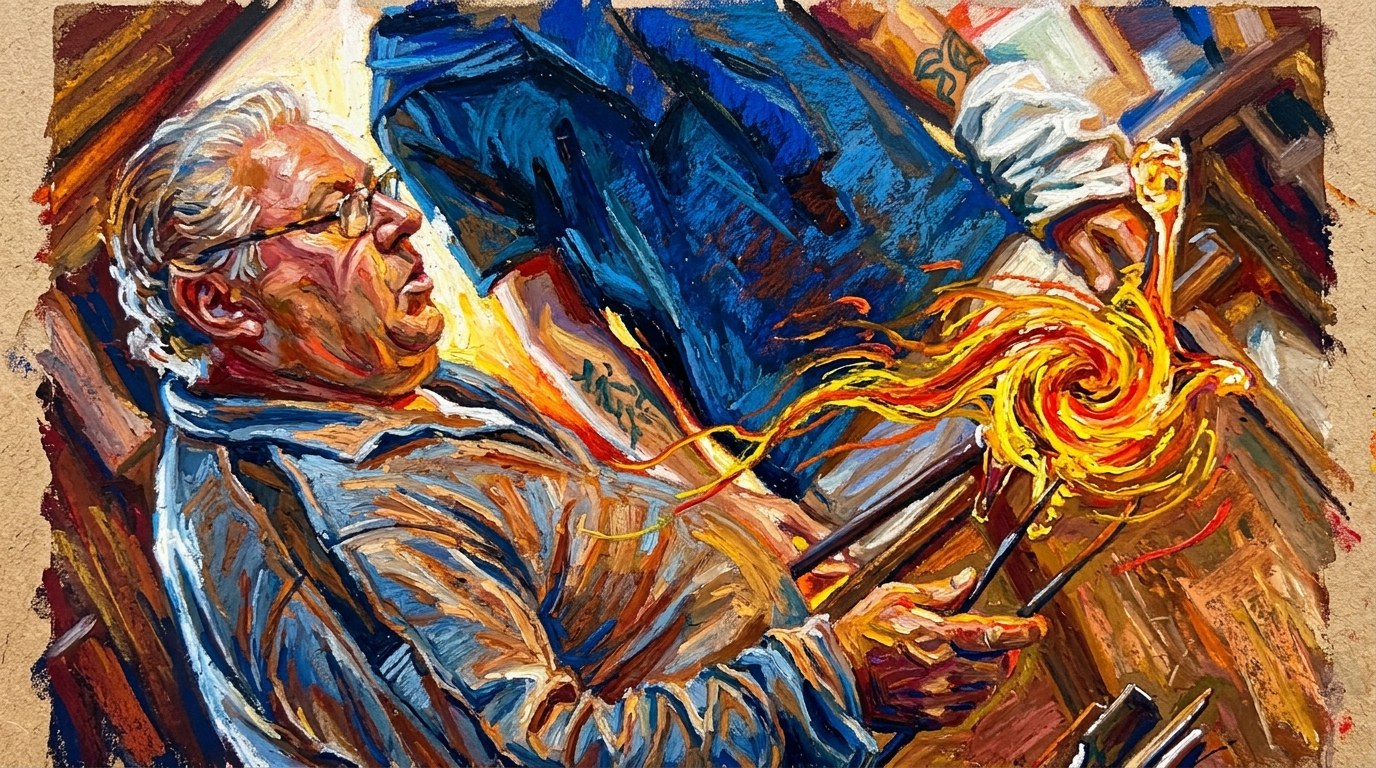
The Master of Opalescence: A Comprehensive Historical and Artistic Analysis of Arnaldo Zanella and His Role in Murano Glass
The Artist Registry
| Attribute | Details |
|---|---|
| Full Name | Arnaldo Zanella |
| Life Dates | 1949 (alternatively cited as 1945) (Sant'Erasmo, Venice) – Present |
| Primary Mediums | Solid Sculpted Glass (Massello), Chalcedony Glass (Calcedonio), Blown Art Glass with Scavo finish |
| Signature Innovations | Mastery of Massello (Solid Sculpting), Contemporary Revival of Calcedonio (Chalcedony chemistry), Scavo Surface Inclusions, 24k Gold Leaf Inclusions |
| Key Associations | Seguso Vetri d'Arte (1950s–1970s); Pino Signoretto Studio (1978–1985); Andromeda Murano (Co-Founder, 1985–1991); Arte Zanetti Vetro / Zanetti Murano srl (Senior Partner, 1991–Present) |
| Key Collaborators | Angelo Seguso, Pino Signoretto, Oscar Zanetti, Rosanna Toso, Karim Rashid, Leonardo De Carlo |
| Market Category | Postwar and Contemporary Italian Decorative Arts / Murano Glass |
1. Historical and Geographical Context
The career of Arnaldo Zanella is geographically and culturally rooted in the Venetian lagoon, yet his life trajectory departed sharply from the agrarian traditions of his birthplace. Born in 1949 on Sant’Erasmo—a fertile island situated just a three-minute boat journey from the glassmaking epicenter of Murano—Zanella was raised in an environment dominated by market gardening and agricultural labor. While most of his contemporaries dedicated their lives to cultivating the land, a young Zanella developed an early and intense fascination with the transformative properties of molten glass.
This attraction was cemented during a childhood visit to a Muranese hot shop with a relative, where the intense heat, the physical strain of the glassmakers, and the glowing, viscous material inspired a lifelong commitment to the craft. To assist his family financially, Zanella entered the furnaces at an early age, exchanging the agricultural rhythms of Sant'Erasmo for the demanding physical choreography of the Muranese glass factories.
While standard biographies and institutional archives document Zanella's birth year as 1949, certain commercial databases and vintage gallery labels record his birth year as 1945. This historical discrepancy represents a common cataloging variance in mid-century Muranese art history, often arising from early apprentice registrations or variations in post-war factory records. Regardless of this minor chronological divergence, Zanella’s entry into the glass industry coincided with a golden age of technical experimentation on Murano, allowing him to absorb centuries-old traditions at their peak of mid-century refinement.
2. Apprenticeship and the Seguso Vetri d’Arte Era
During the 1950s and 1960s, the historic firm of Seguso Vetri d’Arte served as the premier training ground for the island's most talented glassmakers. It was within this highly competitive environment that Zanella began his formal training, working directly alongside legendary figures such as Alfredo Barbini, Ermanno Nason, Angelo Seguso, and Pino Signoretto. Each of these masters possessed a distinct technical methodology that left a lasting imprint on Zanella's developing style: Barbini’s experiments with thick, heavy glass masses, Nason’s expressive, modern figurative work, and Signoretto’s monumental, hyper-realistic hot-sculpting techniques all informed his early artistic education.
Recognizing the young apprentice's physical stamina and technical potential, Angelo Seguso selected Zanella to serve as his personal assistant (serventino). Within the traditional hierarchy of the Muranese piazza (the furnace team), the role of the serventino was critical. It required seamless synchronization with the master, preparing the glass gathers, regulating the kiln temperatures, and assisting in the structural execution of complex designs. This intensive mentorship provided Zanella with a profound understanding of the thermal limits of glass and the physical discipline required to manipulate massive quantities of molten material.
Understanding that manual dexterity alone was insufficient to achieve true artistic independence, Zanella augmented his practical furnace training by attending evening drawing and design classes taught by local Venetian artists. This formal education was a critical turning point in his career. By mastering academic drawing, classical anatomy, and spatial composition, Zanella acquired the intellectual tools to translate three-dimensional concepts onto paper before executing them in the hot shop. This graphic literacy allowed him to transition from a highly skilled production assistant to an independent designer capable of planning complex, balanced sculptural forms that defied traditional glassblowing molds.
3. Technical Chronology and Furnace Affiliations
Zanella's career progressed through several distinct institutional phases, each corresponding to a specific furnace, studio partnership, or collaborative venture. This structured evolution demonstrates his journey from an apprentice to a collaborative designer and, ultimately, to a senior master glassmaker who mentored subsequent generations.
| Phase / Period | Primary Furnace / Studio Affiliation | Primary Role and Capacity | Key Artistic Focus and Technical Milestones |
|---|---|---|---|
| 1950s–1970s | Seguso Vetri d'Arte | Apprentice (Garzone) and Master Assistant (Serventino) to Angelo Seguso | Acquired foundational hot-shop discipline; assisted in high-end production; studied under Barbini, Nason, Seguso, and Signoretto; attended evening drawing classes to build design literacy. |
| 1978–1985 | Pino Signoretto Furnace-Studio | Chief Collaborator and Master Craftsman | Rejoined Pino Signoretto in his newly established independent workshop; refined advanced solid-glass sculpting (massello) techniques; executed large-scale, figurative sculptures. |
| 1985–1991 | Andromeda Murano | Co-Founder and Leading Glass Master | Established an independent collaborative studio with artist friends; innovated with opalescent colored glass, sculpted goblets, and custom architectural lighting designs. |
| 1991–Present | Arte Zanetti Vetro (Zanetti Murano srl) | Senior Master Glassmaker and Collaborative Partner | Established a lifelong creative partnership with Oscar Zanetti; focused on monumental animalier sculptures, gold-leaf inclusion, and chalcedony; served as a senior technical mentor to international apprentices. |
4. Technical Innovations and Material Chemistry
The legacy of Arnaldo Zanella is defined by his mastery of several highly challenging hot-shop techniques. His work is characterized by a unique synthesis of physical mass, chemical complexity, and delicate surface treatment.
Solid Sculpting (Massello) and Thermal Dynamics
While traditional Muranese glassmaking historically emphasized the lightness and transparency of hollow-blown forms, Zanella became a pioneer of the massello (solid-glass) technique. This methodology requires shaping a solid, unblown gather of molten glass directly at the furnace. The physical demands of massello are extraordinary: the master must manipulate heavy glass masses—frequently exceeding 40 kilograms—while maintaining precise control over the cooling rate.
Because solid glass retains heat internally while its outer surface cools rapidly, the artist faces a constant risk of thermal shock and catastrophic cracking. Zanella developed an intuitive, highly precise command over this thermal gradient. Using heavy iron shears, wooden paddles, and wet newspapers, he sculpted complex anatomical forms out of a single, continuous gather of molten glass.
Chalcedony (Calcedonio) Glass and Chemical Syncretism
One of Zanella's most celebrated technical achievements is his revival and mastery of calcedonio (chalcedony) glass. Originally developed in Murano during the mid-fifteenth century, calcedonio is an exceptionally complex chemical process designed to mimic the swirling, organic patterns of semi-precious stones such as agate, chalcedony, jasper, and lapis lazuli.
The technical difficulty of calcedonio lies in its delicate chemical composition. The glass master must introduce silver nitrate (silver salts) alongside various metallic coloring oxides (such as cobalt, copper, and iron) into the molten glass melt. The resulting chemical reaction is highly sensitive to temperature, furnace atmosphere, and timing. If the glass is reheated too many times or exposed to an incorrect reduction flame, the delicate silver suspensions can burn out, leaving the glass a dull, muddy brown.
Zanella successfully mastered this chemical unpredictability. His calcedonio sculptures, such as his celebrated "Bull" and "Manta Ray" figures, exhibit a deep, opaque, multi-striated matrix where rich blues, warm beiges, and metallic silver veins swirl together with remarkable fluidity. By combining calcedonio with massello sculpting, Zanella created works that are simultaneously heavy, dynamic, and mineralogically complex.
[Silver Nitrate + Metallic Oxides (Cobalt, Copper, Iron)]
                         │
                         ▼
        [Volatile Chemical Reaction]
                         │
          (Requires Precise Reduction Flame)
                         │
                         ▼
   Swirling Mineral-Mimic Matrix (Calcedonio)
Scavo and Surface Inclusions
In addition to his work with color and mass, Zanella explored the expressive potential of surface finishes. He frequently employed the scavo (excavated) technique to create sculptures with an weathered, archaeological appearance. This process involves applying a specialized mixture of corrosive salts (such as potassium, sodium, or ammonium compounds) to the surface of the blown or sculpted glass while it is still hot. The heat fuses the salts to the outer layer, creating a matte, textured, and slightly corroded skin that mimics the natural weathering seen on ancient Roman or Syrian glass unearthed from archaeological sites.
Zanella's "Scavo Glass Elephant," featuring solid black glass bodies contrasted with white glass tusks, showcases how this technique can mute the inherent glossiness of glass to emphasize pure sculptural mass. He also frequently incorporated 24-karat gold leaf inclusions (foglia d'oro) into his works. When gold leaf is applied to a hot gather of glass and subsequently expanded, the gold fractures into thousands of shimmering flecks, highlighting the internal contours and kinetic movement of the sculpture.
5. Iconography and Artistic Philosophy: The Bestiary
Zanella's artistic philosophy is deeply naturalistic, rooted in his childhood on the island of Sant’Erasmo. Rather than pursuing the intellectual abstractions that dominated much of late-twentieth-century international studio glass, Zanella chose to focus his creative energy on the animal kingdom. His celebrated "Bestiary" represents a sustained exploration of kinetic energy, anatomical grace, and natural beauty.
The Equestrian Sculptures
The horse is the central and most recognizable icon in Zanella's oeuvre. Sculpting a rearing or galloping horse in solid glass is widely considered one of the ultimate tests of a Muranese master's skill. The challenge is twofold: achieving anatomical accuracy and balancing the heavy, solid torso of the animal on thin, fragile legs.
Zanella's equestrian sculptures, ranging from realistic black glass stallions to gold-flecked, clear glass Pegasus figures, capture a powerful sense of motion. Rather than rendering static figures, he seized upon moments of high physical tension—a horse frozen mid-gallop with legs fully extended, or a stallion rearing back on its hind legs with its mane whipping in the wind. To prevent these heavy sculptures from tipping or fracturing under their own weight, Zanella carefully calculated the center of gravity, often anchoring the rearing forms to integrated glass bases that simulated turbulent water or natural rock formations.
Tropical Bird Trees and Avian Compositions
Another major pillar of Zanella's iconography is his elaborate avian compositions. He is internationally renowned for his complex glass trees hosting large, colorful flocks of tropical birds. These works are remarkable for their technical complexity and scale. In a single monumental bird tree, Zanella would sculpt dozens of lifelike birds—including parrots, cockatoos, and pheasants—using bright opalescent and transparent glass.
These individual birds were then mounted to a central glass tree structure, often fabricated in multiple interlocking sections using internal brass connectors to ensure structural integrity. The contrast between the heavy, dark glass branches and the brilliant, light-catching plumage of the birds exemplifies Zanella's mastery of spatial composition and color harmony.
6. Founding Andromeda: Bridging Art and Architectural Lighting
The year 1985 marked a major entrepreneurial and artistic milestone for Zanella. Along with several close artist friends, he co-founded Andromeda Murano, an independent glassworks and design studio. Under Zanella's guidance, Andromeda emerged as a pioneering force in the realm of high-end decorative lighting and contemporary architectural installations.
Operating under the philosophy "Made to Amaze," Andromeda bridged the gap between traditional Muranese craftsmanship and modern design. Zanella translated his expertise in hot-sculpted figurative art into functional lighting, designing complex glass chandeliers, wall sconces, and custom lighting features. The studio maintained a strictly artisanal production line, ensuring that every hand-blown and assembled light fixture remained a unique, one-of-a-kind creation.
This synthesis of classical technique and contemporary form allowed Andromeda to engage in highly successful collaborations with prominent international designers. These partnerships kept the workshop at the forefront of contemporary interior design while preserving the artisanal integrity of Murano glass:
- In 1998, the prominent Italian designer Rosanna Toso began a long-term collaboration with Andromeda, bringing her elegant, structural design language to the firm's hand-blown glass lighting collections.
- In 2009, the celebrated industrial designer Karim Rashid collaborated with Andromeda to create the Fluxus collection, a series of fluid, brightly colored, and organic glass lighting sculptures.
- Also in 2009, Leonardo De Carlo designed the Hydroargentum collection, which explored the reflective, liquid-like qualities of silvered glass.
7. Pedagogical Legacy and Mentorship
Zanella's contribution to the history of glass extends beyond his own artistic output; he has played a vital role in transmitting Murano's technical heritage to a global audience. His career illustrates how the historically closed, highly guarded world of Murano glass began to open up in the late twentieth century, transforming the island into a vibrant international center of education and creative exchange.
Following his integration into the Arte Zanetti Vetro Corporation in 1991, Zanella's studio became an active site of pedagogical transmission. Working alongside Oscar Zanetti, he mentored numerous international students, apprentices, and studio assistants. Notable examples of his direct mentorship include:
- John Almaguer: During the summers of 2007 and 2010, the American glass artist John Almaguer apprenticed directly under Oscar Zanetti and Arnaldo Zanella at the Zanetti Murano studio. Almaguer’s firsthand accounts describe the intense physical demands of the studio and the extraordinary generosity with which Zanella and Zanetti shared their accumulated knowledge. This mentorship was critical in introducing traditional Muranese solid-sculpting methods to a new generation of American glass artists.
- Asya Reznikov: In 1998, the prominent multi-disciplinary artist Asya Reznikov worked as a studio assistant at Zanetti Vetreria Artistica, helping to produce complex solid and blown glass sculptures for both Zanella and Oscar Zanetti. The experience of working in hot-shop conditions under these masters allowed Reznikov to develop a sophisticated, highly disciplined approach to three-dimensional form that she later integrated into her internationally exhibited kinetic glass sculptures and video installations.
By serving as a mentor to these and other international artists, Zanella helped ensure that highly complex, uncodified physical practices—such as the precise thermal balancing of massello and the chemical manipulation of calcedonio—survived and adapted within a changing global landscape.
8. Analytical Survey of Landmark Artworks
To understand Arnaldo Zanella's technical range, it is necessary to examine his individual landmark artworks.
9. Market Performance and Secondary Market Collectibility
In the global secondary art market, Arnaldo Zanella's sculptures have demonstrated consistent appreciation, particularly within the categories of postwar and contemporary Italian decorative arts. His highly complex, large-scale solid-glass animal sculptures are particularly sought after, with collectors placing a premium on works that showcase specialized techniques such as calcedonio, scavo, and 24-karat gold-leaf inclusions.
- Bolli & Romiti (Rome, Italy): In 2025, Bolli & Romiti recorded a landmark auction result for the artist, selling a large-scale sculpture in blue and colorless glass (Scultura in vetro blu e incolore) for a record-breaking $2,939 USD. This sale reflected a dramatic year-over-year average price growth of +377% for Zanella's high-end sculptural pieces between 2024 and 2025.
- Andrew Jones Auctions (Los Angeles, California): In 2019, Andrew Jones Auctions featured a monumental solid glass sculpture titled "Lovers" (Amanti), which was mounted on an octagonal granite pedestal with an overall height of 42 inches (106.5 cm) . Sourced from a prestigious private collection in Century City and Palm Desert, California, this work illustrated the demand for Zanella's larger, pedestal-mounted figurative sculptures.
- Leland Little Auctions (Hillsborough, North Carolina): In 2026, Leland Little sold a large "Scavo Glass Elephant" measuring 20 x 8 x 19 inches for $800 USD. Sourced from a private collection in Aiken, South Carolina, the piece highlighted the international reach of Zanella’s works within prestigious private estates.
- 1stDibs and Luxury Retailing: In the primary luxury retail market, Zanella's major solid-glass rearing horse sculptures are regularly valued between $3,700 and $4,600 USD, while exceptional gold-flecked, multi-colored horses can reach retail valuations of up to $9,900 USD. Monumental, multi-section bird trees containing multiple life-sized birds are highly prized and command significant premiums at major auction houses, often valued at several thousand dollars due to their complexity.
10. Historical Standing and Artistic Legacy
Arnaldo Zanella's historical significance within the landscape of twentieth-century Muranese art glass is defined by his ability to preserve traditional, physically demanding techniques while adapting them to a contemporary design context. His life story—from an agricultural childhood on Sant’Erasmo to co-founding Andromeda and serving as a master sculptor at Zanetti Murano—embodies the democratic, skill-based meritocracy that helped revitalize Murano's post-war glass industry.
Through his mastery of massello and calcedonio, Zanella demonstrated that glass could move beyond delicate vessels to achieve the weight, presence, and expressive power of classical bronze or marble sculpture. His collaborative work with designers like Rosanna Toso and Karim Rashid helped bring Murano's heritage into a modern dialogue, demonstrating its relevance to contemporary lighting and architecture. As a dedicated mentor to international glass artists, Zanella helped ensure that these complex, physical techniques would survive as a living, evolving language. Today, his sculptures remain highly valued by connoisseurs and institutions worldwide, standing as a lasting testament to the enduring power of fire, chemical craft, and sculptural vision.