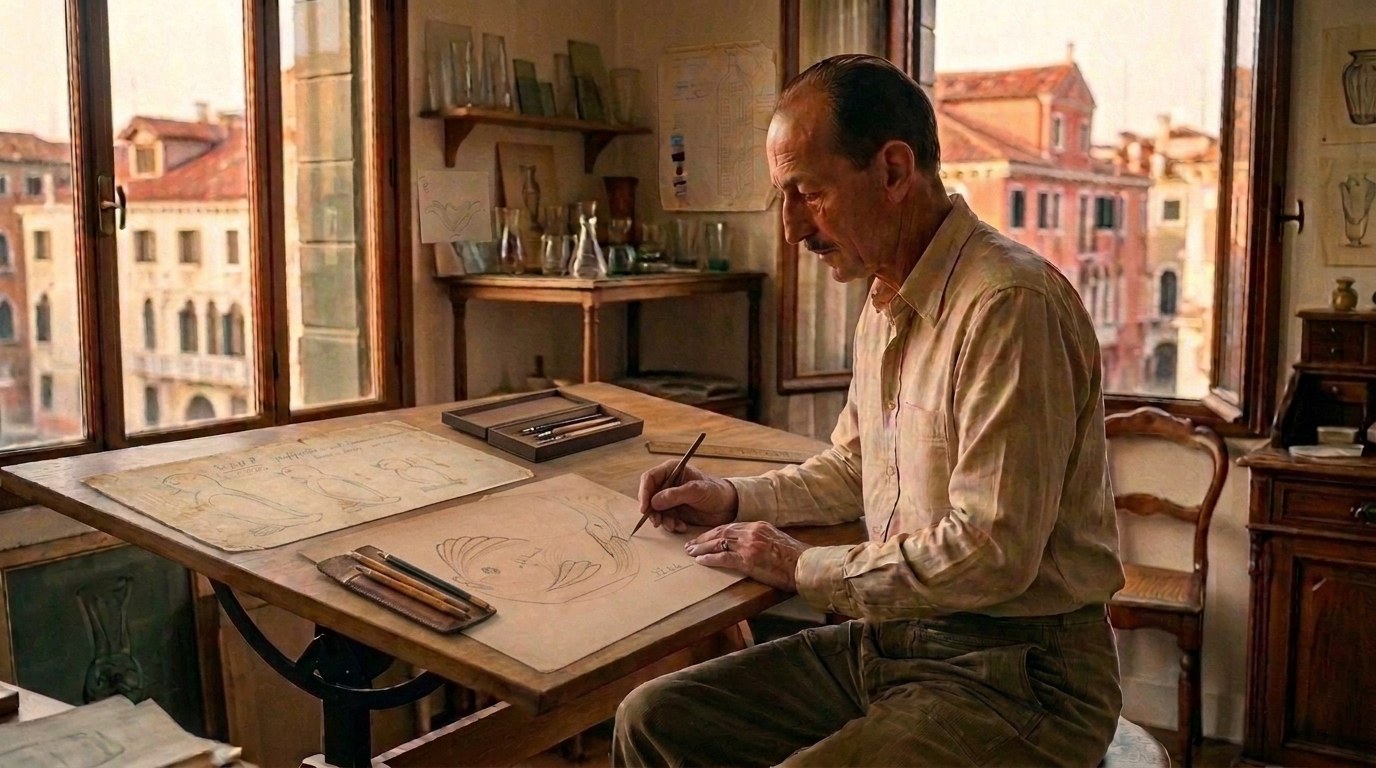
Artist Biography: Corrado "Dino" Martens (1894–1970)
A Comprehensive Reference Guide for Appraisers, Historians, and Collectors of Postwar Venetian Glass
The Artist Registry
| Attribute | Details |
|---|---|
| Full Name | Corrado "Dino" Martens |
| Life Dates | October 24, 1894 (Venice) – 1970 (Venice) |
| Primary Mediums | Fine Art Painting (Oil on Canvas/Panel), Blown Art Glass (Polychrome and Structural Vetro Pesante) |
| Signature Innovations | Oriente (1952), Eldorado (1952), Pittorico (1954), Vetro Vulcano (c. 1958) |
| Key Associations | Vetreria Aureliano Toso (Artistic Director, 1939–1959; Freelance, 1959–1963) |
| Key Collaborators | Master Glassblower Aldo "Polo" Bon, Egidio Costantini (Fucina degli Angeli), Luigi Martens (Son & Draftsman) |
| Market Category | Mid-Century Italian Decorative Arts / Postwar Murano Glass |
Context & Origins: The Formative Phase
Academic Training & Artistic Environment
Unlike the vast majority of Muranese glass designers who rose through the traditional lineage of island furnaces, Dino Martens was a classically trained outsider. Between 1908 and 1912, he attended the Accademia di Belle Arti in Venice, studying monumental painting under Ettore Tito and Umberto Martina. His early career was defined strictly as a painter in the Novecento style, exhibiting figurative works at the secessionist Ca' Pesaro exhibitions and the Venice Biennale between 1912 and 1930. Notable canvases from this period include Tra i cenci and A San Geremia.
Socioeconomic Drivers of the Glass Transition
Following the disruptions of World War I—during which Martens served as a soldier—and the subsequent post-war economic collapse of Venice, the market for fine art painting evaporated. Financial necessity forced Martens to seek commercial employment as a freelance draftsman (disegnatore) for Murano's glass dynasties. By approaching glass with a painter’s eye rather than a glassmaker's craft tradition, Martens bypassed the conservative constraints of traditional Murano design, treating the three-dimensional glass vessel as a dynamic, fluid canvas.
Primary Studio & Factory Collaborations
-
1922: Fratelli Toso Martens's entry into glass consisted of providing freelance decorative drawings for industrial blanks blown at the Fratelli Toso furnace. His earliest documented industrial work is a design for mould-blown glass paste jars, registered in early 1922.
-
1923–1925: Studio Ars et Labor Industrie Riunite (S.A.L.I.R.) As a founding partner and decorator at S.A.L.I.R., Martens engaged in a business model that decoupled artistic decoration from the hot furnace floor. Working with pre-blown blanks, he applied geometric, Novecento-style graphic themes using cold surface manipulation, specifically smalto (enameling) and incisione (engraving).
-
1931–1935: Successori Andrea Rioda & Salviati & C. This era marked Martens's transition into hot-glass design. Due to a complex corporate arrangement, the glass was physically executed at the furnaces of Successori Andrea Rioda and sold under the prestigious Salviati & C. brand. Here, Martens mastered classical symmetrical Venetian cane techniques, producing minimalist, monochrome works in filigrana and reticello.
-
1939–1963: Vetreria Aureliano Toso The definitive phase of Martens’s career. Appointed as artistic director, Aureliano Toso provided Martens with unlimited material support and the island's finest master glassblowers. Chief among these was Aldo "Polo" Bon, whose virtuosity was essential to translating Martens’s highly challenging, asymmetrical 2D designs into physical glass. Martens retired as artistic director in 1959 but supplied freelance designs until 1963.
-
1954–1961: Fucina degli Angeli Seeking liberation from the commercial constraints of serial factory production, Martens collaborated with Egidio Costantini’s avant-garde guild. Unbound by utilitarian market demands, Martens transitioned into pure sculpture (scultura in vetro), designing high-mass, abstract glass pieces.
Technical Vocabulary & Stylistic Milestones
Pre-War Vetro Pesante (Heavy Glass)
Debuted at the 1940 Venice Biennale, Martens's first major innovation for Aureliano Toso was a complete rejection of the fragile, thin-walled soffiato style of the 1930s. He introduced monumental, thick-walled "heavy glass" (vetro pesante), showcased in pieces like the Scacchiera and Fasce indute.
Programmed Asymmetry & Zoomorphism
Martens’s signature sculptural aesthetic is defined by "programmed asymmetry." Rather than allowing the glassblower to shape the vessel symmetrically on a spinning blowpipe, Martens drafted precise 1:1 scale drawings dictating extreme deformations, off-center gravity, pinched lips, and the challenging foro passante (a negative aperture piercing the vessel's center). This structural biomorphism was frequently applied to abstract animal forms, most famously the bird-shaped Osellaria series.
The Oriente Technique (1952)
The peak of Martens's "painting with glass" philosophy, Oriente utilized a cold-assembled mosaic layout picked up on the surface of the molten parison. The layout incorporated ground glass, twisted zanfirico filigree canes, opacified colored squares, copper inclusions, and a central, highly specific black-and-white star-shaped murrina.
The Eldorado Series (1952–1954)
A critical aesthetic inversion of Oriente, Eldorado utilized a highly transparent, clear cristallo ground rather than an opaque mosaic. It featured suspended metallic copper crystal inclusions (aventurina) and finely ground translucent colored powders. Due to the severe coefficient of thermal expansion mismatch between these heavy metallic inclusions and the cased glass, Eldorado suffered astronomically high cooling breakage rates during the annealing process, resulting in an extremely brief production window.
Tactile Textures (Mid-1950s)
- Pittorico (1954–1955): An Abstract Expressionist-style series featuring colorful internal spotting and heavy opaque casing.
- Pulegoso (1953–1954): Opaque cased glass saturated with thousands of microscopic air bubbles, created by introducing chemicals into the melt.
- Battuto: A cold-working finish where the annealed surface of the glass was ground away on stone wheels by a molatore (master cutter) to create a matte, carved texture mimicking hammered metal.
Key Exhibitions & Institutional Milestones
- Venice Biennale (1924–1958): The Biennale served as Martens's primary platform for institutional prestige. Having exhibited paintings there from 1924 to 1930, he returned postwar with Aureliano Toso, utilizing the fine-art focus of the venue to debut his most radical, non-functional glass designs (including the debut of Oriente in 1952 and Pittorico in 1954).
- Milan Triennale (1951–1957): In contrast to the fine art focus of Venice, Martens used the Milan Triennale to exhibit applied designs that integrated into modern interior architecture. Notable exhibits included his brass-framed lighting installations at the 1954 Triennale.
- Corning Museum of Glass: "Glass 1959": This major international traveling exhibition represented a global turning point for Martens’s reputation, solidifying his status as a pioneer who successfully transitioned decorative glass design into the realm of modern art.