The Liquid Geometry of Licio Zanetti: An Art-Historical and Collector’s Guide to a Modernist Sommerso Waterbird
1. Introduction: The Streamlined Licio Zanetti Waterbird for Zanetti Murano
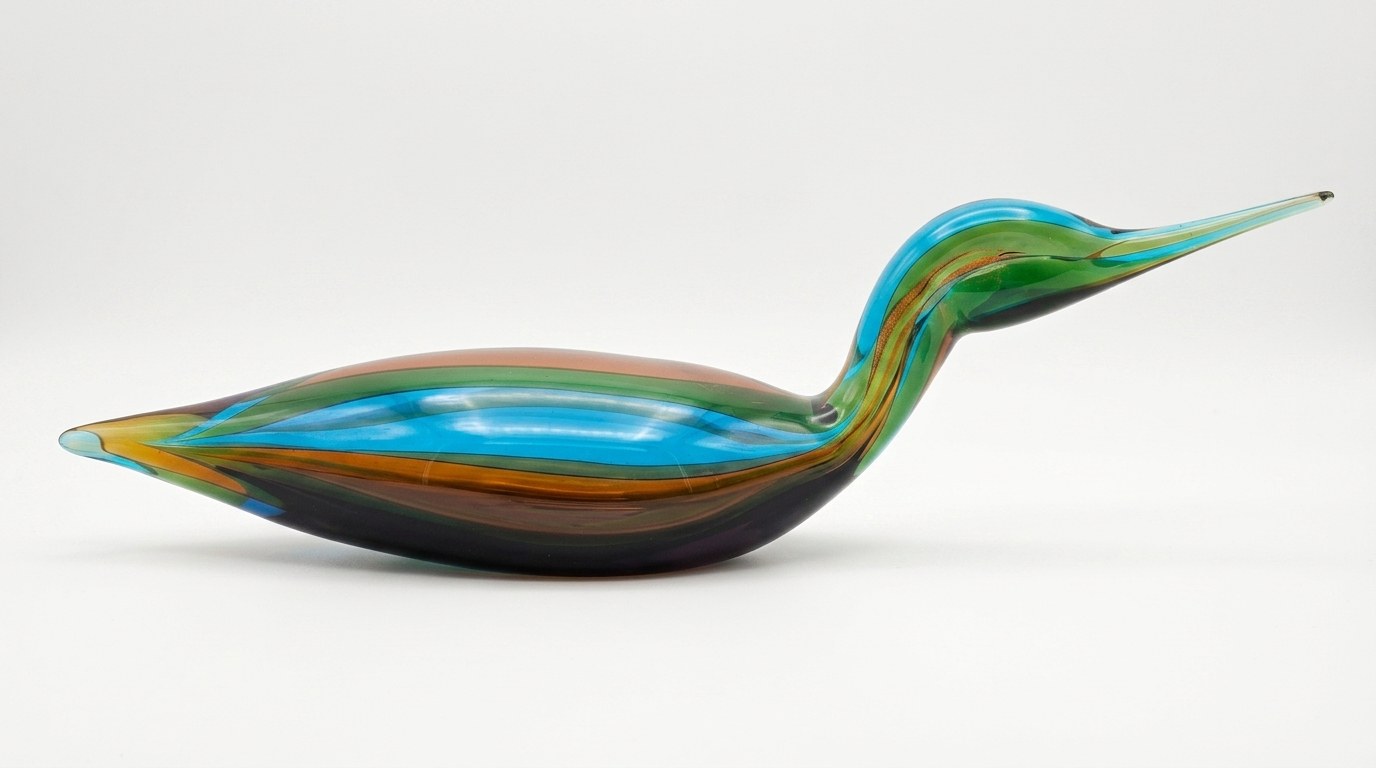
This exceptional glass sculpture represents the pinnacle of mid-century Venetian design and hot-glass sculpting. Depicting a highly stylized, low-slung waterbird—evoking the aerodynamic contours of a diving duck, grebe, or wetland diver—the piece relies on its massive solid-glass weight to bend and refract ambient light, a property Licio Zanetti masterfully exploited to mimic the fluid, natural movement of water. Measuring an impressive 42 cm in length, 13 cm in height, and 14 cm in width, the sculpture possesses a substantial physical presence that commands attention in any gallery or private collection.
The defining visual characteristic of this sculpture is its sophisticated internal color composition. Encased within a thick, dark, smoky-grey outer jacket of crystal are highly defined, vibrant longitudinal color bands of turquoise-blue, emerald-green, and warm amber-orange. When viewed in profile, these parallel ribbons of pigment stretch seamlessly from the tip of the tail to the crest of the head. However, when inspected from a top-down perspective, the optical qualities of the heavy glass encasement warp these linear stripes into a concentric, eye-like pattern. This refractive shift illustrates how the sculpture's physical geometry actively manipulates the visual experience of its internal coloration, transforming a static object into a dynamic study of light.
2. The Signature: Verifying the "Zanetti L" Mark on the Base
Engraved into the flat-polished underside of the bird's base is the hand-etched cursive signature "Zanetti L". In the specialized market for Murano glass, this signature serves as the primary, archival indicator of authenticity for Licio Zanetti's mid-century wildlife designs.
The incised script—fluidly executed with a diamond-point tool directly into the ground base—is highly consistent with verified catalog examples from the furnace's peak production years between the 1960s and 1980s. While some monumental or flat-surfaced exhibition pieces occasionally bear his full name, his highly celebrated sculptural animal figures—ranging from stylized herons and toucans to majestic marine life—classically bear this "Zanetti L" mark.
For collectors and glass historians, this signature confirms that the piece was created under the direct, hands-on supervision of Licio Zanetti at the family's Fondamenta Serenella furnace. Its physical placement on the flat-ground resting base represents the standard, professional signing convention of the Murano workshops, ensuring that the mark remains secure from surface wear while preserving the uninterrupted, fluid lines of the sculptural body.
3. Art-Historical Context: From Realism to Mid-Century Modernism
To fully appreciate this sculpture, one must examine the deep cultural and familial legacy that shaped Licio Zanetti’s artistry. The Zanetti dynasty is intimately woven into the history of Murano glassmaking. Licio was a direct descendant of Abbot Vincenzo Zanetti (1824–1883), a historical champion of Venetian glass who co-founded the Museo del Vetro (Murano Glass Museum) in 1861 and established the Scuola del Vetro (Glass School) in 1862. This ancestral dedication to preserving classical techniques while teaching academic drawing laid the foundation for Licio's design-led approach to glassmaking.
Within 20th-century art history, two competing biographical timelines exist for Licio Zanetti, both documenting his profound impact on the medium:
- The 1920 Chronology: Records his birth on July 27, 1920, in Murano. According to this timeline, he studied formally at the Venice Academy of Fine Arts before refining his practical furnace skills, making him a mature master of thirty-six when he co-founded the family furnace in 1956. He passed away in 2019 at the age of ninety-nine.
- The 1937 Chronology: Places his birth in Venice in 1937, indicating he trained entirely in the workshop of his father, the master glassmaker Oscar Zanetti I, without formal academy instruction. This timeline records his passing in 2019 at the age of eighty-two, meaning he co-founded the family furnace as a nineteen-year-old prodigy.
Both historical frameworks agree that in 1956, Licio co-founded Zanetti Vetreria Artistica on Murano’s Fondamenta Serenella with his father, Oscar Zanetti I. Throughout the 1950s, 1960s, and 1970s, Licio’s style underwent a dramatic evolution. His early works focused on detailed, lifelike naturalism. However, his style was refined by major collaborations with Murano's most avant-garde design houses:
- Venini & C.: Working under Paolo Venini, Licio collaborated with premier external artists and designers such as Fulvio Bianconi. This exposure refined his appreciation for the clean, minimalist lines and stylized geometries that define this waterbird.
- Gino Cenedese & Figlio: Working with Cenedese, he mastered the execution of heavy, submerged (sommerso) animal sculptures.
- Alfredo Barbini: Zanetti’s close connection with Barbini—a pioneer in heavy, unblown glass—reinforced his preference for sculpting massive, solid-glass creatures.
- Pauly & C. (CVM): In 1971, Pauly & C. commissioned Licio to translate the modern, abstract paintings of Italian artist Libero Vitali into three-dimensional hot glass. The success of the resulting solo exhibitions in 1972 and 1973 cemented Licio's reputation as a master who could bridge the gap between traditional craftsmanship and modern abstract art.
By the 1970s, this collection of influences culminated in a signature style that replaced literal anatomic detail with sleek, flowing, modernist contours.
4. Technical Masterclass: Massello and Sommerso Casing
The physical execution of this waterbird required absolute mastery over two of Murano's most physically demanding hot-glass techniques: massello and sommerso.
The Massello (Solid Sculpting) Method
Unlike traditional blown glass, which is hollow and lightweight, this sculpture is executed a massello—meaning it is sculpted from a solid, unblown mass of molten glass. The process requires immense physical strength to manipulate heavy, hot glass on the end of a solid metal rod (pontil) while working directly in front of the high-temperature furnace.
Because solid glass retains heat for a long time, the master must work with extreme speed and precise thermal control. If the glass cools too quickly or unevenly, the internal thermal stresses will cause the entire piece to crack or shatter violently. Licio Zanetti was particularly famous for sketching his animal subjects on-site, pre-planning the precise sequence of tool applications, stretching, and shears required to shape the hot glass before it dropped below its working temperature.
The Sommerso (Submerged) Layering Technique
To achieve the striking color profile of the bird's body, Zanetti utilized an advanced variation of the sommerso (submerged) technique. The internal coloration is not a painted surface or a random swirl; it is a highly controlled arrangement of distinct glass layers:
- The process began by gathering a core of hot, colored glass—starting with the warm amber-orange strip.
- Over this core, precise longitudinal ribbons of turquoise-blue and emerald-green glass were applied, stretched, and flattened along the length of the mass.
- Once the internal color bands were aligned, the entire hot gather was submerged (dipped) into a crucible of dark, smoky-grey glass, creating a heavy outer "jacket" that completely encased the colored stripes.
- Finally, the combined solid mass was reheated and hand-sculpted a massello to form the sleek contours of the bird.
This meticulous casing creates a seamless, integrated color profile. The smoky outer layer of glass acts as a three-dimensional lens, refracting the vibrant internal colors so that they appear to float weightlessly inside the body of the bird.
5. Collector's Valuation and Care Guide
As an authentic, hand-sculpted "Zanetti L" signed work, this waterbird occupies a highly desirable position in the secondary art market.
Market Performance and Collectibility
Signed sculptures by Licio Zanetti from his peak active period (the 1960s through his retirement in 1989) continue to experience strong global demand from design collectors and glass historians.
- Unique, hand-sculpted animal and bird masterworks regularly exceed initial auction estimates.
- Highly complex avian designs have achieved significant prices; for example, his famous toucan sculptures on gilded brass legs have fetched up to $3,750 at major auctions, while his monumental, deeply carved vases have reached up to $4,032.
- This piece is particularly collectible because the stylized waterbird design perfectly captures the 1970s modernist aesthetic that is currently highly sought after by mid-century modern design enthusiasts.
Best Practices for Display and Preservation
To maintain both the physical integrity and the visual beauty of this solid-glass masterwork, collectors should adhere to the following museum-grade care guidelines:
- Illumination: Solid sommerso glass requires strategic lighting to reveal its internal color bands. Avoid flat, overhead lighting. Instead, display the sculpture where it can receive strong directional light from behind or slightly below (such as on a glass shelf). This allows light to pass through the smoky jacket, illuminating the turquoise, green, and amber stripes with brilliant clarity. Avoid direct, intense sunlight for prolonged periods to prevent localized heat buildup.
- Handling: Because this is a solid massello piece, it is deceptively heavy. Never pick up the sculpture by its thinnest or most delicate points, such as the beak or the tip of the tail. Always support the heavy, rounded underbelly of the bird with one hand while stabilizing the upper neck with the other.
- Cleaning: To remove dust and fingerprints without scratching the polished glass surface, use a clean, dry, lint-free microfiber cloth. Avoid spraying commercial chemical glass cleaners directly onto the signature area on the base. If deep cleaning is necessary, use a mild, pH-neutral soap with lukewarm water, rinse thoroughly, and hand-dry immediately with a soft cloth. Never submerge the piece in hot water, as sudden temperature changes can trigger thermal shock in heavy, vintage glass.
6. Summary Profile for Appraisers & Historians
| Attribute | Archival & Visual Specification |
|---|---|
| Designer & Master | Licio Zanetti |
| Workshop / Furnace | Zanetti Vetreria Artistica (Fondamenta Serenella, Murano) |
| Approximate Era | c. 1970s |
| Primary Techniques | Massello (solid hot-sculpting) & Sommerso (submerged multi-color casing) |
| Color Palette | Longitudinal internal bands of turquoise-blue, emerald-green, and amber-orange encased in a dark, smoky-grey outer glass jacket |
| Height | 13 cm |
| Width | 14 cm |
| Length | 42 cm |
| Beak Detail | Elongated, tapered solid glass beak pulled cleanly from the head's flowing gather |
| Base / Support | Integrated flat-ground resting base directly on the heavy, solid glass underbelly |
| Signage & Marking | Hand-etched "Zanetti L" cursive signature on the underside of the flat-polished base, executed with a diamond-point tool |
| Stylistic Paradigm | Mid-century minimalist modernism, prioritizing streamlined geometric contours and light refraction over literal anatomical realism |
With its striking multi-layered sommerso body, expertly sculpted solid massello form, elegant light-refracting smoky-grey jacket, and authentic hand-etched "Zanetti L" signature on the underside base, this waterbird stands as a textbook example of Licio Zanetti's peak-career mastery of physical glass sculpture.
Photo Attribution: Pam Townsend