The Fuga Murano Dynasty — Masters of Stained Glass, Mirror Engraving, and A.V.E.M. Avant-Garde Design
The Fuga Dynasty — Masters of Stained Glass, Mirror Engraving, and A.V.E.M. Avant-Garde Design
Dynasty Key: The Fuga Dynasty
- Active Dynasty Window: 14th Century – Present (documented across seven centuries of master glassmakers, engravers, stained glass artists, and furnace art directors on Murano)
- Ancestral Seat & Primary Kilns / Studios: Fondamenta Venier 47A (Anzolo Fuga Atelier & Stained Glass Studio, 1943–Present) | Fondamenta Vetrai 33 (Arte Vetraria Muranese - A.V.E.M., 1955–1968) | Abate Zanetti Scuola Serale per Vetrai (1949–1972) | Cristalleria di Venezia e Murano (19th c. – 1930s) | Fondamenta da Mula (I.V.R. Mazzega, 1954–1960)
- Hereditary Master Glassmakers, Engravers & Designers: Manfredo Fuga (1331 progenitor) | Nicoleto & Pasqualin Fuga (1638/1681 masters) | Angelo Fuga (19th-c. copper-wheel mirror engraving pioneer) | Giovanni Fuga ("Nane Cina", 1864 master of the monumental 330kg museum chandelier) | Emilio Fuga (Technical Director, Cristalleria di Venezia e Murano) | Anzolo Fuga (1914–1998, master stained-glass artist, Director of Abate Zanetti School, and A.V.E.M. designer) | Giuseppe Fuga (b. 1919, co-founder of Anzolo Fuga & C.) | Flavio Fuga (b. 1953, painter and studio torchbearer) | Mario Fuga | Aldo Fuga (designer for Arte Nuova, 1958)
- Signature Technical & Material Inventions: Leaded Blown-Fragment Stained Glass (Vetrate Istoriate) | Lightning-Bolt Base Trademark (Fulmine FF Enamel Stamp) | Arcobaleno & Bandiere Mosaic Casing (1955–1956) | Occhi & Murrine Giganti Matrices (1959–1962) | Transennati & Folclore Ellenico Grid-Cane Fusions (1962–1966) | Geroglifici Wire-Guided Cane Loops (1963) | Iceberg & Opale Veilings (1968) | Copper-Wheel Engraved Mirror Revival (Angelo Fuga, 1870s)
- Market Price Tier: High-End Investment Grade (1955–1968 Anzolo Fuga A.V.E.M. one-off exhibition vessels including Occhi, Arcobaleno, Transennati, Geroglifici, and signed Bevilacqua La Masa enamel pieces) to Mid-Range (Anzolo Fuga & C. 1940s–1950s enameled/iridized glassware, I.V.R. Mazzega designs, and 19th-century Fuga copper-wheel engraved mirrors) to Accessible (later commercial studio production and architectural stained glass panels)
- Key Collaborators: Luciano Ferro (Master Blower) | Orfeo Compagno (Master Blower) | Egidio Ferro ("Pianzini") | Ada Ferro | Guido Balsamo Stella | Giulio Radi | Emilio Nason | Aldo Nason | Giorgio Ferro | Ercole Moretti | S.A.L.I.R. | Cristalleria Nason & Moretti
Summary:
Discover the magnificent seven-century history and avant-garde genius of The Fuga Dynasty, Murano's premier family of stained-glass artists, mirror engravers, and furnace designers. This comprehensive collector's guide details their 14th-century guild origins, Angelo Fuga's 19th-century copper-wheel mirror revival, Anzolo Fuga's 23-year directorship of the Abate Zanetti School, and his legendary 1955–1968 glory-hole collaborations at A.V.E.M. alongside Maestro Luciano Ferro (Arcobaleno, Occhi, Transennati, Geroglifici). Learn how to evaluate diagnostic markings, enamel lightning-bolt stamps, paper factory decals, and market valuations to collect Fuga glass with absolute curatorial confidence.
Genealogical Lineage Map
┌────────────────────────────────────────────────────────────────────────┐
│                          THE FUGA DYNASTY                              │
│                   - ANCESTRY & GENEALOGICAL DESCENT -                  │
└───────────────────────────────────┬────────────────────────────────────┘
                                    │
                              Manfredo Fuga
                   (1331: First Archival Registration)
                                    │
                              Pasqualin Fuga
                 (1638: Garzon; 1681: Verona Kiln Privilege)
                                    │
                               Angelo Fuga
            (19th C. Copper-Wheel Mirror Engraving Pioneer)
                                    │
           ┌────────────────────────┴────────────────────────┐
           │                                                 │
     Giovanni Fuga                                      Emilio Fuga
    ("Nane Cina")                             (Director, Cristalleria di
 (1864 Museum Chandelier)                       Venezia e Murano; married
           │                                      Adelaide Barovier)
           │                                                 │
     Lorenzo Fuga                          ┌─────────────────┴─────────────────┐
           │                               │                                   │
     Italo Fuga                        Anzolo Fuga                       Giuseppe Fuga
 (Fratelli Toso)                     (1914–1998)                           (b. 1919)
                                (A.V.E.M. Designer &                     (Co-Founder
                               Director Abate Zanetti)                  Anzolo Fuga & C.)
                                           │
                                      Flavio Fuga
                                       (b. 1953)
1. The Medieval Guild Origins & 19th-Century Mirror Revival
The Fuga family represents one of Murano's most ancient, multi-faceted, and intellectually distinguished glassmaking dynasties. Documented in the State Archives of Venice (Archivio di Stato di Venezia) as early as 1331, the family's recorded history begins with the glassmaker Manfredo Fuga. Over the centuries, the lineage expanded rapidly; in the landmark 1605 Golden Book of Murano (Il Libro d'Oro di Murano), no fewer than 19 members of the Fuga family are officially inscribed as privileged citizens and master creators of cristallo.
The Baroque Guild Ranks & The Verona Privilege (1638–1681)
Historical documents published by glass historian Luigi Zecchin illustrate the strict hierarchical progression of the Fuga family within the glassmakers' guild (Mariegola). A contract dated 1638 records that Nicoleto Fuga bound his young son Pasqualin Fuga as a garzon sotto fante (a junior apprentice at the bottom of the furnace hierarchy). Demonstrating extraordinary bench virtuosity, Pasqualin rose to the rank of Maestro and, in 1681, secured a formal Venetian state privilege to open an independent glassworks in Verona. Throughout the 17th and 18th centuries, Fuga masters held ranking positions in the Muranese guild council, with branches recorded operating furnaces in Austria and Germany.
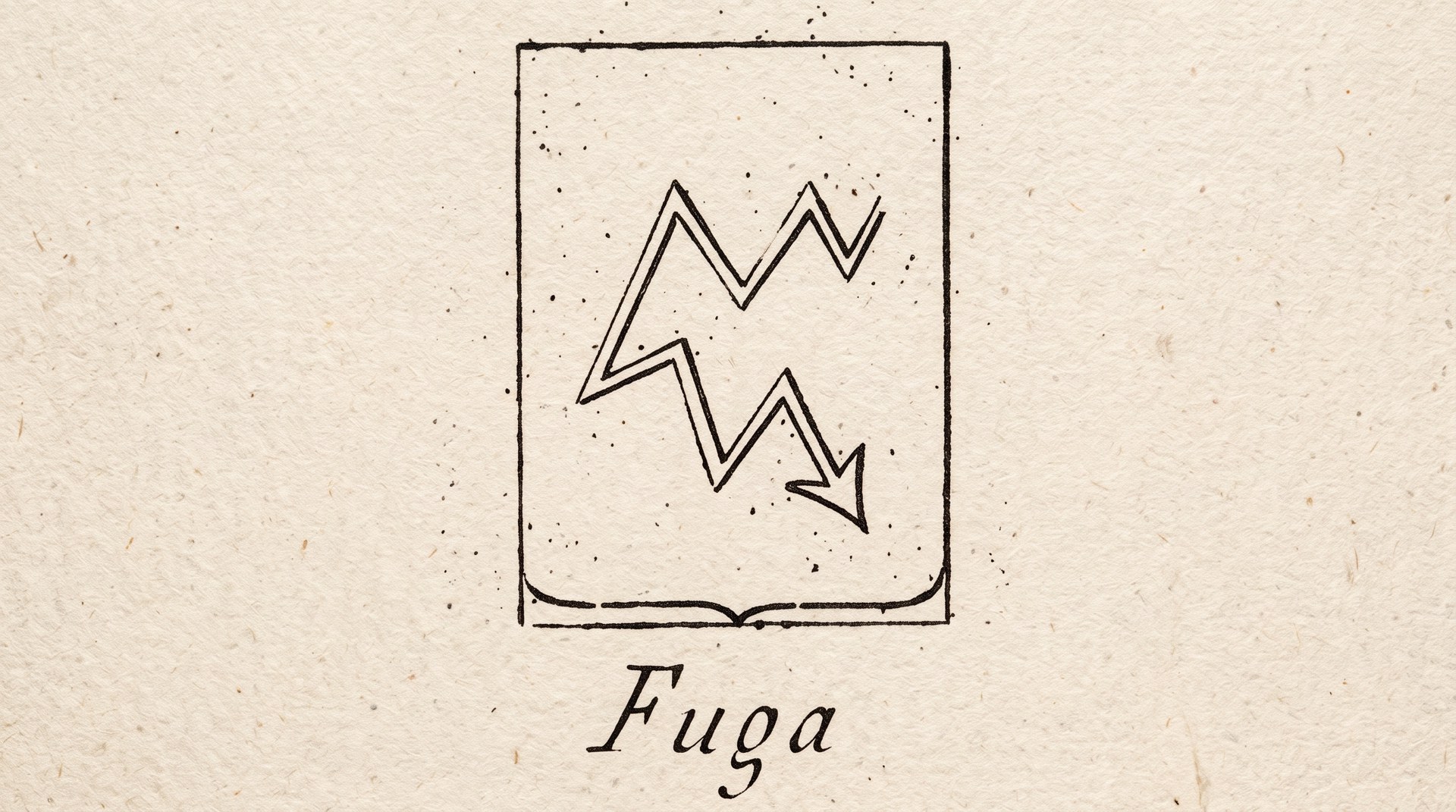
The official heraldic coat of arms (stemma) of the Fuga family features a stylized arrow or lightning bolt (fulmine), semantically linking the weapon's speed to the Italian word fuga (meaning "flight" or "escape"). This emblem was struck onto official municipal coinage (oselle) issued by the Magnifica Comunità di Murano in 1521, 1702, and 1704.
The 19th-Century Copper-Wheel Engraving Renaissance
Following the collapse of the Venetian Republic in 1797, the Fuga family spearheaded the technical recovery of cold-working and mirror decoration:
- Angelo Fuga: In the second half of the 19th century, Angelo Fuga, a brilliant self-taught master engraver, single-handedly resurrected the lost Venetian art of copper-wheel glass engraving (incisione a rotina) and ornate decorated mirror manufacturing. His workshop at Fondamenta Venier was commemorated by Abbot Vincenzo Zanetti in his 1874 monograph, Angelo Fuga, i suoi specchi ed il suo laboratorio in Murano, laying the foundation for the historic Ongaro & Fuga Venetian mirror atelier, uniting the cold-working mastery of the Fuga lineage with the mirror-fabrication tradition of the Ongaro family.
- Giovanni Fuga ("Nane Cina"): A master craftsman at Antica Vetreria Fratelli Toso, Giovanni Fuga teamed with Lorenzo Santi in 1864 to construct the largest glass chandelier produced on Murano up to that time—a monumental 60-branch, 330-kilogram crystal masterpiece. Awarded a Gold Medal at the 1864 Murano Glass Exposition, it was subsequently exhibited at the 1867 Paris Universal Exposition and remains an anchor exhibit in the Murano Glass Museum (Museo del Vetro).
- Emilio Fuga: Served as technical and artistic director of the Cristalleria di Venezia e Murano under Baron Raimondo Franchetti. A cultured scholar and historian of Muranese monuments, Emilio married Adelaide Barovier, daughter of the legendary master blower Giuseppe Barovier (co-founder of Artisti Barovier), uniting two of the lagoon's most aristocratic bloodlines.
2. Anzolo Fuga: Stained-Glass Pioneer & Director of the Abate Zanetti School (1914–1998)
Born on Murano on August 21, 1914, Anzolo Fuga (named in tribute to his 15th-century ancestor Angelo Barovier) inherited the combined artistic heritage of both the Fuga and Barovier dynasties.
Education & Stained-Glass Innovation
Anzolo studied graphic arts, book illustration, xylography, and lithography at Venice's Istituto Statale d'Arte dei Carmini under Guido Balsamo Stella. During his studies, Fuga developed a profound fascination with leaded stained glass (vetrate istoriate). Departing from industrial flat-glass sheets, Fuga collected irregular, hand-blown glass fragments and furnace scraps directly from Murano kilns—most notably from the abandoned warehouses of M.V.M. Cappellin & C., which had closed in 1932.
In 1938, Fuga founded the Stained Glass Department at the Carmini Institute. His leaded windows, constructed from thick, uneven, hand-blown Murano glass fragments with rich color gradients, possessed unprecedented painterly depth and luminous tactile warmth. In 1943, Anzolo and his brother Giuseppe Fuga (b. 1919) established Anzolo Fuga & C. (also trading as Anzolo Fuga e Fratelli) at Fondamenta Venier 47A, producing enameled tableware, iridized vessels, and architectural stained-glass panels for churches across Europe, America, and the Middle East (including a landmark synagogue installation in Jerusalem).
Directorship of the Abate Zanetti School (1949–1972)
In 1949, Anzolo Fuga was appointed Director and Chief Professor of the historic Scuola di Disegno per Vetrai "Abate Zanetti" (founded in 1862 by Abbot Vincenzo Zanetti). For twenty-three years (1949–1972), Fuga educated generations of young Muranese blowers, engravers, and designers. He imparted a deep respect for historic furnace techniques while encouraging his students to embrace international modernism, fine art graphics, and spatial abstraction.
3. The A.V.E.M. Years: The Glory Hole Collaborations with Luciano Ferro (1955–1968)
Following the 1955 secession of Galliano and Giorgio Ferro from Arte Vetraria Muranese (A.V.E.M.), furnace manager Egidio "Pianzini" Ferro invited Anzolo Fuga to assume the role of chief freelance designer for the firm.
The Glory Hole Working Method
Unlike traditional designers who submitted rigid architectural scale drawings, Fuga insisted on working directly on the furnace floor alongside A.V.E.M.'s chief Maestro, Luciano Ferro (1925–1972), and Servente Orfeo Compagno. Fuga provided quick, fluid watercolor sketches and interacted dynamically with the blowers during the hot-shaping process, making spontaneous adjustments as the glass responded to heat and gravity.
Chronological Masterpiece Series for A.V.E.M.
Between 1955 and 1968, Fuga created A.V.E.M.'s most celebrated, internationally sought-after art glass collections:
- Bandiere (Flags, 1955): Fuga's debut collection, featuring clear cristallo bodies cased over squared-off sections of opaque lattimo and primary-colored glass rods, resembling graphic nautical flags.
- Arcobaleno (Rainbow, 1956): Debut at the XXVIII Venice Biennale (1956). Heavy conical vessels with sweeping asymmetric bands of opaque colored glass cased over silver leaf, anchored by a thick clear base that reflected a giant central murrina.
- Occhi di Pavone & Murrine Giganti (1959–1962): Monumental vessels clad in dense, overlapping matrices of large, clear-centered, concentric murrine. Fuga introduced a revolutionary process: picking up murrina bands with a blown clear form and covering the irregular gaps with opaque white opalino glass, creating crisp, graphic borders.
- Finestre (Windows, 1960): Inspired directly by his stained-glass windows, these vessels featured transparent "window" fields framed by opaque opal glass, offering deceiving internal perspectives and multi-layered visual depth.
- Astrali & Astronomici (1960–1962): Exhibited at the XXXI Venice Biennale (1962). Vessels clad in floating spiral webs of zanfirico filigree canes interlinked with concentric cosmic murrine.
- Transennati & Folclore Ellenico (1962–1966): Exhibited at the XXXIII Venice Biennale (1966). Intricate grid-like compositions of fused cane lattice and cross-hatched filigree resembling architectural screens.
- Geroglifici (Hieroglyphics, 1963): One-off vessels featuring hollow, multi-colored cane segments strung onto flexible metal wire. When wrapped hot around the vessel body, the wire prevented the canes from scattering, allowing Fuga to "draw" graphic linear patterns directly onto molten glass.
- Iceberg & Opale (1968): Exhibited at the XXXIV Venice Biennale (1968). Irregular white-veiled vessels incorporating dilated murrine and spontaneous, painterly brushstroke-like glass applications.
Following Luciano Ferro's untimely death in 1972, Ada Ferro preserved Fuga's complete original sketches, model drawings, and unreleased prototypes at the A.V.E.M. archives at Fondamenta Vetrai 33 until her passing in 2000.
4. Forensic Master Registry: Markings, Signatures & Factory Labels
Because Anzolo Fuga operated both as an independent stained-glass artist and as a freelance designer for commercial kilns, verifying his base signatures, studio marks, and factory decals is essential for curatorial attribution:
I. Independent Studio Marks & Enamel Trademarks (1943–1980s)
- The Enamel Lightning-Bolt Signature (Fulmine FF): On select, museum-tier exhibition pieces executed for the Fondazione Bevilacqua La Masa and international triennales, Fuga hand-painted an enamel base mark in white or black enamel consisting of a lightning bolt flanked by the capital letters "F F" (derived from the historic 16th-century Fuga coat of arms). This mark is extremely rare and denotes premier hand-executed works.
- Diamond-Point Hand Script (Independent Works): Fine cursive script etched onto the base of stained glass panels or independent studio glassware reading
Anzolo Fuga / MuranoorA. Fuga. - Invoiced Initials Rule (A.V.E.M.): Anzolo Fuga was the only freelancer at A.V.E.M. whose name and initials (
A.F.) were explicitly recorded alongside model numbers on official factory invoices and export catalogs.
II. Factory Labels & Export Decals (A.V.E.M. & I.V.R. Mazzega)
- A.V.E.M. Rectangular Factory Paper Decal: White rectangular paper sticker with a blue or black printed border reading
A.V.E.M. / ARTE VETRARIA MURANESE / MURANO, with Fuga's handwritten 13000, 14000, or 15000 series inventory codes written in blue ink. - A.V.E.M. Circular Globe Export Label: Silver or gold foil label featuring a stylized terrestrial globe surrounded by
A.V.E.M. / MADE IN ITALY / MURANO. - I.V.R. Mazzega Foil Label (1954–1960): Shield-shaped or rectangular foil sticker reading
I.V.R. MAZZEGA / MURANOapplied to Fuga's lighting diffusers and sculptural vessels.
III. Consortium & Regional Trademark Systems (VM vs. VAM Forensic Codes)
In Murano glass collecting, distinguishing between the late 20th-century Consorzio Vetri Murano (VM) black-label system and the modern Vetro Artistico® Murano (VAM) regional system (Veneto Regional Law No. 70/94) is essential for authenticating mid-century and modern works associated with Anzolo Fuga and the Fuga lineage:
1. The Vetri Murano (VM) Consortium System (1980s–2001)
Label Style: Square white paper sticker with a black border reading vetri / vm / murano and a vertical 3-digit numerical code.
- VAM Code 002 — Ongaro & Fuga snc:
- Dynastic Link: Premier Venetian mirror-making & cold-working atelier.
- Fuga Connection: Directly registered under Veneto Regional Law No. 70/94, Ongaro & Fuga snc (VAM Code 002) represents the historical cross-dynastic mirror-making partnership uniting Angelo Fuga's 19th-century copper-wheel engraving revival (incisione a rotina) with the Ongaro family's mirror-fabrication tradition.
- VAM Code 003 — Ercole Moretti & F.lli snc:
- Dynastic Link: Micro-millefiori & mosaic glass furnace alliance.
- Fuga Connection: Ercole Moretti & F.lli collaborated with Anzolo Fuga on specialized murrine plates, mosaic beads, and exhibition glass. Modern authorized works carrying Ercole Moretti's signature concentric murrine motifs bear official VAM Code 003 regional seals.
- VAM Code 021 — Fratelli Tosi srl (and VM Code 021 - Anfora di Ferro):
- Dynastic Link: Specialized mirror & glassworks alliance.
- Fuga Connection: Fratelli Tosi (VAM Code 021) collaborated on historicist glass chandeliers and decorated mirror framing alongside Ongaro & Fuga and the Fuga workshop.
- VM Code 023 — Effetre International / A.V.E.M. Preserved Archive Re-editions:
- Dynastic Link: Post-war production of historic A.V.E.M. cane and vessel designs.
- Fuga Connection: Anzolo Fuga's mid-century A.V.E.M. models (13000, 14000, and 15000 series) were preserved in the factory archives at Fondamenta Vetrai 33 by Ada Ferro until 2000. Select late-20th-century authorized re-editions produced under consortium supervision carried the VM 023 black-label sticker.
- VM Code 050 / VAM Code 050 — Eugenio Ferro & C. 1929 / Ferro-Lazzarini (I.V.R. Mazzega Kiln):
- Dynastic Link: Technical casting kiln & lighting diffuser partnership.
- Fuga Connection: Connected to the mid-century sculptural glass diffusers, lamps, and artistic vessels designed by Anzolo Fuga during his creative directorship at I.V.R. Mazzega (1954–1960).
2. The Vetro Artistico® Murano (VAM) Regional System (Law No. 70/94, 2002–Present)
Label Style: Tamper-evident adhesive seal (blue, red, or gold foil with the pincers icon, a 3-digit code, and DataMatrix/QR verification).
- VAM Code 009 — Vetreria Artistica Galliano Ferro snc (Fondamenta Colleoni 6):
- Dynastic Link: Furnace established by Galliano & Giorgio Ferro after seceding from A.V.E.M. in 1955.
- Fuga Connection: Galliano Ferro's furnace at Fondamenta Vetrai 106 was the sister furnace to A.V.E.M. (Fondamenta Vetrai 33), where Anzolo Fuga designed his legendary mid-century art glass collections alongside Maestro Luciano Ferro (Arcobaleno, Occhi, Transennati).
- VAM Code 022 — Vetreria Artistica Gambaro & Poggi / Gambaro & Tagliapietra:
- Dynastic Link: Furnace operated by descendants of Elia Ferro & Eduino Ferro.
- Fuga Connection: Mario Gambaro and Luciano Poggi maintained close collaborative ties with the Abate Zanetti School during Anzolo Fuga's 23-year directorship (1949–1972).
- VAM Code 047 — Effetre spa & VAM Code 098 — Effetre Murano srl:
- Dynastic Link: Primary glass rod, millefiori, and cane manufacturing works.
- Fuga Connection: Effetre supplied the specialized multi-colored glass rods, lattimo cores, and zanfirico filigree canes used by Luciano Ferro and Anzolo Fuga to execute the Transennati, Astrali, and Geroglifici series at A.V.E.M.
5. Attribution & Authenticity
In Murano glass collecting, distinguishing authentic Anzolo Fuga masterpieces from modern counterfeits requires rigorous physical inspection:
- Authentic A.V.E.M. Works: Characterized by thick, heavy glass bodies, flawless furnace fusion between opaque opalino fields and transparent fields, crisp murrine alignment without cold gaps, hand-ground mirror-polished pontil bases, and verified archival model numbers (13000 to 15300 series).
- Modern Counterfeits & False Attributions: Cheap modern imitations exhibit lightweight glass, sloppy cold-glued glass applications, unpolished rough pontil scars, and fake dental-drill signatures (
Anzolo FugaorA.V.E.M.). Furthermore, commercial glass flowers produced in the 1960s by Vetri Decorativi Rag. Aureliano Toso (designed by G. Zennaro for Alessandro Pianon) are frequently misattributed to Fuga; historical records from Gianfranco Toso confirm Fuga never collaborated with Aureliano Toso.
Join Our Facebook Group Identify Your Murano - Murano Glass Animals