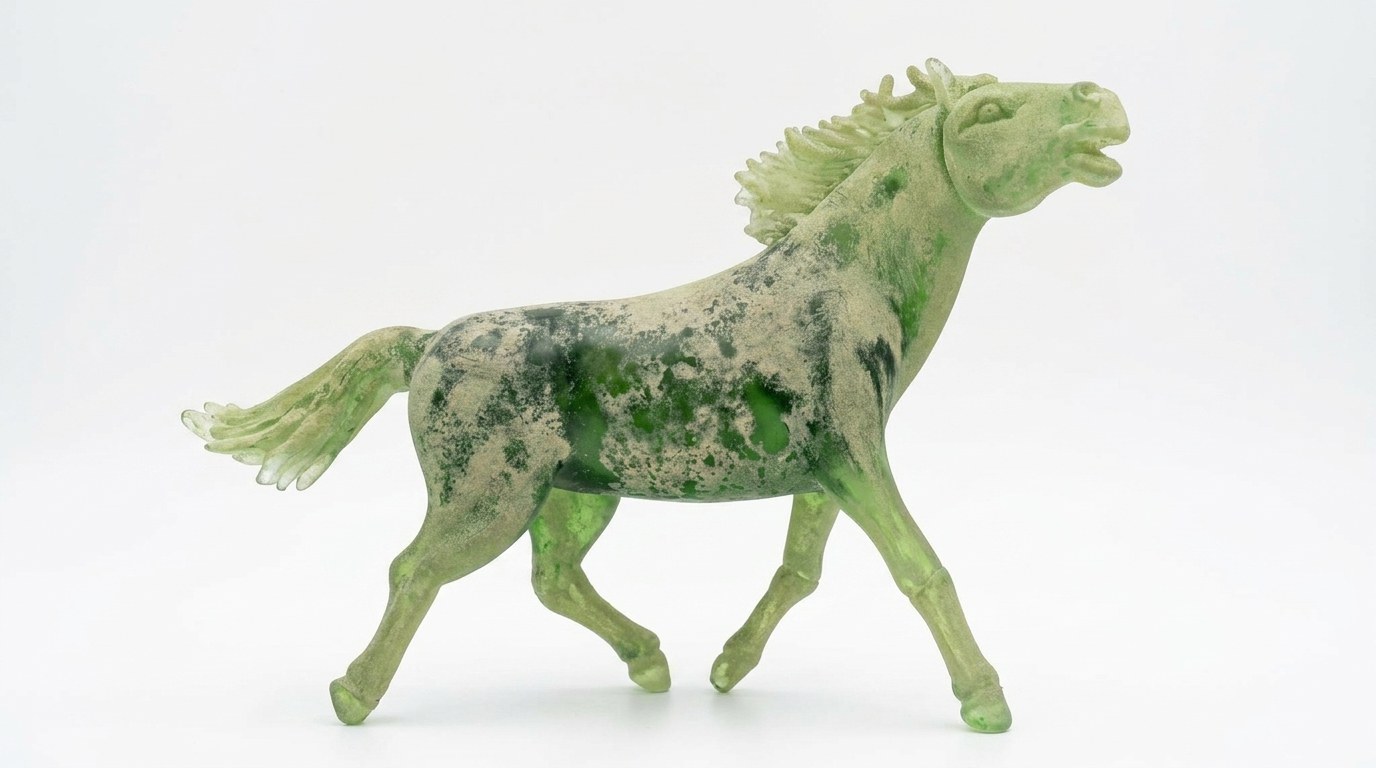
The Archaeologist’s Steed: Analyzing Arnaldo Zanella’s Signed Scavo Horse
Within the twentieth-century Muranese glass renaissance, few subjects tested a master's physical stamina and technical calculation as severely as the equestrian form. To sculpt a horse in solid glass (massello) requires an artist to manipulate a heavy, molten gather directly at the furnace while managing extreme thermal gradients to prevent catastrophic fracturing. When this immense physical challenge is paired with the volatile chemistry of a scavo (excavated) finish, the result is a masterwork of postwar design.
The A. Zanella Signed Scavo Horse is an exceptional case study of this intersection between kinetic sculpture and chemical archaeology. This profile integrates the structural specifications of the piece, details its original attribution, and provides a clear historical framework for why this work is firmly attributed to the Zanetti furnace.
Summary Profile for Appraisers & Historians
| Attribute | Archival & Visual Specification |
|---|---|
| Designer & Master | Arnaldo Zanella |
| Workshop / Furnace | Zanetti Vetreria Artistica / Zanetti Murano srl (collaborative senior master era) |
| Approximate Era | c. late 20th Century (Post-1991) |
| Primary Techniques | Massello (solid hot-sculpting) and Scavo (surface chemical corrosion) |
| Color Palette | Translucent emerald-green and vibrant lime-green glass core, heavily enveloped in a dusty white-to-cream-colored calcareous-like scavo crust |
| Anatomical & Pose Details | A trotting stallion captured in active stride; features a highly textured windswept mane, a stylized flared tail, articulated sculpted eyes, and an open muzzle |
| Height | 28.5 cm |
| Length | 43 cm |
| Width | Proportional (approximately 12–15 cm) |
| Base / Support | Freestanding; balanced directly on its four integrated, flat-polished glass hooves |
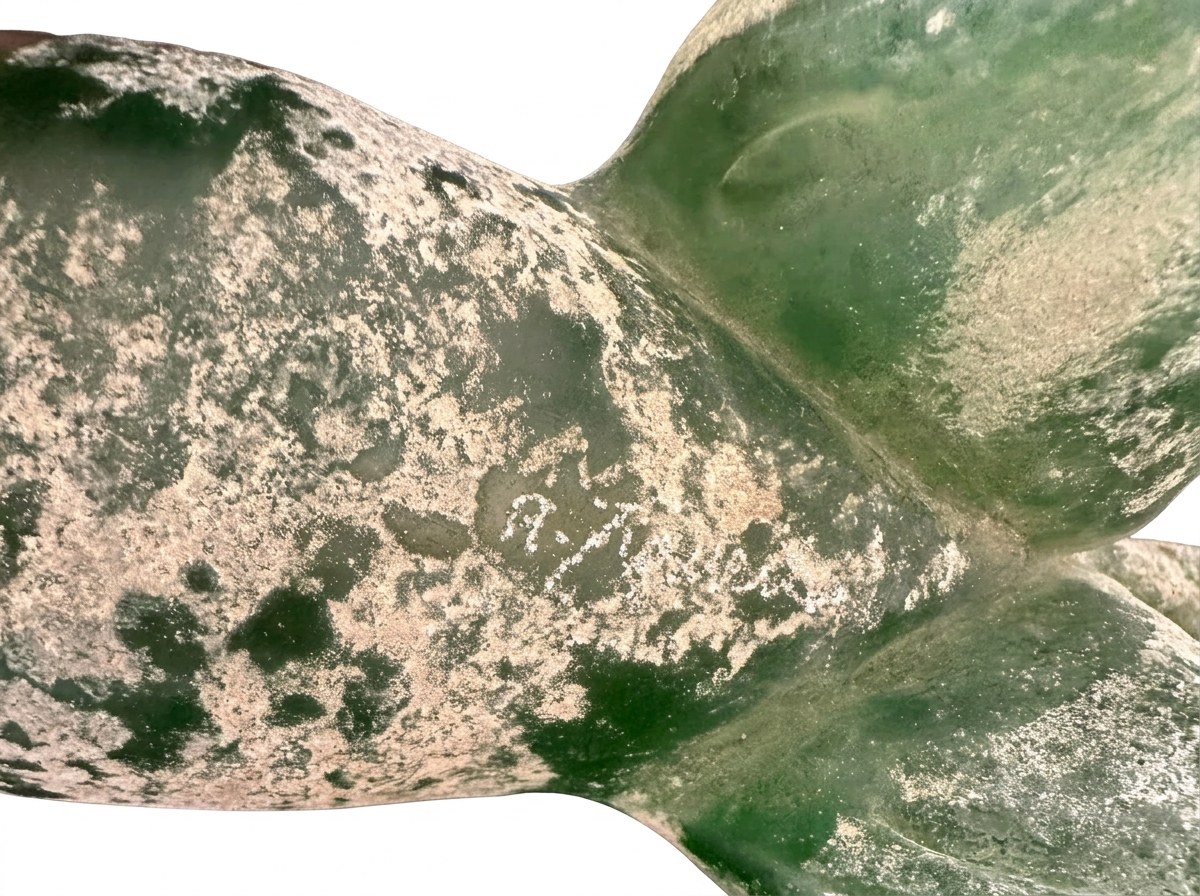
| Signage & Marking | Hand-etched "A. Zanella" cursive signature executed with a diamond-point tool directly onto the scavo-etched underbelly |
| Original Documentation | Original post and documentation attributed by Jenny Cox |
| Stylistic Paradigm | Expressive naturalism combining classical equestrian anatomy with raw, simulated antiquity, muting the glass’s natural gloss to highlight pure sculptural mass |
Technical Breakdown and Design Analysis
1. The Massello Challenge: Equine Balancing
To shape a horse of this scale from solid glass requires the master to work with an unblown, high-density gather. Because solid glass retains immense heat internally while the exterior cools rapidly, the artist faces a constant threat of thermal shock and cracking.
In this sculpture, Zanella captures a powerful sense of motion. Unlike static historical figurines, this stallion is frozen mid-stride. To support the massive weight of the solid torso on four slender, tapered legs, Zanella had to meticulously calculate the piece's center of gravity. By slightly bending the front-left and rear-right legs while extending the others, the weight is distributed evenly down to the polished glass hooves, allowing the heavy sculpture to stand freestanding without the aid of an attached glass base.
2. Chemical Alchemy: The Scavo Finish
The defining visual characteristic of this piece is its remarkable scavo finish. This technique, which translates literally to "excavated," was perfected on Murano to recreate the weathered appearance of ancient Roman or Syrian glass buried for centuries.
While the glass is still hot, a corrosive mixture of sodium, potassium, or ammonium salts is applied to the surface of the horse. The extreme heat fuses these chemicals to the outer layer, creating a dry, textured, and matte skin. On this stallion, the white, chalky scavo crust beautifully contrasts with the vibrant green glass showing through the mane, tail, and joints. By eliminating the glass's natural reflectivity, the scavo finish forces the viewer's eye to focus entirely on the dramatic contours, muscles, and athletic posture of the animal.
3. Signature Verification & Collector Value
For collectors and appraisers, authentication is paramount. The underside of the stallion's underbelly features a hand-etched cursive signature reading "A. Zanella".
This mark is executed with a diamond-point engraving tool directly onto the scavo surface. Unlike acid-stamped signatures or paper labels that can be lost or counterfeited over time, this hand-carved inscription is permanent and displays the fluid, handwritten hand of the master himself.
Furnace Attribution: How We Know This Was Created at Zanetti
For glass historians and appraisers, verifying which furnace a master-signed piece was executed at requires examining the artist's structural chronology, signature rights, and production specialties. Based on Arnaldo Zanella's professional timeline, we can conclusively establish that this Scavo Horse was created at Zanetti Vetreria Artistica (Zanetti Murano) rather than another furnace due to three critical factors:
1. The Timeline of Individual Signature Rights
Throughout his early career, Zanella did not have the authority to sign his own name to commercial glass art:
- Seguso Vetri d'Arte (1950s–1970s): Zanella worked strictly as an apprentice (garzone) and assistant (serventino) to Angelo Seguso. In this highly hierarchical system, individual assistants never signed their work; pieces carried the Seguso furnace mark or the master’s name.
- Pino Signoretto Studio (1978–1985): As Signoretto’s chief collaborator, Zanella executed monumental, complex sculptures, but always under Signoretto's brand and design direction. Pieces from this furnace were cataloged and signed as Signoretto works.
- Andromeda Murano (1985–1991): While Zanella co-founded Andromeda, the studio's output was strictly focused on high-end contemporary architectural lighting, custom chandeliers, and delicate decorative goblets. The studio did not specialize in heavy, unblown solid-glass scavo bestiary sculptures.
- Zanetti Murano srl (1991–Present): It was only after establishing his lifelong creative partnership with Oscar Zanetti in 1991 that Zanella operated as a senior partner with full master signature rights, signing pieces independently as "A. Zanella".
2. Specialized Focus on Monumental "Animalier" Art
While Zanella absorbed foundational techniques across multiple studios, his professional focus shifted entirely to monumental, freestanding animalier sculptures—his celebrated "Bestiary"—upon joining the Zanetti furnace in 1991. The physical scale of this stallion (measuring an impressive 28.5 cm high by 43 cm long) requires the specialized, heavy-duty annealing kilns and hot-shop infrastructure of the Zanetti workshop, which was specifically engineered to slowly cool massive, solid-sculpted animal forms.
3. Zanetti's Signature Scavo and Green Glass Aesthetics
The specific chemical profile of this horse—utilizing a vibrant, heavy green glass core under a dense, weathered white scavo salts crust—is a well-documented stylistic hallmark of Zanetti’s late-20th-century naturalistic catalog. Zanella and Oscar Zanetti utilized these exact matte, archaeological finishes on their collaborative animalier series (including Zanella's famed Scavo Elephant) to mute the reflective surface of the glass and emphasize the underlying muscular tension of the animals.
Furthermore, the style of the diamond-point cursive signature "A. Zanella" inscribed directly onto the rough, scavo-treated underbelly matches verified archival pieces on display at the Zanetti Murano Showroom and Venice Murano Museum.