The Seguso Dynasty: The Complete Murano Glass Collector's Guide
The Dynasties (The Bloodlines)
The Seguso Dynasty — The Masters of Thread and Form
Dynasty Key: The Seguso Dynasty
- Active Dynasty Window: 1397–Present (documented glassmaking lineage on Murano for over six centuries across twenty three generations)
- Ancestral Seat & Primary Kilns: Rio dei Vetrai, Murano | Fondamenta Vetrai 138 (Seguso Vetri d'Arte, 1933–1973) | Fondamenta Serenella 18 (Vetreria Archimede Seguso, 1948–Present) | Fondamenta Venier (Seguso Viro, 1993–Present)
- Hereditary Master Gaffers: Antonio Seguso (1828–1903) | Giovanni Seguso "Nane Patare" (1853–1931) | Antonio Seguso "Toni Patare" (1884–1965) | Archimede Seguso (1909–1999) | Ernesto Seguso (1908–1986) | Alberto Seguso (b. c. 1910) | Angelo Seguso (b. 1921) | Giampaolo Seguso (b. 1943) | Gino Seguso (b. 1938) | Antonio Seguso (b. 1967) | Gianluca Seguso | Pierpaolo Seguso | Gianandrea Seguso
- Signature Technical & Material Inventions: Bullicante (Controlled Bubble Casing, 1936) | Piton d'oro and Traliccio (Gold Thread Casing, 1938–1940) | Merletto (Garza Filigree Casing, 1950–1952) | Piume (Feathered Casing, 1956) | Fili Bianchi Continui (Continuous Verticals, 1962) | Colori and Fasce Sovrapposte (Submerged Layer Bands, 1966) | Spinati and Filigrana a Petali (Star and Petal Filigree, 1972) | Rotture (Solid Sommerso Sculpture, late career) | Carnevale (Angelo and Giampaolo Seguso, 1989)
- Market Price Tier: Investment Grade Contemporary Glass (especially verified interwar Archimede Seguso solid sculptures/animals, 1952 Merletto vases and figures, 1954 Composizione Lattimo, Siderale series, and early sommerso pieces by Flavio Poli)
Summary:
Discover the magnificent six century history and alchemical breakthroughs of the legendary Seguso Dynasty, the cornerstone of Murano glassmaking since 1397. This expert collector's guide covers the nineteenth century revival under Antonio Seguso, the modernist teachings of Giovanni "Nane Patare" Seguso, and the epoch defining twentieth century masterpieces of Archimede Seguso and his brother Angelo Seguso at Seguso Vetri d'Arte. Learn how to verify authentic diagnostic markers—including Zanfirico lace like Merletto casings, polished sommerso base rings, and authentic hand engraved cursive base signatures—to navigate the contemporary glass market with absolute curatorial confidence.
Genealogical Lineage Map
┌────────────────────────────────────────────────────────────────────────┐
│                        THE SEGUSO DYNASTY                              │
│                   - ANCESTRY & GENEALOGICAL DESCENT -                  │
└───────────────────────────────────┬────────────────────────────────────┘
                                    │
                                 Vincenzo
                                (c. 1505)
                                    │
                                 Giovanni
                             (Glassmaker 1575)
                                    │
                             [Centuries of]
                           [Continuous Guild]
                             [Registration]
                                    │
                                 Antonio
                               (1828–1903)
                         (Salviati & VM Foreman)
                                    │
                                 Giovanni
                            "Nane Patare"
                             (1853–1931)
                      (Cappellin & Venini Master)
                                    │
                                 Antonio
                             "Toni Patare"
                             (1884–1965)
                        (SVDA Founder, 1933)
                                    │
            ┌───────────────────────┼───────────────────────┐
            │                       │                       │
         Ernesto                Archimede                Angelo
       (1908–1986)             (1909–1999)              (b. 1921)
     (SVDA Director)         (VAS Founder, 1946)      (SVDA Master)
            │                       │                       │
         [Family Heirs]      ┌──────┴──────┐          [Joined VAs 1988]
                             │             │
                            Gino       Giampaolo
                          (b. 1938)    (b. 1943)
                        (VAS Manager) (Viro Founder)
                             │             │
                          Antonio    ┌─────┼─────┐
                         (b. 1967)   │     │     │
                                  Gianluca Pierpaolo Gianandrea
                                 (Returned SVDA to Family, 2009)
1. The Ancestral Roots and State Registry (1397–1850)
The historical longevity of the Seguso family is a defining pillar of the Muranese glassmaking tradition. The family's official connection to the Venetian art of glass is documented in a state archival registration dating back to May 3, 1397. For over six consecutive centuries and across twenty-three generations, the Seguso line has maintained its hot glass furnaces, making it one of the longest running, uninterrupted glass dynasties in the world.
Throughout the Renaissance and the early modern era, the family's members were regularly registered in the noble Libro d'Oro (Golden Book) of Murano, securing their elite civic, legal, and commercial privileges as master glassblowers of the first rank. In 1575, Giovanni Seguso, the son of Vincenzo Seguso (c. 1505), established a historic joint stock manufacturing contract with the prominent glass merchant Bastian Miotto. Under this agreement, Seguso provided the capital and technical oversight to run a multi-crucible furnace, a partnership that was successfully renewed in 1576.
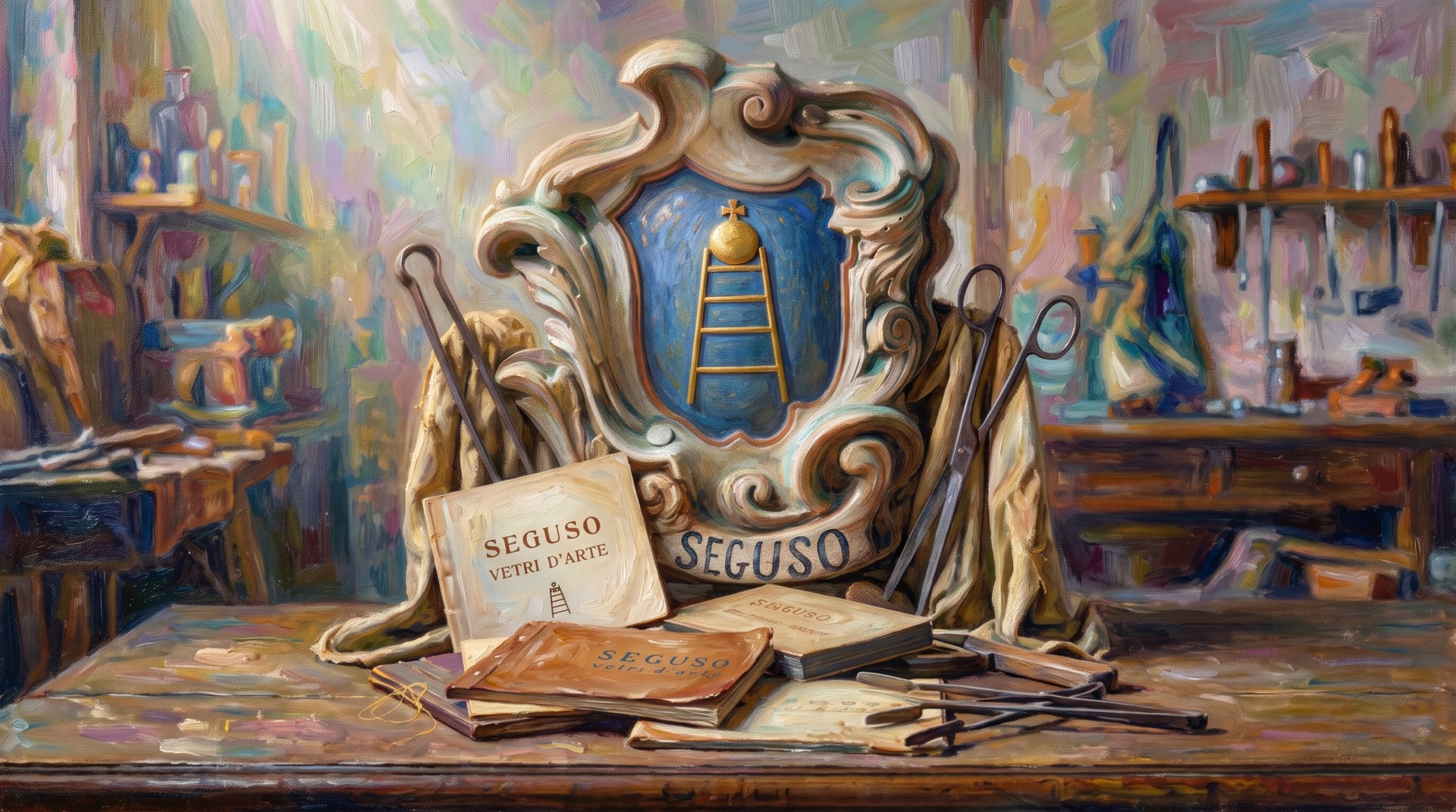
This early entrepreneurial and alchemical framework protected the family's proprietary formulas and furnace techniques during the peak centuries of Venetian glass export. When the Magnifica Comunita di Murano minted the official silver commemorative coins known as oselle, the heraldic coat of arms of the Seguso family—depicting a structured ladder surmounted by a globe—was proudly stamped on the metal. This heraldic seal, which remains painted on the ceiling of the Murano Glass Museum, stands as a lasting monument to the family’s structural and technical dominance within the lagoon.
2. Antonio Seguso and the Nineteenth Century Renaissance (1850–1911)
The catastrophic collapse of the Venetian Republic in 1797 and the subsequent century of foreign occupation reduced Murano's once mighty furnaces to ruins. By the mid nineteenth century, many of the island’s proudest lineages had been stripped of their independent workshops. The resurrection of the Seguso family began with Antonio Seguso (1828–1903), who emerged as a preeminent master glassblower during Murano's mid nineteenth century renaissance.
Recognizing that the survival of Murano glass depended on reclaiming forgotten Renaissance techniques, Antonio Seguso partnered with the pioneering lawyer Dr. Antonio Salviati, joining Salviati's newly established joint stock firm in 1866. At Salviati's kilns, Seguso demonstrated a supreme technical virtuosity. His mastery of classical Venetian forms earned him a Gold Medal at the landmark 1869 Murano Glass Exposition. In 1870, he was selected as part of the elite delegation of Muranese artisans to attend the Workmen’s International Exhibition in London, where his enameled and filigree glass designs captured the attention of British collectors.
From 1872 to 1877, Antonio Seguso served as the chief master foreman (maestro di prima piazza) for the successor firm, The Venice and Murano Glass and Mosaic Company. When Dr. Salviati withdrew from the corporation in 1877 following a dispute over design autonomy, Seguso chose to remain with the company, which was reorganized as the Compagnie di Vetri e Mosaici de Venezia e Murano (C.V.M.). His technical stewardship at C.V.M. preserved the ancient formulas for gold flecked avventurina, multi layered calcedonio, and delicate filigree, ensuring that these complex disciplines were passed intact to the next generation.
3. Giovanni Seguso ("Nane Patare") and the Venini Teachings (1911–1931)
The bridge between Murano's historicist revival and the birth of twentieth century modernism was forged by Antonio’s son, Giovanni Seguso (1853–1931), universally known within the lagoon by his alias "Nane Patare". Giovanni was a master glassblower of legendary physical strength and technical precision. In 1894, alongside the municipal historian Abbot Vincenzo Zanetti, he co-founded the short lived but highly influential cooperative Seguso Zanetti & C..
Following the liquidation of that cooperative, Giovanni was employed as a chief master blower by Andrea Rioda & C. from 1911 until 1921. The defining moment of his late career arrived in 1921, when he was hired as the chief master technician and Technical Director for the newly established Vetri Soffiati Muranesi Cappellin Venini & C.. At the Cappellin Venini furnace, Giovanni Seguso became the primary hand executing the revolutionary, minimalist transparent glass designed by the painter Vittorio Zecchin.
Giovanni's technical expertise was vital to the company's early success. Robert Linzler, a French journalist who visited the furnace floor c. 1922, described Giovanni Seguso as "heavy and muscular, carrying on his strong shoulders a round, brown head, with a visage taken from a Roman emperor". Giovanni's profound understanding of molten glass chemistry allowed him to produce the ultra thin, perfectly balanced transparent vessels that defined the early Venini aesthetic.
Paolo Venini never failed to acknowledge his immense debt to the aging master, famously stating: "Nane Patare taught me everything about glass". When Giacomo Cappellin left the partnership in 1925 to found his own independent workshop, Giovanni Seguso accompanied him to the Palazzo da Mula, where his presence was celebrated in the local press as the vital "link between the new and the old masters". Following World War I, Giovanni also volunteered his time to supervise the complex reorganization and physical reopening of the Murano Glass Museum, preserving its historic collections for future generations of scholars.
4. Antonio ("Toni Patare") and the 1933 SVDA Foundations
Giovanni’s son, Antonio Seguso (1884–1965), known as "Toni Patare," continued the family's legacy of elite glassblowing. After training under his father and working at Soffiera Cerruti and Vetreria Fratelli Toso, Antonio was hired in 1919 as a partner and Managing Director of the newly reorganized Vetreria Artistica Barovier & C..
The onset of the Great Depression severely impacted Murano's luxury sector. In 1931, a massive economic downsizing forced Antonio Seguso, along with his young sons Ernesto (1908–1986), Alberto, and Archimede (1909–1999), to leave the Barovier factory. Undeterred, Antonio immediately established a small, independent glassworks on the Campo del Cimitero, utilizing his family’s limited personal capital to build a temporary furnace. In 1932, they were joined by the master Napoleone Barovier and the technician Luigi Olimpio Ferro.
On January 30, 1933, this informal cooperative was legalized as a joint stock company under the name Artistica Vetreria e Soffieria Barovier Seguso e Ferro. Located at Fondamenta Vetrai 138, near the Vivarini bridge, the firm initially specialized in high end historicist table sets and classical lampshades designed by Vittorio Zecchin. Following Ferro's departure in 1937, the firm reorganized as Seguso Vetri d'Arte. Antonio Seguso served as the firm’s steady administrative hand, coordinating furnace logistics and managing their growing global distribution network until his retirement in 1964.
5. Archimede Seguso and the "Novecento" Sculptural Era (1933–1945)
Antonio's second son, Archimede Seguso (1909–1999), emerged as the undisputed technical genius of twentieth century Murano glass. Archimede began working on the furnace floor at eleven years of age, taking breakfast to his father and absorbing the deft movements of the master blowers. He trained under the direction of Napoleone Barovier, who quickly recognized the young boy’s extraordinary talent for hot modeling stylized animal figures.
Upon the founding of the Barovier Seguso e Ferro furnace in 1933, the twenty four year old Archimede was appointed as the firm's chief master blower (maestro di prima piazza). Working in close creative alignment with the firm's new Artistic Director, Flavio Poli, Archimede transformed the plastic, heavy forms of the Novecento art movement into glass masterpieces.
Archimede possessed an innate physical virtuosity that allowed him to manipulate massive, solid gathers of glass (vetro massiccio) directly on the blowpipe while standing in front of the roaring furnace. Among his technical and artistic achievements during this interwar period were:
- The Solid Glass Sculptures: A series of monumental animal figures—including heavy bears, elephants, owls, and horses hot modeled from a solid glass mass cased with gold leaf and fine chemical powders to mimic plumage and fur.
- The Sommerso and Bullicante Series (1936–1938): Highly stylized, thick walled solid glass figures of female nudes and sea creatures executed in heavy cased colored glass with controlled patterns of air bubbles (bullicante) and internal gold leaf.
- The Archaic Corroso Vessels: Heavy, asymmetrical vases designed by Flavio Poli, which Archimede acid corroded using hydrofluoric acid to mimic the weathered, encrusted surfaces of ancient Roman glass.
While Archimede's virtuosity secured international acclaim for Seguso Vetri d'Arte at successive Venice Biennales and Milan Triennali, the extreme physical toll of blowing heavy glass took a severe strain on his health. In 1942, Archimede began working part-time, and in January 1944 he officially withdrew from the Seguso Vetri d'Arte partnership, selling his shares to his brother Ernesto for 55,000 lire and a selected group of original glass pieces from his personal collection.
6. Vetreria Archimede Seguso: The Golden Age of Lace and Thread (1945–1972)
Following the conclusion of World War II, a fully recovered Archimede Seguso reclaimed his professional autonomy. In late 1945, he established a temporary, small workshop on the Campo del Cimitero alongside the master Alfredo Barbini. Following Barbini's departure in 1946, Archimede ran the workshop alone under the trade name Seguso Archimede. On October 10, 1948, he officially inaugurated his permanent, state of the art factory at Fondamenta Serenella 18, trading under the name Vetreria Archimede Seguso.
At Fondamenta Serenella, Archimede held the dual role of chief designer and master blower, launching a twenty year creative crusade that produced some of the most complex art glass ever executed. Archimede turned his focus toward adapting ancient Renaissance filigree (filigrana) techniques into modern, abstract design languages. This experimental phase yielded several legendary collections:
- The Merletto (Lace) Series (1950–1952): Perhaps his most celebrated technical invention, these heavy but delicate vessels were executed using a highly complex variation of a retortoli filigree. Archimede composed intricate webs using ultra fine opaque white (lattimo) filigree canes—known within the Archimede Seguso furnace as Garza (gauze)—on a cold plate, fused them in the kiln, gathered them on a blowpipe, and expanded them into asymmetric vases. Standing before the roaring kiln, Archimede shaped and distorted these complex threads entirely by hand, relying on the natural expansion, twisting, and physical manipulation of the hot glass gather without the use of any molds or centrifugal machinery, creating a shimmering, layered fabric like pattern that stunned collectors at the 1952 Venice Biennale.
- Composizione Lattimo (1954): Minimalist vessels composed of vertically sliced white zanfirico canes placed adjacent to each other, creating clean, geometric panels cased in perfectly polished colorless crystal.
- The Piume (Feathers) Series (1956): Vessels of thick, organic contours containing suspended, floating feathered elements cased in gold leaf, which were widely acclaimed at the 1956 Venice Biennale.
- Fili Bianchi Continui (1962): Clean, sculptural blown glass decorated with microscopic, continuous parallel white threads that traced the changing contours of the vessel wall.
In the 1960s, Archimede embraced vibrant, saturated colorways, designing the colori sovrapposte and fasce sovrapposte series (1966), which featured flat, intersecting bands of highly contrasting cased colored glass that highlighted the transparency of the material. This was followed by the Spinati and Filigrana a Petali (1972), which pushed the filigree discipline to its absolute limit by embedding star shaped sections of colored canes inside asymmetrical vessels of a light, ethereal presence.
7. The Late Century Transitions, Seguso Viro, and the Return of the Brand (1972–2009)
While Archimede flourished at Fondamenta Serenella, the original Seguso Vetri d'Arte furnace at Fondamenta Vetrai underwent its own transitions. Following Antonio's retirement in 1964 and Ernesto's departure in 1966, the management of the firm was taken over by Antonio's youngest son, Angelo Seguso (b. 1921). Angelo, an exceptional master blower who had spent decades executing Flavio Poli's award winning sommerso designs, served as the Managing Director of Seguso Vetri d'Arte during its final, highly competitive decade.
Due to rising labor costs and shifting design trends, Seguso Vetri d'Arte officially closed and entered liquidation on December 15, 1973. The factory, the trade name, and its massive historic archive of 30,000 original drawings were purchased in 1978 by the prominent investor Maurizio Albarelli. Angelo Seguso continued to work for the reorganized firm as a master blower until 1985, after which he officially joined his brother Archimede at Fondamenta Serenella in 1988.
The next generation of the Seguso dynasty took up the mantle of innovation. In 1993, Archimede’s second son, Giampaolo Seguso (b. 1943), who had worked as his father's administrative and artistic director for decades, parted ways with the family firm to establish his own independent glassworks: Seguso Viro. Founded alongside his sons Gianluca, Pierpaolo, and Gianandrea, Seguso Viro combined ancient techniques with contemporary, limited edition glass poetry. On January 1, 2001, Giampaolo instituted the strict policy of limiting all new creations to exactly 101 numbered copies, combining technical complexity with extreme curatorial exclusivity.
A highly symbolic passing of the baton occurred in 1995. Aunt Maria, the widow of Ernesto Seguso, visited the Seguso Viro headquarters in Venice and presented Giampaolo with two small, hand written alchemical notebooks containing the original color recipes of Seguso Vetri d'Arte. These secret formulas—including their signature verde erba (grass green), blu Savoy (Savoy blue), fumo di Londra (London fog), and Giovanni's legendary, heavy version of lattimo—were successfully integrated into Seguso Viro’s modern melts, preserving the chemical soul of the family line.
The ultimate corporate and emotional triumph arrived on December 5, 2009. Gianluca Seguso negotiated a historic contract with Amelio Cenedese, who had acquired the Seguso Vetri d'Arte brand in the early 1990s. Under this agreement, the legendary Seguso Vetri d'Arte brand, its historic headquarters, and its massive curatorial archive were officially bought back and returned to the hands of the Seguso family. Operating today under the joint administration of Gianluca and Pierpaolo, the unified Seguso Vetri d'Arte and Seguso Viro houses continue to blow glass on their ancestral island, ensuring that the flame first lit in 1397 continues to burn into the twenty first century.
8. The Collector's Diagnostic Checklist: Modern and Mid Century Seguso Glass
To identify, date, and value original art glass produced by Seguso Vetri d'Arte and Vetreria Archimede Seguso (c. 1933–1990), collectors must utilize the following diagnostic criteria:
- Evaluating Filigree Integrity in "Merletto" Wares: Authentic Archimede Seguso Merletto wares from the 1950s must show a complex, layered thread network of fine lattimo Garza canes that is perfectly embedded inside thick, clear crystal walls. Because these pieces were shaped entirely by hand without any molds, there must be zero unsealed cracks, heavy bubbles, or sharp surface ridges along the vessel walls. The splayed rim should be thin, showing natural organic expansion lines from hand shaping.
- Analyzing Pontil Scars on Sommerso Vessels: Mid century sommerso glass designed by Flavio Poli for Seguso Vetri d'Arte features flat, highly polished, and hand ground base rings. The pontil scar on the underside of the base must be ground completely flat, polished to a mirror finish, and show no rough, unfinished concentric fractures.
- Verifying Gold Leaf Casing in Interwar Sculptures: Interwar solid glass animals executed by Archimede Seguso contain heavy flecks of gold leaf (buccole d'oro) cased deep within the solid glass mass. The gold must appear as a suspended, shimmering, three dimensional mist rather than a flat, surface gilded paint.
- The Price Tiers:
- Ultra Premium Investment Grade: Original 1952 Archimede Seguso Merletto vases (carrying early Biennale labels or hand signed signatures), interwar massello stylized figures, and 1952 Flavio Poli Siderale bottles. These regularly command high five figure sums at specialized design auctions.
- Mid-Range: Unsigned 1950s sommerso block vases, Archimede Seguso Piume or Fili Bianchi vessels, and Seguso Viro signed limited editions of the 1990s.
- Accessible: Post-1980 commercial showroom paperweights, signed animal figurines from the Albarelli era, and contemporary corporate production stemwares.
9. Forensic Chronology of Base Markings & Signatures
Because the Seguso workshops underwent multiple corporate transitions, ownership shifts, and commercial partnerships across seven decades, their creations carry highly distinct, chronologically clear markings that determine their value and authenticity on the collector's market:
I. The Anonymous Retailer Era & Early Export Marks (1930–1936)
During its initial years as Barovier Seguso & Ferro, the furnace operated as an anonymous manufacturer for high-end luxury retailers, who applied their own proprietary marks:
- Compagnia Venezia Murano (C.V.M.) Acid Stamps: Pieces retailed through C.V.M. carry an acid-etched crown emblem above the linear designation
VENICE MURANO COMPANYorC.V.M.. - Pauly & C. Retailer Labels: Wares sold through Pauly & C. carry serrated rectangular paper labels with red or blue printed borders containing handwritten inventory numbers. These labels frequently include technical clerk annotations:
FP(fuori produzione / discontinued) orNR(non ripetibile / unique, unrepeatable execution). - Veronese Retailer Stamps: Artistic glass ordered by the Parisian boutique of Marcel Barbier carries a sharp acid stamp reading
Veronese ItalieorVeronese Seguso Italie. - First Factory Export Stamp (1936): Following Venetian export regulations introduced in 1936, Artistica Soffieria e Vetreria - Barovier Seguso & Ferro introduced a standardized, two line acid base stamp reading
Made in / Italyin block capital letters, used in conjunction with a rectangular paper factory label readingA.S.V. BAROVIER SEGUSO & FERRO / MURANO.
II. The Seguso Vetri d'Arte Pre-War Era (1937–1945)
Following the 1937 corporate reorganization, the factory adopted its iconic brand identity:
- The Antonio Seguso Acid Stamp: The cursive, handwritten signature of co-founder
Antonio Segusowas incorporated into a furnace acid stamp to mark artistic production. This same emblem was impressed into metal fixtures for chandeliers and architectural lighting. - Factory Paper Labels: Rectangular paper labels reading
SEGUSO VETRI D'ARTE / Muranodivided by a horizontal line, beneath which model numbers (such as 3984 or 5346) were written in ink. - Discontinuation (1945): All pre-war paper labels, Veronese retailer stamps, and Antonio Seguso acid stamps were permanently retired at the conclusion of World War II.
III. Post-War Reconstruction & Seguso s.r.l. Labels (1946–1949)
- Reconstruction Paper Decals (1946–1948): Serrated paper labels reading
SEGUSO / VETRI D'ARTE / MURANObearing price fields (L. [Price]) and model numbers (440.000). - The Seguso s.r.l. Transition (1949): Following the brief corporate renaming to Seguso s.r.l., a new rectangular paper decal was introduced reading
SEGUSO / VETRI D'ARTE / MURANO / Made in Italy.
IV. The Golden Age of Hand-Engraved Signatures & Heraldic Decals (1950–1962)
During Flavio Poli's tenure as Artistic Director, high end artistic production (including sommerso, corrosi, and pulegoso wares) carried delicate hand engraved signatures:
- Hand-Engraved Cursive Signatures: Cursive, diamond-point base engravings reading
Seguso MuranoorSeguso(frequently scored with a hand-guided underline). - Retailer Dual Engravings: Rare export pieces carry combined hand-engravings reading
Veronese Seguso MuranoorSalviati(when retailed through Salviati's galleries). - The Flavio Poli Signature Rule: Flavio Poli's personal signature (
Flavio Poli) was never applied at the furnace during production. Poli added his signature retroactively upon request at retrospective gallery exhibitions in later decades. - The Heraldic Oval Decal (1952): Commemorating the opening of their Milan showroom, a standing oval paper/foil label was introduced displaying the Seguso heraldic coat of arms—a ladder surmounted by a globe and cross—surrounded by the showroom address.
- The Shield Foil Decals (1953–1959): Metallic gold or silver shield-shaped foil labels displaying the central ladder and globe emblem with text reading
SEGUSO VETRI D'ARTE / MURANO / MADE IN ITALYand handwritten catalog numbers. - Late 1950s Transparent Decals: Fragile, round transparent plastic decals displaying the company name in white, paired with rectangular paper tags indicating model numbers.
V. The Mario Pinzoni Era & Anonymous Factory Standard (1963–1973)
- The Pinzoni Paper Label (1963): Designed by artistic director Mario Pinzoni, a new rectangular paper label was introduced featuring the ladder emblem inside a dark oval with
seguso / vetri d'arte / MADE IN ITALYorseguso / murano. - The Abandonment of Engravings: Under Pinzoni's direction, all hand engraved base signatures were officially abandoned. Mid 1960s to 1973 production relied exclusively on paper decals.
VI. The Albarelli Era & Reintroduced Signatures (1978–1993)
- Reintroduced Base Engravings: Following Maurizio Albarelli's acquisition in 1978, base engravings were restored, reading
Seguso d'Albarelli,SVD'A Albarelli, orseguso vetri d'arte. - Plastic Decals: Heavy, rectangular white plastic labels with crisp black text reading
seguso vetri d'arte.
VII. Vetreria Archimede Seguso Forensic Markings (1947–1999)
- Early Independent Script (1947–1950): Fine diamond-point cursive script reading
Archimede Seguso / MuranoorArchimede Seguso. - Golden Filigree Era (1950–1975): Cursive diamond-point signatures reading
Seguso Archimede(frequently underlined) orArchimede Seguso. Exhibition pieces carry event engravings such asSeguso Archimede / Biennale 1954orSeguso Archimede / Milan 1951. - Scalloped Foil Labels: Distinctive gold or silver foil labels with serrated/scalloped edges displaying the central circular furnace logo surrounded by
ARCHIMEDE SEGUSO / MURANO / MADE IN ITALY. - Elsa Peretti & Tiffany Marks (Post-1982): Dual diamond-point engravings reading
Elsa Peretti / Archimede SegusoorArchimede Seguso for Tiffany & Co.. - Vibro-Engravings & Retroactive Signatures (Post-1975): Mechanical vibrating pen signatures (
Archimede Seguso Murano). Retroactive signatures were frequently added by Archimede at retrospective exhibitions on unsigned 1950s Merletto pieces.
VIII. Seguso Viro & Modern Regional Trademark Markings (Post-1993)
- Seguso Viro Limited Editions: Precision diamond-point / laser engraved signatures reading
Seguso Viro / [Model Name] / [Number]/101. - Vetro Artistico® Murano Regional Trademark (Post-1994): Following the creation of the official regional trade seal under Veneto Law No. 70/94, modern contemporary pieces produced by Vetreria Gianni Seguso carry the official Vetro Artistico® Murano trademark sticker with Factory Code 032. Vintage mid-century pieces (pre-1994) never carry this sticker.
10. Attribution & Authenticity
In the Murano glassmaking tradition, the difference between a fake and a copy rests entirely on intent, origin, and transparent attribution. A fake is a deceptive counterfeit manufactured outside of Murano—often in mass production factories in Asia or Eastern Europe—that utilizes cheap materials and carries forged signatures or illicit trademark stickers to intentionally defraud collectors. Conversely, a copy is a legitimate artistic homage (omaggio) handcrafted by a skilled master using authentic Murano techniques and materials; it serves as a tribute to honor a legendary artisan's legacy and is openly signed by the modern creator, preserving the lineage of Venetian glassblowing rather than exploiting it.
Join Our Facebook Group Identify Your Murano - Murano Glass Animals