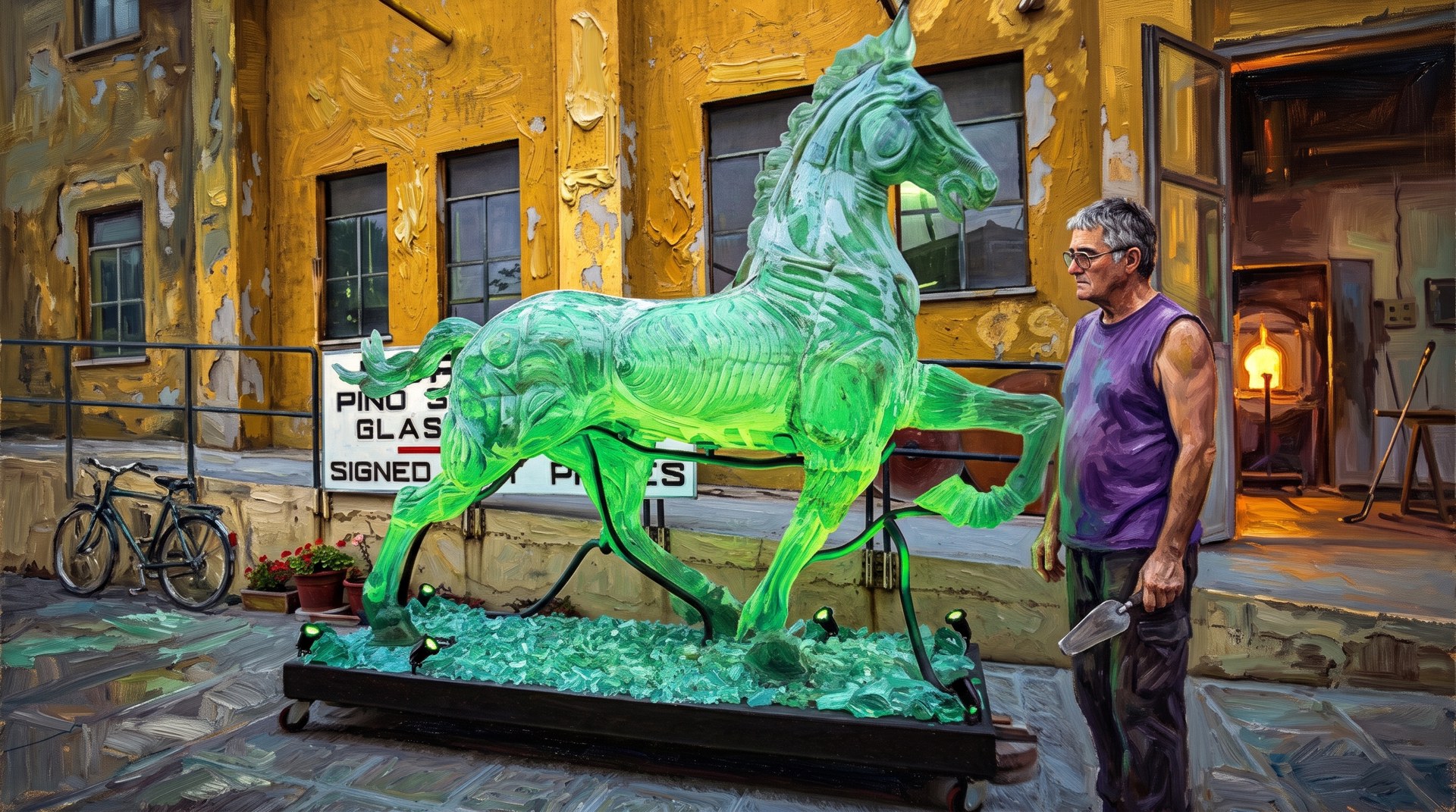
Pino Signoretto Murano Glass: The Ultimate Sculptor's Markings Guide
The Murano Maestri: A Collector's Guide
Pino Signoretto — The Sculptor of Monumental Mass
Artist Key: Pino Signoretto
- Role: Master Glass Sculptor (Maestro di Prima Piazza)
- Life/Dates: Favaro Veneto, September 18, 1944 – Murano, December 30, 2017
- Primary Furnaces: Vetraria Alfredo Barbini (Apprentice, 1950s) | Salviati & Company (Maestro, 1960s) | I.V.R. Mazzega (Chief Maestro, late 1960s, 1971–1973) | Sculture Artistiche Muranesi (S.A.M., 1973–1976) | Seguso Vetri d'Arte (1976–1978) | Independent Studio (1978–2017)
- Signature Techniques: Vetro Massello (Solid hot-glass freehand sculpting) | Plasticato (Centrifugal hot-tool pinching and body draping) | Vetro Corroso e Polveri (Fused mineral powder casings) | Soffiatura alla Graticola (Grid-assisted blow-molding) | Multi-Bench Thermal Synchronization
- Market Price Tier: High-End Investment Grade (specifically 1971–1973 I.V.R. Mazzega solid Amanti sculptures, 1970s S.A.M. cased animals, and custom fine-art collaborations with Robert Willson) to Mid-Range (post-1978 signed studio animals, heavy solid horse sculptures, and late-era decorative centerpieces)
- Key Collaborators: Alfredo Barbini | Ermanno Nason | Livio Seguso | Angelo Seguso | Maurizio Albarelli | Robert Willson | Libero Vitali | Michele Burato | Salvador Dalí | Jeff Koons | Emilio Vedova | Marc Quinn | Kiki Smith | Elizabeth Murray
Summary:
Discover the magnificent legacy and technical mastery of Pino Signoretto, Murano’s undisputed titan of solid hot-glass sculpting. This expert collector's guide covers his career from his training under Alfredo Barbini and Ermanno Nason to his chief master tenures at I.V.R. mazzega, S.A.M., and Seguso Vetri d'Arte before opening his own studio in 1978. Learn how to verify authentic diagnostic markers—including mazzega paper labels, S.A.M. engraved base signatures, Seguso Vetri d'Arte bicolored decals, and his own flowing diamond-point script—to confidently identify his creations, avoid cheap contemporary counterfeits, and discover investment-grade treasures.
Visual Career Timeline
              ┌──────────────────────────────────────────────────────────┐
              │                     PINO SIGNORETTO                      │
              │             - THE SCULPTOR OF MONUMENTAL MASS -          │
              └──────────────────────────┬───────────────────────────────┘
                                         │
     ┌───────┐                           ▼
     │ 1944  │ ──► Born September 18 in Favaro Veneto into a non-glassmaking family.
     └───────┘                           │
     ┌───────┐                           ▼
     │ 1954  │ ──► Enters the furnace at age ten, apprenticing at a lighting factory.
     └───────┘                           │
     │                                   ├─► Undergoes rigorous training under master Alfredo Barbini.
     │                                   └─► Studies physical form under Livio Seguso at Salviati & C.
     │                                   │
     ┌───────┐                           ▼
     │ 1960  │ ──► Attains the rank of chief maestro at only sixteen years of age.
     └───────┘                           │
     │                                   ├─► Shares the workbench with Ermanno Nason at I.V.R. Mazzega.
     │                                   └─► Masters the physical limits of solid and cased glass plasticity.
     │                                   │
     ┌───────┐                           ▼
     │1971-73│ ──► Chief maestro at I.V.R. Mazzega; creates the landmark solid "Amanti" series.
     └───────┘                           │
     ┌───────┐                           ▼
     │1973-76│ ──► Serves as principal gaffer at Sculture Artistiche Muranesi (S.A.M.) with Angelo Seguso.
     └───────┘                           │
     ┌───────┐                           ▼
     │1976-78│ ──► Leads the sculpting workbench at Seguso Vetri d'Arte under Maurizio Albarelli.
     └───────┘                           │
     ┌───────┐                           ▼
     │ 1978  │ ──► Establishes his own independent Murano studio, initiating his fine-art gallery era.
     └───────┘                           │
     │                                   ├─► Executes monumental solid works for Dalí, Quinn, and Vedova.
     │                                   └─► Teaches Muranese technical secrets at Pilchuck in Seattle (from 1989).
     │                                   │
     ┌───────┐                           ▼
     │ 2017  │ ──► Passes away December 30 in Murano, leaving a legacy of unprecedented, muscular scale.
     └───────┘
1. The Legend & Legacy: The Titan of Molten Mass
In the historical development of modern Murano glass, Pino Signoretto stands as the ultimate physical force of the twentieth century—the master who tore glass away from its centuries-old reliance on thin, hollow vessels and transformed it into a monumental, solid, and expressive sculptural medium. Born on September 18, 1944, in Favaro Veneto, Signoretto was not born into an established glassmaking dynasty. This absence of traditional family constraints allowed him to approach the furnace floor with a completely open, untrammeled imagination, treating molten silica not as a bubble to be blown, but as a heavy, viscous clay to be carved, sheared, and modeled.
Signoretto's journey began out of sheer economic necessity. In 1954, at the exceptionally young age of ten, he entered a small local factory making lighting fixtures and bomboniere as a general helper. His explosive natural talent, rare physical coordination, and immense stamina caught the attention of the island's premier masters. Over the next decade, he underwent a grueling, multi-furnace training period. He absorbed the rules of heavy, solid cased glass directly under Alfredo Barbini, mastered abstract physical form under Livio Seguso at Salviati & C., and studied the outer reaches of hot-glass manipulation alongside Ermanno Nason at I.V.R. Mazzega, building a robust, versatile vocabulary of sculptural techniques.
Signoretto's rise was unprecedented in Murano's highly conservative guild hierarchy. In 1960, at only sixteen years of age, he was formally proclaimed a master glassmaker (maestro). Seeking to challenge the traditional limits of the medium, Signoretto returned to I.V.R. Mazzega as chief master blower from 1971 to 1973. During this brief, highly creative period, he created his historic Amanti (Lovers) series—massive, solid, cased sculptures of embraced figures that pushed the physical and thermodynamic capacity of hot glass to its absolute breaking point.
By 1973, Signoretto’s peerless reputation as a master sculptor attracted the entrepreneur Maurizio Albarelli. Signoretto was hired as the principal maestro alongside Angelo Seguso at Sculture Artistiche Muranesi (S.A.M.), subsequently transitioning in 1976 to lead the sculpting bench at Seguso Vetri d'Arte under Albarelli's direction. During these furnace runs, Signoretto’s massive physical strength enabled the furnaces to bypass the prevailing minimalist trend of the 1970s, keeping Murano’s rich, color-heavy sculptural traditions alive with massive, cased solid figures.
In 1978, seeking complete creative independence, Signoretto opened his own studio on Murano, launching his legendary fine-art gallery era. Over the next four decades, he became the primary physical medium for the world's leading contemporary painters and sculptors, executing monumental, solid glass designs for Salvador Dalí, Jeff Koons, Emilio Vedova, Marc Quinn, and Robert Willson. He also became an essential international educator, teaching Murano’s highly guarded technical secrets over several summers at the Pilchuck Glass School in Seattle starting in 1989. Remaining active at the workbench until his passing on December 30, 2017, Signoretto left behind an immortal legacy as the undisputed giant who sculpted monumental mass with hot fire.
2. Advanced Geometries of Solid Sculpting & Thermal Viscosity
Pino Signoretto's technical mastery was defined by his capacity to model massive, solid gathers of glass weighing hundreds of pounds freehand, without the aid of automated molds. He relied entirely on rapid physical speed, calculated thermal tension, and specialized tools:
- Monolithic Solid Sculpting (Vetro Massello): Signoretto was Murano’s absolute master of manipulating solid, non-hollow glass, a technique introduced in Murano in the early 1930s. Gathering a red-hot mass of up to eighty pounds on his solid iron rod (canna non forata), he sat at the glassblower's bench (scagno) and modeled the fluid, 1000°C material. Because solid glass of this weight cannot be inflated, he shaped the forms entirely from the outside using heavy wooden paddles (patatoci), wet newspaper pads (carta), jacks (tagianti or taianti), and large iron shears, cutting and stretching the limbs of horses, dancers, and figures while the core of the glass remained a white-hot, viscous melt.
- The Centrifugal Gravity Fold (Plasticato): Used extensively on his stylized human forms, Signoretto utilized heavy iron pincers (borselle) to seize, crimp, and fold the hot outer skin of cased solid blocks, allowing gravity to drape the cooling mass into elegant, flowing, and spontaneous silhouettes.
- Thermodynamic Symmetries & Thermal Zone Control: Sculpting massive blocks of solid glass introduces severe thermal tension. Because the outer layer of a thick block cools and contracts rapidly upon exposure to room air while the inner core remains an extremely hot, expanded liquid, the resulting tension can cause the entire sculpture to violently explode. To combat this, Signoretto developed an extraordinary, non-verbal intuition for thermal zones. He subjected the sculpture to constant, precise flash-heating cycles at the glory hole, maintaining the outer skin's temperature at a stable plastic state while preventing the inner core from overheating and collapsing, ensuring a flawless, stress-free annealing process.
- Vetro Corroso e Polveri (Mineral Powder Casings): To achieve highly realistic, organic textures, Signoretto cased his solid figures in multiple layers of colored mineral powders, glass fragments, and metallic gold-foil layers. While the solid sculpture was white-hot, he rolled it across a steel plate (bronzino or marmore) layered with polychrome mineral dust, fusing the powders to the core before casing the entire parison in a thick layer of transparent crystal. He often finished these works cold using hydrofluoric acid lead-baths to dissolve silica and scatter surface glare, creating a soft satin finish (velato) that mimicked carved stone.
- Multi-Bench Synchronization: For monumental architectural works, Signoretto operated as a choreographer, directing a team of up to twelve assistants who prepared cased hollow and solid glass elements on separate pipes simultaneously. Signoretto gathered and fused these red-hot, complex components at the exact second when their furnace temperatures were perfectly matched, ensuring a seamless, thermal-shock-free bond.
3. Famous Collaborations: The Sculptor's Medium
Pino Signoretto's entire career was characterized by his role as the premier physical translator for the world's leading creative minds:
- Ermanno Nason: Working alongside Nason at I.V.R. Mazzega in the late 1960s, Signoretto inherited Nason’s ambition to probe the absolute boundaries of solid glass modeling, transitioning from standard tableware into the realm of fine-art sculpture.
- Maurizio Albarelli: Under Albarelli's entrepreneurial leadership at S.A.M. and Seguso Vetri d'Arte during the 1970s, Signoretto was given complete freedom to reject the era's formal minimalism, keeping Murano’s rich, color-heavy sculptural traditions alive.
- Robert Willson: From the early 1980s onwards, the American sculptor collaborated closely with Signoretto on the Murano furnace floor. Together, they bypassed the traditional glassmaking rules to construct giant, colorful, and abstract totemic sculptures that utilized complex internal cane and metallic fusions.
- Libero Vitali: Beginning in 1977, the painter partnered with Signoretto to create a series of highly stylized, solid glass human nudes. In these works, Vitali’s delicate graphic outlines were rendered as three-dimensional cased volumes through Signoretto’s masterful hand-tooling.
- Michele Burato: In the 1990s, Signoretto collaborated with Burato to create a spectacular series of large-scale animal figures, including his famous Large Monkey (scimmione). Burato's experiments with Bullseye glass canes, murrine, and mineral powders were fused directly onto Signoretto's massive solid animal bodies, creating a highly textured, chromatic masterwork.
- Contemporary Fine Artists: In his later years, Signoretto became the trusted gaffer for global avant-garde artists, physically executing complex, highly technical solid glass sculptures for Salvador Dalí, Jeff Koons, Emilio Vedova, Marc Quinn, Elizabeth Murray, and Kiki Smith.
4. The Forensic Chronology of Factory Markings (1971–2017)
Because Pino Signoretto operated across several highly distinct Murano factories before establishing his independent studio in 1978, collectors and curators must verify his work using a strict, chronologically mapped sequence of furnace markings, base finishes, and paper labels:
I. The I.V.R. Mazzega Era (1971–1973)
- The Unsigned Wares: Standard production items and tablewares executed by Signoretto's bench during this brief tenure were typically unsigned.
- Diagnostic Labels: Verify these early works by looking for the factory's standard rectangular paper label reading:
I.V.R. MAZZEGA MURANOorI.V.R. di MAZZEGAprinted in black block lettering. - Specialty Signatures: Major early runs of his solid Amanti series or experimental solid animals occasionally carry a delicate, hand-guided diamond-point engraved base signature reading:
Pino Signoretto per I.V.R. Mazzegaor simplyPino Signoretto.
II. The S.A.M. (Sculture Artistiche Muranesi) Period (1973–1976)
Following his hiring by Maurizio Albarelli, Signoretto’s heavy solid works are highly documented.
- The Engraved Signatures: Authentic pieces bear a hand-guided, diamond-point engraved base signature reading:
S.A.M. Murano - Aesthetic Base Finishes: Solid glass animal sculptures from this period exhibit thick cased walls, ground-polished flat base rings, and polished, offset pontil scars.
III. The Seguso Vetri d'Arte Period (1976–1978)
When S.A.M. transitioned back to the Seguso Vetri d'Arte name under Albarelli, several distinct markings were utilized on Signoretto's bench executions:
- The Showroom Label: Opaque paper stickers with a thin double-line border reading
SEGUSO VETRI D'ARTE MURANOwith space for a handwritten or typed model code (e.g.13981or12456). - The Round Foil Sticker: Circular black and gold foil stickers reading
MURANO GLASS SEGUSO VETRI D'ARTE MADE IN ITALYplaced on the lower wall of the piece. - The Vibro-Engraved Base Signatures: Highly diagnostic hand-guided engravings on the polished base ring reading:
Svt d'AlbarelliorSeguso Vetri d'Arteaccompanied by the exact year of manufacture (such asSvt d'Albarelli 77orSeguso Vetri d'Arte 78). Some pieces carry the combined mechanical engravingSEGUSO VETRI D’ARTE PINO Signoretto.
IV. His Own Independent Murano Studio (1978–2017)
- The Fluid Cursive Signature: Following his departure from Seguso Vetri d'Arte, Signoretto signed all studio creations on the base using a highly fluid, cursive diamond-point engraving pen reading:
Pino Signoretto - Dual Signatures: Fused fine-art collaborations carry joint signatures, such as
Pino Signoretto per Robert WillsonorDalí per Signoretto. - The Forgery Warning (The Dental Drill Rule): Authentic signatures from all his tenures were executed strictly using wheel-carving or diamond-point scratching. Beware of modern tourist copies that carry hand-guided signatures applied with a modern rotary dental drill (recognizable by its uneven, micro-bumpy white lines); Muranese workshops never utilized dental drills for signature markings.
5. The Collector's Diagnostic Checklist & Market Realities
- The Amanti Conundrum (Differentiating Copies): Because Pino Signoretto's solid Amanti series became one of Murano's most widely celebrated post-war designs, it has been heavily plagiarized, copied, and vulgarized by contemporary factories. Authentic Signoretto-blown Amanti stand out by their immense, muscular scale (weighing up to twenty-five pounds), pristine internal glass clarity (with no trapped soot or ash between cased layers), and a perfectly ground flat base ring with a hand-polished, deeply cut offset base hollow carrying a period-correct signature. Crude copies are easily identified by thin-walled glass, a lack of solid weight, uneven or sloppy casing alignments, and a wobbly, unground base showing a raw, unpolished pontil scar.
- Linear Cane Construction Flawlessness: In Signoretto's collaborative works with Michele Burato or Robert Willson, the alignment of the glass canes and powders is mathematically precise, showcasing sharp, distinct color boundaries without any messy overlapping or bleeding.
- The Price Tiers:
- High-End Investment Grade: Original 1971–1973 Amanti sculptures blown during his mazzega tenure; 1970s S.A.M. heavy cased monkeys, frogs, and snakes; and his custom, limited-edition fine-art totems executed alongside Robert Willson.
- Mid-Range: Post-1978 signed studio animal figures; heavy, solid-glass vetro massello horses; and standard production bowls.
- Accessible: Small unsigned utilitarian objects produced under the Seguso Vetri d'Arte banner and small, late-era decorative paperweights.
6. Attribution & Authenticity
In the Murano glassmaking tradition, the difference between a fake and a copy rests entirely on intent, origin, and transparent attribution. A fake is a deceptive counterfeit manufactured outside of Murano—often in mass production factories in Asia or Eastern Europe—that utilizes cheap materials and carries forged signatures or illicit trademark stickers to intentionally defraud collectors. Conversely, a copy is a legitimate artistic homage (omaggio) handcrafted by a skilled master using authentic Murano techniques and materials; it serves as a tribute to honor a legendary artisan's legacy and is openly signed by the modern creator, preserving the lineage of Venetian glassblowing rather than exploiting it.
Join Our Facebook Group Identify Your Murano - Murano Glass Animals