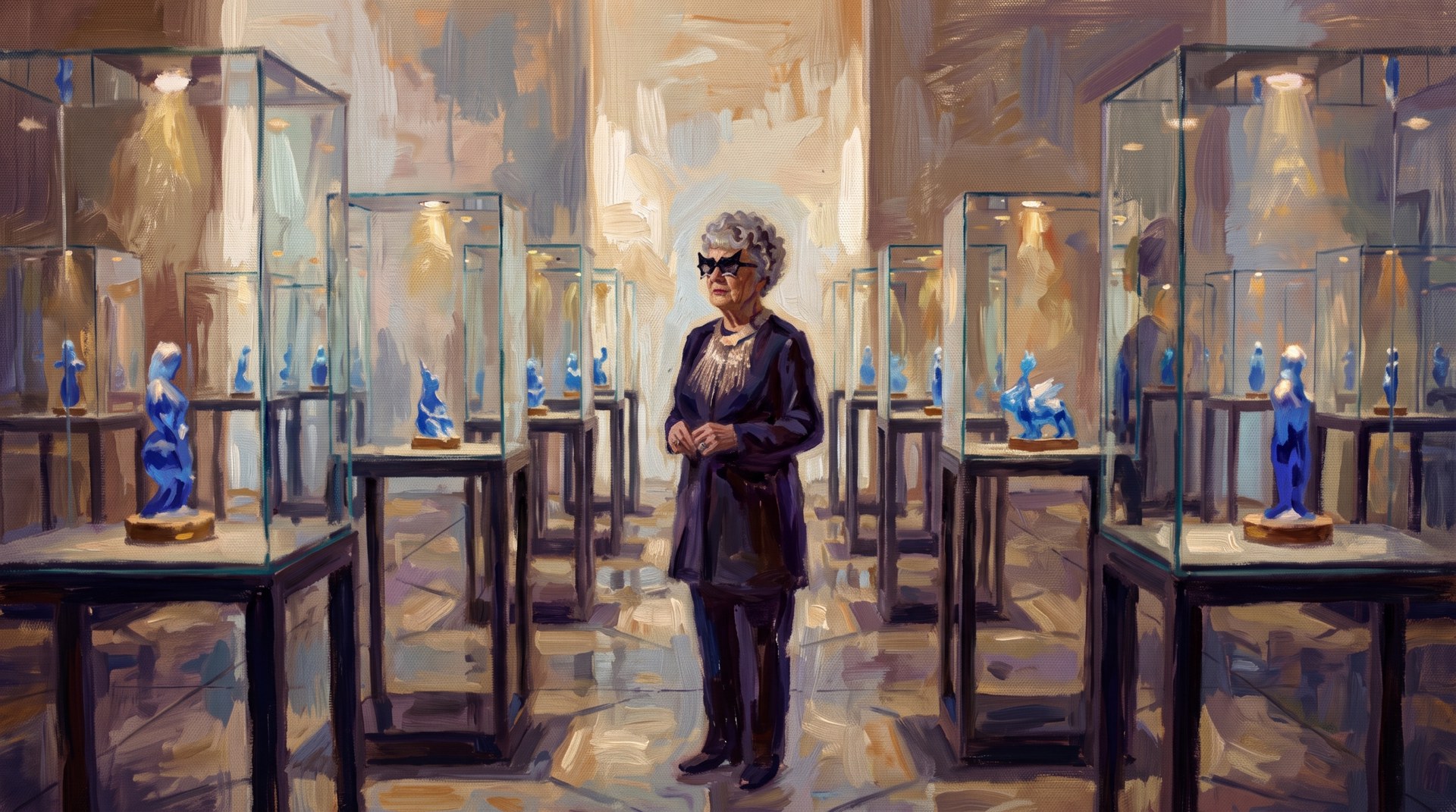
Peggy Guggenheim Picasso Glass: The Ultimate Fucina Collector's Guide
Masters of Murano: A Collector's Guide to the Hands, Minds, and Bridges of Glass (The Bridges)
The Facilitators (The Bridges)
Peggy Guggenheim — The Patroness of Poured Glass
Bridge Key: Peggy Guggenheim
- Role: Art Collector / Patroness of the Avant-Garde / Philanthropist / Exhibition Curator
- Life/Dates: New York City, USA, August 26, 1898 – Camposampiero near Padua, Italy, December 23, 1979
- Primary Associations: Palazzo Venier dei Leoni (Venice Residence, 1949–1979) | Peggy Guggenheim Collection (Venice, Founder) | Solomon R. Guggenheim Foundation | Fucina degli Angeli (Major Financial Patroness, 1961)
- Signature Concepts: Mecenatismo d'Avanguardia (Avant-garde patronage) | Colatura in Vetro (Melted block/poured-glass casting) | Lotta al Kitsch Veneziano (Battle against Venetian tourist kitsch) | Exhibition curation and institutional lending
- Key Collaborators: Egidio Costantini | Pablo Picasso | Jean Cocteau | Jean Arp | Max Ernst | Gino Krayer | Ermanno Nason | Aldo Bon ("Polo") | Albino Carrara
Summary:
Discover the magnificent legacy and avant-garde patronage of Peggy Guggenheim, Murano’s ultimate post-war pioneer of abstract poured glass sculpture. This expert collector's guide covers her career from her arrival at Palazzo Venier dei Leoni to her historic 1961 financial rescue of the Fucina degli Angeli and her landmark 1964 commission of the 23 Picasso cobalt-blue poured glass sculptures. Learn how to verify authentic diagnostic markers—including solid-block poured glass density, velvety indigo cobalt blue purity, micro-carbon inclusions, and original diamond-point signatures and Guggenheim accession marks—to confidently identify these creations, spot true investment-grade masterworks, and navigate the secondary market on Murano.
Visual Timeline of the Patroness
              ┌──────────────────────────────────────────────────────────┐
              │                    PEGGY GUGGENHEIM                      │
              │             - THE PATRONESS OF POURED GLASS -            │
              └──────────────────────────┬───────────────────────────────┘
                                         │
     ┌───────┐                           ▼
     │ 1898  │ ──► Born in New York City into the wealthy Guggenheim mining dynasty.
     └───────┘                           │
     ┌───────┐                           ▼
     │ 1948  │ ──► Exhibits her modern art collection at the Venice Biennale; purchases Palazzo Venier dei Leoni.
     └───────┘                           │
     │                                   └──► Establishes her home as an active, living museum of the avant-garde.
     │                                   │
     ┌───────┐                           ▼
     │ 1958  │ ──► Costantini's first Fucina gallery closes due to severe financial reverses.
     └───────┘                           │
     │                                   └──► Guggenheim steps in to organize foundational and financial support.
     │                                   │
     ┌───────┐                           ▼
     │ 1961  │ ──► Funds the second launch of the Fucina degli Angeli, saving the collaborative enterprise.
     └───────┘                           │
     ┌───────┐                           ▼
     │ 1964  │ ──► Commissions and exhibits the 23 iconic blue poured-glass sculptures at her Palazzo.
     └───────┘                           │
     │                                   ├─► Designed based on Pablo Picasso's abstract sketches.
     │                                   └─► Executed by Murano's leading maestros utilizing solid-pour glass casting.
     │                                   │
     ┌───────┐                           ▼
     │ 1965  │ ──► Masterminds the "Sculptures in Glass" exhibition at the Museum of Modern Art (MoMA).
     └───────┘                           │
     │                                   └─► Displays Arp, Ernst, and Picasso, permanently elevating glass to high art.
     │                                   │
     ┌───────┐                           ▼
     │ 1979  │ ──► Passes away in Italy, bequeathing her Palazzo and glass masterpieces to the Solomon R. Guggenheim Foundation.
     └───────┘
1. The Queen of the Lagoon: The Venice Sanctuary (1948–1958)
In the post-war reconstruction of the Venetian Lagoon, if Egidio Costantini was the energetic spark behind the modern art glass movement, Peggy Guggenheim was the unyielding bedrock of international patronage that sustained it. Born in New York City in 1898 into the legendary, ultra-wealthy Guggenheim mining dynasty, Peggy abandoned the rigid confines of American high society to immerse herself in the Parisian and European avant-gardes. In 1948, she made a historic entrance into Venice, exhibiting her world-class collection of Cubist, Surrealist, and Abstract Expressionist masterpieces at the first post-war Venice Biennale. Captivated by the city’s watery light, she purchased the unfinished, eighteenth-century Palazzo Venier dei Leoni on the Grand Canal, turning its low-slung stone terraces into an active, living sanctuary of modern art.
As she settled in Venice, Peggy grew increasingly frustrated by the state of local craftsmanship. She lamented that Murano's ancestral glassmaking tradition, which had once captured the imaginations of Renaissance kings, had degenerated into a production of "kitschy trinkets and tasteless souvenirs" aimed at cheap mass tourism. She observed that the island’s furnaces were using their spectacular technical capabilities not for creative expression, but to satisfy the low tastes of the souvenir market. She resolved to find a way to liberate the medium from this decorative stagnation, seeking a catalyst who could bring the visceral, primitive energy of modern art directly into the hot-shop.
2. Saving the Angels: The 1961 Financial Rescue
That catalyst arrived in the early 1950s when Peggy met Egidio Costantini, who was struggling to run his co-founded Centro Studio Pittori nell'Arte del Vetro de Murano. Costantini shared her frustration, and his radical mission—convincing the world's greatest painters to provide drawings to be forged into glass—perfectly matched her vision of avant-garde patronage. Peggy watched with fascination as the Fucina produced its first historic fusions of fine art and fire.
However, despite achieving immense artistic acclaim, the Fucina degli Angeli was an administrative and financial disaster. Operating on razor-thin margins and facing high production costs, Costantini’s gallery-space in the sestiere of Castello suffered severe financial reverses, forcing him to suspend all hot-furnace operations and close the gallery in 1958.
Peggy recognized that if the Fucina collapsed, Murano would lose its only bridge to the international avant-garde. She stepped in to organize foundational support, rallying her wealthy network of collectors, artists, and philanthropists. In 1961, she provided the vital financial aid and capital required to launch a second, highly successful iteration of the Fucina degli Angeli. Her financial rescue was highly historic: it represented the first time in post-war Muranese history that an elite international collector systematically acted as a direct corporate benefactor for a glass workshop, preserving a vital creative space where the gaffers could work with foreign artists without commercial constraints.
3. The Blue Masterpieces: Picasso and the 1964 Commission
The absolute peak of Peggy Guggenheim’s collaborative patronage arrived in 1964 through a monumental commission that remains a landmark of twentieth-century sculpture. Fascinated by the abstract, sculptural possibilities of the material, she commissioned a cohesive collection of twenty-three glass sculptures based on original, unpublished sketches provided by her close friend Pablo Picasso.
- The Technical Composition (Colatura in Vetro): Unlike the Fucina's early Gufo (Owl) or Flamenco figurines, which were executed in the traditional way of vetro soffiato (blown glass) and brought to life through the master blower’s breath, this entire commission was executed utilizing the highly complex poured glass technique (colatura in vetro or vetro colato). Thick, heavy gathers of intensely saturated, deep cobalt-blue glass were poured directly from the crucible onto flat iron casting tables. While white-hot and highly volatile, the molten mass was hand-tooled, flattened, and modeled with heavy iron jacks into solid, dense, and block-like abstract forms.
- The Aesthetic Language: The resulting 23 sculptures form an alluring, highly expressive ensemble that directly mirrors Picasso's unique pictorial-visual language. Curvaceous, rounded standing women of a striking, sensual silhouette alternate with sitting, highly angular, and block-like animalesque male counterparts. These rounded, dense bodies directly reflect Picasso's painterly idiom from the 1930s onwards, finding their almost exact counterparts in his famous canvas La Baignade (On the Beach, 1937), which was held in Peggy's personal collection at Palazzo Venier. The collection stands as a magnificent monument to the Fucina's mission, permanently proving that glass could serve as a primary, non-functional medium for modern sculpture.
4. Staging the High-Art Coup: From Palazzo Venier to MoMA (1964–1966)
Peggy Guggenheim did not merely commission these pieces for private amusement; she was a brilliant, highly strategic curator who used her global cultural influence to lobby institutional elites on behalf of the glass medium.
- The Palazzo Exhibition (1964): Peggy staged the first exhibition of the 23 Picasso-designed cobalt-blue sculptures directly in the sun-drenched, white-stone rooms of Palazzo Venier dei Leoni. Placed on marble pedestals against the windows, the dense cobalt glass captured and splayed the natural, watery reflections of the Grand Canal, stunning visiting critics and art historians.
- The MoMA Triumph (1965–1966): Following the palazzo exhibition, Peggy partnered with Costantini to mastermind the landmark exhibition Sculptures in Glass, staged at the prestigious Museum of Modern Art (MoMA) in New York from November 1965 until January 1966. Peggy acted as a major institutional lender, shipping her prized Picasso poured-glass collection across the Atlantic. The exhibition displayed creations by Jean Arp, Max Ernst, and Pablo Picasso, with loans from Peggy Guggenheim, Nelson A. Rockefeller (who exhibited 14 Picasso pieces from the Nymphs and Fauns series), and Richard L. Franck of San Francisco.
The MoMA show marked a decisive, historical turn for the Fucina degli Angeli and Murano glass. For the first time in modern history, a major museum of fine art displayed glass on the same terms as bronze, canvas, tapestry, or marble. The exhibition shattered the traditional, patriarchal hierarchy of craft over art, confirming Peggy’s lifelong belief that the alchemical fusions of the Fucina represented a sovereign contribution to modern sculpture.
5. The Collector's Diagnostic Checklist: Guggenheim-Fucina Wares
To confidently identify, date, and value original glass sculptures produced under the direct patronage of Peggy Guggenheim for the Fucina degli Angeli (c. 1961–1968), collectors must utilize the following diagnostic criteria:
- Evaluating Glass Density and Mass: The absolute, defining physical characteristic of an authentic Guggenheim Picasso sculpture is its extreme, solid-block density. Because they were executed utilizing the vetro colato (poured glass) technique rather than blown hollow, these pieces are extraordinarily heavy and substantial. There should be zero hollow cavities, blow-pipe marks, or thin-walled sections.
- Analyzing Cobalt Blue Saturated Purity: The 23 original pieces were cast in a highly specific, custom-melted cobalt blue glass of an intense, velvety saturation. Under strong light, the glass must show a rich, deep indigo-blue transmission without shifting to an inferior, cheap turquoise or blackish-grey cast. The color must be completely uniform throughout the entire mass.
- Inspecting Surface Inclusions and Imperfections: Due to the primitive casting methods utilized on the iron tables in 1964, authentic pieces must exhibit microscopic, hand-worked irregularities. Under a magnifying glass, the surface will show tiny carbon inclusions, minute ash deposits, and elongated, teardrop-shaped air bubbles (bollicine) trapped during the pour. A perfectly sterile, flawless, or machine-smooth surface is an immediate indicator of a modern reproduction.
- The Price Tiers:
- Ultra-Premium Investment Grade: Original 1964 Picasso-designed cobalt-blue poured glass sculptures from the Peggy Guggenheim Collection sequence, or verified 1950s Oskar Kokoschka Baccanti vases carrying documented provenance. These represent museum-grade masterpieces, commanding high six-figure sums at specialized international fine art auctions.
- Mid-Range: Original 1960s production models from the Fucina catalog (including Jean Cocteau's Nymphs, Max Ernst's Surrealist Birds, and Jean Arp's Abstract Forms), and early enameled plates carrying early paper labels.
- Accessible: Post-1980s Fucina renaissance-era sculptures, and later, posthumous limited-edition glass sculptures authorized by the Costantini estate.
6. Forensic Chronology of Accession Marks & Provenance
Because Peggy Guggenheim bequeathed her entire collection and palace to the Solomon R. Guggenheim Foundation in 1976, authentic masterworks from this circle carry highly distinct, chronologically clear markings that determine their value on the collector's market:
I. The Official Foundation Accession Engravings
The original 23 Picasso blue poured glass sculptures remain on permanent display at Palazzo Venier dei Leoni under the curatorial custody of the Solomon R. Guggenheim Foundation. Authentic, authorized limited-edition replicas or matching Fucina proofs carry the standard corporate marks of the firm:
- The Inscription: Hand-engraved on the polished base edge with a diamond-point drill reading:
76.2553 PG 294(followed by the specific sequence number.1through.23). - The Co-Signatures: Pieces designed by Picasso and facilitating-brokers like Costantini are hand-signed on the ground base:
E. Costantini / Fucina degli Angeliaccompanied by Picasso's signature (e.g.,Picasso).
II. The Fucina degli Angeli Paper Labels
Original 1960s pieces retailed or exhibited during Peggy's tenure carried a highly distinct paper label:
- The Paper Label: A rectangular white paper label printed in red ink reading:
FUCINA DEGLI ANGELI / VENEZIAaccompanied by a hand-written archive, mold, or model number.
III. The Modern Estate Re-Editions (Post-1980s)
Re-editions and modern castings sanctioned by the Costantini estate carry modern, vibro-engraved signatures (vibro-engraving was not utilized until after 1975):
- The Mark: A jagged, vibrating electric-pen signature reading:
Egidio Costantini Fucina degli Angelioften accompanied by a printed certificate of authenticity signed by Costantini or his heirs.
7. Attribution & Authenticity
In the Murano glassmaking tradition, the difference between a fake and a copy rests entirely on intent, origin, and transparent attribution. A fake is a deceptive counterfeit manufactured outside of Murano—often in mass production factories in Asia or Eastern Europe—that utilizes cheap materials and carries forged signatures or illicit trademark stickers to intentionally defraud collectors. Conversely, a copy is a legitimate artistic homage (omaggio) handcrafted by a skilled master using authentic Murano techniques and materials; it serves as a tribute to honor a legendary artisan's legacy and is openly signed by the modern creator, preserving the lineage of Venetian glassblowing rather than exploiting it.
Join Our Facebook Group Identify Your Murano - Murano Glass Animals