The Nason Dynasty: Ermanno Nason Massello, AVEM and Nason Moretti Guide
The Nason Family Murano Dynasty — Masters of Massello Sculpture, Fucina degli Angeli Modernism, and Nason & Moretti Tableware Alchemy
Dynasty Key: The Nason Dynasty
- Active Dynasty Window: 14th Century – Present (documented across seven centuries of master glassmakers, sculptors, designers, and furnace founders on Murano)
- Ancestral Seat & Primary Kilns / Studios: Fondamenta Vetrai 33 (Arte Vetraria Muranese - A.V.E.M., 1932–1968) | Fondamenta da Mula (I.V.R. Mazzega, 1953–1959) | Calle S. Giuseppe 18/A (Vetraria Arte E. Nason s.n.c., 1959–1994) | Calle degli Orti 12 / Via Serenella 12 (Cristalleria Nason & Moretti, 1923–Present) | Calle S. Bernardo (Scarpa & Nason s.n.c., 1961–1963) | Fondamenta Vetrai 106 (Gino Cenedese & Figlio, 1948–1953, 1964–1972)
- Hereditary Master Glassmakers, Engravers & Designers: Antonio Nason (1769 progenitor) | Ugo Nason (1870–1939, technical founder of Nason & Moretti) | Emilio Nason (1891–1959, A.V.E.M. co-founder and figurine master) | Italo "Otello" Nason (1894–1966, master blower, Nason & Zaniol) | Aldo Nason (1920–2017, "Il re dei galli", A.V.E.M. master) | Ermanno Nason (1928–2013, master of a massello and chief gaffer for Fucina degli Angeli) | Umberto Nason (Compasso d'Oro 1955 winner) | Vincenzo Nason (V. Nason & C.) | Carlo Nason (AV Mazzega lighting pioneer) | Giampaolo Nason | Quinto Nason (Ermanno's brother & servente)
- Signature Technical & Material Inventions: Hot-Sculpted Solid Glass (A Massello) | Fucina degli Angeli Fine-Art Fusions (Fusi con il Fuoco) | Incamiciato a Rovescio (1955 Compasso d'Oro) | Pasta Vitrea Figurines (Emilio & Aldo Nason) | Yokohama & Con Fiamme Series (Aldo Nason, 1955–1959) | Alabastro "Seta" & Cenedese Sommerso Monoliths (Ermanno Nason & Antonio Da Ros)
- Market Price Tier: High-End Investment Grade (Ermanno Nason Fucina degli Angeli Picasso/Chagall/Cocteau executions, 1950s A.V.E.M. Emilio/Aldo Nason figurines, and Cenedese Da Ros monumental sculptures) to Mid-Range (Nason & Moretti Compasso d'Oro tableware, Carlo Nason AV Mazzega lighting, V. Nason & C. opaline/avventurina) to Accessible (later commercial V. Nason & C. figurines)
- Key Collaborators: Egidio Costantini (Fucina degli Angeli) | Pablo Picasso | Marc Chagall | Georges Braque | Jean Cocteau | Gio Ponti | Fulvio Bianconi | Antonio Da Ros (Cenedese) | Giulio Radi (A.V.E.M.) | Gino Cenedese | Ulderico & Ercole Moretti | Peggy Guggenheim
Summary:
Discover the magnificent history and sculptural mastery of The Nason Dynasty, Murano's premier family of a massello sculptors, A.V.E.M. founders, and tableware pioneers. This comprehensive collector's guide details their 14th-century origins, Emilio and Aldo Nason's A.V.E.M. masterpieces, Ermanno Nason's legendary Fucina drawings with Pablo Picasso, Marc Chagall, and Jean Cocteau, Nason & Moretti's 1955 Compasso d'Oro award, and Carlo Nason's AV Mazzega lighting. Learn how to evaluate diagnostic signatures, factory labels, heraldic shield crests, and VAM/VM codes to collect Nason glass with absolute curatorial confidence.
### Genealogical Lineage Map
```text
┌──────────────────────────────────────────────────────────────────────────────────────────────────┐
│                                       THE NASON DYNASTY                                          │
│                             - ANCESTRY & GENEALOGICAL DESCENT -                                  │
└──────────────────────────────────────────────┬───────────────────────────────────────────────────┘
                                               │
                                         Antonio Nason
                                  (b. 1769; m. Antonia Ferro)
                                               │
           ┌───────────────────────────────────┼───────────────────────────────────┐
           │                                   │                                   │
   Giovanni Battista                       Agostino                             Giuseppe
(Sisto Branch Ancestor)                 (Tonòe Branch)                   (Bote Branch Ancestor)
           │                                   │                                   │
     "Nane Sisto"                             Ugo                            Arturo & Ovidio
   (1901 Ferro Toso)                      (1870–1939)                      (1861–96 / b. 1868)
           │                      (Nason & Moretti Founder)                        │
      Mario Nason                              │                       ┌───────────┼───────────┐
    ("Chebo", 1900s)             ┌─────────────┼─────────────┐         │           │           │
                                 │             │             │       Emilio      Italo      Ermanno
                              Antonio       Vincenzo      Umberto  (1891–1959) (1894–1966)  ("Pipon")
                            (1892–1957)    (d. 1948)    (1898–1964) (A.V.E.M.)  ("Otello")      │
                                 │                           │         │           │           │
                                Ugo                       Angelo     Aldo       Ermanno     Renato
                             (b. 1927)                  (1935–1986)(b. 1920)   (1928–2013) (Cappellin)
                                                                       │        (Massello)
                                                                    Flavio
1. The Medieval Lineage & The Three Historical Branches (Sisto, Tonòe, Bote)
The Nason family represents one of Murano's most prolific, technically versatile, and historically resilient glassmaking dynasties. Documented in municipal archives as early as c. 1300, the family's identity is encapsulated by the traditional Muranese proverb: "Pasta de vero dentro al serveo, questo gera i Nason!" ("Molten glass in their brains, that was the Nasons!").
The Ancestral Roots & 18th-Century Reorganization
In the late 18th century, Antonio Nason (b. 1769), a master glassblower working in 1789 at the furnace of Vittorio Mestre, married Antonia Ferro (daughter of Domenico Ferro). Their three sons established the three distinct genealogical branches of the modern dynasty:
- The Sisto Branch: Derived from Giovanni Battista Nason, whose son Giovanni Battista Nason ("Nane Sisto") co-founded Ferro Toso & C. in 1901 alongside Luigi Giovanni Toso and Ferdinando Ferro—a direct predecessor to Barovier & Toso. His son Mario Nason ("Chebo") was a celebrated master blower in the early 1900s.
- The Tonòe Branch: Derived from Agostino Nason, leading to Ugo Nason (1870–1939). In 1923, Ugo and his sons (Antonio, Giuseppe, Vincenzo, Umberto) partnered with the Moretti family to establish Cristalleria Nason & Moretti, transforming Muranese table art and winning the prestigious Compasso d'Oro in 1955.
- The Bote Branch: Derived from Giuseppe Nason, leading to Arturo Nason, who founded Società Operaia Arturo Nason & C. in 1890 with his brothers Ovidio Nason (b. 1868) and Romano Nason. Ovidio's sons included Emilio Nason (1891–1959), co-founder of A.V.E.M.; Italo "Otello" Nason (1894–1966), master blower for Barovier & C., I.V.A.M., and founder of Nason & Zaniol; and Ermanno "Pipon" Nason.
2. Emilio & Aldo Nason: A.V.E.M. Co-Founders & "Il Re dei Galli" (1932–1968)
In 1932, Emilio Nason (1891–1959), formerly a master blower at Vetri Soffiati Muranesi Venini & C. (c. 1925), joined Egidio Ferro ("Pianzini"), Antonio Luigi Ferro, Galliano Ferro, and chemist Giulio Radi to found Arte Vetraria Muranese (A.V.E.M.) at Fondamenta Vetrai 33.
Emilio Nason's Figurative Virtuosity
Within A.V.E.M., Emilio Nason served as chief master blower for figurative and animal subjects. Departing from classical vessel shapes, Emilio developed a signature style of stylized, humorous human figures, Commedia dell'Arte characters, and exotic animals. Executed in opaque pasta vitrea, lattimo with gold/silver leaf, and cristallo oro, Emilio's figures—such as his 1934 Cristallo Lady supporting an A.V.E.M. exhibition sphere and his 1936 pulegoso horses—were featured prominently at the Venice Biennale.
Aldo Nason: "Il Re dei Galli" & Avant-Garde Radi Collaborations
Emilio's son, Aldo Nason (1920–2017), apprenticed under his uncle Italo "Otello" Nason before joining A.V.E.M. in 1937. Aldo became legendary on Murano as "Il re dei galli" (the king of roosters) due to his lightning-fast virtuosity in hand-shaping Murano's signature glass roosters.
- Mastery of Giulio Radi's Techniques: Following World War II, Aldo Nason became the primary master blower executing the revolutionary experimental designs of A.V.E.M. Technical Director Giulio Radi. Aldo mastered the complex hot application of gold/silver foils, reaction chemicals (reazioni policrome), and cased murrine.
- Independent Designs (1955–1967): Aldo developed his own design series for A.V.E.M., including the Con Fiamme (c. 1955) flame-motif series, the Yokohama (c. 1959) iridescent murrine series, and caricature figurines (African and Indian figures). Upon Emilio's death in 1959, Aldo inherited his father's ownership shares in A.V.E.M., remaining until 1968 when he established his own independent atelier (Vetri Artistici Aldo Nason).
3. Ermanno Nason: Master of Massello & Chief Virtuoso for Fucina degli Angeli (1928–2013)
Born on Murano on July 21, 1928, Ermanno Nason (son of Italo "Otello" Nason) stands as one of the most technically gifted and prolific master glassblowers and sculptors in 20th-century history.
The Prodigy's Rise & Bench Training
Ermanno began working at his father's furnace, Nason & Zaniol (known as "the two Foscaris"), at the age of nine while still in elementary school. He completed the classical Muranese apprenticeship—rising from garzon to serventino to servente—working across A.V.E.M., Italo Toso, Fratelli Ferro, and Pinzan & Cimarrosti. In 1946, at just eighteen years old, Ermanno was formally proclaimed Maestro at Pinzan & Cimarrosti.
Fucina degli Angeli & Fine-Art Fusions (Fusi con il Fuoco) (1953–1959)
From 1953 to 1959, Ermanno Nason served as Maestro di prima piazza at I.V.R. di Mazzega (Fondamenta da Mula). During this period, Nason became the principal physical medium for Egidio Costantini's Centro Studio Pittori nell'Arte del Vetro (later named Fucina degli Angeli by Jean Cocteau in 1958). Working directly from two-dimensional sketches provided by the world's greatest avant-garde artists, Nason translated their fine-art concepts into hot-sculpted glass:
- Pablo Picasso: Executed Picasso's iconic glass sculptures, including Gufo (The Owl, 1954), Flamenco (1954), Portatrice d'acqua (The Water Bearer, 1959), Il Centauro (The Centaur, 1959), Il Diavolo (The Devil, 1959), and Il Burlesco (1959).
- Marc Chagall & Georges Braque: Hot-sculpted Chagall's Re David (King David) plate and Braque's Innamorati (Sweethearts) plate.
- Jean Cocteau & Gio Ponti: Executed Cocteau's surrealist heads and Ponti's Luci (Lights) series.
- Fulvio Bianconi: Sculpted Bianconi's 1959 Dama (Lady) and Hommage à Bianconi series.
The Cenedese Monoliths & Haile Selassie Imperial Lion (1964–1972)
After operating independent studios (Arte E. Nason s.n.c., 1959–1962; Scarpa & Nason, 1962–1963), Nason joined Gino Cenedese & Figlio in 1964 as chief master blower. Collaborating with Artistic Director Antonio Da Ros, Nason created monumental, heavy-walled sommerso sculptures, the 1964 Mosè (Moses head in ruby/aquamarine), and a 52 cm crystal and gold lion commissioned in November 1970 for Emperor Haile Selassie of Ethiopia (who awarded Nason a pure gold medal).
In 1973, Nason reopened Vetraria Arte E. Nason s.n.c. at Calle S. Giuseppe 18/A, producing independent massello sculptures and artist collaborations (Remo Brindisi, Salvatore Fiume, Fulvio Bianconi) until a catastrophic fire destroyed the factory on February 18, 1993.
4. Cristalleria Nason & Moretti, V. Nason & C. & AV Mazzega: Tableware, Lighting & Commercial Alchemy (1923–Present)
Cristalleria Nason & Moretti (1923–Present)
Founded on March 23, 1923, by Ugo Nason (1870–1939) and his sons (Antonio, Giuseppe, Vincenzo, Umberto) alongside the Moretti brothers (Ulderico, Pietro, Vincenzo, Germano), Cristalleria Nason & Moretti specialized in refined glass tableware and colored crystal services.
- The 1955 Compasso d'Oro Award: In 1955, director and designer Umberto Nason (1898–1964) was awarded the prestigious Compasso d'Oro for his revolutionary Bicolore service—executed in opaque white lattimo on the exterior and vibrant colored glass on the interior (incamiciato a rovescio).
- Modern Evolution: Following the Moretti family's withdrawal in 1949, the firm continued under the sole leadership of the Nason family (Umberto, Ugo b. 1927, Paolo b. 1941, Marco b. 1957, Giorgio b. 1966, Piero b. 1965), reorganizing in 1989 as Nason & Moretti S.r.l. at Calle degli Orti 12.
Carlo Nason & AV Mazzega Lighting (1960s–1970s)
Descended from the Tonòe branch, Carlo Nason established an international reputation in post-war lighting design through his landmark partnership with AV Mazzega (A.V. Mazzega S.r.l. / Mazzega 1946, Via Vivarini 3). Carlo designed modular, opalescent, and translucent glass lighting series—such as the Planet, Dune, Ghibli, and Lotus lamps—combining Muranese blowing virtuosity with mid-century industrial elegance.
V. Nason & C. (1967–Present)
Established in 1967 as VNC Opaline de Venise (later Veritable Opaline de Murano and V. Nason & C. in 1989) by Vincenzo Nason, this furnace became one of Murano's largest producers of opaline vessels, avventurina animals, and molded art glassware, utilizing distinctive foil labels bearing the stylized square "N" logo.
5. Forensic Master Registry: Markings, Signatures & Factory Labels
Understanding the full spectrum of Nason family marks, factory labels, and heraldic emblems is essential for curatorial verification:
I. Independent Studio Signatures & Hand Etchings (Ermanno & Carlo Nason)
- Picasso & Fucina degli Angeli Inscriptions: Hand-etched cursive base signatures reading:
OMAGGIO A PICASSO E. NasonorCENTAURO E. Nason 1959OMAGGIO A F. BIANCONI E. Nason 1959E. Nason/Arte E. Nason
- Cenedese Era Signatures: Select Cenedese pieces carry Da Ros / Nason collaborative marks or Cenedese inventory stickers alongside
E. Nasondiamond-point signatures. - Carlo Nason Lighting Signatures: Diamond-point etched signatures on base rings or diffuser rims reading
Carlo Nason MuranoorC. Nason.
II. The Giampaolo Nason Heraldic Crest / Shield Label
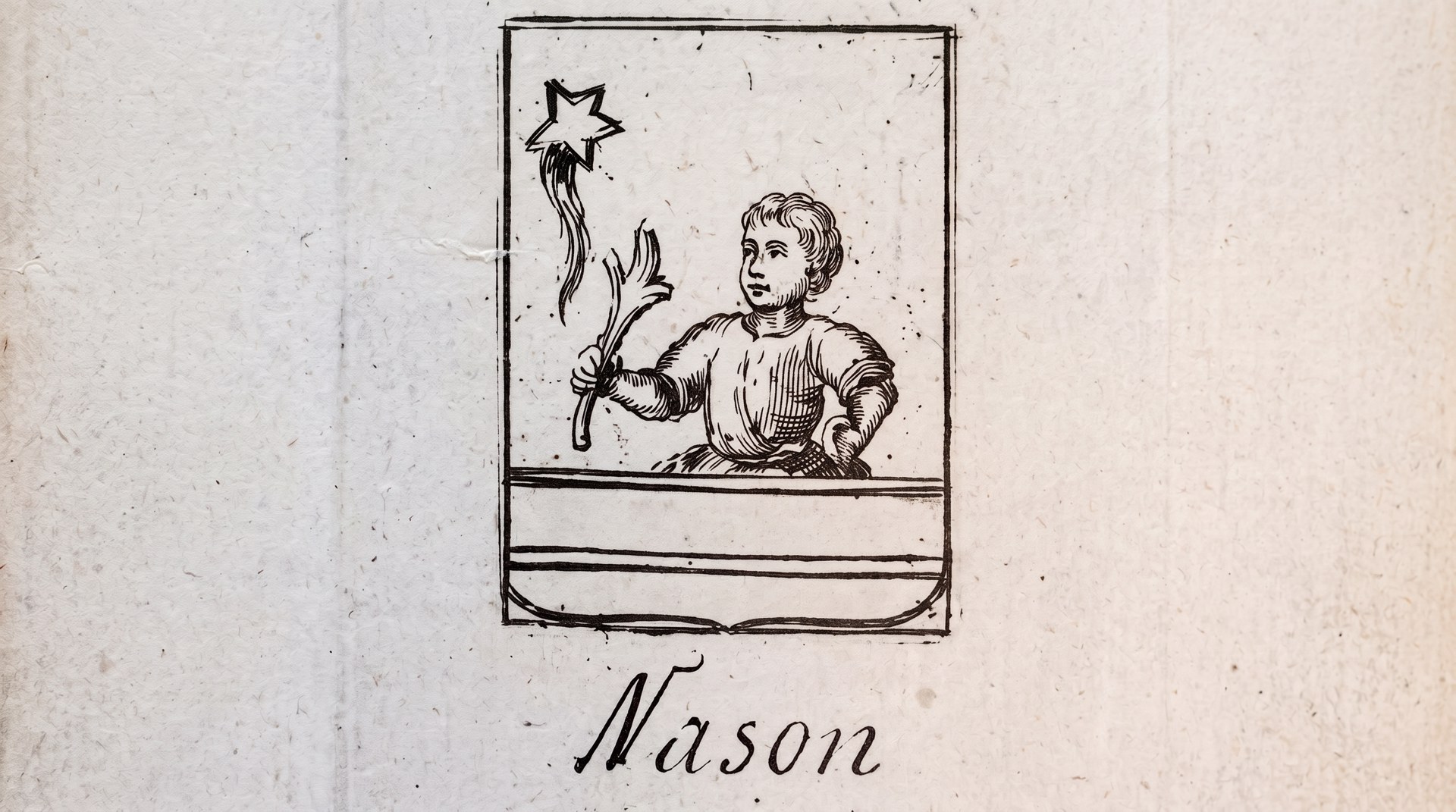
- The Family Crest / Shield Logo: In Venetian heraldry, Muranese glass dynasties displayed family coats of arms (stemmi) in civic monuments and official registries. Giampaolo Nason (Vetri Artistici Giampaolo Nason) incorporated an explicit heraldic coat of arms / shield emblem onto his official factory foil labels.
- Label Layout: Gold foil or tan paper label featuring a printed shield on the left (depicting a saint/figure holding an anchor or cross above horizontal bars) flanked by gold/black text reading
GIAMPAOLO NASON / VETRI ARTISTICI / VENEZIA - MURANO - ITALY.
III. Factory Labels & Export Decals (Nason & Moretti, Aldo Nason, V. Nason & C.)
- Angelo & Aldo Nason Export Labels:
- 1930s Angelo Nason Serrated Paper Label: Rectangular white paper label with serrated edges reading
VETRERIA ARTISTICA ANGELO NASON / MURANO / MADE IN ITALYwith handwritten catalog numbers. - 1960s Aldo Nason Foil Label: Oval red foil label with scalloped gold border reading
NASON ALDO / VETRI ARTISTICI / MURANO.
- 1930s Angelo Nason Serrated Paper Label: Rectangular white paper label with serrated edges reading
- Cristalleria Nason & Moretti Labels:
- 1920s–1940s Historic Glass Chalice Seal: Round/oval seal depicting a glass goblet between the letters
N MaboveMURANO. - 1950s Compasso d'Oro Foil Label: Black & gold foil label commemorating the 1955 award reading
NASON & MORETTI / COMPASSO D'ORO 1955 / MURANO. - 1950s–1960s Black/Gold Rectangular Label: Black rectangular sticker reading
NASON & MORETTI / MURANO / MADE IN ITALY. - 1950s–1960s "NM" Clear Plastic Sticker: Transparent sticker with black text reading
NM MADE IN ITALY MURANO. - Export Rooster / Gallo Label: Scalloped paper export decal bearing the Venetian Rooster logo (Code
AI) associated with Nason & Moretti export tableware. - Modern Foil Seal: Rectangular gold/black label reading
NASON & MORETTI / MURANO ITALYornasonmoretti.it.
- 1920s–1940s Historic Glass Chalice Seal: Round/oval seal depicting a glass goblet between the letters
- V. Nason & C. / VNC Labels:
- 1967 VNC Wax-Seal Style Label: Gold circular ribbon/wax-seal style label reading
VNC / Opaline de Venise / HAND MADE IN ITALY. - 1970s Gold Stamped Dual-Square Seal: Interlocking gold squares reading
VETRO MURANO / VNC. - 1980s Interlocking Square "N" Label: Rectangular gold, silver, black, or clear label featuring the stylized square "N" logo above
V. NASON & C. / MURANO ITALY. - 1980s Avventurina Banner Label: Gold ribbon banner reading
AVVENTURINA / V. NASON e C. - MURANO ITALYwith the square "N" logo on both ends. - Modern Web Label: Round clear sticker reading
glass collection / NASON / murano.com.
- 1967 VNC Wax-Seal Style Label: Gold circular ribbon/wax-seal style label reading
IV. Consortium & Regional Trademark Systems (VM vs. VAM Codes)
VAM Code 002— Ongaro & Fuga snc: Registered under Vetro Artistico® Murano for mirror/cold-working alliance.VAM Code 003— Ercole Moretti & F.lli snc: Official regional seal for Ercole Moretti, historic partner of Nason & Moretti (1923–1949).VAM Code 027/VM #014— AV Mazzega S.r.l. (Via Vivarini 3): Official trademark code for AV Mazzega (collaborator with Carlo Nason on 1960s–70s lighting). Note: I.V.R. Mazzega (Industrie Vetrarie Riunite I.V.R. Mazzega, Fondamenta da Mula 148, where Ermanno Nason was chief gaffer 1953–1959) closed permanently in 1983 prior to the 1994 enactment of Veneto Regional Law No. 70/94 (Vetro Artistico® Murano), and thus carries no VAM code.VAM Code 050— Eugenio Ferro & C. 1929 srl: Official regional trademark seal under Vetro Artistico® Murano.
6. Attribution & Authenticity
In Murano glass collecting, authenticating Nason family works requires technical discernment:
- Authentic Ermanno Nason Massello Works: Characterized by heavy, solid glass mass (massello), flawless hot-tool modeling without cold-glue joints, rich internal iridescence or alabastro seda tones, and crisp, authentic hand-engraved signatures (
E. Nason). - Counterfeit & False Attributions: Commercial Asian or Eastern European pressed-glass figures often carry fake
V. NasonorE. Nasonelectric-pen etchings. True Ermanno Nason fine-art sculptures exhibit monumental weight, hand-polished base rings, and flawless pontil finishing.
Join Our Facebook Group Identify Your Murano - Murano Glass Animals