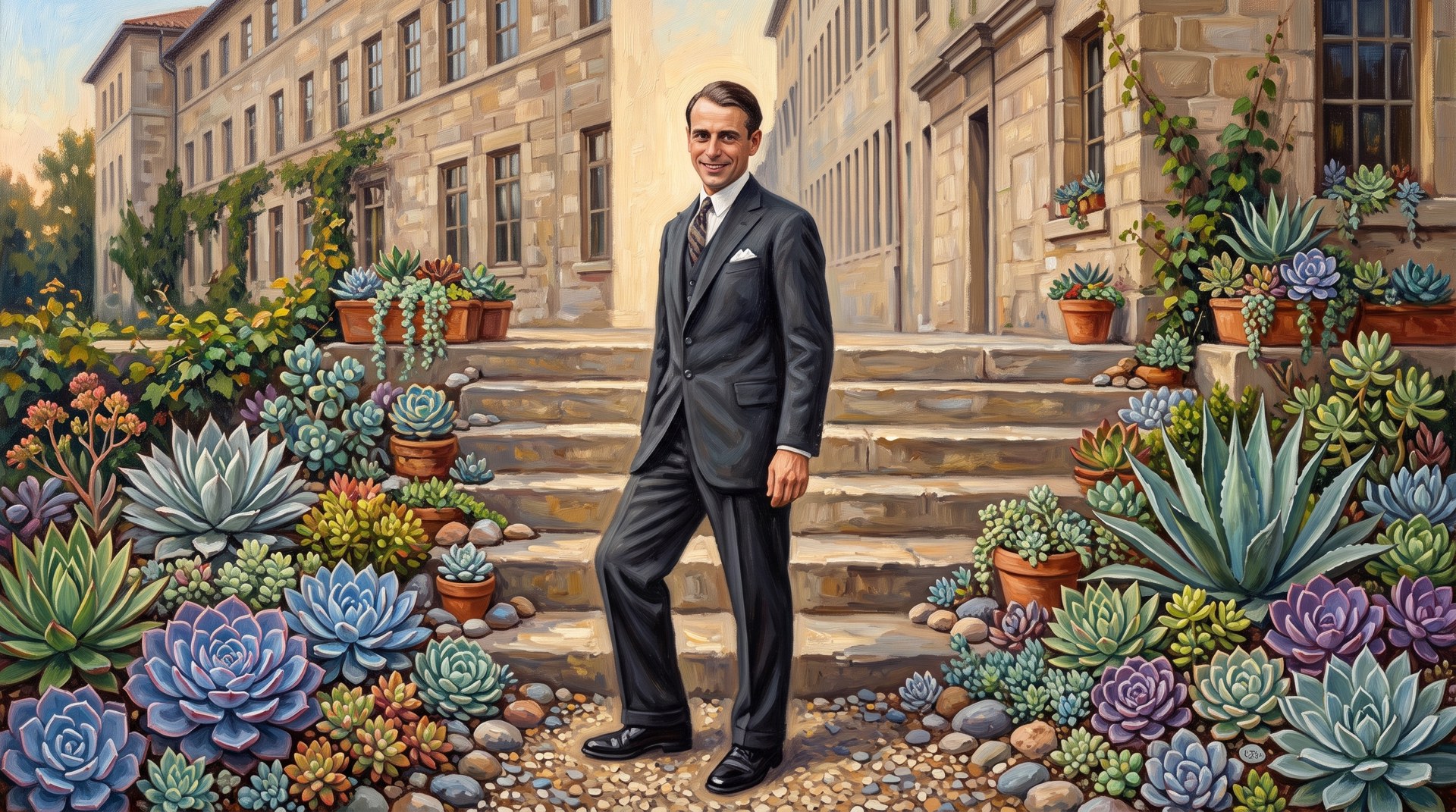
Napoleone Martinuzzi Murano Glass: The Collector's Guide to Pulegoso & Cacti
The Visionary Designers: A Collector's Guide
Napoleone Martinuzzi — The Sculptor of Opaque Succulents
Artist Key: Napoleone Martinuzzi
- Role: Sculptor-Designer / Art Director / Museum Curator / Entrepreneur (The Sculptor of Opaque Succulents)
- Life/Dates: Murano, May 21, 1892 – Venice, 1977
- Primary Furnaces/Associations: Vetri Soffiati Muranesi Cappellin Venini & C. (Artistic Director, 1925) | Vetri Soffiati Muranesi Venini & C. (Artistic Director, 1925–1931) | Zecchin-Martinuzzi Vetri Artistici e Mosaici (Artistic Director & Partner, 1932–1936) | Pauly & C. / C.V.M. (Post-war freelance designer) | Vetreria Gino Cenedese (Post-war designer)
- Signature Techniques: Vetro Pulegoso (Highly bubbly, semi-opaque spongy glass) | Pasta Vitrea Opaca (Intensely colored opaque glass pastes) | A Caldo Hot-Modeling (Sculpting plants, fruit, and animals while white-hot) | Incamiciatura (Multi-layered casing of opaque and colored glasses) | Velato (Delicately veiled satin acid treatments or light grinding) | Massiccio (Solid hot-modeled glass sculpting)
- Market Price Tier: High-End Investment Grade (specifically 1920s green pulegoso cacti and succulent pots, ten-handled d'Annunzio vases, and early Zecchin-Martinuzzi solid nudes) to Mid-Range (Zecchin-Martinuzzi opaque glass animals, post-war Pauly incised vessels, and Cenedese scavo vases)
- Key Collaborators: Paolo Venini | Francesco Zecchin | Gabriele d'Annunzio | Arturo Biasutto ("Boboli") | Ferdinando Toso ("Fei") | Alfredo Barbini | Otello Nason | Francesco Martinuzzi ("Checo") | Gio Ponti | Tomaso Buzzi
Summary:
Discover the secrets to identifying, dating, and collecting the legendary, heavy-walled art glass designed by Napoleone Martinuzzi, the visionary sculptor who introduced the modern Novecento style to Murano. This comprehensive guide covers his transition from bronze sculpture to his appointment as Artistic Director of V.S.M. Venini & C. and co-founder of Zecchin-Martinuzzi, detailing the chemistry behind his revolutionary, bubble-filled vetro pulegoso and his iconic hot-modeled piante grasse green cacti. Learn how to verify authentic diagnostic markers—including uniform micro-bubble matrices, heavy solid-glass weights, rare Zecchin-Martinuzzi acid stamps, and Barbini co-signatures—to confidently identify his creations and spot true investment-grade treasures on the secondary market.
Visual Career Timeline
              ┌──────────────────────────────────────────────────────────┐
              │                   NAPOLEONE MARTINUZZI                   │
              │            - THE SCULPTOR OF OPAQUE GLASS -              │
              └──────────────────────────┬───────────────────────────────┘
                                         │
     ┌───────┐                           ▼
     │ 1892  │ ──► Born on Murano, son of a master blower; studies sculpture at Venice Accademia.
     └───────┘                           │
     ┌───────┐                           ▼
     │ 1908  │ ──► Ca' Pesaro Secession: rebels against academy, exhibiting early bronze sculptures.
     └───────┘                           │
     ┌───────┐                           ▼
     │ 1917  │ ──► Becomes favorite artist of poet Gabriele d'Annunzio; designs Vittoriale monuments.
     └───────┘                           │
     ┌───────┐                           ▼
     │ 1921  │ ──► Appointed Director of the Murano Glass Museum, cataloging historical forms.
     └───────┘                           │
     ┌───────┐                           ▼
     │ 1925  │ ──► Succeeds Vittorio Zecchin as Artistic Director of Vetri Soffiati Muranesi Venini.
     └───────┘                           │
     ┌───────┐                           ▼
     │ 1928  │ ──► Invents the revolutionary, micro-bubbled Vetro Pulegoso; launches Novecento style.
     └───────┘                           │
     ┌───────┐                           ▼
     │ 1929  │ ──► Models the iconic green pulegoso cacti (Piante Grasse) and artichoke centerpieces.
     └───────┘                           │
     ┌───────┐                           ▼
     │ 1932  │ ──► Leaves Venini; co-founds Zecchin-Martinuzzi Vetri Artistici e Mosaici.
     └───────┘                           │
     ┌───────┐                           ▼
     │1932-36│ ──► Employs Barbini & Nason; designs solid nudes and opaque-cased Novecento animals.
     └───────┘                           │
     ┌───────┐                           ▼
     │ 1936  │ ──► Retires from glassmaking to return to pure marble and bronze sculpture in Venice.
     └───────┘                           │
     ┌───────┐                           ▼
     │ 1940s │ ──► Collaborates with Alfredo Barbini on post-war salinizzato and scavo textures.
     └───────┘                           │
     ┌───────┐                           ▼
     │ 1977  │ ──► Passes away in Venice, celebrated as the primary plastic sculptor of Murano.
     └───────┘
1. The Legend & Legacy
In the history of twentieth-century decorative arts, Napoleone Martinuzzi represents the great plastic force that permanently transformed Murano glass from a medium of airy transparency into a medium of dense, sculptural weight. Born on Murano on May 21, 1892, Martinuzzi was the son of an elite local glassblower, growing up in a world where manual virtuosity was second nature. However, his formal education was academic and artistic. He enrolled in the Accademia di Belle Arti di Venezia, studying sculpture under the renowned master Antonio Dal Zotto and attending the free school of the nude.
Martinuzzi’s youth was defined by the secessionist spirit of Ca' Pesaro, where he exhibited his powerful bronze and plaster sculptures alongside Venice’s avant-garde rebels. His reputation as a sculptor of immense power caught the attention of Italy's legendary poet-soldier, Gabriele d'Annunzio, in 1917. Martinuzzi became d'Annunzio's preferred artist, designing a grand mausoleum, monumental bronze war memorials, and numerous custom glass sculptures that still decorate d'Annunzio's famous estate, Il Vittoriale degli Italiani, on Lake Garda.
From 1922 to 1931, Martinuzzi served as the Director of the Murano Glass Museum. This curatorial tenure was critical; by cataloging, drawing, and handling thousands of Roman, Renaissance, and Andalusian glass vessels, he developed a profound, intimate vocabulary of historical forms. He noticed that ancient glass was often heavily textured, irregular, and rich with impurities—a stark contrast to the sterile, flawless crystal of his own era.
In 1925, when the partnership between Giacomo Cappellin and Paolo Venini dissolved, Venini convinced Martinuzzi and the engineer Francesco Zecchin to join him. Martinuzzi assumed the position of Artistic Director at Vetri Soffiati Muranesi Venini & C., succeeding the painter Vittorio Zecchin. In his initial years, Martinuzzi maintained Zecchin's delicate, feather-light transparent style, designing beautiful, ultra-thin filigree vessels in 1927 that won the praise of architect Gio Ponti in the inaugural issues of Domus.
However, by late 1928, Martinuzzi staged a brave aesthetic revolution. Recognizing that contemporary European interior design was converting to the blocky, geometric, and architectural Novecento style, he realized that paper-thin transparent glass had no place in modern, solid-oak rooms. He abandoned Zecchin’s weightless symmetry, treating molten glass instead as a heavy, viscous, and completely opaque clay. By introducing revolutionary opaque glass pastes and micro-bubbled textures, Martinuzzi gave glass a spatial presence and physical weight that mirrored modern sculpture.
In January 1932, Martinuzzi and Francesco Zecchin departed Venini to establish their own independent company: Zecchin-Martinuzzi Vetri Artistici e Mosaici. Here, serving as artistic director, Martinuzzi pushed his sculptural concepts to their absolute peak. He hired Murano’s absolute finest young master blowers, including a young Alfredo Barbini and Otello Nason, to execute highly sophisticated, opaque-cased animals, stylized cacti, and beautiful female nudes in solid glass. The firm's designs triumphed at the 1933 Milan Triennale and 1934 Venice Biennale. However, Martinuzzi's true ambition remained pure fine-art sculpture; he withdrew from the company in 1936 to return to his studio, and Francesco Zecchin closed the furnace in 1938. Martinuzzi passed away in Venice in 1977, recognized as the master who proved that fire could sculpt as powerfully as a chisel.
2. The Chemistry & Physics of Vetro Pulegoso
Napoleone Martinuzzi's most famous and historically significant technical contribution to glassmaking is the invention of Vetro Pulegoso in 1928. Derived from the local Muranese dialect word pulega (meaning a small air bubble), this glass is characterized by its semi-opaque, translucent, and spongy appearance, covered both internally and externally with millions of trapped micro-bubbles.
This material was a complete thermodynamic and chemical departure from Murano's traditional pursuit of flawless clarity. To achieve this highly textured, effervescent effect, Martinuzzi altered the chemistry of the molten batch inside the crucible:
- The Carbonization Process: While the silica sand, soda ash, and flux were melting inside the furnace at temperatures exceeding 1200°C, the master glassmaker added specialized, gas-producing organic ingredients directly into the white-hot molten pool—specifically bicarbonate of soda and petroleum (refined kerosene).
- The Trapped Bubble Matrix: The intense heat caused these organic compounds to immediately vaporize and combust, releasing massive volumes of carbon dioxide and hydrocarbon gases. Because the viscosity of the molten glass was carefully controlled, these gas bubbles could not escape to the surface. Instead, they remained permanently trapped within the cooling glass matrix as a dense, uniform network of microscopic bubbles (puleghe).
- The Surface Texture: When the master pulled the gather from the pot, the cooling glass felt highly tactile, rough, and slightly pitted. This eliminated the furnace’s glassy, cold reflections, giving the vessels a soft, organic matte finish that beautifully scattered light.
- The Splay-Rim and Festoons: Because the gas bubbles made the glass tissue structurally spongy, it had to be worked quickly. Martinuzzi used this physical thickness to model robust classical forms—such as his celebrated Dieci Anse (ten-handled) amphoras—decorating the rims, bases, and handles with thick, hand-pinched ribbons cased in gold leaf.
3. The Iconic Green Cacti & Opaque Succulents
The ultimate expression of Martinuzzi’s sculptural Novecento philosophy is his series of Piante Grasse (Succulent Plants and Cacti), designed and modeled between 1928 and 1930 for Venini, and subsequently expanded at Zecchin-Martinuzzi.
These works are a complete departure from traditional utilitarian tableware. They are purely decorative, surrealist tabletop sculptures that represent the first time Murano glass was used to mimic living botanical geometries in an abstract, modern key:
- The Material Choice: The bodies of the cacti are sculpted almost exclusively from a dense, highly saturated dark green vetro pulegoso. This spongy, bubble-filled glass perfectly replicates the organic, porous, and water-retaining texture of real desert succulents.
- Hot-Modeling A Caldo: These complex plants were modeled entirely a caldo (while still white-hot at the glory hole). The master blower gathered a thick core of green glass, blowing a hollow stem, and then rapidly hand-tooled the ribbed, segmented, and spiraling arms using jacks and iron shears. To form the tiny needles and fleshy leaves, the master applied small dabs of hot glass, pulling and pinching them individually.
- The Black Glass Pots: To highlight the brilliant green tone of the cacti, Martinuzzi housed them inside custom-blown, wide-rimmed flower pots made of high-gloss black glass (vetro nero). The pots are typically decorated with vertical ribbed or spiraled patterns (costolature) and finished with a flared pedestal base.
- Polychrome Accents: The cacti are often topped with spectacular, highly stylized flowers modeled in bright, contrasting opaque glass pastes (pasta vitrea)—such as coral red, orange, and butter-yellow—veiled with gold leaf applications to capture the light.
4. The Zecchin-Martinuzzi Era & Sculptural Collaborations
When Martinuzzi co-founded Zecchin-Martinuzzi Vetri Artistici e Mosaici in 1932, he was freed from Venini's commercial lighting constraints, allowing him to treat the furnace as a fine-art sculpture studio. Under his direction, the company produced some of the most sophisticated, highly sought-after collector pieces of the interwar era:
- The Solid Female Nudes: Bypassing hollow-blown glass entirely, Martinuzzi designed elegant, elongated female figures sculpted from massive blocks of solid clear and tinted glass (massiccio). Executed by Alfredo Barbini, these figures required incredible physical endurance and thermal control, as the master had to hand-model the heavy, hot mass using woodblocks and wet paper without causing internal stress fractures.
- Opaque Novecento Animals: Martinuzzi created a spectacular menagerie of stylized animal figures—including dachshunds, ponies, horses, charging bulls, and elephants—modeled in dense, opaque lattimo glass and brightly colored glass pastes (pasta vitrea).
- The Coated & Gilded Technique (Incaminciato): To soften the primitive appearance of these opaque animals, Martinuzzi cased them in multiple, thin layers of contrasting glass. A typical Zecchin-Martinuzzi horse or elephant features an inner core of opaque white lattimo, cased in a layer of turquoise, blue, or deep amethyst glass, finished with a heavy outer coating of clear crystal filled with shimmering gold leaf applications (incaminciato con foglia d'oro).
- The Velato Finish: Many interwar vases and animal sculptures were treated with a delicate, satin acid-etching or light wheel-grinding finish (velato), which eliminated the high-gloss shine of the furnace and gave the glass the soft, velvet feel of carved marble or polished alabaster.
5. Famous Collaborations
As a sculptor who designed primarily on paper, Martinuzzi’s vision was executed by an elite group of Muranese masters:
- Arturo Biasutto ("Boboli"): Venini’s legendary powerhouse who physically blew Martinuzzi's heaviest and most complex early pulegoso vases, managing the difficult, bubbly glass with extreme manual speed.
- Ferdinando Toso ("Fei"): Served as the lead master blower at Venini in the late 1920s, co-executing the original piante grasse cacti and the complex, multi-handled historical amphoras.
- Alfredo Barbini: Martinuzzi's ultimate physical medium. Entering Zecchin-Martinuzzi in 1932 as a young master, Barbini embraced Martinuzzi's sculptural philosophy, abandoning paper-thin blowing to master the heavy a massello technique. Post-war, Barbini received a competitive New York foundation grant to study under Martinuzzi, and in the 1960s, Barbini continued to freelance for Pauly & C., physically executing Martinuzzi's Vasi Pesanti cased vessels with fine wheel-cut incisions.
- Gabriele d'Annunzio: Martinuzzi designed numerous custom collections for the poet, including the famous Ten-Handled Vase (Model 3259) in green pulegoso glass, featuring ribbed ribbon handles cased in gold leaf, which d'Annunzio kept on display in his private bedchamber at the Vittoriale.
6. The Collector's Diagnostic Checklist
- The Pulegoso Bubble Matrix: Authentic Martinuzzi pulegoso is characterized by a dense, uniform, and highly consistent distribution of micro-bubbles throughout the entire body of the glass. The bubbles should appear microscopic and spongy. If a piece features large, unevenly spaced, or isolated bubbles, it is a cheap modern imitation—not authentic 1920s pulegoso.
- Analyzing the Weight: Martinuzzi’s Novecento vessels and cacti pots are monumentally heavy. They are constructed with thick, substantial glass walls and wide, solid bases designed to anchor the heavy sculptural forms.
- Inspecting Hot-Applied Joins: In authentic cacti and multi-handled vases, the points where the arms, handles, or gold-leaf ribbons fuse to the main body are seamless, clean, and structurally perfect. There should be no sloppy overlaps, visible reheating fractures, or trapped furnace soot at the joins.
- The Gold Leaf Test: In authentic gilded handles or splay-rims, the gold leaf must appear finely and evenly dispersed (pulviscolo d'oro), creating a shimmering, subtle dusting. Counterfeits often use cheap gold paint or uneven, clumpy foil flakes.
7. Market Realities & Markings Guide
- The Price Tiers:
- High-End Investment Grade: Original 1928–1930 green pulegoso cacti and succulent pots designed for Venini; original interwar ten-handled pulegoso vases; and Zecchin-Martinuzzi cased incaminciato horses and elephants with gold leaf.
- Mid-Range: Zecchin-Martinuzzi solid female nudes; classical pulegoso amphoras; and post-war Pauly & C. collaborations executed by Barbini.
- Accessible: Small pulegoso cups, matching saucers, and simple fruit or vegetable figurines designed for table decorations.
- Verifying the Markings:
- The Venini Era (1925–1931): Original pulegoso vases and cacti from this era were completely unsigned. They did not utilize acid stamps or engraved signatures. Identification relies strictly on matching silhouettes to the factory’s blue catalog drawings (such as Model 3259 or 3273) and contemporary exhibition logs.
- The Zecchin-Martinuzzi Era (1932–1936): High-art pieces designed by Martinuzzi for this furnace often carry a delicate circular acid stamp reading
ZECCHIN - MARTINUZZI / MURANOon the underside of the base. - The Post-War Barbini Collaborations: Unique, post-war solid sculptures designed by Martinuzzi and executed by Barbini bear a combined hand-signed diamond-point signature reading
A Barbini N. MartinuzziorBarbini Martinuzzion the polished pontil.
8. Attribution & Authenticity
In the Murano glassmaking tradition, the difference between a fake and a copy rests entirely on intent, origin, and transparent attribution. A fake is a deceptive counterfeit manufactured outside of Murano—often in mass production factories in Asia or Eastern Europe—that utilizes cheap materials and carries forged signatures or illicit trademark stickers to intentionally defraud collectors. Conversely, a copy is a legitimate artistic homage (omaggio) handcrafted by a skilled master using authentic Murano techniques and materials; it serves as a tribute to honor a legendary artisan's legacy and is openly signed by the modern creator, preserving the lineage of Venetian glassblowing rather than exploiting it.
Join Our Facebook Group Identify Your Murano - Murano Glass Animals