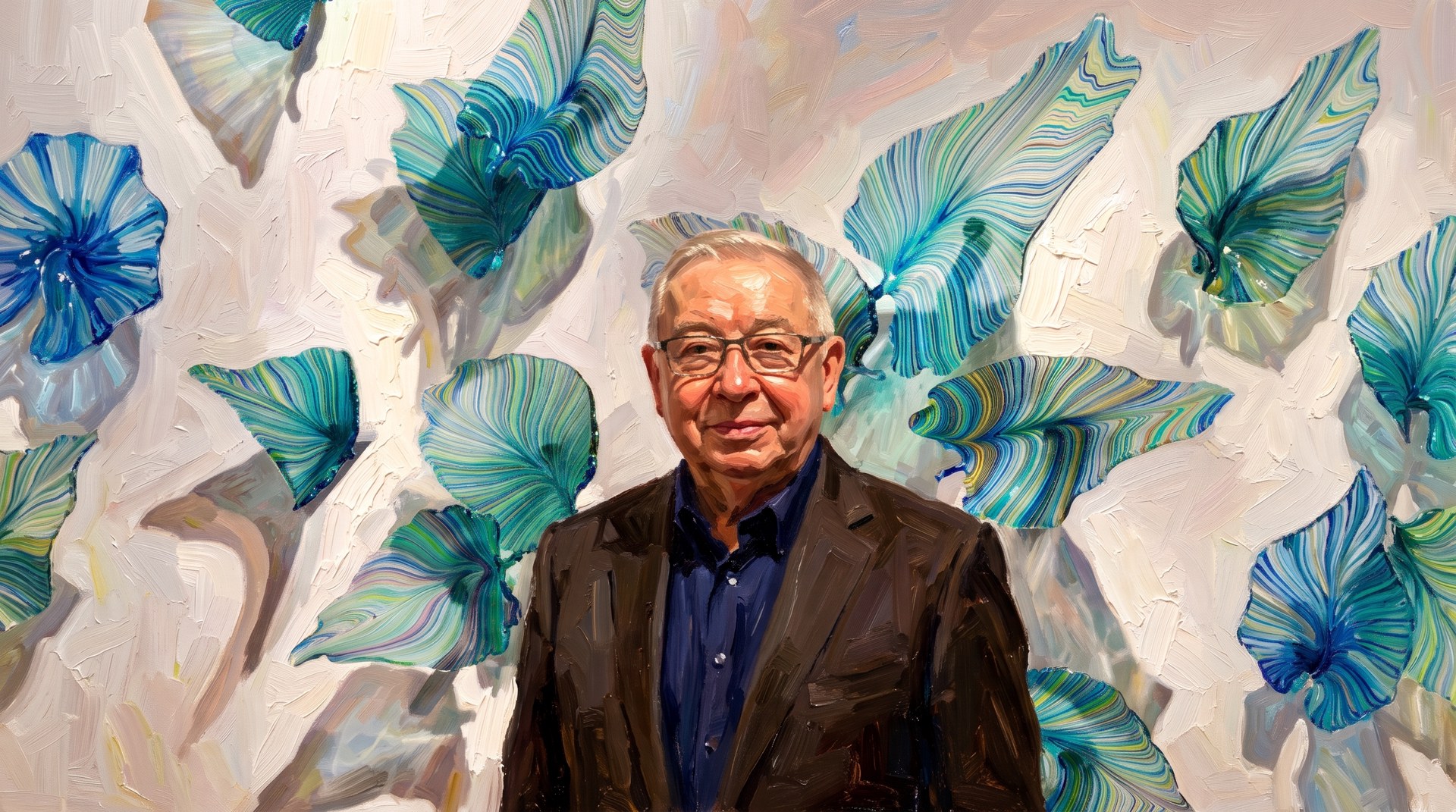
Lino Tagliapietra Murano Glass: The Ultimate Complete Maestro Guide
The Murano Maestri: A Collector's Guide
Lino Tagliapietra — The Apostle of Silk and Cane
Artist Key: Lino Tagliapietra
- Role: Maestro-Designer (The Complete Artist)
- Life/Dates: August 10, 1934 – Present
- Primary Furnaces: Vetreria Archimede Seguso (1946–1955) | Galliano Ferro Vetri Artistici (1955–1966) | Venini & C. (1966–1968) | La Murrina (1968–1977) | Effetre International (1977–1989) | EOS Design nel Vetro (1991–1992) | Independent Studio (1989–Present)
- Signature Techniques: Dinosaur (Off-axis cane twisting) | Saturneo & Saturno (Folded-ring casing) | Pilchuck '96 (Axis-shifting cane realignment) | Incalmo (Hot-fusion joining) | Zanfirico, Reticello, & Mezza Filigrana (Complex thread-work) | Battuto & Inciso (Wheel-carved surface engraving)
- Market Price Tier: High-End Investment Grade (specifically monumental Dinosaur vessels, Andries Dirk Copier fusions, Chihuly Venetians, and Endeavor boat installations) to Mid-Range (early Saturno series, Hopi vessels, and Orfeo incalmo works)
- Key Collaborators: Giovanni "Nane Catari" Ferro | Attilio Frondi | Benjamin Moore | Dale Chihuly | Andries Dirk Copier | Marina Angelin | Dan Dailey | Richard Marquis | Dante Marioni
Visual Career Timeline
              ┌──────────────────────────────────────────────────────────┐
              │                     LINO TAGLIAPIETRA                    │
              │               - THE APOSTLE OF SILK & CANE -             │
              └──────────────────────────┬───────────────────────────────┘
                                         │
     ┌───────┐                           ▼
     │ 1934  │ ──► Born August 10 in Murano into a working-class Buranese lineage.
     └───────┘                           │
     ┌───────┐                           ▼
     │ 1946  │ ──► Apprenticed at Vetreria Archimede Seguso at age eleven under Attilio Frondi.
     └───────┘                           │
     ┌───────┐                           ▼
     │ 1955  │ ──► Joins Galliano Ferro; apprenticed under Giovanni "Nane Catari" Ferro.
     └───────┘                           │
     ┌───────┐                           ▼
     │ 1956  │ ──► Achieves the rank of maestrino at age 21, and master (maestro) shortly after.
     └───────┘                           │
     ┌───────┐                           ▼
     │ 1959  │ ──► Marries Lina Ongaro, heir to a 500-year-old Muranese glass lineage.
     └───────┘                           │
     ┌───────┐                           ▼
     │ 1966  │ ──► Designs and blows the Saturneo; leaves Ferro for brief Venini residency.
     └───────┘                           │
     ┌───────┐                           ▼
     │1968-77│ ──► First master blower at La Murrina; wins Grand Prix at 1972 Barcelona Fair.
     └───────┘                           │
     ┌───────┐                           ▼
     │ 1976  │ ──► Invents the twin-bubble Saturno, folding a wide collar around a spherical core.
     └───────┘                           │
     ┌───────┐                           ▼
     │1977-89│ ──► Technical and Artistic Director at Effetre International; perfects complex cane.
     └───────┘                           │
     ┌───────┐                           ▼
     │ 1979  │ ──► Travels to Pilchuck School at Benjamin Moore's invitation; begins global teaching.
     └───────┘                           │
     ┌───────┐                           ▼
     │ 1981  │ ──► Collaborates with Dutch design giant A.D. Copier; shifts to fine-art philosophy.
     └───────┘                           │
     ┌───────┐                           ▼
     │1982-86│ ──► Designs and blows the legendary Oggetti Eggs with Marina Angelin.
     └───────┘                           │
     ┌───────┐                           ▼
     │ 1989  │ ──► Leaves industry to operate independently; begins monumental Chihuly collaborations.
     └───────┘                           │
     ┌───────┐                           ▼
     │ 1996  │ ──► Realizes Pilchuck '96 axis-shift cane realignment, inspired by Checco Ongaro.
     └───────┘                           │
     ┌───────┐                           ▼
     │ Present │ ──► Continues to blow and exhibit internationally as a global icon of contemporary glass.
     └───────┘
1. The Legend & Legacy
Born on August 10, 1934, in an apartment overlooking the Glassblower’s Channel (Rio dei Vetrai) on Murano, Lino Tagliapietra was destined to become the most influential, technically complete, and universally celebrated master glassblower of the modern era. Unlike many of Murano’s historical giants, Lino was not born into an established glassmaking dynasty. His parents—Albino Tagliapietra, a fisherman, and Clementina Zane, a lacemaker—were working-class immigrants from the nearby island of Burano who had moved to Murano in 1926. Lino’s familial connection to Murano’s noble craft came later, when he married Lina Ongaro in 1959, whose family possessed a proud, five-hundred-year lineage of master mosaicists and glassmakers.
Lino’s formal journey with glass began at approximately age ten, when he ended his school education due to illness. After a brief period in a furniture repair workshop, he was drawn to the glowing furnaces of Arte Vetraria Muranese (A.V.E.M.). He soon began hanging around the workshop of Giuseppe "Beppo" Toso, cleaning blowpipes and opening molds, before entering a full-time, unpaid apprenticeship with the independent master blower "Piccolo" Rioda.
In June 1946, at the young age of eleven, Lino was engaged as a full-time general employee (garzonetto) at Vetreria Archimede Seguso, earning a weekly wage of 250 lira. Here, he spent years operating as a helper on the four-person team of master Attilio Frondi. He briefly served under Archimede Seguso himself, observing the creation of the complex Merletti (lace) works. Following a two-year interruption for mandatory military service—which forced Lino to forfeit his earned position and restart the furnace hierarchy from the bottom—he left Seguso in December 1955 to join the newly established Galliano Ferro Vetri Artistici.
At Galliano Ferro, Lino’s raw talent and work ethic flourished. He became the primary assistant (servente) to master Giovanni "Nane Catari" Ferro, specializing in fine goblet blowing. In 1956, at the age of twenty-one, Lino was awarded the rank of maestrino (aspiring master), and within a year, his peers formally acknowledged him as a full maestro.
During the 1960s and 1970s, Lino bridged the gap between strict production blowing and modern design. He spent fourteen months at Venini & C. before joining La Murrina (1968–1977) as first master blower. At La Murrina, Lino’s technical mastery earned him international design awards, including the Grand Prix at the 1972 Barcelona Trade Fair for his futuristic Formichiere (Anteater) lamps. In 1977, Lino’s brother-in-law Mario Ferro invited him to join the new firm Effetre International as Artistic and Technical Director. Over the next twelve years, Lino pushed traditional filigree, incalmo, and reticello procedures to unprecedented heights of complexity, formulating highly sophisticated cane arrangements that became his visual signature.
Lino’s career underwent a profound metamorphosis in 1979 when the American glass coordinator Benjamin Moore invited him to teach at the Pilchuck Glass School in Washington State. Arriving in a rustic US encampment speaking no English and carrying only two Effetre trade catalogs, Lino shattered Murano’s centuries-old codes of industrial secrecy. He freely shared the lagoon’s most complex glassmaking formulas, single-handedly transforming the global Studio Glass movement. In 1989, Lino retired from industrial glassmaking to operate as an independent freelance artist, embarking on legendary collaborations with international modernists like Andries Dirk Copier, Dale Chihuly, and Dan Dailey before focusing entirely on his own acclaimed solo art glass and monumental installations.
2. The Physics & Chemistry of Advanced Incalmo Alignments
Lino Tagliapietra's technical virtuosity reaches its zenith in his revolutionary mastery of advanced, pattern-aligned incalmo. Historically, incalmo is a Renaissance technique requiring the hot-fusion joining of two separate, open-ended blown glass cups of identical diameter and wall thickness.
While classical masters executed incalmo using monochrome, transparent glasses to create simple bicolored bands, Lino elevated the process into a complex mathematical and thermodynamic feat. He engineered the technique to fuse cups pre-patterned with highly intricate, parallel zanfirico and filigrana cane networks, forcing the vertical lines of the canes to meet and align perfectly across the horizontal fusion boundary.
This multi-stage execution demands surgical precision on the furnace floor:
- Dimensional Calibration: The master glassmaker must blow two separate, independent bubbles of glass in different parts of the furnace, matching their diameters down to the millimeter. Even a microscopic mismatch in the circumference or wall thickness of the cup lips will result in a messy join, trapped air bubbles, or immediate structural cracking during cooling.
- The Incalmo Seam Alignment: While both glass cups are held at their working temperature of approximately 1100°C on separate pontil rods, the cups are opened into flared cylinders. At the critical instant of fusion, the master must slide the cups together. To align the complex, multi-threaded cane patterns, Lino developed an extraordinary, non-verbal intuition: he slightly twists the pontil rod at the fraction of a second the hot edges touch, aligning the vertical cane threads of the top half with those of the bottom half so perfectly that the joint appears to be a single, continuous vertical column of cane rather than two fused pieces.
- Expansion Coefficient Compatibility: Fusing highly contrasting colors and complex patterned glasses across an incalmo boundary requires perfect chemical compatibility. If the chemical composition of the color oxides in the top half (for example, a copper-rich turquoise) has a different coefficient of thermal expansion than the bottom half (such as a manganese-rich violet), the two halves will contract at different rates as they cool. This creates immense internal tension along the incalmo seam, causing the finished piece to violently explode. Lino conducts rigorous chemical testing on his batches to ensure that the physical viscosity and expansion rates of all colored glasses are chemically balanced before starting a blow.
3. Contemporary Global Studio Fusions
Lino Tagliapietra single-handedly bridged the gap between traditional Muranese technical execution and global abstract expressionism, transforming the American and European Studio Glass movements through deep, collaborative partnerships:
- Andries Dirk Copier: The ultimate turning point in Lino’s artistic career. Meeting the Dutch design patriarch at the 1881-founded Scuola Internazionale del Vetro in 1981, a profound bond of trust was established. Copier completely changed Lino's view of glass, opening his eyes to the potential of the material as a medium for fine art. Copier famously requested Lino not to trim or hide the ends of twisted canes on the rim, leaving them raw and exposed to showcase the organic construction of the glass—defying traditional Muranese rules of flawless finishing.
- Benjamin Moore: In 1979, the American glass coordinator Benjamin Moore invited Lino to teach at the Pilchuck Glass School. Their close friendship and technical collaboration spanned decades, with Moore designing minimalist, elegant geometric shapes that relied on Lino's pristine execution.
- Dale Chihuly: The historic Venetians series (1989–1991). Chihuly’s wild, gestural drawings of flamboyant, Rococo vessels were translated into physical form by Lino. Operating as Chihuly's master blower, Lino manipulated massive gathers of hot glass with unprecedented speed, adding elaborate hand-drawn leaves, handles, and coiling decorations, bridging Seattle's expressive scale with Murano's technical lightness.
- Dan Dailey: Lino blew fifty unique, thick-walled, semi-matte crystal vessels, which Dailey subsequently cold-carved and decorated with fired enamel drawings of surrealist landscapes and figures. All pieces were co-signed by both artists.
- Richard Marquis: Marquis studied under Lino's supervision, mastering traditional Muranese murrine and filigree techniques. Together, they introduced structured, pictorial murrine cane arrangements to American contemporary glass.
- Dante Marioni: Lino mentored the young American virtuoso, inspiring Marioni's signature tall, slender, and brightly colored vessels that combined traditional Venetian delicacy with modern American proportions.
4. The "Fingerprint" Techniques
Lino Tagliapietra's technical virtuosity lies in his ability to execute complex, multi-stage cane constructions with absolute fluidity and linear symmetry:
- The Dinosaur (1990s–Present): Lino's ultimate sculptural masterpiece. This technique produces an organic, fluidly curved vessel with a wide, bulbous base that tapers into a long, sweeping, off-axis neck, culminating in a small, folded head. The body is composed of highly complex parallel and twisted multicolored zanfirico and filigrana canes, requiring the maestro to manipulate and stretch the molten glass off-center while maintaining perfect thermal control.
- The Saturneo (1966) & Saturno (1976): Designed to replicate the ringed planet, the early Saturneo cased a single bubble of glass, which was meticulously folded and squeezed while hot to form a continuous, flat lateral ring using a classic Roman technique. In 1976, Lino re-engineered this form into the Saturno, blowing two separate glass bubbles—fusing a wide, flat disk-like collar around a central, perfectly spherical core.
- Pilchuck '96 (Axis-Realignment): Realized in the summer of 1996, this advanced method was inspired by Lino’s brother-in-law, the master Checco Ongaro, who demonstrated how to alter the axis of a cane pattern. Lino took this technique and adapted it to his own large-scale works, folding the hot cane mass upon itself to create a sharp, vertical, or diagonal seam. This allowed him to realign the linear flow of the glass canes, creating complex, intersecting geometries and contrasting bands that run from top to bottom.
- Surface Carving (Battuto & Inciso): From the 1990s onward, Lino integrated extensive cold-working treatments. Once the cased, multi-threaded vessels cooled, he carved the surfaces with deep, hand-guided diamond-grinding wheels. The resulting matte, frosted scars (battuto) or fine, parallel groovings (inciso) cut through cased color layers, exposing the clear or opaline glass underneath to refract light.
5. The Forensic Chronology of Lino Tagliapietra Markings
To confidently identify, date, and authenticate a Lino Tagliapietra vessel, collectors must understand the precise evolution of markings, paper labels, and hand-engraved signatures utilized across his distinct creative eras:
I. The Early Industrial Era (1946–1977)
- Vetreria Archimede Seguso, Galliano Ferro, and Venini Years: Pieces executed during these years were completely unsigned by Lino. They carried only the standard paper labels or foil stickers of their respective factories.
- La Murrina Years (1968–1977): High-art lighting and vessels produced under Lino's supervision carry the factory's signature
LMmarkings. Look for:- A small, circular, acid-etched stamp reading
la murrinaorla murrina muranoon the underside of base rings. - A highly distinct, red-and-white glass
LMmonogram murrina fused directly into the body of the vessel near the pontil.
- A small, circular, acid-etched stamp reading
II. The Effetre International Era (1977–1989)
- Factory Labels: Utilitarian wares and standard catalog models carry rectangular paper labels reading
F3 / EffetreorEffetre International Muranoin black or blue ink. - The Diamond-Point Signature (Post-1981): Following his historic 1981 collaboration with Andries Dirk Copier (who refused to allow the master blower to remain anonymous), Lino began hand-signing his finest works. High-art creations are signed with a hand-guided diamond-point script:
- Collaborative Works: Signed with both names, reading
Lino Tagliapietra - A.D. Copier [Year]orLino Tagliapietra - Marina Angelin [Year]. - Solo Creations (Post-1982): Signed
Lino Tagliapietrain elegant cursive on the underside of the polished base, frequently accompanied by the exact year of execution.
- Collaborative Works: Signed with both names, reading
III. The EOS Design nel Vetro Era (1991–1992)
- The EOS Signature: Works designed and blown during his brief residency with EOS carry a distinct hand-engraved cursive signature reading
EOS Lino Tagliapietra [Year]orEOS Lino Tagliapietra Murano.
IV. The Independent Studio Era (1989–Present)
- The Master Cursive Signature: Authentic solo art glass and installations produced in his independent studio are consistently hand-signed with a fine, hand-guided diamond-point pen on the flat-ground base. The signature reads:
Lino Tagliapietra. - Dated Signatures: Almost all independent works carry the year of execution directly beneath the name, reading
Lino Tagliapietra 1991,Lino Tagliapietra 2002, orLino Tagliapietra 2012. - Series & Model Titles: Unique exhibition pieces or works belonging to celebrated limited series carry the hand-engraved title of the series alongside the signature, such as
Lino Tagliapietra 'Dinosaur',Lino Tagliapietra 'Hopi', orLino Tagliapietra 'Saturno'.
6. The Collector's Diagnostic Checklist & Market Realities
- Analyzing Pontil Base Finish: Lino's vessels exhibit an exceptional, surgical base finish. Look for a perfectly flat-ground base rim and a beautifully offset, circular, cut-out hollow that is ground to a fine matte or polished to a mirror-like finish.
- Linear Cane Construction Flawlessness: In Lino's cane-worked vessels (like the Dinosaur or Hopi series), the alignment of the glass threads is mathematically precise. The parallel lines of the canes must never bleed, overlap, or distort, remaining razor-sharp even when stretched and twisted across dramatic, asymmetrical contours.
- The Price Tiers:
- High-End Investment Grade: Monumental Dinosaur sculptures in multi-colored zanfirico patchwork; original Andries Dirk Copier collaboration vessels (co-signed by both artists and showing the raw, untrimmed cane rims); original Chihuly Venetians hand-blown by Lino; and large-scale installation groupings like his floating Endeavor boats.
- Mid-Range: Early Saturneo and Saturno vessels; Hopi wide-shouldered vases; Medea black plates with white-centered red canes; and unique Orfeo incalmo works.
- Accessible: Small Oggetti eggs designed with Marina Angelin; everyday utility glassware and lamps produced for La Murrina or Effetre International during the 1970s and early 1980s.
- Differentiating the Copies: Because Lino Tagliapietra is the most celebrated living master of Murano, his designs have been heavily copied, plagiarized, and forged by anonymous factories. Authentic Lino glass is characterized by its astonishing lightness, paper-thin wall execution (even on massive shapes), and the micro-precision of the cane layouts. Cheap fakes stand out by their thick, heavy, clumsy crystal walls; wavy, distorted, or bleeding cane alignments; and rough, unpolished pontil marks with clumsy, crudely etched signatures.
7. Attribution & Authenticity
In the Murano glassmaking tradition, the difference between a fake and a copy rests entirely on intent, origin, and transparent attribution. A fake is a deceptive counterfeit manufactured outside of Murano—often in mass production factories in Asia or Eastern Europe—that utilizes cheap materials and carries forged signatures or illicit trademark stickers to intentionally defraud collectors. Conversely, a copy is a legitimate artistic homage (omaggio) handcrafted by a skilled master using authentic Murano techniques and materials; it serves as a tribute to honor a legendary artisan's legacy and is openly signed by the modern creator, preserving the lineage of Venetian glassblowing rather than exploiting it.
Join Our Facebook Group Identify Your Murano - Murano Glass Animals