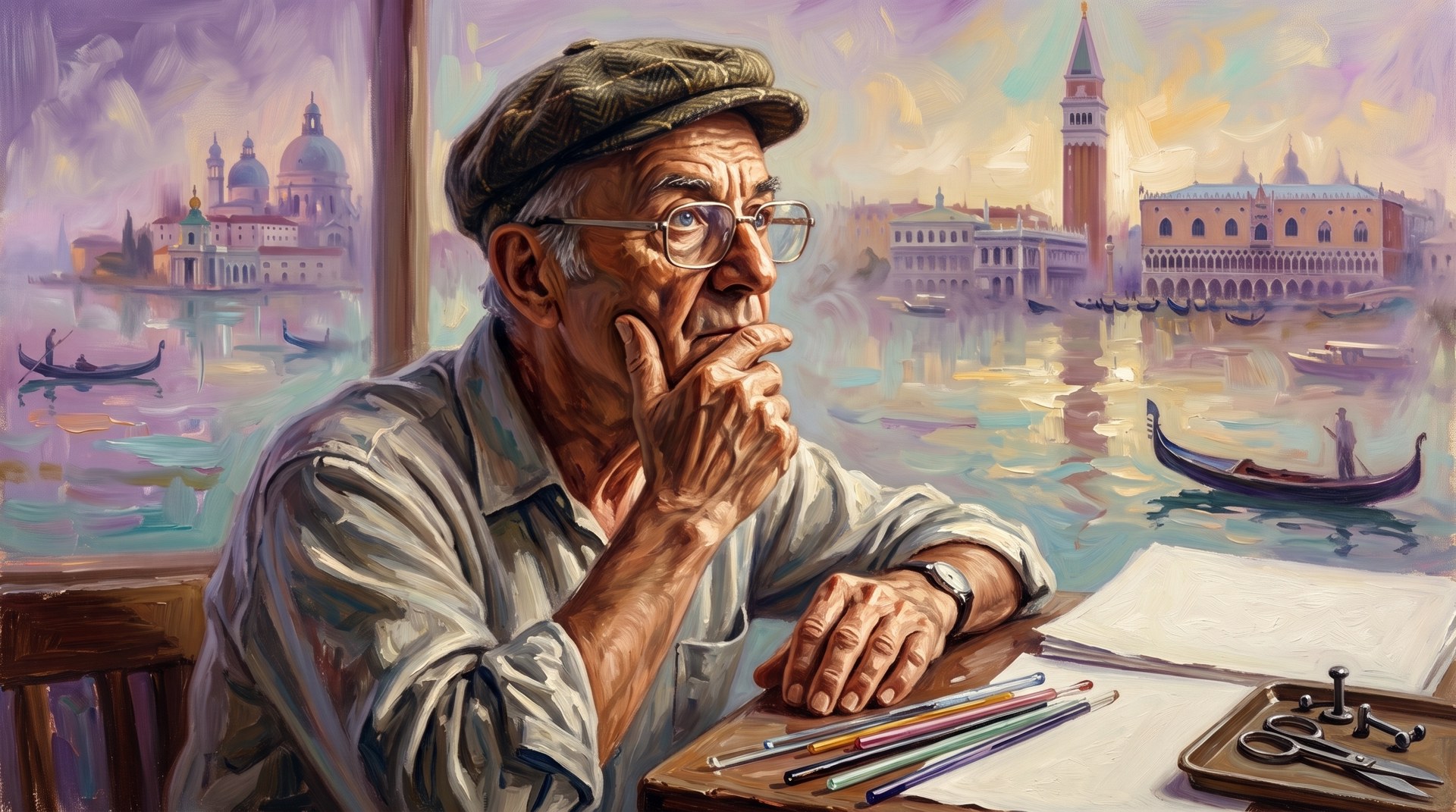
Fulvio Bianconi Murano Glass: The Ultimate Visionary Designer Guide
The Murano Maestri: A Collector's Guide
Fulvio Bianconi — The Choreographer of Color
Artist Key: Fulvio Bianconi
- Role: Freelance Designer & Illustrator (The Choreographer of Color)
- Life/Dates: Padua, August 28, 1915 – Milan, May 13, 1996
- Primary Furnaces: Venini & C. (1947–1958, 1965–1968, 1989) | Gino Cenedese & C. (1950, 1954–1958) | I.V.R. Mazzega (1958–1961) | Vetraria Vistosi (1963) | Vetraria Ferro Galliano (1966)
- Signature Techniques: Pezzati (Patchwork mosaic) | Fazzoletto (Centrifugal spun handkerchief) | Scozzese (Tartan cane overlays) | A Canne & Fasce Orizzontali (Polychromatic ribbon wrapping) | Forato (Hot-perforated voids) | A Macchie (Stained glass blotting) | Ritagli (Fused glass ribbon scraps)
- Market Price Tier: High-End Investment Grade (specifically 1950s Pezzati, early Fazzoletti, Scozzese, and Commedia dell'arte figurines) to Mid-Range (utilitarian tableware and Cenedese/Mazzega/Vistosi collaborations)
- Key Collaborators: Paolo Venini | Arturo Biasutto ("Boboli") | Ermete Vittorio Toso ("Fasioloni") | Ermanno Nason | Gino Cenedese | Dino Villani
SEO Article Summary:
Discover the secrets to identifying and collecting the magnificent mid-century modern glassware designed by Fulvio Bianconi, Venini’s premier colorist of kinetic motion. This collector's guide covers his transition from graphic illustration to pioneering some of glassmaking's most legendary techniques, including the patchwork Pezzati series, the fluid Fazzoletto (Handkerchief) vase, and the complex Scozzese tartan series. Learn how to verify authentic diagnostic markers—including uneven weight distributions, seamless patchwork fusions, flat ground bases, and Venini acid-stamped signatures—to confidently identify his creations and spot true investment-grade treasures on the secondary market.
Visual Career Timeline
    ┌──────────────────────────────────────────────────────────┐
    │      FULVIO BIANCONI      │
    │    - THE CHOREOGRAPHER OF COLOR -    │
    └──────────────────────────┬───────────────────────────────┘
           │
  ┌───────┐       ▼
  │ 1915 │ ──► Born August 28 in Padua; moves with family to Venice in 1920.
  └───────┘       │
  ┌───────┐       ▼
  │1930-31│ ──► Apprenticed in historicist enamel-painted glass under Michele Pinto.
  └───────┘       │
  ┌───────┐       ▼
  │ 1935 │ ──► Moves to Milan; hired by Dino Villani as Mondadori & Rizzoli illustrator.
  └───────┘       │
  ┌───────┐       ▼
  │ 1945 │ ──► Designs perfume bottles for G.I.V.I.M., blown by Boboli at Venini & C.
  └───────┘       │
  ┌───────┐       ▼
  │ 1948 │ ──► Exhibits solid-blown Commedia dell'arte figures at XXIV Venice Biennale.
  └───────┘       │
  ┌───────┐       ▼
  │ 1949 │ ──► Co-designs the iconic Fazzoletto (Handkerchief) vase with Paolo Venini.
  └───────┘       │
  ┌───────┐       ▼
  │ 1950 │ ──► Launches Pezzati, Macchie, Fasce, and Sirena series at XXV Venice Biennale.
  └───────┘       │
  ┌───────┐       ▼
  │ 1951 │ ──► Exhibits the Margherite collection at the IXth Triennale di Milano.
  └───────┘       │
  ┌───────┐       ▼
  │ 1954 │ ──► Introduces the complex, double-axis tartan Scozzese series.
  └───────┘       │
  │         ├─► Partners with Gino Cenedese & C. on cased animal lines.
  │         └─► Collaborates with master Ermanno Nason at Cenedese.
  ┌───────┐       ▼
  │1958-61│ ──► Partners with I.V.R. Mazzega; designs abstract mosaics for Danese gallery.
  └───────┘       │
  ┌───────┐       ▼
  │ 1965 │ ──► Returns to Venini; launches the minimalist, stone-like Sassi series.
  └───────┘       │
  ┌───────┐       ▼
  │ 1968 │ ──► Explores organic textures with the orange-peel-surfaced Informale vase.
  └───────┘       │
  ┌───────┐       ▼
  │ 1989 │ ──► Final Venini collaboration: designs Ritagli, Vasi Donna, and Sommerse.
  └───────┘       │
  ┌───────┐       ▼
  │ 1996 │ ──► Passes away May 13 in Milan, leaving a legacy of chromatic play.
  └───────┘
1. The Legend & Legacy: The Illustrator of Fire
Born in Padua on August 28, 1915, Fulvio Bianconi became the most exuberant, revolutionary, and widely popular design force of mid-century Murano glass. He first encountered the medium at the young age of fifteen when he studied traditional enamel painting under the guidance of master Michele Pinto at Salviati & C. After completing his formal studies at the Venice State Art Institute Carmini and the Academy of Fine Arts in Venice, Bianconi moved to Milan in 1935 to work as a window dresser and graphic illustrator. He was quickly noticed by Dino Villani, who introduced him to the leading Milanese publishing giants Mondadori, Rizzoli, and Motta.
Following World War II, Bianconi returned to Murano to deeply explore the technical physics of blown glass. In 1945, the perfume house G.I.V.I.M. (Visconti di Modrone) commissioned him to design a series of custom perfume bottles. Bianconi had the prototypes executed at the Venini & C. furnace by the legendary first master glassblower Arturo Biasutto, known as "Boboli". This historic encounter marked a complete turning point in Bianconi's career, initiating a decade-long freelance partnership with Paolo Venini that forever altered the course of modern Italian design.
Bianconi brought a carefree, explosive, and mischievous graphic sensibility to Venini’s furnace floor. His first major critical triumph came at the 1948 Venice Biennale, where he exhibited his iconic Maschere della Commedia dell’arte—a series of twelve hand-sculpted, solid white figurines (such as Brighella, Arlecchina, and Arlecchino) that were beautifully detailed with trailed-on colored threads, masks, and collars. The series was a massive financial success and never went out of production.
Over the next decade, Bianconi operated as Venini’s principal creative spark. He worked in close synergy with Boboli and Ermete Vittorio Toso, translating the abstract trends of contemporary painting and sculpture directly into the hot, plastic medium of blown glass. While Bianconi officially dissolved his full-time association with Venini in 1958, he spent the subsequent decades designing brilliant collections for Gino Cenedese, I.V.R. Mazzega, Vistosi, Ferro Galliano, Toso Vetri d'Arte, and de Majo. He returned to Venini twice—in the mid-1960s to pioneer a series of elegant minimalist Sassi vessels, and once more in 1989 to create his late-career masterpieces, the Ritagli and Vasi Donna series. He passed away on May 13, 1996, in Milan, leaving behind an immortal legacy as the undisputed master who infused Murano glass with the vibrant spirit of modern art.
2. Neoplastic & Kinematic Design Formulas
Fulvio Bianconi did not view glass as a static, decorative vessel; he approached it as a dynamic, moving canvas. He combined principles of Neoplasticism—dividing space through structural colored segments—with kinematic motion, utilizing centrifugal force and structural inflation to manipulate the shapes of hot glass:
- The Centrifugal Handkerchief Dynamics (Fazzoletto): Designed around 1949, this series transformed the traditional, rigid vase into a fluid, draping silk sculpture.
- The Kinematic Process: While the hand-blown cased parison was white-hot (approximately eleven hundred degrees Celsius) and attached to the pontil rod, the master glassmaker rotated the iron rapidly. The centrifugal force flared the open mouth of the cylinder outward, determined by the mass of the molten glass at the rim, the square of the angular velocity of the spinning pontil, and its radial distance from the center. As the glass expanded radially under this rotational force, the master tilted the rod downward, letting gravity sag and drape the soft glass walls. The opposing forces of centrifugal expansion and gravitational drag forced the paper-thin cased glass to fold, drape, and ripple into the organic, waving configuration resembling a suspended handkerchief.
- The Proportional Mosaic Expansion of Pezzati: Launched at the twenty-fifth Venice Biennale in 1950, this series represented a brilliant, geometric division of space.
- The Mathematical Process: Bianconi arranged individual, flat square and rectangular colored tiles into a flat, horizontal chessboard pattern on a steel plate. Once heated to a softening point inside the kiln, a clear glass bubble was rolled over the sheet, gathering the flat mosaic skin onto the parison. During blowing, the flat two-dimensional grid was inflated into a three-dimensional curved surface of revolution. Because the tiles were fused as a single skin, they expanded proportionally to the local curvature of the vessel walls without bleeding, tearing, or overlapping. As the glassmaster blew and expanded the vessel, the surface area of each individual tile increased in proportion to its distance from the central axis of rotation and the slope of the vase’s profile, maintaining perfect adjacent alignment across even the most dramatic, splayed contours.
- Double-Axis Tartan Grid (Scozzese): Introduced in 1954, the Scozzese (Tartan) series applied a highly complex, multi-layered mesh design.
- The Geometrical Process: Rather than laying tiles, Bianconi arranged colored glass canes along two perpendicular, intersecting axes on the kiln plate. The master rolled a transparent parison over this cross-hatched cane grid. When inflated and blown, the horizontal canes stretched outward to form widening bands, while the vertical canes twisted and lengthened along the vessel's vertical axis, replicating the warp-and-weft texture of a woven Scottish plaid fabric.
3. The Metallurgy and Chemistry of Chemical Colorways
Fulvio Bianconi was Murano's supreme colorist. He conducted exhaustive chemical trials on metal oxide colorants, formulating custom glass batches to achieve the vivid, pure, and non-bleeding hues that characterized his iconic palettes:
- The Metallurgy of the Fused Pezzati Colorways:
- Parigi (Paris): A bold, primary-color mosaic combining deep cobalt blue, emerald green, fiery red, and transparent amber tiles.
- Stoccolma (Stockholm): A cool, Scandinavian-inspired palette of turquoise, ruby red, clear, and grass-green tiles.
- Istanbul: A rich, orientalist combination of coral red, emerald green, and transparent amber.
- Americano (American): A high-contrast, pop-art combination of bright yellow, opaque white, ruby red, and cobalt blue.
- The Chemical Oxide Formulations:
- Fiery Red & Coral Tiles: The high-art reds of the Pezzati tiles were achieved using a highly delicate colloidal suspension of cadmium sulfoselenide. The batch required strict temperature reduction cycles during melting to prevent the selenium from volatilizing, ensuring a dense, opaque crimson that did not bleed into adjacent clear seams.
- The Deep Cobalt Blues: Colored with cobalt oxide at a microscopic concentration of approximately one-tenth of a percent to one-half of a percent inside a potash-soda silica glass batch, yielding an incredibly rich, deep blue with maximum light refraction.
- The Grass and Emerald Greens: Obtained by combining chromium oxide with copper carbonate, producing a highly saturated, vibrant green that remained stable when subjected to multiple reheats at the glory hole.
- The Bright Yellow Tiles: Formulated using cadmium sulfide or lead antimonate (traditionally known as Naples Yellow), yielding a stable, opaque yellow that maintained sharp boundaries when fused.
- The Deep Violet/Black Linings: Achieved using high concentrations of manganese dioxide mixed with iron impurities, absorbing almost all visible light waves to appear as a high-gloss, opaque black under normal light, but transmitting deep violet when held directly against a strong light source.
- Expansion Coefficient Compatibility: Fusing up to twenty contrasting colored glass tiles on a single parison requires perfect physical and chemical compatibility. Every colored oxide alters the glass batch's density and its coefficient of thermal expansion. If the red tile contracts faster than the blue tile during the cooling phase, the resulting tension along the seam lines will cause the vessel to crack. Bianconi worked closely with Venini's chemists to maintain all colors at a uniform coefficient of thermal expansion of approximately ninety points by ten to the minus seven per degree Celsius, ensuring that the patchwork expanded and contracted as a single, structurally unified sheet.
4. Famous Collaborations
Fulvio Bianconi’s graphic, painterly designs demanded an unprecedented level of execution, requiring close, highly productive partnerships with Murano’s premier masters:
- Paolo Venini: The founder-director of Venini & C. Venini's strict, demanding eye and search for classical proportion acted as the perfect focusing lens for Bianconi's carefree, polychromatic energy, resulting in the co-designed and shared patent registries for the Fazzoletto series.
- Arturo Biasutto ("Boboli"): Venini's premier post-war master blower. Possessing immense physical strength and technical discipline, Boboli was the primary hands who physically executed Bianconi’s earliest and most complex masterpieces, including the solid Commedia dell’arte figures and original Fazzoletti.
- Ermete Vittorio Toso ("Fasioloni"): A master blower of incredible speed, Ermete worked hand-in-hand with Bianconi to refine the rapid, centrifugal spinning of the Fazzoletto series, ensuring that the folds draped elegantly without collapsing.
- Gino Cenedese & C.: From 1950 to 1958, Bianconi collaborated part-time with Cenedese to design heavy sommerso vases decorated with delicate applied glass filaments that traced abstract human figures and silhouettes (such as his famous Teatrino series at the 1954 Venice Biennale). He shared furnace spaces there with master sculptor Ermanno Nason.
- I.V.R. Mazzega: From 1958 to 1961, Bianconi partnered with Mazzega to create a range of modern, thick-walled violet-black vases decorated with irregular mosaic bands and stylized, solid figurative sculptures like his Egyptian winebearer.
- Vetraria Vistosi: In 1963, Bianconi designed a series of monumental quadrangular vases (such as Model S 160 and S 504) featuring bold color applications and asymmetrical geometries.
5. The Forensic Chronology of Venini Markings (1947–1989)
To confidently identify, date, and authenticate a Fulvio Bianconi vessel, collectors must understand the precise chronological evolution of base markings, paper labels, and acid stamps used by the Venini workshop across different eras:
I. The Early Post-War Era (1947–1950)
- The Linear Three-Line Stamp (Wartime Style): Early Commedia dell'arte figures and the first Fazzoletto models carry a crisp, linear three-line acid-etched mark on the flat underside of the base ring reading:
venini / murano / MADE IN ITALYprinted in sans-serif capital letters. - Early Foil Labels: Rectangular paper labels reading
VENINI / MURANO / Made in Italyprinted in red or blue ink on fragile foil backgrounds.
II. The Golden Age of Pezzati and Fazzoletti (1950–1965)
- The Standard Three-Line "ITALIA" Stamp: The most common and famous diagnostic stamp of his primary tenure. It features a clean, linear three-line acid stamp reading:
venini / murano / ITALIAprinted in sans-serif capital letters on the underside of the base. - The Circular Loop Stamp: Used specifically on fused mosaic Pezzati plates, small bowls, and thin-walled cased lines where space was limited. The stamp reads:
venini / muranoarranged in a circular loop. - The Central "ITALY" Circular Stamp: Found on highly tooled, hand-finished lines like Inciso or Incalmo vessels. The stamp reads:
venini / ITALY / muranowithITALYprinted horizontally in the center of the circular loop. - The Square Paper Labels: Look for square paper stickers reading
VENINI MURANO VENEZIA N MADE IN ITALYwith handwritten blue or black ink model codes matching his catalog registry numbers (e.g. Model4397for Pezzati, Model4406for Fazzoletti).
III. The Return & Late-Career Period (1965–1968)
- The Hand-Guided Vibro-Engraving: For his returns (including the minimalist Sassi or textured Informale series), Venini phased out acid-etched stamps in favor of hand-guided, vibro-engraved signatures reading:
venini italiaoften accompanied by the exact year of execution (e.g.,venini italia 1968). After 1971, the last two digits of the year were appended (e.g.,venini italia 72orvenini italia 75). - The Rare Designer Script: Highly premium, unique gallery pieces or non-catalogued prototypes designed by Bianconi carry his full engraved signature reading
Fulvio Bianconi / Veniniand the date.
IV. The Final Collaborations (1989)
- The Late Engraved Mark: Pieces designed during his final 1989 residency—specifically the ribbon-strip Ritagli series and Vasi Donna—are hand-signed on the polished pontil base reading:
Venini F. Bianconi 89orVenini F. Bianconi 90. - The "Dental Drill" Forgery Alert: Collectors must be highly vigilant against pieces presenting signature carvings made with a modern rotary dental drill. It is an established academic fact that Muranese glassworks never employed dental drills for signature markings. Any authentic engraved signatures from the period were executed strictly using wheel-cutting or diamond-point scratching.
6. The Collector's Diagnostic Checklist & Market Realities
- Evaluating Patchwork Seam Quality: In authentic Pezzati patchwork vases, the boundary lines between the square colored plates are seamless, mathematically clean, and show zero bleeding. Beware of pieces with large air gaps, bubbles trapped inside the seam lines, or dirty soot deposits at the joints, which indicate cheap modern reproductions.
- Unorthodox Weight Distribution & Symmetry: Genuine Bianconi vessels reject traditional symmetry. On Pezzati vases, look for bilaterally flattened sides, slightly splayed rims, and uneven wall thicknesses. True Fazzoletti are never identical; the folds must appear organic, flowing, and spontaneous.
- Analyzing Base Finish: Bianconi's vessels are characterized by deep, offset, hand-ground base rings and polished pontil marks on the bottom of the base.
- The Price Tiers:
- High-End Investment Grade: Original 1950–1952 Pezzati vases (specifically those in the highly desirable Parigi, Stoccolma, Istanbul, and Americano colorways) represent premium investment-grade works where master blowers like Boboli worked behind the scenes; original 1948 solid-blown Commedia dell’arte figures; and 1954 Scozzese tartan vessels.
- Mid-Range: Early Fazzoletto centerpieces in zanfirico filigree; Forato perforated vases; his 1950s Fasce orizzontali bottles; and late 1960s Informale vases with their signature "orange peel" molded texture.
- Accessible: Late-era solid-glass animal figurines, small utility wares produced for Vistosi or mazzega, and small everyday cased bowls.
- Differentiating the Copies: Because Fulvio Bianconi’s Pezzati and Fazzoletto series represent the absolute pinnacle of mid-century Murano glass, they have been extensively plagiarized and copied by contemporary factories. Authentic Bianconi pieces stand out by their exceptional lightness, paper-thin wall execution, and pure, non-bleeding color boundaries. Cheap copies are characterized by thick, clumsy, heavy glass walls; messy, overlapping patchwork tiles that bleed into one another; and raw, unpolished, or jagged pontil scars on the base that cause the piece to wobble.
7. Attribution & Authenticity
In the Murano glassmaking tradition, the difference between a fake and a copy rests entirely on intent, origin, and transparent attribution. A fake is a deceptive counterfeit manufactured outside of Murano—often in mass production factories in Asia or Eastern Europe—that utilizes cheap materials and carries forged signatures or illicit trademark stickers to intentionally defraud collectors. Conversely, a copy is a legitimate artistic homage (omaggio) handcrafted by a skilled master using authentic Murano techniques and materials; it serves as a tribute to honor a legendary artisan's legacy and is openly signed by the modern creator, preserving the lineage of Venetian glassblowing rather than exploiting it.
Join Our Facebook Group Identify Your Murano - Murano Glass Animals