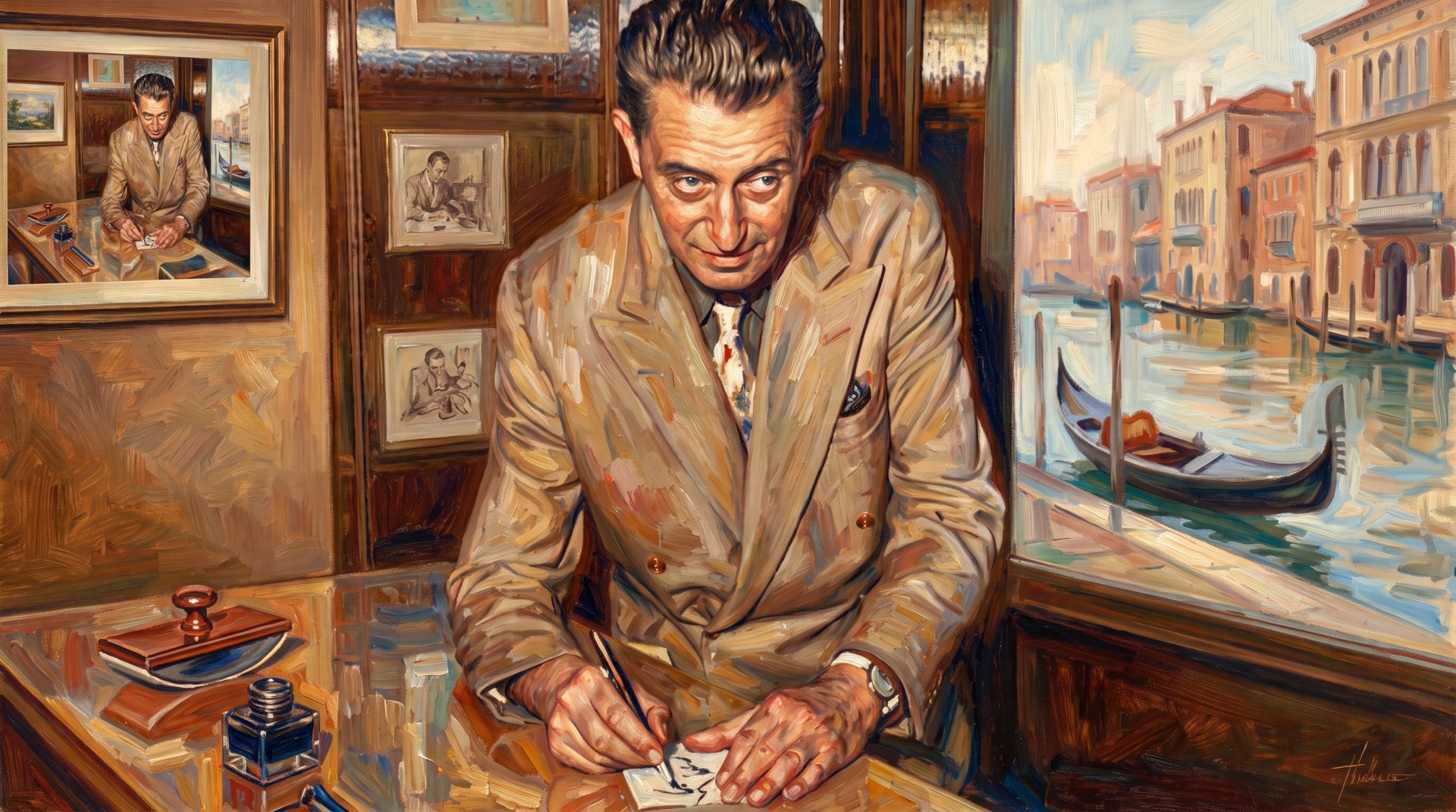
Flavio Poli Murano Glass: The Ultimate Visionary Designer Guide
The Visionary Designers: A Collector's Guide
Flavio Poli — The Sculptor of Sommerso
** Artist Key: Flavio Poli**
- Role: Artistic Director & Co-Owner (The Mind of Glass)
- Life/Dates: Chioggia, 1900 – Venice, 1984
- Primary Furnaces: I.V.A.M. (Industria Vetraria Artistica Muranese, 1929–1931) | Compagnia di Venezia e Murano (C.V.M., 1931–1932) | Artistica Vetreria e Soffieria Barovier Seguso & Ferro (later Seguso Vetri d'Arte, 1934–1963) | Società Veneziana di Conterie e Cristallerie (1964–1967)
- Signature Techniques: Sommerso (Layered color submergence) | Siderale / Astrale (Concentric target bands) | Corroso (Acid-matte texturing) | Bullicante (Controlled bubble gold-flecking) | A Massello (Solid hot-glass sculpting) | Incamiciato (Cased milk glass)
- Market Price Tier: High-End Investment Grade (specifically 1952 Siderale target vases, interwar I.V.A.M.-era solid nudes, and award-winning 1954 Valva vases) to Mid-Range (post-war Corroso vessels, Bullicante centerpieces, and cased Ciclamino or Turchese bowls)
- Key Collaborators: Archimede Seguso | Angelo Seguso | Italo "Otello" Nason | Gino Francesconi | Mario Pinzoni | Giovita Vitali | Gio Ponti | Plinio Pustetto | Giusto Nichetto
Summary:
Discover the secrets to identifying and collecting the magnificent mid-century modern glassware designed by Flavio Poli, Seguso Vetri d'Arte's legendary artistic director. This collector's guide covers his transition from ceramics to pioneering some of glassmaking's most iconic techniques, including the multi-layered sommerso series, the target-patterned Siderale (Astrale) series, and the heavily frosted corroso collections. Learn how to verify authentic diagnostic markers—including razor-sharp casing alignments, ground-polished flat bases, and authentic Seguso Vetri d'Arte paper decals and engraved signatures—to confidently identify his creations and spot true investment-grade treasures on the secondary market.
Visual Career Timeline
              ┌──────────────────────────────────────────────────────────┐
              │                       FLAVIO POLI                        │
              │             - THE SCULPTOR OF SOMMERSO -                 │
              └──────────────────────────┬───────────────────────────────┘
                                         │
     ┌───────┐                           ▼
     │ 1900  │ ──► Born in Chioggia; trains as a master ceramist at the Venice Art Institute.
     └───────┘                           │
     ┌───────┐                           ▼
     │ 1929  │ ──► Enters glass design at I.V.A.M.; pioneers Murano's early solid nudes.
     └───────┘                           │
     ┌───────┐                           ▼
     │ 1932  │ ──► Designs stylized interwar figures for C.V.M. at the Venice Biennale.
     └───────┘                           │
     ┌───────┐                           ▼
     │ 1934  │ ──► Appointed Artistic Director of Barovier Seguso & Ferro, succeeding Zecchin.
     └───────┘                           │
     ┌───────┐                           ▼
     │ 1937  │ ──► Buys partner shares to co-own and establish Seguso Vetri d'Arte.
     └───────┘                           │
     ┌───────┐                           ▼
     │ 1938  │ ──► Collaborates with Archimede Seguso on solid, corroso-finished bestiaries.
     └───────┘                           │
     ┌───────┐                           ▼
     │ 1942  │ ──► Lead master Archimede Seguso departs; Poli turns toward minimalist casing.
     └───────┘                           │
     ┌───────┐                           ▼
     │ 1950  │ ──► Begins post-war sommerso trials under restructuring with Angelo Seguso.
     └───────┘                           │
     ┌───────┐                           ▼
     │ 1952  │ ──► Launches the concentric, multi-layered Siderale series at the Biennale.
     └───────┘                           │
     ┌───────┐                           ▼
     │ 1954  │ ──► Wins the Compasso d'Oro for the iconic, asymmetrical Valva vase.
     └───────┘                           │
     ┌───────┐                           ▼
     │ 1963  │ ──► Resigns from Seguso Vetri d'Arte, transferring art direction to Pinzoni.
     └───────┘                           │
     ┌───────┐                           ▼
     │ 1964  │ ──► Joins Conterie e Cristallerie as Artistic Director, leading modern lines.
     └───────┘                           │
     ┌───────┐                           ▼
     │ 1984  │ ──► Passes away in Venice, leaving an unmatched legacy of mid-century grace.
     └───────┘
1. The Legend & Legacy: The Mind of Glass
Trained as a master ceramist at the Venice State Institute of Art, Flavio Poli was a rare visual genius who approached the medium of hot glass with the structural, volume-focused mindset of a sculptor. Born in Chioggia in 1900, Poli spent his early career designing modern ceramics for the Benedettelli and Guerrieri factories. His transition to glass began in 1928 upon meeting Giovita Vitali, whose family operated the newly formed furnace I.V.A.M. (Industria Vetraria Artistica Muranese) at the fondamenta Andrea Navagero on Murano. Intrigued by Poli’s plastic sensibility, the Vitalis invited him to experiment on their furnace floor.
Working alongside chief master blower Italo "Otello" Nason, Poli pioneered Murano’s earliest attempts at the a massello (solid hot-glass) sculpting method. His classical, Novecento-style statuettes, Olympian deities, and athletic figures in solid black, fume, and opalescent glass were immediate aesthetic revelations. Many of these early, thinly blown objects of modern appearance were decorated with intricate, elegant figurative engravings executed by the master engraver Gino Francesconi. Following I.V.A.M.’s bankruptcy and closure in December 1934, several of Poli’s pioneering models were reintroduced by the newly formed Artistica Soffieria e Vetreria - Barovier Seguso & Ferro.
By that time, Poli enjoyed a well-established reputation on Murano, which secured him the position of Artistic Director at the Barovier Seguso & Ferro cooperative, succeeding the painter Vittorio Zecchin. In 1937, Poli purchased the partner shares of departing founder Luigi Olimpio Ferro, officially renaming the corporate entity Seguso Vetri d'Arte and entering the firm as a full administrative partner. This marked the beginning of an extraordinary, nearly thirty-year tenure.
Poli radically shifted the factory’s production away from traditional historicism toward a bold, architectural style. In close partnership with the legendary first master blower Archimede Seguso, Poli designed massive, thick-walled vessels and solid glass bestiaries cased in controlled bubbles (bullicante) or gold powder. Their collaboration reached its critical peak at the 1936 Milan Triennale, where they exhibited the monumental solid opalescent mural relief Lo Zodiaco, and at the 1938 Venice Biennale, where they debuted a primitive, corroso-finished bestiary of solid bulls, foxes, and hippopotamuses.
Following World War II and the departure of Archimede Seguso, Poli steered Seguso Vetri d'Arte into a weightless, highly refined mid-century style. In 1954, his fluid, organic sommerso vessels—typified by the asymmetrical, lip-drawn Valva vase—won the prestigious Compasso d'Oro, establishing Poli as one of the leading design figures of the international modern era. He resigned from the firm in 1963, transferring artistic direction to his long-time assistant Mario Pinzoni, and spent his final active years directing art glass lines for the Società Veneziana di Conterie e Cristallerie before passing away in Venice in 1984.
2. Advanced Sommerso Geometry & Thermal Symmetries
Flavio Poli's designs are defined by their strict geometric disciplines, clean contours, and structural plays of light. Unlike his contemporaries, who favored surface enamels or painterly trailings, Poli treated glass as a liquid lens to refract interior colors, utilizing advanced casing geometries and thermal calculations to achieve a "northern" formal perfection:
- The Optical Refraction of Vetro Sommerso: Sommerso represented Poli’s ultimate aesthetic calling card, turning heavy, transparent vessel walls into dynamic prisms. To execute this technique, the master blower gathered a starting bubble of intensely colored molten glass—such as cobalt blue, selenium red, or deep violet—and repeatedly submerged (sommerso) it into separate crucibles of contrasting colored transparent glasses before casing the entire parison in a final, thick outer layer of clear crystal. The thermodynamic and optical secret lay in the absolute preservation of the boundary layers. Instead of blending or bleeding together, the colors remained perfectly distinct. The refraction of light through the thick clear crystal walls created floating, suspended three-dimensional color chambers, producing entirely new, shifting secondary hues where the overlapping color bands intersected.
- The Contrasting Symmetries of Incamiciato vs. Sommerso: While sommerso utilized thick, heavy transparent walls to maximize depth and refraction, Poli simultaneously designed vessels in the incamiciato (cased) style to explore opaque color fields. This technique involved coating a thin inner parison of opaque milk glass (lattimo) or an opaline base with a thin layer of vibrant transparent color, such as Ciclamino (cyclamen) or Turchese (turquoise). The resulting vessel had thin, highly structured walls where the interior white core reflected light outward through the colored casing, giving the glass a radiant, saturated, and uniform surface quality.
- The Complex Cane Division of Siderale (1952): In his legendary Siderale (also known as Astrale) series, Poli pushed casing geometry to its absolute limit. Instead of standard color gathers, these works utilized highly intricate arrays of colored glass canes. Master blowers arranged contrasting colored canes (such as white, black, and selenium red) in concentric target or teardrop patterns on a refractory plate. These canes were fused under intense heat, picked up on the parison, and subsequently cased in thick, transparent crystal before being blown into smooth, minimalist shapes. The resulting vessels displayed floating, concentric target bands of color suspended within clear crystal.
- The Thermodynamic Balance of Multi-Layer Casing: Executing these multi-layered sommerso and incamiciato vessels required extreme manual precision and an intuitive understanding of thermal physics. Each separate gather of glass possessed its own specific weight, density, and Coefficient of Thermal Expansion (C.O.E.). When casing highly contrasting glass layers, the master blower had to keep the entire parison at a uniform, working temperature. If one layer cooled too rapidly relative to another, the resulting thermal tension would cause the vessel to instantly fracture in the annealing oven. To prevent this, the master blower rotated the heavy parison continuously in the mouth of the glory hole, maintaining a perfect thermal balance across splayed, asymmetrical contours.
3. The Chemistry of Surface Weathering: Corroso and Iridato
To complement his clean, sculptural shapes, Flavio Poli developed advanced chemical surface treatments that altered the surface's relationship with light, transforming glossy hot glass into frosted, tactile, or metallic skins:
- The Chemistry of Vetro Corroso (Acid-Corrosion): Perfected in the late 1930s, this chemical technique simulated archaeological weathering, removing the furnace's high-gloss reflection to give the glass a frosted, organic texture resembling natural sea-worn stones or ancient ice.
- The Chemical Process: Once the solid-sculpted animal or thick-walled vessel was annealed and cold, its surface was irregularly treated with a protective coating of wax or lacquer applied using a sponge. The piece was then plunged into lead tubs filled with sawdust or rough wood shavings soaked in hydrofluoric acid. Hydrofluoric acid is the only chemical compound capable of corroding silica at room temperature. The acid aggressively attacked and ate away at the silica in the unprotected areas. Because the wood shavings and sponge-applied wax created an uneven, irregular barrier, the acid bit into the glass at varying depths. This left behind a deeply pitted, irregular, and satin-matte finish (corroso) with a grainy, slightly shiny surface in low relief.
- Corroso Bugnato: A variation using wood shavings. The object was submerged in rough wood shavings over which acid was subsequently sprinkled. The wood absorbed the acid and affected the glass surface in an uneven, highly localized low-relief pattern.
- The Chemistry of Vetro Iridato (Iridescent Glass): First introduced during his early collaborations with Archimede Seguso c. 1937–1938, this chemical treatment gave solid animal sculptures and bowls a shimmering, mother-of-pearl sheen.
- The Chemical Process: While the hand-sculpted solid glass figure remained white-hot on the pontil rod, it was exposed to metallic fumes inside a specialized reducing chamber in the furnace. This was achieved by burning tin chloride or titanium compounds under an intense, oxygen-low (reducing) atmosphere. As the metal oxides evaporated, they deposited a microscopically thin metallic film onto the hot glass surface. Because this deposit had a different refractive index than the underlying glass, it caused light waves to interfere and scatter, producing a beautiful, iridescent rainbow shimmer across the surface.
4. Famous Collaborations: The Designer and the Hands
As a complete designer who never held a blowpipe, Flavio Poli’s masterpieces were physically birthed by an elite lineage of master glassblowers:
- Archimede Seguso: As Seguso Vetri d'Arte's premier master blower until 1942, Archimede was the physical force behind Poli's heavy-walled interwar achievements. Together, they developed the bullicante and pulegoso animal series, and Archimede hand-sculpted the solid opalescent tiles for the historic 1936 Zodiaco mural.
- Angelo Seguso: Archimede's younger brother served as chief master blower of the post-war furnace floor. Angelo possessed the extreme manual discipline and linear control required to blow Poli's award-winning 1950s sommerso vessels. It was Angelo's hands that shaped the delicate, asymmetrical folds of the 1954 *Valva collection.
- Italo "Otello" Nason: The chief master blower at I.V.A.M. who served as the primary physical medium for Poli's earliest solid, Novecento-style figurines, helping him pioneer the a massello method on Murano.
- Gino Francesconi: A master engraver of exceptional talent who hand-cut delicate figurative engravings onto Poli's thin-walled I.V.A.M. wares.
- Mario Pinzoni: Joining the company in 1953, Pinzoni served as Poli’s personal assistant for a decade, learning his design language so deeply that his subsequent post-war sommerso models perfectly preserved the linear elegance of the "Poli style".
5. The Forensic Chronology of Seguso Markings (1929–1984)
To confidently date and verify an art glass vessel designed by Flavio Poli, collectors must learn to recognize the exact paper tags, metallic decals, and acid-etched signatures utilized by his primary workshops across different eras:
I. The Early Apprenticed & Partnership Eras (1929–1934)
- The Unsigned I.V.A.M. Era (1929–1931): No factory markings or signatures were utilized on Poli's early solid nudes or animals produced at I.V.A.M.; verification depends on matching historical design sketches and contemporary exhibition logs.
- The C.V.M. Acid Stamp (1931–1934): Thin-walled, transparent vessels produced for the Compagnia di Venezia e Murano occasionally carry an acid-etched factory mark on the base. Look for a small stamp featuring a crown over the initials
C.V.M.orVenezia-Murano Companyarranged in concentric rings.
II. The Barovier Seguso & Ferro Transition (1934–1937)
- Diagnostic Paper Labels: Rectangular paper stickers with a simple, double-lined black border reading
A.S.V. BAROVIER SEGUSO & FERRO MURANOon the underside of bases. - The "Z" Model Prefix: Poli's interwar catalog designs carry model numbers prefixed with the letter
Z(inherited from Vittorio Zecchin, such as Model Z 1335 for his corroso fox). - The Two-Line Acid Stamp: In 1936, the company introduced its first factory stamp. Look for a small, two-lined base acid stamp reading
Made in / Italy(orMADE IN ITALY) in block capital letters on base rings.
III. The Pre-War Seguso Vetri d'Arte Era (1937–1945)
Following the 1937 corporate restructuring and name change, a suite of new markings was introduced:
- The Main Factory Label: Rectangular paper stickers reading
SEGUSO VETRI D'ARTE / Muranodivided horizontally by a thin line, under which the specific model number was written in blue or black ink. - The Antonio Seguso Stamp: To mark high-art production, the handwritten script signature of co-founding maestro
Antonio Segusowas incorporated into a delicate acid stamp and etched onto base rings. - The Veronese Stamp: Export items sent to the French retailer Marcel Barbier in Paris carry a combined acid stamp reading
Veronese Seguso MuranoorVeronese Seguso Italiein hand-guided uppercase letters. - Discontinuation: All pre-war labels, Antonio Seguso acid stamps, and Veronese stamps were permanently discontinued in 1945.
IV. The Post-War Sommerso Golden Age (1946–1963)
- Restructuring Labels: In 1946, two new paper labels were introduced. In 1949, as the company restructured to Seguso s.r.l., a rectangular paper sticker reading
SEGUSO Vetri d'Arte MURANOwas established. - The Hand-Engraved Cursive Signature: Standard art glass lines are incised on the base with a delicate, hand-guided diamond-point signature reading
Seguso Murano(and occasionallySeguso Murano Veronesefor French exports). - The Heraldic Crest Stickers (1952): Coinciding with the relocation of their primary showroom, Seguso introduced an oval paper sticker featuring the Seguso family heraldic crest (a ladder and a globe surmounted by a cross), surrounded by the shop address on Corso Vittorio Emanuele.
- The 1953–1958 Foil Stickers: Three distinct markings were used—two metallic foil decals (one circular, one rectangular) and a standard paper tag displaying the heraldic ladder-and-globe crest.
- Late-Tenure Transparent Decal: In the late 1950s, a fragile, round, transparent film decal presenting the Seguso crest (ladder/globe/cross) was combined with a small rectangular paper strip showing the handwritten chronological model number (such as model
12403or12756). - The Late-Tenure Engraved Mark: For standard production, the engraved base signature was simplified to
Seguso(without "Murano") from the late 1950s to 1963. - The Mario Pinzoni Transition (1963): When Poli left the company in 1963, Pinzoni designed a completely new paper label showing a stylized abstract shape, and all hand-engraved signatures were discontinued.
- The Personal "F. Poli" Signature: Collectors must understand that Poli never signed his name on production pieces during active furnace operations. Any bases incised with a cursive
F. Poliindicate custom signatures added by Poli by hand upon request at private gallery events decades later. - Vibro-Engraving Forgeries: Cursive, vibro-engraved base signatures reading
Seguso Vetri d'Artewere introduced by Maurizio Albarelli in the late 1970s and 1980s. Any 1950s sommerso pieces carrying a vibro-engraved signature indicate a late-career re-issue or an added mark.
6. The Collector's Diagnostic Checklist & Market Realities
- Evaluating Sommerso and Siderale Geometry: Authentic post-war sommerso and Siderale vessels designed by Flavio Poli are characterized by the absolute precision of their internal casing boundaries. The lines separating the colors must be razor-sharp, uniform, and completely free of bleeding, color dispersion, or accidental air bubbles (unless executing his specialized bullicante series). The outer clear crystal layer must be completely transparent, presenting a high-gloss, mirror-polished finish with a perfectly flat, ground-and-polished base ring.
- Analyzing Corroso Surface Textures: Authentic corroso vessels designed by Poli must exhibit a complex, organic, and irregularly pitted surface that feels rough and tactile to the touch. The frosted matte texture must appear chemically fused into the glass wall—never simulated using cheap modern sandblasting, which produces a uniform, powdery white surface that scratches off easily and lacks the varying depths of a hydrofluoric sawdust bath.
- The Price Tiers:
- High-End Investment Grade: Original 1952 Siderale target-pattern vases and bowls; early 1930s I.V.A.M.-era solid nudes sculpted by Otello Nason; and massive, multi-layered 1954 Valva vases in highly desirable bicolored combinations (such as viola cardinale and amber).
- Mid-Range: Post-war Corroso vases cased in green or smoky grey; Bullicante bowls cased with gold leaf; and his 1950s and 1960s cased bowls in Ciclamino and Turchese with their signature spruzzato oro (sprayed gold) inclusions.
- Accessible: Small everyday utility objects, small ashtrays, and standard production bowls produced from the late 1960s onwards under his successor Pinzoni.
- Differentiating the Copies: Because Flavio Poli's minimalist sommerso designs defined the "mid-century look," they have been plagiarized more than almost any other Murano glass style. Cheap copies produced by contemporary tourist factories are instantly betrayed by their extreme weight, clumsy thick walls, and distorted inner color casings. Authentic Poli vessels possess an ethereal lightness, an incredibly pure play of light through the crystal walls, and a flawless, mirror-polished finish.
7. Attribution & Authenticity
In the Murano glassmaking tradition, the difference between a fake and a copy rests entirely on intent, origin, and transparent attribution. A fake is a deceptive counterfeit manufactured outside of Murano—often in mass production factories in Asia or Eastern Europe—that utilizes cheap materials and carries forged signatures or illicit trademark stickers to intentionally defraud collectors. Conversely, a copy is a legitimate artistic homage (omaggio) handcrafted by a skilled master using authentic Murano techniques and materials; it serves as a tribute to honor a legendary artisan's legacy and is openly signed by the modern creator, preserving the lineage of Venetian glassblowing rather than exploiting it.
Join Our Facebook Group Identify Your Murano - Murano Glass Animals