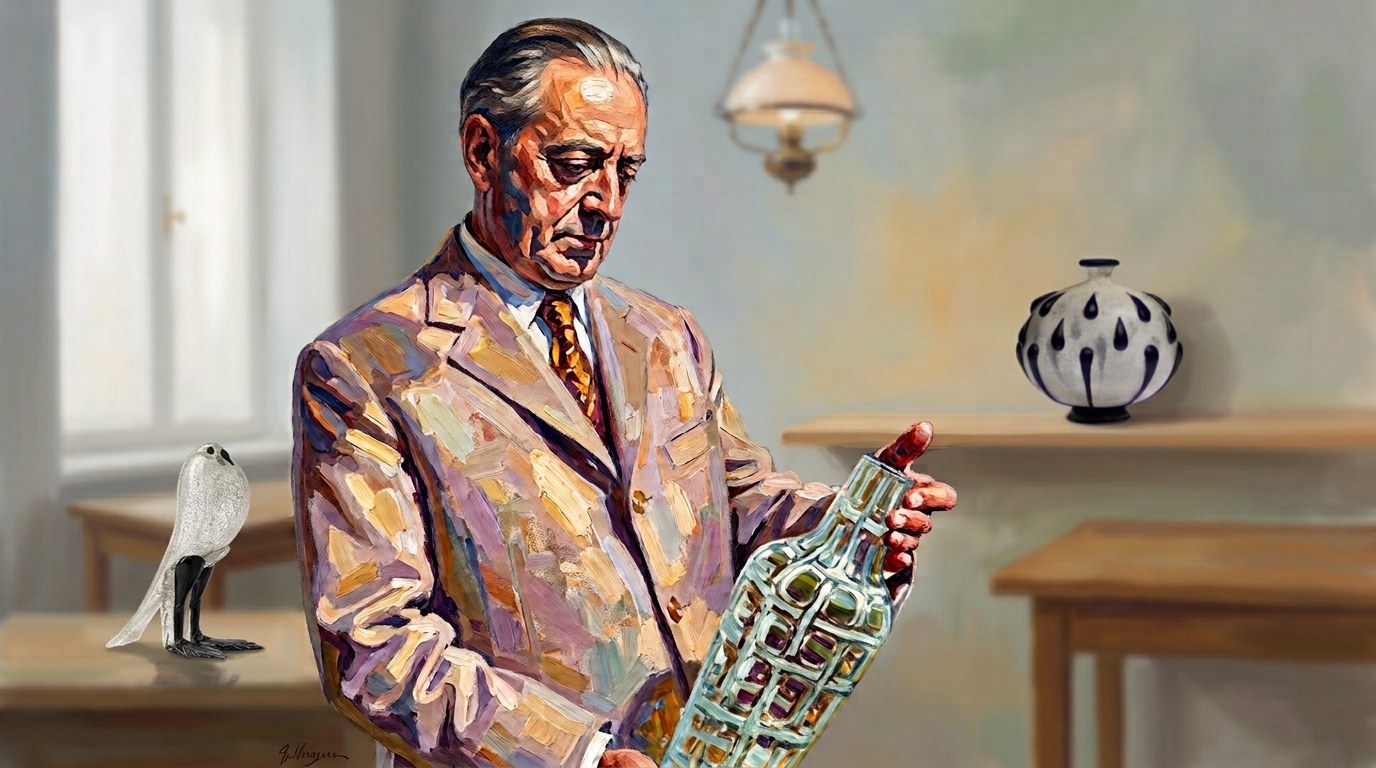
Ercole Barovier Murano Glass: The Alchemist of Fused Pigments
The Visionary Designers: A Collector's Guide
Ercole Barovier — The Alchemist of Murano
Artist Key: Ercole Barovier
- Role: Chemist-Designer / Alchemist / Entrepreneur (The Alchemist of Murano)
- Life/Dates: Murano, 1889 – Murano, 1974
- Primary Furnaces: Vetreria Artistica Barovier & C. (1919–1936) | S.A.I.A.R. Ferro Toso Barovier (1936–1939) | Barovier Toso & C. (1939–1942) | Barovier & Toso (1942–1972)
- Signature Techniques: Colorazione a Caldo Senza Fusione (Coloring through heat without fusion) | Primavera (Water-crackled glass) | Crepuscolo (Iron wool inclusion) | Barbarici (Archaeological texture) | Millefili & Pezzati (Chessboard patchwork) | A Spina (Herringbone tesserae) | Sidereo (Hollow cane relief) | Rostrato (Pyramidal diamond points)
- Market Price Tier: High-End Investment Grade (specifically 1929 Primavera, 1930s Crepuscolo, 1950s Millefili, and Barbarici) to Mid-Range (post-war tesserae series, Rostrato, and later Dorici vessels)
- Key Collaborators: Nicolò Barovier | Napoleone Barovier | Ferdinando Toso ("Fei") | Carlo Tosi ("Caramea") | Francesco Ongaro | Libero Toso | Gio Ponti | Sirio Toso | Decio Toso
Summary:
Discover the secrets to identifying, dating, and collecting the revolutionary glassware designed by Ercole Barovier, the legendary alchemist of Murano's most influential dynasty. This collector's guide covers his transition from medicine to chemistry, exploring his pioneering Colorazione a Caldo Senza Fusione technique, the crackled Primavera series, the iron-wool Crepuscolo vessels, and the mathematically perfect A Spina herringbone chevron series. Learn how to verify authentic diagnostic markers—including rough surface textures, sharp hand-drawn Rostrato points, and authentic Barovier & Toso markings and paper labels—to confidently identify his creations and spot true investment-grade treasures on the secondary market.
Visual Career Timeline
              ┌──────────────────────────────────────────────────────────┐
              │                     ERCOLE BAROVIER                      │
              │               - THE ALCHEMIST OF MURANO -                │
              └──────────────────────────┬───────────────────────────────┘
                                         │
     ┌───────┐                           ▼
     │ 1889  │ ──► Born into Murano's oldest family; pursues medicine and WWI radio operations.
     └───────┘                           │
     ┌───────┐                           ▼
     │ 1919  │ ──► Attracted back to the family furnace at age thirty, taking over administration.
     └───────┘                           │
     ┌───────┐                           ▼
     │ 1926  │ ──► Becomes Managing Director and co-Artistic Director with brother Nicolò.
     └───────┘                           │
     ┌───────┐                           ▼
     │ 1929  │ ──► Invents the accidental, highly coveted water-crackled Primavera series.
     └───────┘                           │
     ┌───────┐                           ▼
     │ 1932  │ ──► Becomes sole proprietor of Vetreria Artistica Barovier.
     └───────┘                           │
     ┌───────┐                           ▼
     │1935-36│ ──► Perfects Colorazione a Caldo Senza Fusione; launches Crepuscolo and Gemmati.
     └───────┘                           │
     ┌───────┐                           ▼
     │ 1936  │ ──► Merges furnace with S.A.I.A.R. Ferro Toso, becoming Artistic Director.
     └───────┘                           │
     ┌───────┐                           ▼
     │ 1938  │ ──► Invents the iconic, diamond-pointed Rostrato glass; wins Paris Grand Prix.
     └───────┘                           │
     ┌───────┐                           ▼
     │ 1942  │ ──► Formally establishes the legendary corporate entity Barovier & Toso.
     └───────┘                           │
     ┌───────┐                           ▼
     │ 1948  │ ──► Wins gold medal at VIII Triennale di Milano for the gold-flecked Murano series.
     └───────┘                           │
     ┌───────┐                           ▼
     │ 1951  │ ──► Launches primitive Barbarici and Eugenei series at Paris Pavillon de Marsan.
     └───────┘                           │
     ┌───────┐                           ▼
     │ 1956  │ ──► Wins the Compasso d'Oro for the paper-thin, chessboard-patterned Millefili.
     └───────┘                           │
     ┌───────┐                           ▼
     │ 1960s │ ──► Reinterprets mosaic glass with the bold Dorico, Egeo, and Caccia target series.
     └───────┘                           │
     ┌───────┐                           ▼
     │ 1972  │ ──► Retires after a fifty-year career, leaving artistic direction to son Angelo.
     └───────┘                           │
     ┌───────┐                           ▼
     │ 1974  │ ──► Passes away in Murano, leaving behind a legacy of over 20,000 unique designs.
     └───────┘
1. The Legend & Legacy: The Alchemist-Visionary
In the history of Murano’s modern glass revival, Ercole Barovier occupies a completely unique position: he was a brilliant designer who never once held a blowpipe. Born on Murano in 1889 into the island's oldest and most prestigious glassmaking dynasty, his early life was entirely detached from the heat of the furnace floor. Ercole completed a rigorous classical education, studied medicine, and served as a radio operator in the Italian military during World War I. However, in 1919, at the relatively late age of thirty, he was irresistibly drawn back to his family’s historic cooperative, Vetreria Artistica Barovier.
Because he had bypassed the grueling multi-decade physical apprenticeship of a master glassblower, Ercole never physically blew glass. Instead, he approached the medium as a chemist, alchemist, and visual theorist. He was a prolific visionary who designed over 20,000 unique pieces of art glass entirely in his mind and on paper. While other designers shaped glass during the actual creative process at the bench, Ercole formulated his designs, chemical coloring recipes, and poetic titles before they were ever realized in the workshop.
In 1926, Ercole and his brother Nicolò took over the management of the firm as co-artistic directors. Under his administrative and creative guidance, the company successfully weathered the Great Depression, which forced many partners to withdraw. By 1932, Ercole was the sole owner. Recognizing the need to scale production, in 1936 he engineered a brilliant corporate merger with Artemio and Decio Toso's S.A.I.A.R. Ferro Toso to form Ferro Toso Barovier (which officially became the world-renowned Barovier & Toso in 1942). The Toso brothers took charge of commercial operations, leaving Ercole free to operate as the absolute artistic director of the firm for nearly forty years.
Ercole’s genius lay in his ability to establish a profound, intuitive rapport with the furnace’s master glassblowers. He stood side-by-side with his craftsmen at the glory hole, actively directing their movements and conducting daring chemical experiments with raw minerals, metal foils, and chemical compounds. He passed away in Murano in 1974, leaving behind a monumental body of work that permanently shifted the aesthetics of 20th-century glass art.
2. Neoplastic Design Formulas & Structural Geometry
Ercole Barovier did not view glass as a simple receptacle; he approached it as a geometric canvas. He combined principles of Neoplasticism—dividing space through structural colored segments—with architectural proportion, utilizing spatial configurations, light-refracting surfaces, and precise thermal treatments to balance his designs:
- The Neoplastic Grid of "A Spina" (1958) and "Pezzati" (1956): Similar to modern abstract paintings, these series represented a clean division of space.
- The Geometrical Conception: Ercole arranged rectangular monochrome and opalescent glass tiles (tessere) on a flat refractory plate. In the A Spina (Herringbone) series, the tiles were laid out in a diagonal, interlocking chevron grid, with contrasting tiles arranged in alternating diagonal directions. This created a dynamic, wave-like pattern of alternating tones (such as violet-edged opalescent white, jade green, and amber) that wrapped around the vessel. When gathered by the hot parison, this flat, two-dimensional composition was picked up as a unified skin. As the master inflated the bubble, the flat plane expanded into a three-dimensional cylindrical shape, wrapping the chevrons seamlessly around the vessel's curved contours while maintaining perfect adjacent alignment.
- The Pyramidal Light Refraction of Rostrato (1938): The surface of the Rostrato vessels is covered with high-relief, hand-drawn quadrangular pyramids.
- The Optical Conception: Each pyramid acts as a miniature physical prism, refracting and scattering the light falling across the vessel walls. By hand-pulling these sharp, diamond-like points individually using specialized iron shears (borcello) while the glass remained hot at the bench, the master glassmaker expanded the local surface area. This created crisp, optical-grade facets that captured and reflected ambient light, mimicking the brilliance of hand-cut crystal without requiring wheel cutting.
- The Accidental Thermal Shock of Primavera (1929): Breathed into life during an accidental furnace experiment, the milky-white Primavera features a dense, uniform craquelé grid.
- The Thermal Conception: During modeling, the hot, semi-opaque parison was momentarily plunged into water. The sudden and dramatic temperature drop established an extreme thermal gradient between the rapidly cooling outer skin and the incandescent, molten core. This intense thermal shock created severe transient tensile stresses that exceeded the ultimate strength of the glass, inducing a dense, crackled network of micro-fractures in the outer skin. By immediately gather-casing the fractured parison in a protective layer of clear, transparent crystal, the cracks were sealed safely inside the glass wall, preserving the beautiful crackled pattern while keeping the final outer surface completely smooth and flat.
3. The Metallurgy and Chemistry of Chemical-Metallic Fusions
Ercole Barovier’s chemical mastery resulted in several of the modern era’s most revolutionary glass textures. His ultimate metallurgical and chemical contribution was Colorazione a Caldo Senza Fusione (Coloring through heat without fusion), perfected between 1935 and 1936.
This revolutionary furnace technique bypassed traditional pot-melting chemistry. Instead of melting coloring agents directly into the crucible glass, the process involved applying layers of unmeltable metallic oxides, raw chemical salts, crystalline powders, and thick gold or silver foils directly to the outer surface of an incandescent gather of glass at temperatures hovering between 800°C and 900°C:
- The Chemistry of Crepuscolo (1935-1936):
- The Reaction: Finely spun iron wool (paglia di ferro) was sandwiched between two incandescent layers of clear crystal. Heated to combustion inside the furnace, the iron fibers oxidized into a structured network of charcoal-grey, rust-brown, and black ash filaments, leaving microscopic carbon ash deposits cased in transparent glass.
- The Gemmati Series (1936):
- The Reaction: In Autunno Gemmato, Laguna Gemmata, and Marina Gemmata, Ercole applied flat inclusions of raw metallic powders and gold leaf directly to cased vessels. This created irregular, shimmering flecks of burnt-gold, aquamarine, and deep lapis blue cased within heavy crystal walls.
- The Rough Textures of Barbarici (1951):
- The Reaction: To achieve an archaeological, primitive surface, Ercole applied thick, un-melted layers of black iron and manganese oxides, copper salts, and gold leaf onto a dark cobalt blue or smoky grey glass core. While still on the pontil rod, the vessel was sprayed with sulfur or acid-iridizing vapors under an intense reducing atmosphere, creating a rough, crusted finish that mimicked excavated Roman glass.
- Thermodynamic Expansion Balance:
- Fusing highly contrasting metal oxides and heavy metallic foils on a single parison requires perfect physical and chemical compatibility. Every element alters the glass batch's density and its Coefficient of Thermal Expansion (C.O.E.). If the applied oxides contracted faster than the surrounding crystal core as it cooled, the resulting tension would cause the vessel to crack. Ercole spent years chemically adjusting the flux percentages in his batches to ensure that all contrasting components had chemically compatible contraction rates, allowing these chaotic, volcanic fusions to survive the annealing oven.
4. Famous Collaborations
As a visionary designer who never blew glass, Ercole’s masterpieces were physically birthed by an elite lineage of master glassblowers:
- Ferdinando Toso ("Fei"): As the lead master blower for Ferro Toso Barovier during the 1930s, Fei was the physical force behind Ercole's early heavy-walled Novecento achievements. It was Fei who successfully cased the heavy, iron-wool Crepuscolo vessels and molded the massive, diamond-pointed Rostrato vases.
- Francesco "Beua" Ongaro: Head of Barovier & Toso's premier workstation (prima piazza), Ongaro was a versatile master glassblower who specialized in executing Ercole’s largest and most physically challenging post-war vessels, including the multi-colored Aborigeni and Caccia target centerpieces.
- Carlo Tosi ("Caramea"): Specialized in highly precise, classical styling, Caramea executed Ercole's delicate mid-century footed vases and Morandiani collections.
- Libero Toso: A master craftsman of exceptional patience, Libero was responsible for the grueling process of laying out and fusing the thousands of tiny mosaic tessere needed for the Pezzati, Sidone, and A Spina herringbone series.
- Gio Ponti: The legendary Milanese architect collaborated with Ercole to adapt the diamond-pointed *Rostrato glass into structural furniture components and lighting fixtures for his high-profile interior designs.
5. The Forensic Chronology of Barovier Markings & Signatures (1919–1972)
To confidently date and verify an Ercole Barovier vessel, collectors must learn to recognize the exact paper tags, metallic decals, and acid-etched signatures utilized by his primary workshops across different eras:
I. The Vetreria Artistica Barovier & C. Era (1919–1936)
- The Unsigned Rule: All pieces from this early era—including the historic Primavera series—were completely unsigned. No hand-engraved or acid-etched signatures were utilized.
- Diagnostic Paper Labels: Wares were identified strictly using small, rectangular paper stickers with a simple, double-lined black border reading
VETRERIA ARTISTICA BAROVIER & C. - MURANOin sans-serif block capital letters on the underside of bases. Alternatively, look for small circular paper tags displaying a stylized anchor crest.
II. The S.A.I.A.R. Ferro Toso Barovier S.A. Era (1936–1939)
- The Concentric Acid Stamp: This era marked the introduction of the first acid-etched factory mark. Look for a rare circular, double-bordered acid stamp reading:
S.A.I.A.R. / FERRO TOSO / BAROVIER / MURANOarranged in concentric rings on the underside of base rings. This mark was reserved strictly for high-art exhibition wares. - Diagnostic Paper Labels: Rectangular paper stickers reading
S.A.I.A.R. FERRO TOSO BAROVIER S.A. MURANOin black ink.
III. The Barovier Toso & C. Transition Era (1939–1942)
- The Two-Line Acid Stamp: A simple, two-line base acid stamp reading:
BAROVIER TOSO / MURANOprinted in clean block capital letters on the underside of bases. - Diagnostic Paper Labels: Paper stickers displaying the simplified name
BAROVIER TOSO & C. - MURANO.
IV. The Golden Age of Barovier & Toso (1942–1972)
- The Standard Three-Line Stamp (Post-1945): The most common diagnostic mark found on post-war Millefili, Pezzati, and Barbarici series. It features a prominent, crisp, three-line acid-etched stamp reading:
BAROVIER & TOSO / MURANO / MADE IN ITALYprinted in block capital letters on the underside of the base. - The Heraldic Foil Decals (1950s): Highly stylized metallic foil stickers (often in gold or silver) reading
BAROVIER & TOSO MURANOsurrounding a central crest of a glassblower's pipe. - The Hand-Engraved Cursive Signatures: Unique artistic trials, private collections, or pieces selected for international bienniales carry a cursive, hand-guided diamond-point base signature reading
barovier & toso muranoor simplybarovier & toso. - The Main Factory Label: Rectangular paper stickers reading
BAROVIER & TOSO - MURANOdivided horizontally by a thin line, under which the specific model number and color code were written in blue or black fountain pen ink.
V. The 1975 Angelo Barovier Transition & Vibro-Engraving Era
- The Vibro-Engraved Mark: Following Ercole's retirement in 1972, his son, Angelo Barovier, assumed the management of the firm. In 1975, the furnace officially phased out acid-etched stamps in favor of hand-guided, vibro-engraved base signatures reading:
Barovier & Toso Murano - The Retroactive Signature Rule: In a 1996 oral communication, Dr. Angelo Barovier confirmed that vibro-engraved signatures were not generally used for identification purposes until 1975. Any authentic piece from before 1975 presenting a vibro-engraved signature was either signed later (at a retrospective or by the furnace) or represents a late-century reissue. Original interwar and mid-century executions designed by Ercole carry strictly the chemical acid stamps or paper labels detailed in sections I through IV.
5. The Collector's Diagnostic Checklist & Market Realities
- Forensic Indicators for Primavera (1929):
- The Surface Finish: The outer surface of an authentic Primavera vessel must be completely smooth, glossy, and flat. The crackle pattern is entirely internal, cased safely beneath a thick outer layer of clear crystal. Any piece featuring a rough, tactile, or physically fractured outer surface indicates common Renaissance-style ice glass (vetro a ghiaccio), not Primavera.
- The Trim and Applications: Authentic pieces are decorated with applied handles, rims, or pedestal feet made of opaque, high-gloss black glass (vetro nero) or deep cobalt blue glass.
- The Weight: Due to the high volume of trapped microscopic air bubbles inside the glass matrix, authentic Primavera vessels are breathtakingly light for their visual volume.
- Forensic Indicators for Crepuscolo (1935–1936):
- The Texture of the Web: The trapped filaments must appear three-dimensional, irregular, and slightly charred. Look for microscopic black carbon ash deposits surrounding the fibers, indicating the high-temperature combustion of the iron wool inside the glory hole.
- The Weight and Mass: Unlike Primavera, Crepuscolo vessels are monumentally heavy. They feature thick, solid-crystal walls and a wide, ground-and-polished flat pontil base.
- The Applied Details: Original interwar Crepuscolo models frequently feature lateral ribbed crystal handles or heavy, solid crystal pedestal rings cased with gold leaf.
- Identifying Rostrato Pyramids: Authentic Rostrato glass is distinguished by the surgical, hand-drawn sharpness of the pyramidal points, which are pulled individually with jacks while hot, resulting in a brilliant play of light. Counterfeits use pressed-mold glass with blunt, dull, and uniform points that fail to refract light.
- The Price Tiers:
- High-End Investment Grade: Original 1929 Primavera pigeons and vases; 1935 Crepuscolo vessels featuring original lateral crystal handles; 1951 Barbarici bowls cased with gold leaf; and 1956 Millefili chessboards.
- Mid-Range: Post-war Pezzati patchwork vases; A Spina herringbone chevron vessels; Sidereo collections decorated with hollow cane rings; and massive 1938 Rostrato crystal centerpieces.
- Accessible: Small everyday Cordonati Oro ribbed bowls, late-era solid animal figurines, and post-1970s tableware produced by the furnace.
6. Attribution & Authenticity
In the Murano glassmaking tradition, the difference between a fake and a copy rests entirely on intent, origin, and transparent attribution. A fake is a deceptive counterfeit manufactured outside of Murano—often in mass production factories in Asia or Eastern Europe—that utilizes cheap materials and carries forged signatures or illicit trademark stickers to intentionally defraud collectors. Conversely, a copy is a legitimate artistic homage (omaggio) handcrafted by a skilled master using authentic Murano techniques and materials; it serves as a tribute to honor a legendary artisan's legacy and is openly signed by the modern creator, preserving the lineage of Venetian glassblowing rather than exploiting it.
Join Our Facebook Group Identify Your Murano - Murano Glass Animals