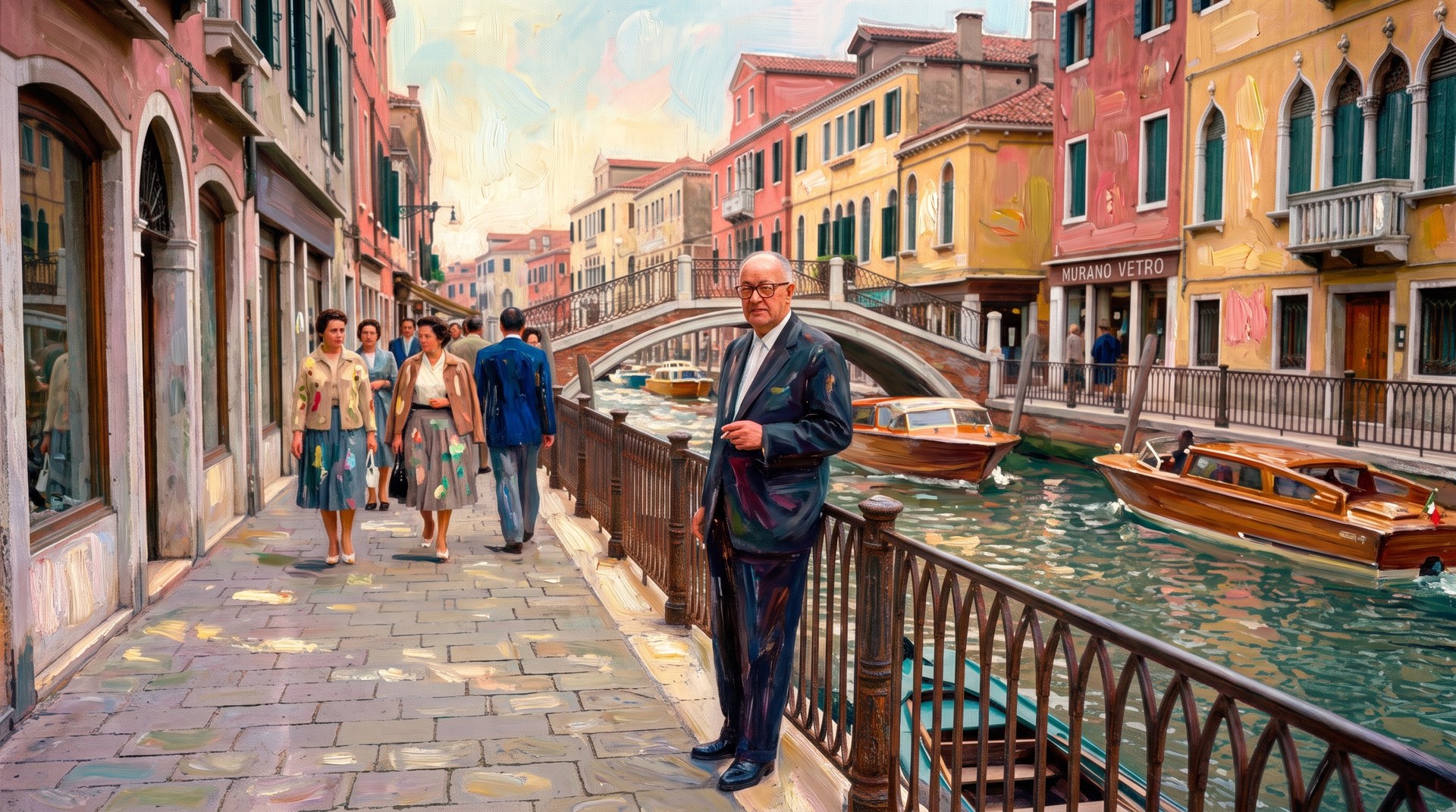
Egidio Costantini Fucina degli Angeli: The Ultimate Collector's Guide
The Visionary Facilitators: A Collector's Guide
Egidio Costantini — The Matchmaker of Fine Art
Facilitator Key: Egidio Costantini
- Role: Agent / Cultural Impresario / Gallery Founder / Strategic Matchmaker (The Matchmaker of Fine Art)
- Life/Dates: Brindisi, Puglia, April 22, 1912 – Venice, Italy, 2007
- Primary Furnaces/Associations: Centro Studio Pittori nell'Arte del Vetro di Murano (Principal Founder/Director, 1950–1955) | Fucina degli Angeli (Founder and Director, 1955–2007)
- Signature Concepts: Ideazione contro Realizzazione (Ideation vs. Realisation) | Vetro Colato di Piccole Dimensioni (Poured-glass block casting) | Scultura Monumentale (Large-scale collaborative glass sculptures) | Fusi con il Fuoco (Fusions of fine art drawings with hot glass)
- Market Price Tier: Ultra-Premium Investment Grade (specifically 1954 original Picasso-designed Gufo and Flamenco blowings co-executed by Ermanno Nason at I.V.R. di Mazzega, 1950s Picasso-designed Il Centauro and Il Burlesco sculptures, 1952 Oskar Kokoschka Baccanti vases by Albino Carrara, and the 1964 Peggy Guggenheim unico collection of 23 blue poured-glass sculptures after sketches by Picasso)
- Key Collaborators: Pablo Picasso | Jean Cocteau | Peggy Guggenheim | Marc Chagall | Georges Braque | Max Ernst | Jean Arp | Alexander Calder | Le Corbusier | Oskar Kokoschka | Gino Krayer | Ermanno Nason | Francesco Martinuzzi ("Checo") | Aldo Bon ("Polo") | Albino Carrara
Summary:
Discover the magnificent legacy and artistic fusions of Egidio Costantini, Murano’s undisputed post-war pioneer of modern sculptural art glass. This expert collector's guide covers his career from his early commercial agency to the founding of the Centro Studio Pittori in 1950 and his historic, legendary partnership with Pablo Picasso in Vallauris to launch the Fucina degli Angeli in 1955. Learn how to verify authentic diagnostic markers—including rough corroded surface finishes, heavy poured-glass masses, hand-applied enamel fusions by Ermanno Nason, and original diamond-point signatures—to confidently identify his creations, spot true investment-grade masterworks, and navigate the secondary market on Murano.
Visual Career Timeline
              ┌──────────────────────────────────────────────────────────┐
              │                     EGIDIO COSTANTINI                    │
              │              - THE MATCHMAKER OF FINE ART -              │
              └──────────────────────────┬───────────────────────────────┘
                                         │
     ┌───────┐                           ▼
     │ 1912  │ ──► Born on April 22 in Brindisi, Puglia.
     └───────┘                           │
     │                                   └──► Relocates to Venice at age six following his father's premature death.
     │                                   │
     ┌───────┐                           ▼
     │ 1940s │ ──► Operates as a sales agent and commercial broker for several Muranese furnaces.
     └───────┘                           │
     │                                   └──► Resolves to elevate glassblowing beyond functional craft into fine art sculpture.
     │                                   │
     ┌───────┐                           ▼
     │ 1950  │ ──► Co-founds "Centro Studio Pittori nell'Arte del Vetro" with local Venetian artists.
     └───────┘                           │
     │                                   ├─► Partners with local surrealists: Gino Krayer, Fioravante Seibezzi.
     │                                   ├─► 1952: Collaborates with Oskar Kokoschka on the legendary "Baccanti" vase.
     │                                   └─► 1954: Collaborates with Le Corbusier on the "Bucranio Blu."
     │                                   │
     ┌───────┐                           ▼
     │ 1954  │ ──► Daring Pilgrimage: Travels to Vallauris in early summer to meet Pablo Picasso.
     └───────┘                           │
     │                                   ├─► Picasso is highly enticed and hands over twelve abstract sketches.
     │                                   ├─► August: Costantini returns to Vallauris with the first glass "Gufo" (Owl).
     │                                   └─► Picasso is overcome with joy, initiating a lifetime friendship.
     │                                   │
     ┌───────┐                           ▼
     │ 1955  │ ──► Dissolves the Centro Studio Pittori; launches "Fucina degli Angeli" gallery.
     └───────┘                           │
     │                                   └──► Jean Cocteau suggests the magical name "The Angels' Forge" in 1958.
     │                                   │
     ┌───────┐                           ▼
     │ 1964  │ ──► Peak Creative Zenith: Peggy Guggenheim commissions 23 iconic blue poured-glass sculptures.
     └───────┘                           │
     │                                   └──► Hand-sculpted based on Picasso's sketches; permanently housed in Venice.
     │                                   │
     ┌───────┐                           ▼
     │ 1966  │ ──► The Great Disaster: Legendary "Acqua Alta" floods Venice, destroying historic archives.
     └───────┘                           │
     ┌───────┐                           ▼
     │ 2007  │ ──► Passes away in Venice, remembered as the master catalyst who permanently wedded Fine Art to Fire.
     └───────┘
1. The Visionary Agent: Elevating Craft to Fine Art
Egidio Costantini’s entrance into the history of Murano glass represents a radical, highly successful paradigm shift that forever altered the boundaries between traditional craftsmanship and the international avant-garde. Born in Brindisi on April 22, 1912, Costantini moved to Venice at the age of six following his father's premature death, growing up in the Lagoon City. In his adult years, he did not work as a physical glassblower; instead, he operated as a highly professional sales agent and commercial broker for several Muranese glassworks. This position allowed him to learn the complex financial and technical structures of the trade, but it also exposed him to a frustrating reality. Costantini observed that Murano was locked in a self-referential cycle: even its most brilliant furnaces were treating the glassblower’s masterly skill purely as a commercial trade, dedicating their immense technical capabilities to functional tableware, kitschy tourist figurines, and classical copies.
Costantini developed a revolutionary, highly ambitious vision: he wanted to liberate glass from its everyday, industrial, and decorative contexts and propose the vitreous medium as a primary vehicle for pure, three-dimensional sculptural expression. He believed that if the raw, primitive energy of modern art could be injected directly into the crucible, Murano could achieve an entirely new artistic language. In 1950, together with a group of local artists, he co-founded the Centro Studio Pittori nell'Arte del Vetro di Murano. Bypassing commercial templates, Costantini acted as a cultural matchmaker. He approached leading artists of the post-war era—starting with local Venetian surrealist painter Gino Krayer, followed by landscape master Fioravante Seibezzi, Armando Tonello, and Mario Carraro—convincing them to provide original drawings. Costantini then carried these drawings directly to Murano’s leading workshops, supervising their physical execution in glass.
During this pioneering early period, Costantini achieved several major international coups. In 1952, he came into contact with the Austrian expressionist master Oskar Kokoschka, translating Kokoschka's raw drawings into the famous Baccanti (Bacchantes) vase—a magnificent, heavy vessel with dramatic inverted handles executed by the gaffer Albino Carrara at the Ferro e Lazzarini furnace. In 1954, Costantini partnered with the legendary Swiss architect Le Corbusier, coordinating with Carrara to execute the famous Bucranio Blu (Blue Bucranium), a heavy, highly conceptual solid-glass bull's head. Through these landmark fusions of fire and fine art, Costantini successfully demonstrated that glass could move beyond decorative trade to claim a place in the highest echelons of modern sculpture.
2. The Vallauris Pilgrimage: Pablo Picasso and the Birth of the Angels
In the early summer of 1954, Egidio Costantini and his son Luigi (a professional photographer) embarked on a daring, historic pilgrimage that would permanently secure his place in modern art history. They traveled to Vallauris in the south of France to meet Pablo Picasso. At that time, Picasso’s experiments in ceramics, wood, and bronze were famous throughout the world, but he had never explored the expressive possibilities of glass. Intrigued by the energetic Italian agent and eager to experiment with a completely unfamiliar material, Picasso welcomed them into his studio. He gave Costantini a dozen abstract sketches to test in the Muranese furnaces.
Costantini immediately rushed back to Venice, bringing the sketches straight to the active workbench of Murano’s undisputed post-war master of masters: Ermanno Nason at the furnace of I.V.R. di Mazzega. Working with incredible speed and manual precision, Nason translated Picasso’s two-dimensional lines into three-dimensional hot glass. In August of 1954, Costantini returned to Vallauris to present Picasso with the first completed glass sculptures: the Gufo (Owl) and the Flamenco.
Picasso’s reaction was captured in a series of historic snapshots taken by Costantini's son: the Spanish master's face was filled with pure delight, incredulity, and excitement as he held the finished objects in his hands. He embraced Costantini, deeply moved by the realization that a completely new artistic dimension had been unlocked. Gufo was executed in the traditional way of vetro soffiato (blown glass), brought to life entirely through the master blower’s breath, capturing the undulating, bulbous caprices of the molten mass to evoke the owl’s biological form. Picasso was so captivated by the material's ability to refract and trap light that he became a lifelong supporter of Costantini's project.
Following the dissolution of the Centro Studio Pittori in 1955, Costantini opened a new gallery space in Venice to continue his collaborative ventures. In 1958, the famous French poet, filmmaker, and artist Jean Cocteau—who had himself designed several whimsical glass sculptures for the furnace—suggested the magical, enduring name for Costantini's workshop and gallery: the Fucina degli Angeli (The Angels' Forge). Cocteau declared that Costantini’s furnaces did not merely melt silica, but served as a divine workshop where the angels themselves forged the dreams of the world's greatest painters into glass.
3. The Master of Masters: Ermanno Nason and the Unsung Heroes
In the history of the Fucina degli Angeli, a delicate, highly sensitive tension has always existed regarding the question of authorship: who is the true creator of a glass sculpture—the artist who designs the paper sketch, or the master glassmaker who physically shapes the molten mass? Unlike traditional materials like clay or bronze, which are worked slowly by the sculptor’s own hands, glass is a volatile, hostile medium that must be worked at extreme speeds while white-hot. For an international artist like Picasso or Chagall, the maestro vetraio was the essential, irreplaceable "physical brush" that translated intellectual concept into molten reality.
The undisputed technical engine behind the Fucina’s most complex, legendary glass sculptures was the maestro Ermanno Nason. Operating as the chief gaffer at the I.V.R. di Mazzega furnace, Nason possessed a phenomenal manual technique that allowed him to look at a highly abstract, flat sketch by Picasso or Chagall and instantly understand how to gather, tool, and fuse the glass to preserve the artist's unique hand. Nason was the unsung hero who co-executed:
- Picasso's Portatrice d'acqua (The Water Bearer) and Diavolo (Devil, 1959).
- Marc Chagall’s lyrical, enameled Re David (King David) plate.
- Georges Braque’s pure, geometric Innamorati (Sweethearts) dish.
- Gio Ponti’s abstract, colorful Luci (Lights) series.
Nason spent his entire career in the shadow of the famous international artists, later lamenting: "I have always regretted that the Maestri have passed into the background. Nobody remembers them, few know their names and this is a true crime... We were the life blood of that remarkable concept that was later called the Fucina degli Angeli."
To preserve the historical record of these geniuses, Costantini coordinated with other elite Muranese gaffers:
- Francesco Martinuzzi ("Checo") at Dalla Venezia e Martinuzzi, who executed Picasso’s monumental Il Centauro (The Centaur) and Bruno de Toffoli’s Occhi.
- Aldo Bon ("Polo") at Vetreria Aureliano Toso, who executed Picasso’s whimsical, multi-handled Il Burlesco (Burlesque) and Fioravante Seibezzi’s Gatto iconico veneziano.
- Albino Carrara at Ferro e Lazzarini, who brought to life Alexander Calder’s Colomba volante (Flying Dove), Le Corbusier’s Bucranio, and Oskar Kokoschka’s Baccanti vase.
4. The Peggy Guggenheim Commission (1964)
The absolute zenith of the Fucina degli Angeli’s historical and curatorial triumph arrived in 1964 through a monumental collaboration with the legendary American heiress, art collector, and Venice resident Peggy Guggenheim. Fascinated by the abstract, sculptural possibilities of Costantini’s workshop, Guggenheim commissioned a series of twenty-three glass sculptures based on original, unpublished drawings provided by Pablo Picasso.
- Technical Composition: Unlike the early Gufo blown glass, this landmark series was executed utilizing the highly complex poured glass technique (vetro colato). Thick gathers of brilliant, intensely saturated cobalt-blue glass were poured directly onto iron tables, hand-tooled, and modeled into dense, heavy, and block-like solid forms.
- Aesthetic Analysis: The resulting collection is an alluring, highly expressive ensemble that directly mirrors Picasso’s visual vocabulary from the 1930s onwards. Curvaceous, rounded standing women of a striking, sensual silhouette alternate with sitting, angular, and block-like animalesque male figures.
- Curatorial Home: These 23 masterpiece sculptures remain on permanent display in their original curatorial setting within the galleries of the Peggy Guggenheim Collection at Palazzo Venier dei Leoni in Venice. They stand as a magnificent monument to the Fucina's mission, permanently proving that glass can serve as a primary, non-functional medium for modern art.
5. The Great Acqua Alta of 1966 & The Renaissance
Just as the Fucina degli Angeli was achieving its peak international renown, a catastrophic, historic disaster struck Venice. On November 4, 1966, the city was devastated by the worst Acqua Alta (exceptional high tide) in its documented history, with the sea rising to an incredible 1.94 meters.
The catastrophic floodwaters completely inundated the Fucina’s low-lying gallery spaces and administrative archives near Piazza San Marco. In a single day, the vast majority of the original drawings, cardboard templates, correspondence files, and photographic records provided by Picasso, Chagall, Cocteau, and Leger were physically destroyed or carried away by the tides.
This devastating loss brought the Fucina’s hot-furnace collaborations to a sudden, painful halt. For over a decade, the gallery operated primarily as a commercial exhibition space, showing surviving wares. It was only in the 1980s that Costantini initiated a creative renaissance, reviving the Fucina's collaborative mission and inviting a new generation of international designers—including the Japanese master Yoichi Ohira in 1973—to work directly at the Murano benches, continuing the forge's legacy until his passing in 2007.
6. The Collector's Diagnostic Checklist: Fucina degli Angeli Glass
To confidently identify, date, and value original glass sculptures produced under the banner of the Centro Studio Pittori and the Fucina degli Angeli (c. 1950–1968), collectors must utilize the following diagnostic criteria:
- Evaluating Surface Textures and Finishes: Authentic Fucina sculptures, particularly those designed by Picasso, Ernst, or Kokoschka, are characterized by a rough, heavily corroded, or highly irregular surface finish (vetro corroso). Costantini actively rejected the glossy, decorative sheen of commercial glass, utilizing acid-corrosion, solid-block marvering, and heavy metallic iridization to give the glass the visceral, primitive texture of weathered stone or ancient bronze.
- Analyzing Solid Mass and Weight: Because many Fucina sculptures were modeled freehand from solid, gather-poured glass (vetro massiccio) rather than blown thin on the pipe, they are extraordinarily heavy, dense, and physically substantial. The bases must show a flat, meticulously ground and polished pontil scar or a splayed base ring designed to bear the extreme weight.
- Verifying Complex Cane and Enamel Fusions: On plates like Chagall's Re David or Braque’s Innamorati, look for perfectly crisp, non-uniform, and hand-applied enamel lines. There should be zero mechanical symmetry, screen-printing patterns, or decals. The vivid blues, reds, and golds must show microscopic manual variations in thickness and bubbles trapped within the enameled layers, proving they were painted hot on the active pipe by a master decorator.
- The Price Tiers:
- Ultra-Premium Investment Grade: Original 1954 Vallauris prototypes (such as Gufo or Flamenco), 1964 blue poured-glass sculptures from the original Peggy Guggenheim commission series, and 1950s Oskar Kokoschka Baccanti vases carrying verified hand-engraved signatures. These represent some of the most valuable mid-century glass objects in the world, commanding high six-figure sums at specialized international fine art auctions.
- Mid-Range: Original 1950s and 1960s production models from the Fucina catalog (including Jean Cocteau's Nymphs, Max Ernst's Surrealist Birds, and Jean Arp's Abstract Forms), and early enameled plates carrying early paper labels.
- Accessible: Post-1980s renaissance-era sculptures, Yoichi Ohira transparent bottles designed for the firm in 1973, and later, posthumous limited-edition glass sculptures authorized by the Costantini estate.
7. Forensic Chronology of Base Markings & Signatures
Because the Fucina degli Angeli operated both as a collaborative studio and an independent fine art gallery, its creations carry highly distinct, chronologically clear markings that determine their value on the collector's market:
I. The Early Centro Studio Pittori Era (1950–1955)
Wares executed during the original cooperative period carry no formal factory logo. Instead, they are authenticated by the hand of the master blower and carry diamond-point engraved signatures:
- The Engraving:
Centro Studio Pittori / MuranoorC.S.P.V. Muranoprinted in an elegant, hand-guided cursive hand. - The Master's Tributes: Ermanno Nason’s early masterpieces designed by Picasso carry verified, hand-signed engraved tributes on the base ring reading:
OMAGGIO PICASSO 1959 E. NasonorOMAGGIO A PICASSO 1959 E. Nasonetched with a diamond-point drill.
II. The Classical Fucina degli Angeli Era (1955–1968)
Following the name change and Jean Cocteau’s 1958 christening, high-art sculptures are always signed by both Egidio Costantini and the designing artist, accompanied by the Fucina's official trademark markings:
- The Engraved Signatures: Hand-engraved with a diamond-point drill or a flexible-drive drill reading:
E. Costantini / Fucina degli Angeliaccompanied by the artist's name (e.g.,Picasso,Cocteau,Chagall,Max Ernst). - The Model Number Labels: Original pieces carried a rectangular white paper label printed in red ink reading
FUCINA DEGLI ANGELI / VENEZIAaccompanied by a hand-written archive or model number.
III. The Post-1980s Renaissance Wares
Later productions and modern re-editions carry modern, vibro-engraved signatures (vibro-engraving was not utilized until after 1975):
- The Mark: A jagged, vibrating electric-pen signature reading:
Egidio Costantini Fucina degli Angelioften accompanied by a printed certificate of authenticity signed by Costantini or his heirs.
If any piece claims to be a rare 1954 Picasso Vallauris prototype or a 1950s Oskar Kokoschka masterpiece but carries a vibro-engraved company signature alone, it is a dangerous, modern tourist-factory counterfeit.
8. Attribution & Authenticity
In the Murano glassmaking tradition, the difference between a fake and a copy rests entirely on intent, origin, and transparent attribution. A fake is a deceptive counterfeit manufactured outside of Murano—often in mass production factories in Asia or Eastern Europe—that utilizes cheap materials and carries forged signatures or illicit trademark stickers to intentionally defraud collectors. Conversely, a copy is a legitimate artistic homage (omaggio) handcrafted by a skilled master using authentic Murano techniques and materials; it serves as a tribute to honor a legendary artisan's legacy and is openly signed by the modern creator, preserving the lineage of Venetian glassblowing rather than exploiting it.
Join Our Facebook Group Identify Your Murano - Murano Glass Animals