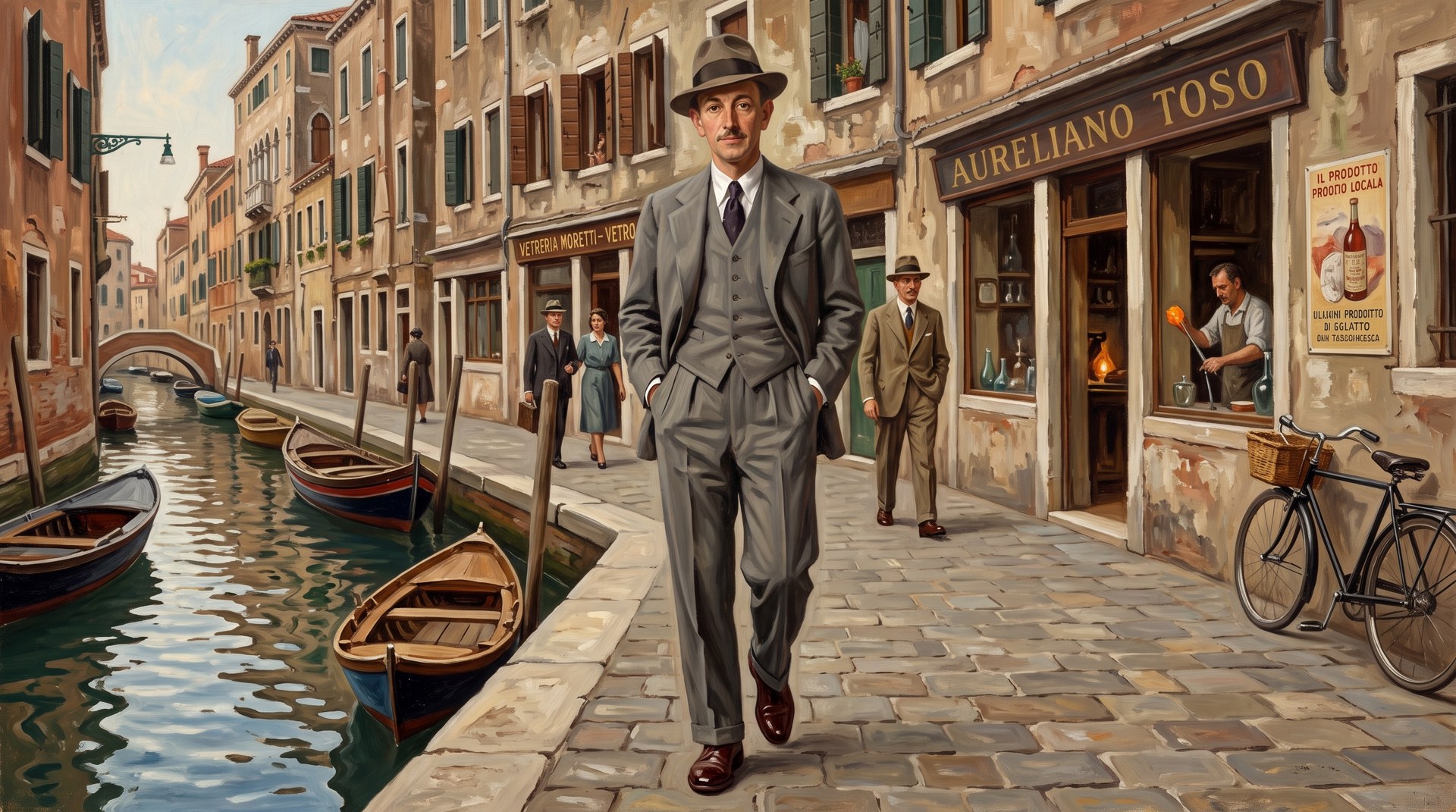
Dino Martens Murano Glass: The Painter of Asymmetric Chaos
The Visionary Designers: A Collector's Guide
Dino Martens — The Abstract Expressionist
Artist Key: Dino Martens
- Role: Painter-Designer / Art Director (The Abstract Expressionist)
- Life/Dates: Venice, 1894 – Venice, 1970 (Born Corrado Martens; signed paintings as "Dino")
- Primary Furnaces: Successori Andrea Rioda (1932–1937) | Vetri Decorativi Rag. Aureliano Toso (Artistic Director, 1939–1963)
- Signature Techniques: Vetro Oriente (Opaque glass patchwork with pinwheel murrine) | Vetro Eldorado (Aventurina transparent mosaic) | Zanfirico Patchwork (Asymmetrical filigree cane grids) | A Reazione Polidroma (Multi-fluid chemical fusions) | Corroso (Sponge-applied acid corrosion) | Iridato (Iridescent metallic reductions) | Pennellata (Painterly gestural splashes) | Forati / Moore Perforations (Asymmetric hollow perforations) | Vetro Pesante a Spinte (Thick-walled modeled masses)
- Market Price Tier: Very High-End Investment Grade (specifically 1952 Oriente and Eldorado asymmetrical models with intact star-shaped pinwheels, early Zanfirico Patchwork vases, and 1950s Forati) to Mid-Range (later Fascia Bianca Nera filigree bowls, molded tablewares, and post-1960 utility items)
- Key Collaborators: Aureliano Toso | Aldo "Polo" Bon | Mario Zanetti | Luigi "Gigetti" Martens | Ermete Vittorio Toso | Guglielmo Barbini | Enrico Potz
Summary:
Discover the secrets to identifying and collecting the radical, avant-garde mid-century modern glassware designed by Dino Martens, Aureliano Toso’s legendary artistic director. This collector's guide covers his transition from Futurist painting to glass design, exploring his pioneering Vetro Oriente opaque patchwork series, the glittering Vetro Eldorado aventurina series, and his organic, perforated Forati collection. Learn how to verify authentic diagnostic markers—including asymmetrical mosaic layouts, distorted star-shaped pinwheels, flat ground-polished base rings, and authentic Aureliano Toso paper labels—to confidently identify his creations and spot true investment-grade treasures on the secondary market.
Visual Career Timeline
              ┌──────────────────────────────────────────────────────────┐
              │                       DINO MARTENS                       │
              │             - THE ABSTRACT EXPRESSIONIST -               │
              └──────────────────────────┬───────────────────────────────┘
                                         │
     ┌───────┐                           ▼
     │ 1894  │ ──► Born Corrado Martens in Venice; later signs paintings as "Dino."
     └───────┘                           │
     ┌───────┐                           ▼
     │1918-24│ ──► Studies painting at the Venice Accademia di Belle Arti after WWI military service.
     └───────┘                           │
     ┌───────┐                           ▼
     │ 1925  │ ──► Partner and glass decorator at S.A.L.I.R.; later focuses strictly on painting.
     └───────┘                           │
     ┌───────┐                           ▼
     │ 1926  │ ──► Marries Amelia Toso, niece of accountant and future furnace founder Aureliano Toso.
     └───────┘                           │
     ┌───────┐                           ▼
     │ 1932  │ ──► Designs avant-garde blown glass for Salviati & C. / Successori Andrea Rioda.
     └───────┘                           │
     ┌───────┐                           ▼
     │1935-37│ ──► Volunteers for WWI-era campaigns in East Africa; continues to paint in Asmara.
     └───────┘                           │
     ┌───────┐                           ▼
     │ 1939  │ ──► Returns to Murano; Aureliano Toso invites him to design for his newly opened furnace.
     └───────┘                           │
     ┌───────┐                           ▼
     │ 1940  │ ──► Debuts at XXII Venice Biennale with bold, heavy-walled chessboard patchwork designs.
     └───────┘                           │
     ┌───────┐                           ▼
     │ 1944  │ ──► Appointed formal Artistic Director of Vetri Decorativi Rag. Aureliano Toso.
     └───────┘                           │
     ┌───────┐                           ▼
     │ 1948  │ ──► Unleashes "pennellata" splashed vases and "Fantasia" series at XXIV Venice Biennale.
     └───────┘                           │
     ┌───────┐                           ▼
     │ 1952  │ ──► Landmark XXVI Venice Biennale: launches the legendary Oriente and Eldorado series.
     └───────┘                           │
     │                                   ├─► Introduces the organic, perforated Moore-style "Forati" vases.
     │                                   ├─► Pioneers "A Reazione Polidroma" multi-fluid fusions.
     │                                   └─► Pairs with legendary master blower Aldo "Polo" Bon.
     │                                   │
     ┌───────┐                           ▼
     │ 1954  │ ──► Launches the commercial, half-filigree Fascia Bianca Nera and Pittorico lines.
     └───────┘                           │
     ┌───────┐                           ▼
     │ 1959  │ ──► Aureliano's son, Gianfranco Toso, enters; pushes for semi-industrial modern lighting.
     └───────┘                           │
     ┌───────┐                           ▼
     │ 1963  │ ──► Dino Martens completely withdraws from glass design due to creative clashes.
     └───────┘                           │
     ┌───────┐                           ▼
     │ 1970  │ ──► Passes away in Venice in September, immortalized as Murano's boldest modernist.
     └───────┘
1. The Legend & Legacy: Futurist Painter on the Furnace Floor
In the chronicle of twentieth-century Murano glass, Dino Martens stands as the ultimate champion of painterly expressionism. Unlike contemporaries who entered the furnaces with background training in architecture or formal industrial design, Martens was first, last, and always a fine-art painter. Born Corrado Martens in Venice in 1894, he adopted the pseudonym "Dino" to sign his avant-garde, Futurist-influenced canvases. After serving in World War I, he completed rigorous studies in painting and decoration at the Accademia di Belle Arti di Venezia between 1918 and 1924, immediately throwing himself into the Novecento secessionist art movement that swept through northern Italy.
Martens's entry into glassmaking was highly bohemian. In 1925, he briefly partnered in the elite decorative workshop S.A.L.I.R., designing avant-garde copper-wheel engravings, but withdrew within a year to return to his easel. In February 1926, he married Amelia Toso, whose uncle, Aureliano Toso, was then working as the chief accountant for the historic Fratelli Toso cooperative. This familial tie became the bridge that eventually linked Martens's radical visual imagination to the physical heat of the furnace floor.
Throughout the early 1930s, Martens freelance-designed highly progressive, asymmetric transparent glass for Salviati & C. and the Successori Andrea Rioda furnace. However, his volatile, restless, and deeply anti-authoritarian temperament made corporate stability impossible. Seeking escape, both Martens and his brother-in-law Aureliano Toso volunteered for military service in East Africa in 1935. When they returned to Murano in late 1939, Aureliano had acquired Romano Mazzega’s former workshop to establish his own independent furnace: Vetri Decorativi Rag. Aureliano Toso. Searching for a signature design director to establish his company's prestige at the Venice Biennale, Aureliano turned to his painter brother-in-law.
The partnership was revolutionary. Formally appointed Artistic Director in 1944, Martens completely ignored the daily, commercial lighting production of the factory. He treated the furnace instead as a private laboratory, spending entire days sitting at the bench next to the master blower, sketching and directing the hot glass manipulation. Working in tight, intuitive synergy with master blower Aldo "Polo" Bon, Martens translated the raw, gestural freedom of abstract expressionism into hot glass. His chaotic, asymmetrical, and brilliantly colored patchwork vessels shocked the conservative Venetian establishment at the Venice Biennales of 1948, 1952, and 1954, instantly establishing Aureliano Toso as a global powerhouse of modern Italian design. Martens completely withdrew from glass design in 1963 due to commercial and artistic clashes with the next generation of the Toso family, returning to his beloved easel until his death in Venice in September 1970.
2. Neoplastic Design Formulas & Asymmetric Chaos
Dino Martens did not approach glass as a symmetrical, transparent container; he viewed it as a plastic, three-dimensional canvas. His designs are heavily grounded in the principles of Neoplasticism (De Stijl) and Cubist-Futurist painting, which sought to deconstruct traditional three-dimensional space into dynamic, flat planes, intersecting lines, and high-contrast color blocks.
To translate these flat canvas concepts into a hollow-blown body of glass, Martens rejected the classical "axis of symmetry" that had governed Murano glassblowing for five hundred years. He engineered asymmetrical design formulas that relied on offsetting the physical center of gravity to create a sense of movement:
- Opposing Vector Balance: In his famous asymmetric vases, Martens deliberately positioned thick, heavy-walled, and highly loaded opaque color inclusions on one side of the vessel, while balancing the opposite side with a light, paper-thin network of transparent filigree (zanfirico) cane.
- Managing the Off-Center Mass: To prevent the cooling vessel from collapsing under its own off-center weight while hot on the pontil rod, the master glassmaker had to manipulate the blowing iron with variable rotational velocity. When the heavy, asymmetrical color gathers swung off-axis, they established a strong centrifugal force. To counter this force and prevent the asymmetrical glass walls from distorting or swinging outward, the master had to continuously adjust the angle of the pipe, tilting it upward and downward against gravity to maintain control over the off-axis gather.
- The Geometry of Moore Perforations (Forati): Inspired by the hollowed-out modern sculptures of Henry Moore, Martens designed the Forati series. These vessels feature massive, gaping holes placed directly through the center of the vase. To achieve this, the master blower pierced the hot parison at its center, applied a thick clear glass trail to reinforce the edges of the opening, and then blew the vessel, forcing the glass walls to split around the hole and reunite at the neck. The geometry of the Forato acts as a negative-space partition, splitting the visual and physical volume of the vessel into two contrasting columns that reunite at the neck. This was a direct, plastic application of Neoplastic spatial division, converting a void into a primary structural element.
3. The Metallurgy and Chemistry of Chemical-Metallic Fusions
The extraordinary visual depth of Dino Martens’s vessels was achieved through a series of complex chemical-metallic fusions executed directly inside the crucible and on the kiln plate. He treated the glass melt as a highly reactive chemical soup, combining minerals, metal foils, and sulfur-based colorants:
- The Synthesis of Vetro Oriente: The iconic Oriente (1952) patchwork was a masterpiece of chemical layering. The core of the composition was laid out on a cold iron plate (marmore) as a mosaic collage:
- The Pinwheel Fiore: A large, custom-fused mosaic murrina featuring aubergine, white, and black rays.
- Zanfirico Canes: Pre-drawn canes of white milk glass (lattimo) twisted into spiral filigrees.
- Opaque Color Blocks: Raw, un-melted chunks of highly saturated colored glass pastes (pasta vitrea).
- The Chemistry of Advanced "A Reazione Polidroma" Fusions: Perfected in the early 1950s, this groundbreaking technique represented the peak of high-temperature fusions, where Dino Martens exploited the chemical reactions between metal foils and superimposed layers of glass to create complex, bubbling patterns.
- The Chemical Process: While constructing the parison, Martens applied thin leaves of silver and gold foil directly onto a hot, colored glass core containing highly reactive metal oxides—primarily cobalt oxide, copper oxide, and manganese dioxide. This gather was then cased inside successive layers of transparent crystal. When the cased mass was reheated inside the intense heat of the glory hole (hovering around 1100°C), a dramatic multi-fluid chemical reaction (reazione polidroma) was triggered. The extreme heat caused the gold and silver foils to expand and rupture, while the metal oxides in the underlying layers underwent a localized redox reaction. This chemical boiling caused the metallic foils to split and separate, forming shimmering, iridescent, and bubbling polychromatic islands suspended safely between layers of crystal, giving the patchwork of the Oriente and Eldorado series its volcanic visual energy.
- Metallurgy of Aventurina Fusions: Both the Oriente and Eldorado series featured heavy applications of Aventurina (avventurina) glass. This highly prized, technically difficult material is created by melting a batch containing high concentrations of copper oxide under an intense, oxygen-deprived reducing atmosphere. As the furnace cools slowly over days, the copper oxide decomposes, allowing microscopic, triangular, and hexagonal crystals of pure metallic copper to separate out within the silica matrix. When rolled onto the hot gather and blown, these crystals fracture and stretch, creating a glittering, brilliant golden dust effect.
- Oxide Color Recreations: Martens formulated custom chemical batches using heavy metal oxides to achieve his signature "painterly" colorways:
- Cobalt Oxide & Zaffre: Used to achieve the deep, velvety cobalt blue patchwork blocks.
- Manganese Dioxide: Formulated to create the rich, dark aubergine/violet tones of his pinwheel cores.
- Cadmium and Selenium Sulfides: Combined to yield the brilliant, high-contrast reds and oranges that defined his Novecento animal and vase details.
- Thermodynamic Expansion Symmetries: Fusing highly contrasting opaque glass pastes with delicate filigree canes and dense copper-aventurina across a single vessel wall is a thermodynamic nightmare. Each of these materials possesses a different coefficient of thermal expansion. If the cobalt blue paste contracted faster than the surrounding transparent crystal core as it cooled, the resulting tension would cause the vessel to crack. Martens spent years chemically adjusting the lead and flux percentages in his batches to ensure that all contrasting components had chemically compatible contraction rates, allowing these chaotic fusions to survive the annealing oven.
4. Chemical Surface Treatments: Corroso, Iridato, and Pennellata
To complement his radical shapes and advanced fusions, Dino Martens developed unique chemical surface treatments that altered the glass skin, giving his abstract creations a highly tactile, weathered, or metallic quality:
- Vetro Corroso (Acid-Corrosion): To soften the high-gloss reflection of his bold color patchworks, Martens utilized hydrofluoric acid baths to etch the cold glass surface.
- The Chemical Process: Once the heavy, asymmetrical vessel was fully annealed and cold, its surface was covered with a protective layer of wax or lacquer applied using a porous sponge to create irregular openings. The vessel was then submerged in a lead tub containing hydrofluoric acid and ammonium fluoride salts. The acid reacted with the unprotected silica on the surface, dissolving it to create a deeply pitted, irregular, and satin-matte finish (corroso) that resembled water-worn stones or archaeological relics.
- Vetro Iridato (Iridescent Reduction): To give his vessels a shimmering, oily luster that changed color depending on the angle of light, Martens exposed hot glass to metallic fumes.
- The Chemical Process: While the vessel remained hot on the pontil rod at the mouth of the glory hole, it was placed in a specialized reducing chamber. Inside this chamber, tin chloride or titanium oxides were burned under an intense, oxygen-deprived (reducing) atmosphere. As the metal compounds evaporated, they deposited a microscopically thin metallic film onto the glass surface. This iridescent layer had a different refractive index than the underlying glass, scattering light waves to create a beautiful, rainbow-colored pearl sheen across the patchwork body.
- Vetro Pennellata (Painterly Brushstrokes): To replicate the gestural sweeps of a paintbrush, Martens developed the pennellata technique. While the parison was white-hot, he threw highly saturated, colored glass powders and granules onto the surface. Using a wet wooden paddle or iron shears, he quickly dragged and smeared the melting granules across the glass body before casing it in clear crystal, freezing the gestural, painterly strokes forever inside the glass wall.
5. Famous Collaborations: The Painter and the Masters
Though Dino Martens designed these chaotic, painterly forms on paper and canvas, they required the most physically disciplined and technically complete masters of Murano to bring them to life:
- Aureliano Toso: Martens’s primary administrative patron and brother-in-law (Dino married his niece Amelia). Toso protected Martens from the commercial realities of the factory floor, funding his incredibly expensive, multi-stage material trials and allowing him complete creative freedom to run the furnace as a fine-art studio.
- Aldo "Polo" Bon (1906–1988): Aureliano Toso’s legendary First Master blower from 1939 to 1955. Bon possessed the immense physical strength, rapid reflexes, and thermodynamic intuition required to execute the "Martens style." He was the primary hands who physically gathered, inflated, and manipulated the heavy, asymmetrical, and perforated Oriente and Eldorado vessels.
- Luigi "Gigetti" Martens (1926–1989): Dino Martens’s son entered the company as an apprentice in 1941, rose to first assistant in 1950, and became a master blower in 1952. Under his father's direct artistic supervision, Luigi executed many of the firm's finest mid-century sommerso and pulegoso vases.
- Mario Zanetti: Succeeding Aldo Bon on the furnace floor in 1960, Zanetti was a highly disciplined maestro who executed Martens’s final design portfolios, including the elegant, color-reduced Flavia and Augusta table services for the 1963 Venice Biennale.
- Enrico Potz: Joining the firm in 1962 as Martens’s young assistant, Potz’s early designs so heavily emulated his mentor's late zanfirico and opalescent style that collectors frequently confuse the authorship of works from this transition era.
6. The Forensic Chronology of Aureliano Toso Markings (1939–1963)
To confidently identify, date, and authenticate a Dino Martens vessel, collectors must understand the precise evolution of markings, paper labels, and base finishes used by the furnace of Aureliano Toso across different eras:
I. The Early Founding & Wartime Era (1939–1944)
- The Unsigned Rule: All pieces from this early period—including his early heavy-walled chessboard patchwork designs—were completely unsigned. No acid stamps, engraved signatures, or metal decals were used.
- Diagnostic Labels: Wares were identified strictly using small, rectangular paper labels reading
V.D.R. / AURELIANO TOSO / MURANOprinted in black ink on cheap, fragile wartime paper on the underside of bases. These labels almost never survive on the secondary market.
II. The Post-War Biennale and Expansion Era (1944–1950)
- The Foil Labels: High-art exhibition pieces and early tablewares carry a rectangular, silver or gold foil label reading:
VETRI DECORATIVI / REG. AURELIANO TOSO / MURANO / ITALYprinted in elegant, sans-serif block capital letters. - Base Finish: The bases of vessels show a clean, rough-cut pontil mark that was left unground, characteristic of early production methods.
III. The Golden Age of Patchwork (1950–1956)
This legendary era saw the production of the celebrated Oriente, Eldorado, and Forati series.
- The Nickname Handwriting Rule: High-art vessels from this golden era were never signed with an engraved signature. Instead, the underside of the base features a circular or shield-shaped paper label. Most crucially, the factory clerks wrote the poetic nicknames of the models (such as Oriente curzio, Eldorado Dionisiaco, or Oriente Lubecca) directly onto the underside of the base or on the paper labels in a distinctive, elegant cursive black ink.
- The S.A.I.V. Decals: Many export models from this era carry a small, circular metallic foil label reading
S.A.I.V. / ITALYalongside the factory label, representing the premier distributor that marketed Aureliano Toso's finest art glass to the international market. - Base Finish: The bases of premium Oriente and Eldorado models are meticulously finished. The base ring is ground flat to a smooth matte finish, surrounding an uneven, offset, and deeply cut pontil hollow that is highly polished to a mirror-like sheen.
IV. The Late Design & Reissue Era (1956–1963)
- The Circular Paper Label: Wares designed during Martens's final years carry a highly distinct, circular paper label reading
VETRERIA AURELIANO TOSO / MURANOprinted in black ink on a gold or white background, featuring a stylized blowing pipe and crucible logo in the center. - Model Number Stamps: Paper labels from this late era feature typed or handwritten model codes prefixed by the letters
DM(Dino Martens) orAT(Aureliano Toso), such as Model DM 5342 or AT 2890. - Differentiating Later Reissues (Post-1970s): Because of the immense financial success of the Oriente series, the Aureliano Toso furnace (and other contemporary Murano workshops) reissued simplified versions of these models in the late twentieth century. Original 1950s executions are easily distinguished because they are completely unsigned and carry only the paper labels and handwritten nicknames detailed above. Post-war and late-century reissues carry a modern, hand-engraved diamond-point signature reading
Aureliano TosoorDino Martensaccompanied by a year code—signatures that Dino Martens himself never utilized during his active furnace years.
7. The Collector's Diagnostic Checklist & Market Realities
- Analyzing the Pinwheel Fiore (Flower): Authentic early Oriente and Eldorado pieces (c. 1952–1956) almost always feature a prominent, highly distorted star-shaped pinwheel murrina with approximately 19 to 23 radiating rays in black, white, and aubergine. If this pinwheel is perfectly circular, uniform, and lacks distortion, it is a modern reproduction.
- Irregularity vs. Order: On genuine Martens patchworks, the arrangement of colors, zanfirico rods, and metal powders is completely asymmetrical and chaotic. Beware of pieces that show a neat, repeating checkerboard or a structured linear grid—these indicate a cheaper imitation produced by other Murano factories (such as A.V.E.M.’s c. 1959 Colori Oriente series, which utilized identical glass inclusions but laid them out in regular square grids).
- Analyzing Glass Weight and Casing: Authentic Martens vessels are exceptionally heavy, thick-walled, and feature a brilliant, light-refracting clear glass encasing (sommerso) that feels like solid crystal. Cheap contemporary copies stand out by their symmetrical forms, uniform colors, and thin, weightless glass walls.
- Analyzing Base Pontil and Edge Finish: Authentic Aureliano Toso pieces designed by Martens feature a base rim ground flat to a matte finish, with an uneven, offset, and deeply cut pontil hollow that is meticulously ground and polished. Fakes lack this surgical base grind and mirror-polished pontil hollow.
- The Price Tiers:
- High-Art Investment Grade: Original 1952 Oriente biconical and ovoid vases with central Moore perforations (Forati); original 1952 Eldorado large-scale bowls and pitchers featuring dense aventurina flecks; and 1950 Zanfirico Patchwork exhibition vessels.
- Mid-Range: Post-1954 Fascia Bianca Nera half-filigree vases; Pittorico splashed-color bowls with opalescent white backings; and Vetro Epico trailed-ribbon vases.
- Accessible: Small everyday utility items, molded-blown tablewares, and post-1960 decorative plates produced under his successor Enrico Potz.
8. Attribution & Authenticity
In the Murano glassmaking tradition, the difference between a fake and a copy rests entirely on intent, origin, and transparent attribution. A fake is a deceptive counterfeit manufactured outside of Murano—often in mass production factories in Asia or Eastern Europe—that utilizes cheap materials and carries forged signatures or illicit trademark stickers to intentionally defraud collectors. Conversely, a copy is a legitimate artistic homage (omaggio) handcrafted by a skilled master using authentic Murano techniques and materials; it serves as a tribute to honor a legendary artisan's legacy and is openly signed by the modern creator, preserving the lineage of Venetian glassblowing rather than exploiting it.
Join Our Facebook Group Identify Your Murano - Murano Glass Animals