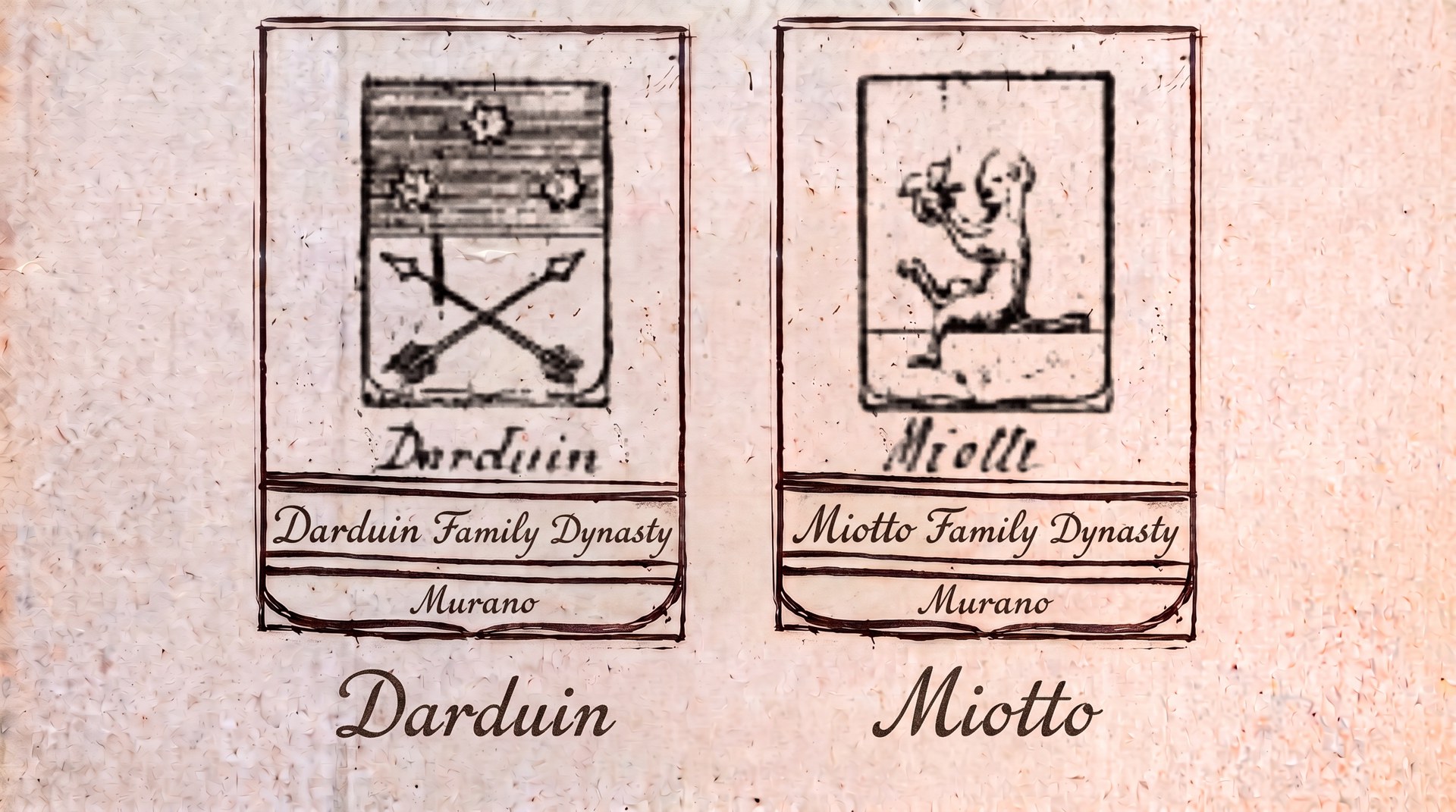
The Darduin & Miotto Dynasty: 1644 Secret Recipes, Al Gesù Kiln & Medici Patrons
The Darduin / Miotto Dynasty — 17th-Century Secret Recipe Pioneers, Al Gesù Furnace Masters, and the Golden Era of Enamel Chemistry
Dynasty Key: The Darduin / Miotto Dynasty
- Active Dynasty Window: 1485 – Late 18th Century (Historical furnace operations concluded in the 18th century; no active modern furnaces exist today)
- Ancestral Seat & Primary Kilns / Studios: Al Gesù Glassworks (Murano, 16th–17th c.) | Alle Due Fortune Glassworks (Murano, 1654–1700s) | San Giacinto Kiln | Fondaco dei Tedeschi Export Depot (Venice)
- Hereditary Master Glassmakers, Directors & Chemists:
- Darduin Line: Enrico ("Rigo") Darduin (c. 1485 German immigrant & export facilitator) | Marco Darduin (early 1500s furnace founder) | Nicolò Darduin (early 1500s founder) | Vincenzo Darduin (d. 1564, early 1500s founder) | Nicolò Darduin (1546–1599, master glassmaker) | Giovanni Darduin (1585–1654, compiler of the 1644 master formulation manuscript Secreti per far lo smalto et vetri colorati) | Giacomo Darduin (1585–1619, furnace operator) | Domenico Darduin (c. 1618–c. 1683, operator of Alle Due Fortune, host to Cosimo de' Medici in 1664) | Giacomo Darduin (c. 1655–c. 1715, manager of Alle Due Fortune, supplier to King Vittorio Amedeo of Savoy in 1687)
- Miotto Line: Vincenzo Miotto (1579–1637, master at Al Gesù) | Daniele Miotto (1618–1673, operator of Al Gesù from 1663, specialist in lattimo and enamel painting)
- Signature Technical & Material Inventions: The Ricettario Darduin (1644 master compilation of 16th and 17th-century batch recipes for smalti, opaque glass pastes, colored fluxes, and avventurina/calcedonio) | Al Gesù Enamel-Painted Lattimo Ware & Architectural Tiles | Baroque Cristallo with Intricate Knopped Stemwork & Zoomorphic Vessels | Grand Tour Lattimo Plates with Red Enamel Architectural Views
- Market Price Tier: Premier Museum & Archival Investment Grade (17th-century Darduin Alle Due Fortune filigree carafes, Baroque cristallo, and Miotto enamel-decorated lattimo hold top institutional, royal, and museum provenance)
- Key Collaborators & Royal Patrons: Cosimo de' Medici (Grand Prince of Tuscany) | Vittorio Amedeo (King of Savoy) | Fondaco dei Tedeschi | Venetian State Inquisitors & Council of Ten
Summary:
Uncover the 300-year legacy of The Darduin / Miotto Dynasty, Murano's supreme pioneers of secret batch formulation, enamel chemistry, and Baroque cristallo. This comprehensive guide explores Enrico Darduin's 1485 Fondaco dei Tedeschi trade roots, Giovanni Darduin's legendary 1644 Ricettario Darduin treatise (Secreti per far lo smalto), Domenico and Giacomo Darduin's Alle Due Fortune glassworks (patronized by Cosimo de' Medici in 1664 and King Vittorio Amedeo of Savoy in 1687), and Daniele Miotto's Al Gesù furnace specializing in enameled lattimo. Includes forensic identification for 17th-century royal court stemware and Grand Tour lattimo views.
Genealogical Lineage Map
┌─────────────────────────────────────────────────────────────────────────────────────────────┐
│                              THE DARDUIN / MIOTTO DYNASTY                                   │
│                    - ANCESTRY & GENEALOGICAL DESCENT (1485 – 1700s) -                      │
└──────────────────────────────────────────────┬──────────────────────────────────────────────┘
                                               │
                                     Enrico ("Rigo") Darduin
                                (c. 1485 Fondaco Export Official)
                                               │
                     ┌─────────────────────────┼─────────────────────────┐
                     │                         │                         │
               Marco Darduin             Nicolò Darduin           Vincenzo Darduin
              (1500s Founder)           (1500s Founder)             (d. 1564)
                                                                         │
                                                                  Nicolò Darduin
                                                                    (1546–1599)
                                                                         │
                                               ┌─────────────────────────┴─────────────────────┐
                                               │                                               │
                                       Giovanni Darduin                                 Giacomo Darduin
                                     (1585–1654, Author of                              (1585–1619)
                                      *Ricettario Darduin*)                                    │
                                                                                        Domenico Darduin
                                                                                     (c. 1618–c. 1683)
                                                                                  [*Alle Due Fortune* Owner]
                                                                                        (Medici Host 1664)
                                                                                               │
                                                                                        Giacomo Darduin
                                                                                     (c. 1655–c. 1715)
                                                                                  [*Alle Due Fortune* Owner]
                                                                                       (Savoy King Supplier)

═══════════════════════════════════════════════════════════════════════════════════════════════

                                       PARALLEL KILN LINE:
                                      THE MIOTTO DYNASTY
                                     (17th-Century *Al Gesù*)
                                               │
                                        Vincenzo Miotto
                                          (1579–1637)
                                               │
                                        Daniele Miotto
                                          (1618–1673)
                                     [*Al Gesù* Glassworks]
                                  [Enamel & *Lattimo* Master]
Walkthrough of the Family Tree: How the Branches Connect & Where Lineages Split
The Darduin and Miotto Dynasties represent the intellectual and technological guardians of 17th-century Muranese glass chemistry. While other families built renown through hot-glass manipulation and blowing techniques, the Darduins and Miottos dominated the secret alchemy of vitreous color pastes, enamels (smalti), opaque milk-glass (lattimo), and heavy Baroque cristallo:
1. Branch 1: German Trade Origins & The Early 16th-Century Kilns
- Enrico ("Rigo") Darduin (c. 1485): The family line originated with Enrico Darduin, a German immigrant documented on Murano in 1485. Positioned as an export liaison at the Fondaco dei Tedeschi (the German merchant headquarters in Venice), Enrico facilitated the trade of Murano glass into Transalpine Central Europe.
- The 16th-Century Founders: Enrico's three sons—Marco, Nicolò, and Vincenzo Darduin (d. 1564)—transitioned from commercial brokerage to direct furnace operation, founding an independent glassworks on Murano in the early 1500s.
- Nicolò Darduin (1546–1599): Son of Vincenzo, Nicolò deepened the family's expertise in batch chemistry, meticulously recording raw material ratios for colored melts and enamels.
2. Branch 2: Giovanni Darduin & The 1644 Master Formulation Treatise
- Giovanni Darduin (1585–1654): Son of Nicolò, Giovanni Darduin achieved eternal historical prominence by compiling the celebrated
Ricettario Darduinstarting in 1644. Titled Secreti per far lo smalto et vetri colorati (Secrets for Making Enamel and Colored Glass), this manuscript codex gathered over a century of private family formulas dating back to 1523. - Archival Preservation: Preserved today in the Venice State Archives (Archivio di Stato di Venezia), the Ricettario Darduin remains one of the most comprehensive primary historical sources for 17th-century Venetian batch chemistry, detailing the exact metallic oxide proportions needed for cobalt blues, copper greens, manganese violets, lead-tin lattimo, and shimmering avventurina.
3. Branch 3: The Alle Due Fortune Glassworks & Royal Court Patronage
- Domenico Darduin (c. 1618–c. 1683): Nephew of Giovanni (son of Giacomo Darduin), Domenico established the famous Alle Due Fortune (At the Two Fortunes) furnace on Murano, registered in 1654.
- Cosimo de' Medici's Royal Visit (1664): In 1664, Grand Prince Cosimo de' Medici (son of Grand Duke Ferdinando II of Tuscany) made a formal state visit to Domenico's Alle Due Fortune furnace, praising its flawless, ultra-pure cristallo.
- Giacomo Darduin (c. 1655–c. 1715) & Royal Savoy Commission (1687): Succeeding his father in 1683, Giacomo expanded international exports. In 1687, King Vittorio Amedeo of Savoy visited Alle Due Fortune, personally acquiring filigree carafes, goblets, and luxury table hollowware.
4. Branch 4: The Miotto Dynasty & The Al Gesù Furnace
- Vincenzo (1579–1637) & Daniele Miotto (1618–1673): Operating the historic Al Gesù glassworks on Murano, Daniele Miotto specialized in firing opaque milk-glass (lattimo) vessels and architectural tiles decorated with delicate, fusible enamels (smalti).
- Grand Tour Souvenir Legacy: In the 18th century, the Miotto lineage (alongside the Bertolini glassworks) produced the iconic lattimo parade plates painted in red enamel with architectural views (vedute) of Venice taken from Antonio Visentini and Luca Carlevarijs engravings for English Grand Tour aristocrats.
1. German Export Roots & Early 16th-Century Kiln Foundations (1485–1590s)
Enrico "Rigo" Darduin & The Fondaco dei Tedeschi Connection
- Commercial Brokerage: In 1485, Enrico Darduin ("Rigo") was appointed as an official trade facilitator for the Fondaco dei Tedeschi in Venice. Controlling the flow of luxury Murano stemware across the Alps into German, Austrian, and Bohemian lands, Enrico recognized the immense international demand for specialized Venetian color formulation.
- Establishing the Murano Kilns: In the early 1500s, Enrico's three sons—Marco, Nicolò, and Vincenzo Darduin—established an independent furnace on Murano, shifting the family from trade brokerage to direct hot-glass production.
Nicolò Darduin (1546–1599) & Experimental Alchemy
- Recording Furnace Batches: Vincenzo's son Nicolò Darduin recognized that furnace temperature control and metal oxide purity determined the brilliance of enameled glass. He began recording batch weights in Venetian libre and oncie, creating the private family logbook that would form the core of the Ricettario Darduin.
2. Giovanni Darduin & Secreti per far lo smalto (1644 Treatise)
The Compilation of the Ricettario Darduin
- A Masterwork of Vitreous Chemistry: In 1644, Giovanni Darduin finalized the compilation of his lifetime work: Secreti per far lo smalto et vetri colorati.
- Scope of Recipes: The manuscript contains hundreds of precise formulations dating from 1523 to 1644, covering:
- Smalti per Mosaici: Opaque colored glass cakes for mosaic tesserae and goldsmith enamels.
- Vetri Colorati in Massa: Deep cobalt blue (zaffera), emerald green (ramina), ruby red (rame e ferro), and manganese amethyst.
- Batch Chemistry for Lattimo & Avventurina: Step-by-step instructions for precipitating metallic copper crystals under a reducing atmosphere to yield shimmering avventurina (stellaria).
State Secrecy & Penalties
- Protection of Secrets: Because glass formulation was guarded under strict Council of Ten (Consiglio dei Dieci) decrees, the Ricettario Darduin was held in total secrecy within the family, accessible only to sworn master gaffers.
3. The Alle Due Fortune Furnace: Medici & Savoy Royal Patronage (1654–1715)
Domenico Darduin & Cosimo de' Medici (1654–1664)
- Founding Alle Due Fortune: Registered under the trademark sign of Alle Due Fortune in 1654, Domenico Darduin's furnace specialized in ultra-light, clear cristallo and complex filigree hollowware.
- The 1664 Medici Visit: When Cosimo de' Medici visited Murano in 1664, he selected Domenico's furnace as the pinnacle of Venetian technical perfection, purchasing custom cristallo hollowware for the Florentine court.
Giacomo Darduin & The Savoy Royal Commission (1683–1687)
- King Vittorio Amedeo's Royal Purchase: In 1687, King Vittorio Amedeo of Savoy made a formal visit to Alle Due Fortune, acquiring an extensive suite of filigree carafes (vetro a retortoli and reticello), knopped goblets, and decorative table centerpieces.
4. The Miotto Dynasty & The Al Gesù Furnace (Lattimo & Enamel Virtuosity)
Daniele Miotto (1618–1673) at Al Gesù
- The Al Gesù Furnace: Operating the Al Gesù furnace on Murano from 1663, Daniele Miotto (son of Vincenzo Miotto) established a reputation for producing high-purity lattimo (milk glass) decorated with low-fusion enamel paints (refogolar process).
18th-Century Grand Tour Red-Enamel Vedute
- The Grand Tour Market: In the 18th century, the Miotto family furnace adapted lattimo production to cater to wealthy European aristocrats on the Grand Tour. Blown milk-glass plates were hand-painted in red monochrome enamel with detailed architectural views of Venice (Piazzetta San Marco, Santa Maria della Salute) copied from Antonio Visentini engravings, then refired in muffle kilns.
Modern Industrial Continuity & Archival Legacy
Unlike Muranese lineages that revived or established modern industrial kilns in the 19th and 20th centuries (such as Barovier & Toso, Seguso, Toso, Zanetti, or Vistosi), there are no active modern furnaces or contemporary glassworks associated with either the Darduin or Miotto (Miotti) family on Murano today.
- The Darduin Lineage: Direct furnace operations concluded in the early-to-mid 18th century following the management of Alle Due Fortune by Domenico and Giacomo Darduin. The family's enduring legacy resides in their unparalleled intellectual contribution—most notably Giovanni Darduin’s 1644 Ricettario Darduin (Secreti per far lo smalto et vetri colorati), preserved in the Venice State Archives (Archivio di Stato di Venezia).
- The Miotto (Miotti) Lineage: The historic Al Gesù glassworks operated by Daniele Miotto and his 18th-century descendants ceased operations during the general economic decline of Murano glassmaking in the late 18th century and post-Napoleonic era. Their masterworks exist today exclusively as premier museum artifacts, Grand Tour collector showpieces, and archival codices.
5. Technical & Material Innovations: Batch Chemistry & Surface Form
| Technical Innovation | Italian Name | Physical Description & Furnace Chemistry | Historical Era & Primary Innovator |
|---|---|---|---|
| Secret Enamel Formulation Treatise | Ricettario Darduin | Manuscript codex (Secreti per far lo smalto) detailing 16th–17th c. batch recipes for smalti and colored glass. | Compiled 1644 by Giovanni Darduin. |
| Aventurine Copper Reduction | Avventurina / Stellaria | Complex reducing melt yielding suspended metallic copper leaf crystals inside a brown glass matrix. | Formulated & perfected in Ricettario Darduin. |
| Enamel Refiring Technique | Refogolar | Subjecting enamel-decorated cold glass to low-temperature muffle kiln firing to fuse pigments permanently. | Mastered at Miotto's Al Gesù glassworks. |
| Grand Tour Lattimo Painting | Lattimo Dipinto a Smalto | Opaque milk-glass vessels hand-painted in red/monochrome enamels with Venetian architectural views. | Produced by 18th-c. Miotto furnace line. |
6. Forensic Master Registry: Explicit Mapping of Markings, Signatures & Decals to the Genealogical Lineage Tree
Cross-referencing historical shop signs, archival recipe marks, and physical vessel characteristics directly against the Genealogical Lineage Map is essential for authenticating 17th and 18th-century Darduin and Miotto family glass:
I. Archival Manuscript Inscriptions & Furnace Trademarks
-
Secreti per far lo smalto/ Ricettario Darduin (Archival Codices)- Physical Medium & Material: Paper manuscript codex bound in vellum, preserved in the Venice State Archives.
- Exact Archival Title: Secreti per far lo smalto et vetri colorati di Giovanni Darduin (1644).
- Exact Lineage Tree Mapping: Branch 2 Master Chemist → Giovanni Darduin (1585–1654).
- Curatorial Context: Primary historical recipe ledger documenting 16th and 17th-century Muranese batch secrets.
-
Alle Due Fortune(Furnace Trademark Sign)- Physical Medium & Marking: Carved wooden shop sign and stamped wax seals depicting two allegorical figures of Fortune holding sails.
- Exact Inscription:
ALLE DUE FORTUNE - MURANO. - Exact Lineage Tree Mapping: Branch 3 Furnace Line → Domenico Darduin (1654) & Giacomo Darduin (1683).
- Curatorial Context: Found on transport crates and official export certificates for luxury cristallo supplied to the Medici and Savoy royal courts.
-
Al Gesù(Furnace Trademark Sign)- Physical Medium & Marking: Furnace shop sign depicting the sacred monogram 'IHS' with a cross.
- Exact Inscription:
AL GESÙ - MURANO. - Exact Lineage Tree Mapping: Parallel Kiln Line → Daniele Miotto (1618–1673).
- Curatorial Context: Identifies the historic 17th-century furnace specializing in lattimo, enamels, and decorative tiles.
II. Physical & Material Diagnostic Markers
-
17th-Century Baroque Knopped Stemware (Alle Due Fortune Cristallo)
- Physical Characteristics: Extremely thin, lightweight, greyish-manganate clear cristallo with blown hollow knops, pincered wing-handles (a alette), and diamond-point engraved scrollwork.
- Exact Lineage Tree Mapping: Branch 3 Glassworks → Domenico & Giacomo Darduin (c. 1660–1700).
- Curatorial Context: Matches documented royal court purchases by Cosimo de' Medici (1664) and King Vittorio Amedeo of Savoy (1687).
-
18th-Century Red-Enamel Architectural Lattimo (Miotto Al Gesù Wares)
- Physical Characteristics: Pure opaque white lead-tin lattimo porcelain-imitation plates decorated with fine red-iron enamel depictions of Venetian plazas (Piazzetta San Marco, Rialto Bridge) refired via the refogolar method.
- Exact Lineage Tree Mapping: Miotto Dynasty → Al Gesù Lineage (c. 1740–1780).
- Curatorial Context: Executed for English aristocrats on the Grand Tour, preserved in the Corning Museum of Glass and Murano Glass Museum.
7. Attribution & Authenticity
Authenticating Darduin and Miotto family glass requires specialized knowledge of 17th and 18th-century material science:
- 17th-Century Cristallo Purity: Genuine Darduin cristallo displays slight micro-air bubbles (puleghe) and faint grey/purple tinting caused by manganese oxide decoloring agents. Pontil marks show 17th-century hand-snapping without modern mechanical grinding.
- Enamel Adhesion & Wear: Authentic Miotto enameled lattimo features subtle crackle (craquelure) in the enamel layer caused by differential thermal expansion during the refogolar refiring process. Beware of 19th-century cold-painted imitations where enamel peels easily off the glass body.
- Avventurina Copper Flakes: 17th-century avventurina formulated using the Ricettario Darduin methods exhibits irregular, hand-crystallized octagonal copper flakes embedded within an amber-brown matrix, unlike uniform modern synthetic substitutes.
Join Our Facebook Group Identify Your Murano - Murano Glass Animals