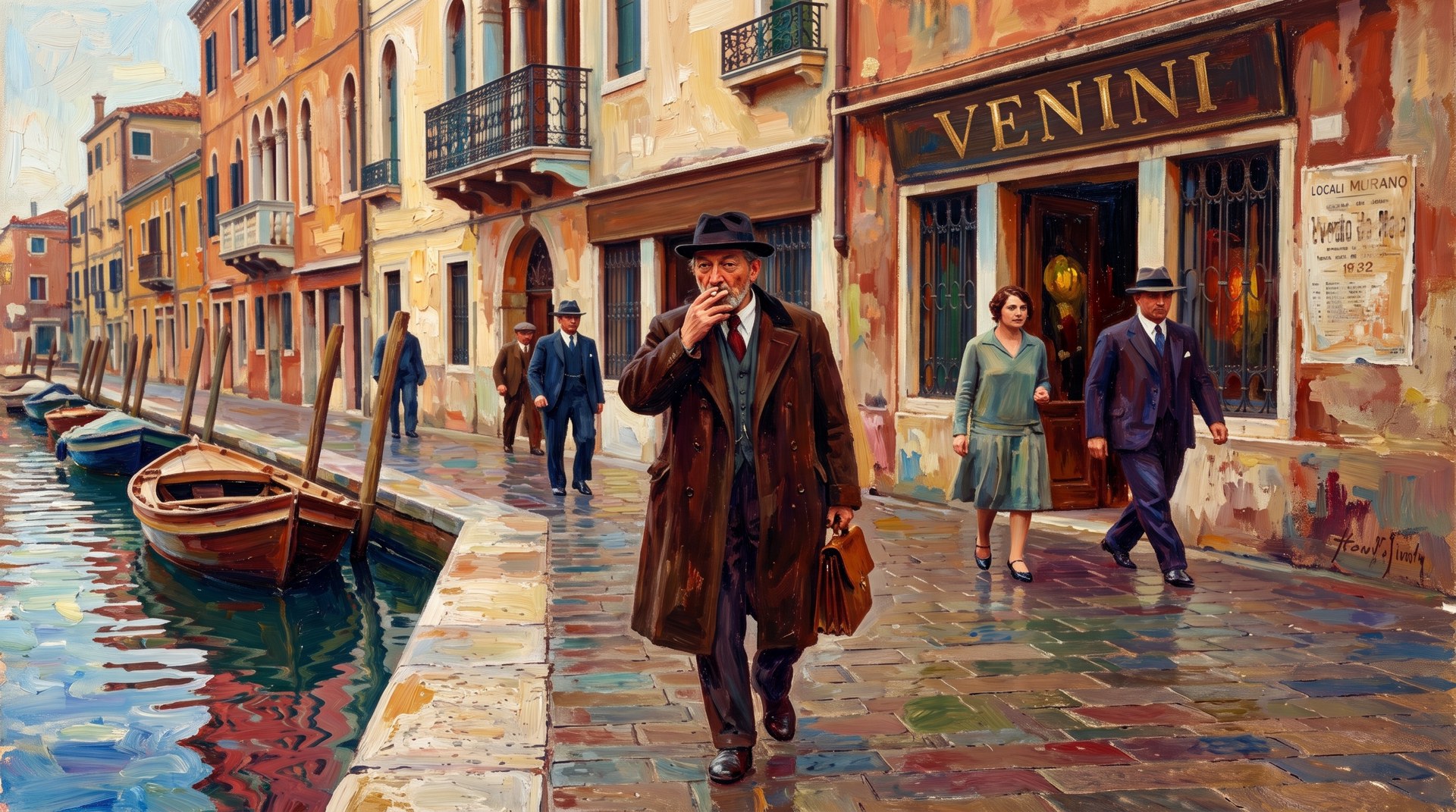
Carlo Scarpa Murano Glass: The Ultimate Architect of Structural Light
The Visionary Designers: A Collector's Guide
Carlo Scarpa — The Architect of Texture
Artist Key: Carlo Scarpa
- Role: Architect / Designer / Visionary (The Architect of Texture)
- Life/Dates: Venice, June 2, 1906 – Sendai, Japan, November 28, 1978
- Primary Furnaces: Maestri Vetrai Muranesi Cappellin & C. (M.V.M., 1925–1931) | Venini & C. (1932–1947)
- Signature Techniques: Corroso (Acid-corroded) | Battuto & Inciso (Wheel-carved) | Tessuto (Woven fine canes) | Mezza Filigrana (Lace-thread spiral) | A Bollicine (Micro-bubbled) | Laccati (Opaque lacquer-style) | Pennellate (Brushstroke application) | Murrine Romane & Opache (Fused mosaic tesserae) | Decoro Fenicio (Phoenician feather festoons) | Sommerso a Bollicine (Submerged gold-leaf bubbles) | A Fasce Applicate (Applied bands)
- Market Price Tier: High-End Investment Grade (specifically 1940s Murrine Opache, early Pennellate vessels, 1940s Tessuto bottles, and early corroso trials) to Mid-Range (A Bollicine tablewares, Mezza Filigrana bowls, and post-war corroso re-editions)
- Key Collaborators: Giacomo Cappellin | Paolo Venini | Arturo Biasutto ("Boboli") | Francesco "Checco" Ongaro | Ermete Toso | Mario De Luigi (known as "Guido Bin") | Tobia Scarpa (son and designer of "Occhi" and "Battuti")
Summary:
Discover the secrets to identifying, dating, and collecting the revolutionary glassware designed by Carlo Scarpa, the legendary architect of Murano's golden age. This collector's guide covers his transition from M.V.M. Cappellin to Venini & C., exploring his pioneering corroso acid-etched technique, the woven tessuto vertical cane series, the textured battuto wheel-cut vessels, and the mathematically perfect murrine opache mosaic bowls. Learn how to verify authentic diagnostic markers—including hand-guided wheel carvings, metallic iridescence shifts, flat ground-polished bases, and authentic Venini acid stamps—to confidently identify his creations and spot true investment-grade treasures on the secondary market.
Visual Career Timeline
              ┌──────────────────────────────────────────────────────────┐
              │                       CARLO SCARPA                       │
              │                 - THE ARCHITECT OF TEXTURE -             │
              └──────────────────────────┬───────────────────────────────┘
                                         │
     ┌───────┐                           ▼
     │ 1906  │ ──► Born June 2 in Venice; spends childhood in Vicenza (1908–1919).
     └───────┘                           │
     ┌───────┐                           ▼
     │ 1926  │ ──► Graduates from Venice Accademia delle Belle Arti in architectural drawing.
     └───────┘                           │
     ┌───────┐                           ▼
     │ 1927  │ ──► Commences freelance design for Giacomo Cappellin's M.V.M. furnace.
     └───────┘                           │
     ┌───────┐                           ▼
     │ 1928  │ ──► Appointed M.V.M. Artistic Director; introduces opaque marbling (pasta vitrea).
     └───────┘                           │
     │                                   ├─► Invents iconic Vetro Lattimo with gold/silver leaf.
     │                                   └─► Establishes the splayed-foot spherical vase logo.
     ┌───────┐                           ▼
     │ 1930  │ ──► Debuts gold-leafed Lattiginosi and silvered Nero Argenteo at Venice Biennale.
     └───────┘                           │
     ┌───────┐                           ▼
     │ 1932  │ ──► M.V.M. Cappellin closes; Scarpa collaborates with Venini & C.
     └───────┘                           │
     │                                   ├─► Develops microscopic bubble glass (A Bollicine).
     │                                   └─► Designs the spatial mosaic wall "Il Bagno" with De Luigi.
     ┌───────┐                           ▼
     │ 1934  │ ──► Appointed Artistic Director at Venini, replacing Tomaso Buzzi.
     └───────┘                           │
     │                                   ├─► Debuts weightless Mezza Filigrana.
     │                                   └─► Launches bubble-embedded Sommerso a Bollicine series.
     ┌───────┐                           ▼
     │ 1936  │ ──► Introduces rough acid-etched Corroso; co-creates Murrine Romane.
     └───────┘                           │
     ┌───────┐                           ▼
     │ 1940  │ ──► Landmark VII Milan Triennale: launches Tessuto, Laccati, and Battuto.
     └───────┘                           │
     │                                   ├─► Exhibits the iconic, sagged Piatto del Serpente.
     │                                   └─► Introduces hand-guided wheel cuts to simulate metal.
     ┌───────┐                           ▼
     │ 1942  │ ──► Final wartime fusions: exhibits fluid Pennellate and trailed A Fili series.
     └───────┘                           │
     ┌───────┐                           ▼
     │ 1947  │ ──► Leaves Venini to focus on architecture; continues to consult on museum layouts.
     └───────┘                           │
     ┌───────┐                           ▼
     │ 1961  │ ──► Designs monumental polyhedron glass window wall for Italia '61 in Turin.
     └───────┘                           │
     ┌───────┐                           ▼
     │ 1978  │ ──► Passes away November 28 in Sendai, Japan; internationally immortalized.
     └───────┘
1. The Legend & Legacy
In the history of twentieth-century decorative arts, Carlo Scarpa is revered as the towering genius who successfully introduced the absolute discipline of architecture to the fluid, mercurial medium of hot glass. Born in Venice on June 2, 1906, Scarpa completed his formal studies in architectural drawing at the Academy of Fine Arts in Venice, graduating with his teaching diploma in 1926. His lifelong passion for glass began entirely by chance in 1925, when the eccentric entrepreneur Giacomo Cappellin engaged him to supervise the architectural restoration of the Gothic Palazzo da Mula on Murano, which served as the headquarters for the newly founded Maestri Vetrai Muranesi Cappellin & C. (M.V.M.).
Sensing the young architect’s profound spatial intuition and visually refined taste, Cappellin invited Scarpa to freelance for the furnace, initially as a draftsman assisting the painter Vittorio Zecchin, and subsequently as the furnace's sole Artistic Director following Zecchin’s departure in late 1926. Scarpa completely revolutionized M.V.M.'s output. Rather than repeating Zecchin’s thin, transparent historicism, Scarpa treated glass as an opaque, light-refracting ceramic body, creating the legendary, highly textured pasta vitrea (colored glass paste), gold-and-silver-flecked lattimo (opaque milk glass), and combed decoro fenicio (Phoenician style) collections that triumphed at the 1930 Monza Triennale and Venice Biennale. He also established the ultimate logo of the M.V.M. workshop: a light-green spherical vase balanced on a truncated-cone base with a splayed blue-glass mouth (Model 5673).
Following the tragic bankruptcy of M.V.M. Cappellin in 1932, Paolo Venini instantly recognized Scarpa’s unmatched design authority and invited him to join Venini & C. as Artistic Director. Over the next fifteen years—a period broadly celebrated by collectors as the "Carlo Scarpa Era"—Scarpa initiated a golden age of research and development that permanently transformed Murano’s technical landscape. Working in close spiritual alignment with Paolo Venini, Scarpa systematically revived and re-engineered ancient, forgotten techniques—ranging from Roman mosaic fusion to cold wheel-carving—translating them into a deeply intellectual, highly modern design language.
Scarpa’s output at Venini was monumental, resulting in successive historical triumphs: the weightless, transparent Mezza Filigrana in 1934; the acid-corroded Corroso series in 1936; and the unparalleled, texture-heavy Battuto, Laccati, and Tessuto series that debuted at the 1940 Venice Biennale. Under the grueling constraints of wartime materials, Scarpa realized his final glass masterpieces in 1942, exhibiting the fluid, gestural Pennellate and trailed A Fili collections. In 1947, Scarpa departed Venini to devote himself fully to teaching and his historic architectural practice, which earned him global renown. He passed away on November 28, 1978, in Sendai, Japan, leaving a legacy as the undisputed architect who taught Murano how to capture structural light.
2. The Chemical Surface Treatments of Carlo Scarpa
Carlo Scarpa completely rejected the classical, high-gloss surface of blown glass. He treated the exterior wall of the vessel as a canvas for complex chemical and metallurgical reactions, pioneering several of the modern era’s most celebrated surface treatments:
- Vetro Corroso (Acid-Corrosion): Perfected in 1936, this technique bypassed traditional transparent finishes to achieve a heavily textured, archaic surface resembling excavated Roman relics or sea-weathered stones.
- The Chemical Process: Once the thick-walled cased glass vessel was cold and annealed, its outer surface was irregularly coated with a protective layer of beeswax or a specialized glue-varnish using a sponge. The object was then plunged into a tank of sawdust soaked in hydrofluoric acid—the only acid capable of aggressively corroding silica glass at room temperature. The acid attacked only the unprotected areas, eating away at the silica matrix. This chemical corrosion produced a deeply pitted, irregular, and frosted matte finish (corroso) that varied beautifully in depth.
- Vetro Iridato (Metallic Iridescence): Pioneered in 1929 at M.V.M. Cappellin and subsequently expanded at Venini, this process gave monochrome transparent and opaque vessels a highly reflective, mineral quality.
- The Chemical Process: While the hand-blown vessel was still hot on the pontil rod at the mouth of the glory hole, it was subjected to an intense reducing atmosphere. The master glassmaker sprayed or sprayed-on specialized metallic salt solutions—primarily tin chloride (cloruro di stagno) or titanium chloride—directly onto the white-hot glass surface. The intense heat caused the salts to decompose, fusing a microscopic, paper-thin film of metal oxides onto the glass. This chemical reducing reaction created a subtle, shimmering metallic iridescence (iridato) that shifted colors dramatically between reflected light (from above) and transmitted light (shining through).
- Lattimo Aurato and Nero Argenteo (Metallic Foil Fusions): Perfected for his 1930 Monza Triennale showcase, this treatment integrated metallurgy directly into the blowing process.
- The Chemical Process: The master gathered a core of opaque white milk glass (lattimo) or dense black glass (nero), rolled it over a sheet of pure gold leaf (foglia d'oro) or silver leaf (foglia d'argento), and cased it in a protective outer layer of clear crystal. As the master blew and expanded the parison, the intense thermal expansion stretched the precious metal foil, fracturing it into billions of microscopic, shimmering, and suspended metallic flecks. This process gave the opaque glass body an extraordinary, reflective, and precious depth.
3. The Architectural Geometry of Carlo Scarpa’s Forms
As a trained architect, Carlo Scarpa did not view glass as a mere decorative container. He approached every design through a systematic structural framework, utilizing mathematically precise proportions, geometric fusions, and load-bearing symmetries:
- The Spherical-Cone Fusion (Model 5673): Designed in 1927, this vessel became the celebrated logo and structural symbol of the M.V.M. Cappellin workshop.
- The Geometrical Formula: The vase balances a perfectly spherical, thin-blown transparent or filigree body upon a massive, solid truncated-cone base (tronco di cono) made of contrasting transparent glass splayed at the mouth. This architectural formula deliberately juxtaposed a sphere with a truncated cone. By placing the heavy, solid cone base below the paper-thin, hollow-blown sphere, Scarpa established a low, stable center of gravity, anchoring the fragile volume through perfect structural load-bearing balance.
- The Grid-Modular Ribbing of Tessuto: Invented for his landmark showcase at the 1940 Venice Biennale, the tessuto technique adapted the modular grid-work of modern architectural drawings to three-dimensional glass vessels.
- The Geometrical Formula: Scarpa arranged ultra-thin colored glass canes vertically in a mathematically perfect, flat linear sequence. The height-to-width ratios of his cylindrical, rectangular, and splayed bottles were calculated using classical architectural proportions (frequently matching the Golden Ratio. When fused and blown, the vertical colored stripes functioned as structural, load-bearing ribbing, creating a dense, woven grid that structured the light falling across the vessel walls.
- The Sagged Planar Mosaic of Murrine Opache: In his opaque mosaic bowls (such as the legendary Piatto del Serpente designed in 1940), Scarpa abandoned traditional glassblowing entirely, treating the medium as a flat, modular tessellation of architectural space.
- The Geometrical Formula: Alternating square tiles (tessere) of opaque black, white, and red glass were arranged on a flat ceramic plate in concentric, spiraling, or chessboard patterns. Once heated to a softening point, gravity and thermal slumping (vetro curvato) sagged the flat horizontal mosaic disk slowly into a concave, three-dimensional bowl mold. Once cold, the piece was subjected to extensive hand-grinding and polishing in the moleria to produce a mathematically flat, matte, and geometric plane with no furnace shine, mimicking the clean lines of cast concrete or polished marble.
4. The "Fingerprint" Techniques
In addition to his chemical and geometric breakthroughs, Scarpa's creative period resulted in several of modern glass's most technically grueling and iconic blowing techniques:
- Battuto (Hammered Style) & Inciso (Cut Style): Developed c. 1940, these treatments completely rejected the smooth, glossy finish of hot glass, transferring the vessel to the cold-cutting workshop (moleria).
- Battuto: The cased, thick-walled vessel was held against specialized, hand-guided diamond-grinding wheels, carving thousands of short, irregular horizontal depressions across the entire surface. This created a highly tactile, satin-matte texture that mimicked hammered copper or hand-chiseled stone.
- Inciso: The cold vessel was carved with fine, vertical parallel grooves, creating a clean, structured linear texture that caught the light like the fluting of a classical column.
- Vetro Pennellato (Brushstroke Style): Designed c. 1942, this technique simulated the gestural, fluid brushwork of abstract canvas painting. While the clear crystal parison was being blown, the master glassmaker applied hot, irregular, and overlapping swirls of highly colored glass pastes and gold-ruby powders directly to the expanding core. The centrifugal force of the blowing naturally stretched, bled, and feathered the colors across the expanding walls, mimicking fluid paint strokes.
- Sommerso a Bollicine (Submerged Bubbles): Developed in 1934, this technique cased a thick, colored glass body containing billions of tiny, trapped air bubbles (a bollicine) in a thick outer layer of clear crystal filled with suspended gold leaf, creating a dense, sparkling, and three-dimensional depth.
5. Famous Collaborations
Carlo Scarpa’s programmatic drawings demanded an unprecedented level of manual discipline, forcing him to establish close, highly productive relationships with Murano’s absolute premier masters:
- Giacomo Cappellin: The aristocratic founder of M.V.M. Cappellin. Cappellin was a visionary entrepreneur who granted the young, unproven Scarpa complete creative freedom to conduct costly, experimental chemical and material research on the furnace floor.
- Paolo Venini: The founder-director of Venini & C. Venini's strict, demanding eye and search for classical proportion acted as the perfect focusing lens for Scarpa's architectural theories. Venini was directly involved on the furnace floor, frequently collaborating with Scarpa on the design of the Murrine Romane and A Bollicine series.
- Arturo Biasutto ("Boboli"): Venini's premier master glassblower. Possessing legendary technical skill and manual discipline, Boboli was the primary hands who physically executed Scarpa’s early sommerso and mezza filigrana collections, translating the architect’s drawings into hot glass with flawless linear precision.
- Francesco "Checco" Ongaro: Entering Venini as a highly gifted young master, Ongaro’s non-verbal speed and non-standard physical movements made him the perfect medium for Scarpa’s late-career, highly complex tessuto and asymmetric pennellate vessels.
- Mario De Luigi (Guido Bin): The spatialist Venetian painter collaborated with Scarpa in 1932 to design the monumental architectural mosaic panel Il Bagno for the XVIII Venice Biennale, bridging the gap between painting, architectural space, and glass.
6. The Forensic Chronology of Carlo Scarpa Markings
To confidently identify, date, and authenticate a Carlo Scarpa vessel, collectors must understand the precise evolution of markings, paper labels, and acid stamps utilized across his primary creative eras:
I. The M.V.M. Cappellin & C. Era (1926–1931)
- The Concentric Acid Stamp: Original works designed by Scarpa for M.V.M. Cappellin carry a highly distinct, circular, double-bordered acid-etched factory mark on the underside of the base ring or flat-ground pontil. The stamp reads
M.V.M. / CAPPELLIN / MURANOin thin, sans-serif block capital letters arranged in concentric rings. - Unsigned Items: Many early M.V.M. transparents and unique exhibition pieces from 1925-1926 were completely unsigned.
II. The Early Venini & C. Era (1932–1936)
- The Two-Line Circular Stamp: Transparent and micro-bubbled soffiati from this transition era carry a small, two-line, circular acid stamp reading
venini / muranoin sans-serif lowercase letters on the vessel bottom or inside the base ring hollow.
III. The Mid-to-Late Venini Era (1936–1945)
- The Standard Three-Line Stamp (The Wartime Mark): The most common and famous diagnostic mark from Scarpa's primary tenure. It features a crisp, linear three-line acid stamp reading
venini / murano / MADE IN ITALYin sans-serif capital letters on the underside of the base. - The "Ars" Circular Stamp: High-art wares, limited exhibition pieces, and complex tessuto bottles often carry a circular acid stamp reading
venini / murano / arsarranged in concentric rings.
IV. The Post-War Venini Era (1946–1947)
- The Post-War Linear Stamp: Pieces executed during Scarpa's final active year of direction carry a distinct three-line linear acid stamp reading
venini / murano / ITALIAin sans-serif block capital letters. - Differentiating Later Reissues (Post-1970s): Because of the immense popularity of Scarpa's Tessuto and Battuto designs, Venini continued to produce these models throughout the late 20th century. Modern reissues (often executed under the supervision of his son, Tobia Scarpa) are easily distinguished because they carry a vibro-engraved or diamond-point signed signature reading
Venini Carlo Scarpaaccompanied by the exact year of reissue. Carlo Scarpa himself never used hand-engraved signatures during his active design years—all original interwar pieces carry strictly the chemical acid stamps detailed above.
7. The Collector's Diagnostic Checklist & Market Realities
- Evaluating Wheel-Cut Finish Quality: On genuine Battuto and Inciso vessels, the wheel cuts must appear hand-guided, showing minute, organic variations in depth, alignment, and spacing. Beware of contemporary pressed-glass counterfeits, which feature perfectly uniform, molded depressions with smooth, uniform edges.
- Analyzing Pontil Marks: Early Scarpa vessels (especially thin mezza filigrana and lattimo bowls) feature a clean, rough, and slightly splayed pontil mark on the underside. Heavy, wheel-cut, or corroso pieces feature a deep, circular, polished cut hollow in the base ring, ground flat and finished to a fine matte or mirror polish.
- Color Oxidation and Transmitted Light: In authentic corroso pieces, the surface iridescence was applied while the glass remained hot on the pontil rod under an intense reducing atmosphere. This produces a highly complex metallic play of light that shifts colors drastically between reflected light (from above) and transmitted light (shining through the side). Cheap modern chemical coatings fail to replicate this mineral shift.
- The Price Tiers:
- High-End Investment Grade: Original 1940 Murrine Opache bowls (including the legendary Piatto del Serpente); original 1942 Pennellate bottle-shaped vases; early 1930s Nero Argenteo and Lattiginosi pieces designed for M.V.M. Cappellin; and original 1940 Laccati red-and-black incalmo vessels.
- Mid-Range: Original 1940 Tessuto bottle vases; heavy-walled Corroso vases with their patchy matte finish; A Bollicine double-handled green vases; and 1942 A Fili trailed-thread bottles.
- Accessible: Small everyday utility pieces (such as clear, thin-walled soffiati tumblers and plates); small mezza filigrana cased bowls; and late-era (post-1980s) re-editions produced under his son Tobia's supervision.
- Differentiating the Copies: Because Carlo Scarpa's masterpieces represent the holy grail of mid-century Italian design, they have been extensively copied and forged. Authentic Scarpa pieces are characterized by their superb technical execution, sophisticated color balances, and exceptional lightness (where intended) or architectural weight (where carved). Cheap copies stand out by their thick, clumsy crystal bases; bleeding, uneven colored threads; chemical, uniform acid coatings; and crude, modern vibro-engraved signatures of his name (which Scarpa himself never used during his active furnace years).
8. Attribution & Authenticity
In the Murano glassmaking tradition, the difference between a fake and a copy rests entirely on intent, origin, and transparent attribution. A fake is a deceptive counterfeit manufactured outside of Murano—often in mass production factories in Asia or Eastern Europe that utilizes cheap materials and carries forged signatures or illicit trademark stickers to intentionally defraud collectors. Conversely, a copy is a legitimate artistic homage (omaggio) handcrafted by a skilled master using authentic Murano techniques and materials; it serves as a tribute to honor a legendary artisan's legacy and is openly signed by the modern creator, preserving the lineage of Venetian glassblowing rather than exploiting it.
Join Our Facebook Group Identify Your Murano - Murano Glass Animals