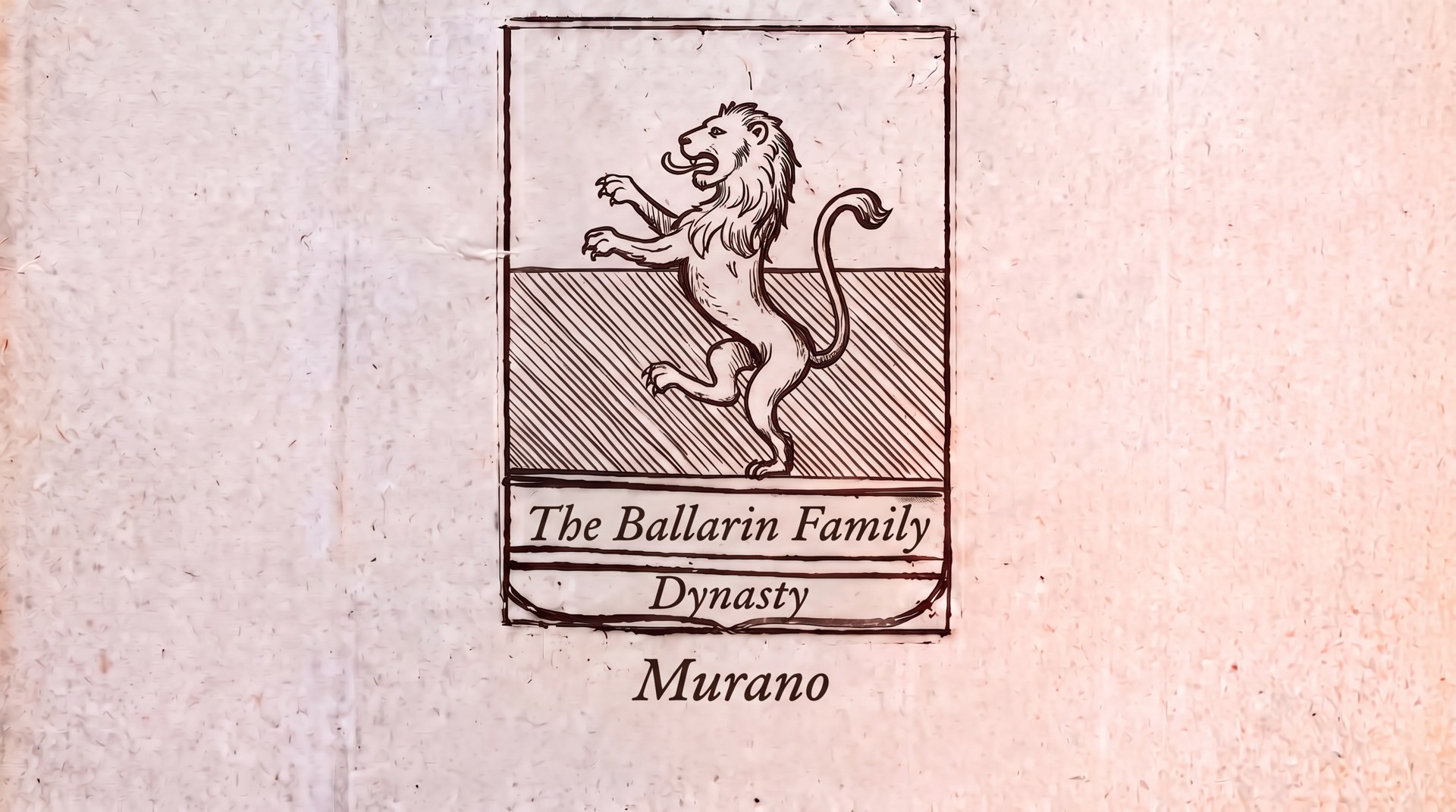
The Ballarin Family Murano Dynasty — Renaissance Mavericks, Formula Theft, San Marco Glassworks, Royal Patronage, and Modern Studio Maestri
The Ballarin Family Murano Dynasty — Renaissance Mavericks, Formula Theft, San Marco Glassworks, Royal Patronage, and Modern Studio Maestri
Dynasty Key: The Ballarin Dynasty
- Active Dynasty Window: 15th Century – Present (documented across five centuries from Renaissance Dalmatian progenitor Giorgio "Il Ballerino" to modern studio gaffers and furnace owners on Murano)
- Ancestral Seat & Primary Kilns / Studios: San Marco Glassworks (Fondamenta Vetrai) | San Zuan Battista Glassworks | Al San Zorzi Kiln | Cappella Ballarin (Church of San Pietro Martire, Murano) | Vetreria de Majo | Vetreria Artistica Ballarin (Giuliano & Roberto) | F. & M. Ballarin S.r.l. (Francesco, Mario & Angelo)
- Hereditary Master Glassmakers, Directors & Historians: Giorgio Ballarin ("Il Ballerino", c. 1440–1506, Dalmatian progenitor, master blower, formula innovator, and founder of the San Marco furnace) | Giovanni Ballarin (d. 1512, San Marco manager, lattimo master, and early glass historian) | Francesco Ballarin (16th-century master blower celebrated for intricate glass ships and galleys) | Domenico Ballarin (d. 1570, San Marco director, supplier to King Francis I of France, collaborator with painter Giovanni da Udine) | Pietro Ballarin (1532–1599, author of the landmark 1590 Ottoman export price list) | Domenico Ballarin (1575–1643, San Marco manager) | Giambattista Ballarin (b. 1603, Grand Councillor of the Venetian Republic) | Alvise Ballarin (master blower at San Zuan Battista glassworks, 1654–1662) | Giuliano Ballarin (b. 1942, filigree master & founder of Vetreria Artistica Ballarin) | Roberto Ballarin (b. 1969, master blower & co-director of Vetreria Artistica Ballarin) | Italo Ballarin (20th-century master blower at Vetreria de Majo, executor for Fulvio Bianconi) | Francesco & Mario Ballarin (1956 founders of F. & M. Ballarin) | Angelo Ballarin (Mario's son, 1997 managing director of F. & M. Ballarin)
- Signature Technical & Material Inventions: Rosechiero Glass (1493, bright red glass formula introduced with Lorraine technicians) | Enamelled Lattimo Pilgrimage Flasks (c. 1500s) | Intricate Glass Galley Architecture (Galee in Vetro) | The 1590 Ottoman Export Price List & Catalog | 18th-Century Filigree Revival (A Retincello / A Zanfirico) | Post-War Abstract Patchwork Executions | Contemporary Multi-Colored Mosaic & Spiral Canes
- Market Price Tier: High-End Investment Grade (Rare Renaissance lattimo vessels and 16th-century enamelled Ballarin glass command premier international museum and auction valuations; 1980s–1990s Italo Ballarin executions for Fulvio Bianconi command top investment prices; Giuliano Ballarin filigree masterworks range from High-End to Investment Grade; F. & M. Ballarin modern studio pieces range from Mid-Range to Accessible)
- Key Collaborators: Maria Barovier | Marin Barovier | King Francis I of France | Giovanni da Udine | Pietro Aretino | Marin Sanudo | Leandro Alberti | Fulvio Bianconi | Vetreria de Majo | Fred Wilson | Chisa Kotaki | Albino Carrara | Francesco Martinuzzi
Summary:
Discover the historical brilliance and hot-glass sculpting triumphs of The Ballarin Dynasty, Murano's premier family of Renaissance pioneers, royal suppliers, and modern studio masters. This comprehensive collector's guide details Giorgio Ballarin's ("Il Ballerino") c. 1480 copying of Maria Barovier's secret chemical formulas, his 1487 founding of the landmark San Marco glassworks, the 1493 invention of rosechiero red glass, Giovanni Ballarin's 1511 lattimo masterworks, Francesco Ballarin's 1525 glass galleys, Pietro Ballarin's 1590 Ottoman export ledger, Giuliano Ballarin (b. 1942) and Roberto Ballarin's founding of Vetreria Artistica Ballarin (1973/1989), Francesco & Mario Ballarin's 1956 founding of F. & M. Ballarin, Angelo Ballarin's 1997 modern color revolution, Italo Ballarin's executions for Fulvio Bianconi at de Majo, and forensic signature/decal identification. Learn how to evaluate diagnostic pontil marks, cane alignments, and factory decals to collect Ballarin glass with absolute curatorial confidence.
Genealogical Lineage Map
┌─────────────────────────────────────────────────────────────────────────────────────────────┐
│                                    THE BALLARIN DYNASTY                                     │
│                    - ANCESTRY & GENEALOGICAL DESCENT (15th c. – PRESENT) -                  │
└──────────────────────────────────────────────┬──────────────────────────────────────────────┘
                                               │
                                   Giorgio Ballarin 'Il Ballerino'
                                 (c. 1440–1506, Dalmatian Progenitor)
                                     [San Marco Kiln Founder]
                                               │
═══════════════════════════════════════════════╪═══════════════════════════════════════════════
                                               │
                  ┌────────────────────────────┼────────────────────────────┐
                  │                            │                            │
   ┌──────────────┴──────────────┐  ┌──────────┴──────────┐  ┌──────────────┴──────────────┐
   │ 1. HISTORIOGRAPHICAL &      │  │ 2. ROYAL PATRONAGE & │  │ 3. NAVAL GLASS & MODERN  │
   │    EARLY KILN BRANCH        │  │    SAN MARCO BRANCH  │  │    STUDIO LINEAGES       │
   └──────────────┬──────────────┘  └──────────┬──────────┘  └──────────────┬──────────────┘
                  │                            │                            │
          Giovanni Ballarin            Domenico Ballarin           Francesco Ballarin
             (d. 1512)                    (d. 1570)                 (16th-c. Master)
       [Lattimo & Hist. Notes]      [Francis I & Udine Glass]    [Glass Galleys & Ships]
                  │                            │                            │
         Giambattista Ballarin           Pietro Ballarin             Alvise Ballarin
           (1605 Grand Council)           (1532–1599)              (San Zuan Battista)
                  │                     [1590 Ottoman List]                 │
        Grand Councillor Line         Domenico Line (d. 1698)       18th-Century Filigree
         (San Pietro Chapel)           (San Marco Furnace)           Preservation Line
                                                                            │
                                               ┌────────────────────────────┼────────────────────────────┐
                                               │                            │                            │
                                 ┌─────────────┴─────────────┐┌─────────────┴─────────────┐┌─────────────┴─────────────┐
                                 │ BRANCH 3A: VETRERIA       ││ BRANCH 3B: F. & M.        ││ BENCH EXECUTORS & INDEP.  │
                                 │ ARTISTICA BALLARIN        ││ BALLARIN S.R.L.           ││ GAFFERS                   │
                                 └─────────────┬─────────────┘└─────────────┬─────────────┘└─────────────┬─────────────┘
                                               │                            │                            │
                                        Giuliano Ballarin           Francesco & Mario            Italo Ballarin
                                     (b. 1942, 1973 Studio)             (1956 Founders)          (de Majo / Bianconi)
                                               │                            │                            │
                                        Roberto Ballarin             Angelo Ballarin             Sergio & A. Ballarin
                                       (b. 1969, Co-Director)       (b. 1968, 1997 Director)     (Studio Gaffers)
                                       [Filigree & Sculptures]      [Modern Color Aesthetics]    [Custom Bench Line]
Walkthrough of the Family Tree: How the Branches Connect & Where Lineages Split
Understanding the Ballarin Dynasty requires tracing how a Dalmatian immigrant nicknamed for a physical limp ("Il Ballerino") built one of the richest glassmaking empires of the Venetian Renaissance, evolving across three interconnected branches over five centuries:
1. Branch 1: The Historiographical & Early Kiln Branch (Giorgio & Giovanni Ballarin)
- The Progenitor's Industrial Caper: Giorgio Ballarin (c. 1440–1506), a native of Dalmatia ("schiavon" in Venetian dialect), arrived on Murano as a poor youth and worked as a furnace assistant for Marin and Maria (Marietta) Barovier. By feigning clumsiness and simplicity around 1480, Giorgio observed and secretly recorded Maria Barovier's secret recipe journals containing formulas for cristallo, lattimo, and metallic glass colorations.
- Founding the San Marco Glassworks (1487): After an initial business attempt failed in 1482, Giorgio established the famous San Marco glassworks on Murano by 1487. In 1493, he brought glassmaker Roberto "lothoringese" (from Lorraine) to Murano, introducing advanced flat windowpane technology and inventing a brilliant red glass known as rosechiero.
- The First Glass Historian: Giorgio's son Giovanni Ballarin (d. 1512) succeeded his father at the San Marco glassworks. Giovanni produced exquisite lattimo vessels and compiled priceless archival notes on Murano's history and early glass terminology, later published in part by 19th-century scholar Cesare Augusto Levi.
2. Branch 2: The Royal Patronage & San Marco Branch (Domenico & Pietro Ballarin)
- Royal Commissions for King Francis I: Giorgio's second son Domenico Ballarin (d. 1570) expanded the San Marco furnace into an international luxury supplier. In 1532, King Francis I of France purchased major crystal collections directly from Domenico.
- Artistic Collaborations with Giovanni da Udine: Domenico collaborated with celebrated Renaissance painter Giovanni da Udine (a pupil of Raphael), producing custom glassware that satirist Pietro Aretino praised as "the model of this art."
- The 1590 Ottoman Export Ledger: Domenico's son Pietro Ballarin (1532–1599) took over San Marco management. In 1590, Pietro compiled a famous price list sent to buyers in Constantinople, offering historians an unparalleled window into 16th-century export pricing, vessel typologies, and global trade networks.
3. Branch 3: The Naval Glass Architecture & Modern Studio Lineages (Francesco, Giuliano, Roberto, Mario, Francesco & Angelo)
- Francesco Ballarin & Glass Galleys: Giorgio's third son Francesco Ballarin became famous across Europe for blowing intricate glass ship models. Renaissance humanist Leandro Alberti (Descrittione di tutta I'Italia, 1550) wrote that Francesco's glass galleys were "made so perfectly with all fittings that it would seem impossible," declaring that Ballarin surpassed all contemporaries. When a French royal delegation visited Murano in 1525, San Marco was chosen as one of three primary destination furnaces alongside Barovier's All'Angelo and Catani's Alla Serena.
- Civic Nobility & Grand Councillors: In 1660 and 1666, descendants Giambattista Ballarin (b. 1603) and Domenico Ballarin (d. 1698) were named Grand Councillors of the Venetian Republic. The family erected the magnificent Cappella Ballarin in the Church of San Pietro Martire, housing the marble bust of Giovanbattista Ballarin, Chancellor of the Republic.
- Branch 3A: Vetreria Artistica Ballarin (Giuliano & Roberto Ballarin): Born in Murano on March 15, 1942, Giuliano Ballarin apprenticed under mid-century blowers Albino Carrara, Francesco Martinuzzi, and Carlo Tosi ("Caramea"). In 1973, Giuliano achieved artistic independence and opened his own studio, establishing Vetreria Artistica Ballarin in 1989 with his son Roberto Ballarin (b. 1969). Together, they specialize in virtuoso filigree (a retincello, zanfirico, mezza-filigrana) and high-art international collaborations, including executing installation sculptures for American artist Fred Wilson at the 2003 Venice Biennale.
- Branch 3B: F. & M. Ballarin S.r.l. (Francesco, Mario & Angelo Ballarin): In 1956, brothers Francesco Ballarin and Mario Ballarin co-founded the F. & M. Ballarin studio on Murano after years of apprenticing in major island furnaces. In 1992, Mario's son Angelo Ballarin joined the atelier, officially assuming management in 1997. Angelo revolutionized the furnace's line by introducing modern color harmonies and designing custom bench tools, establishing the firm's globally recognized signature style of multi-colored spiral cane and mosaic art glass (
A. Ballarin Murano). - Independent Bench Gaffers (Italo Ballarin at Vetreria de Majo): In the late 20th century, master glassblower Italo Ballarin served as chief gaffer at Vetreria de Majo, physically executing late-career abstract patchwork (pezzati) masterpieces for legendary designer Fulvio Bianconi (c. 1988–1992).
1. The Progenitor's Caper: Giorgio "Il Ballerino" & The San Marco Furnace (c. 1440–1506)
The foundation of the Ballarin dynasty is one of the most famous narratives in Venetian industrial history:
The Dalmatian Apprentice & Maria Barovier's Secret Journals
- Origin: Giorgio Ballarin was born in Dalmatia c. 1440. Arriving on Murano as a young laborer, he suffered from a noticeable limp that earned him the island nickname "Il Ballerino" (the unsteady or dancing one).
- The Recipe Theft (c. 1480): Hired as a furnace tender in the workshop of Marin Barovier and his sister Maria (Marietta) Barovier (inventor of the Rosetta chevron bead), Giorgio feigned a simple-minded, awkward demeanor. While working the fires, he carefully observed Maria preparing her secret metallic-oxide batch mixtures. Around 1480, Giorgio secretly copied her entire journal of chemical formulas for cristallo, lattimo, and glass colorations.
From Failure to the San Marco Empire (1482–1506)
- The 1487 San Marco Kiln: After an initial attempt to establish a kiln failed in 1482, Ballarin leveraged the stolen Barovier formulas to open the San Marco glassworks in 1487. The furnace quickly grew into one of the largest and most profitable on the island.
- The Lorraine Alliance & Rosechiero Red Glass (1493): In 1493, Giorgio brought glassmaker Roberto "lothoringese" from Lorraine to Murano. Together, they introduced advanced European flat windowpane production to Venice and formulated Rosechiero—a vibrant, clear rose-red glass that required precise thermal reduction of copper oxides.
- Civic Legacy & Bequests: At his death in 1506, Giorgio Ballarin was one of Murano's wealthiest industrial magnates. His will funded extensive religious bequests and endowed the Cappella Ballarin in the Church of San Pietro Martire on Murano.
2. Renaissance Historiography, Lattimo & Glass Galleys: Giovanni & Francesco Ballarin (c. 1480s–1550s)
Following Giorgio's death in 1506, his sons expanded the family's technical and cultural influence:
Giovanni Ballarin: Master Blower & Early Glass Historian
- Management of San Marco (1506–1512): Giorgio's eldest son, Giovanni Ballarin (d. 1512), assumed direction of the San Marco furnace, specializing in opaque white Lattimo glass mimicking imported Chinese porcelain.
- Archival Historical Notes: Giovanni kept detailed personal journals recording 15th-century Muranese history, furnace operations, and specialized glassmaking terminology. Transcribed in part by Cesare Augusto Levi in L'Arte del Vetro in Murano nel Rinascimento e i Barovier (1895), Giovanni's records provide modern scholars with indispensable insights into Renaissance bench practices.
Francesco Ballarin: Master of Naval Glass Architecture
- The 1525 French Embassy Visit: In 1525, when a royal diplomatic delegation from France visited Murano to inspect Venetian glassmaking, the Venetian Senate selected three premier furnaces for the tour: Barovier's All'Angelo, Catani's Alla Serena, and Ballarin's San Marco works under Francesco Ballarin.
- Miniature Glass Ships: Francesco Ballarin specialized in galee in vetro—fully rigged Venetian war galleys and sailing vessels blown entirely from thin hot glass with detailed rigging, sails, and cannons. Scholar Leandro Alberti (Descrittione di tutta I'Italia, 1550) wrote that Francesco's glass ships were executed with such incredible perfection that "in making glass vases Ballarin surpassed all his contemporaries."
3. Royal Patronage, Pietro Aretino & The Ottoman Trade: Domenico & Pietro Ballarin (1530s–1590s)
Domenico Ballarin & King Francis I of France
- The 1532 French Royal Purchase: Under Domenico Ballarin (d. 1570), the San Marco furnace established direct commercial ties with the French crown. In 1532, King Francis I of France personally commissioned and purchased major collections of Ballarin crystal vessels for the French royal court.
- Giovanni da Udine & Pietro Aretino: Domenico produced fine blown glassware based on graphic cartoons supplied by Renaissance painter Giovanni da Udine. The satirist and critic Pietro Aretino published a glowing praise of Ballarin's glass, declaring Domenico's vessels to be "the true model of this art."
Pietro Ballarin & The 1590 Constantinople Export Price List
- Pietro Ballarin (1532–1599): Domenico's son Pietro succeeded to San Marco management during the height of Murano's Mediterranean export boom.
- The Ottoman Trade Ledger (1590): In 1590, Pietro Ballarin dispatched an exhaustive commercial price list to trade agents in Constantinople (Istanbul). Documented by glass historian Luigi Zecchin (Vetro e Vetrai di Murano), this ledger cataloged hundreds of specific glass typologies, wholesale prices, and packing specifications, providing crucial evidence of how Venetian furnaces tailored production for Ottoman markets.
4. Patrician Councillors, San Pietro Chapel & Modern Studio Revival (1650s–Present)
Civic Elevation & Grand Councillors
- Grand Councillor Giambattista Ballarin (b. 1603): In 1660, Giambattista Ballarin (son of Domenico Ballarin, 1575–1643) was appointed Grand Councillor of the Venetian Republic (Gran Consigliere), elevating the family into the highest echelons of Venetian governance.
- Grand Councillor Domenico Ballarin (d. 1698): Giambattista's son Domenico Ballarin was similarly named Grand Councillor in 1666.
- The Ballarin Chapel: The family's noble standing was immortalized in the Cappella Ballarin at the Church of San Pietro Martire on Murano, which houses the celebrated marble bust of Giovanbattista Ballarin, Chancellor of the Republic.
Branch 3A: Vetreria Artistica Ballarin (Giuliano & Roberto Ballarin)
- Giuliano Ballarin (b. March 15, 1942): Approached glassmaking at an early age under masters Albino Carrara, Francesco Martinuzzi, and Carlo Tosi ("Caramea"). After founding his independent studio in 1973, Giuliano established Vetreria Artistica Ballarin in 1989 with his son Roberto Ballarin (b. 1969).
- Technical Virtuosity & Fine Art Fusions: Giuliano and Roberto specialize in classical filigrana (a retincello, a zanfirico, mezza-filigrana) and fine art executions. Giuliano was selected by conceptual artist Fred Wilson to physically execute the glass sculptures ("I Mori") for the 2003 Venice Biennale exhibition.
Branch 3B: F. & M. Ballarin S.r.l. (Francesco, Mario & Angelo Ballarin)
- The 1956 Foundation: Brothers Francesco Ballarin and Mario Ballarin founded F. & M. Ballarin on Murano in 1956 to produce fine blown art glass.
- Angelo Ballarin's Stylistic Shift (1992–Present): Mario's son Angelo Ballarin joined the company in 1992 and officially assumed management in 1997. Angelo introduced vibrant multi-colored cane combinations and custom-designed shaping tools, defining the atelier's contemporary signature aesthetic (
A. Ballarin Murano).
Post-War Masterworks: Italo Ballarin & Fulvio Bianconi
- Italo Ballarin at Vetreria de Majo (c. 1988–1992): In the late 20th century, master glassblower Italo Ballarin served as chief gaffer at Vetreria de Majo. When legendary colorist Fulvio Bianconi created his late-career series of abstract, kinetic patchwork vessels, Italo Ballarin was selected as the master gaffer to physically blow Bianconi's complex designs at the bench.
5. Technical & Material Innovations: Batch Chemistry & Surface Form
The Ballarin dynasty introduced and perfected crucial material innovations across five centuries of glassmaking:
| Technical Innovation | Italian Name | Physical Description & Furnace Chemistry | Historical Era & Primary Innovator |
|---|---|---|---|
| Rose-Red Glass | Rosechiero | Clear, vibrant rose-red glass created via precise copper oxide reduction at high kiln temperatures. | Formulated in 1493 by Giorgio Ballarin & Roberto "lothoringese". |
| Opaque Milk Glass | Lattimo | Dense white glass opacified with lead-tin calx, mimicking fine Ming Dynasty Chinese porcelain. | Perfected c. 1511 by Giovanni Ballarin at San Marco furnace. |
| Naval Glass Architecture | Galee in Vetro | Fully rigged, miniature glass war galleys and sailing vessels blown with sails and cannons. | Executed 1520s–1550s by Francesco Ballarin (featured in 1525 French Embassy tour). |
| Ottoman Export Typologies | Vetri da Levante | Specialized goblets, ewers, and hookah bases designed for Turkish and Levantine markets. | Documented in Pietro Ballarin's landmark 1590 Constantinople price ledger. |
| Fine Filigree Revival | Filigrana a Retincello | Criss-crossing spiral glass canes enclosing microscopic air bubbles within thin vessel walls. | Perfected across 18th–21st c. by Giuliano & Roberto Ballarin. |
| Abstract Patchwork Fusion | Pezzati Moderni | Hot-fused mosaic tesserae blown into fluid modern forms for avant-garde designers. | Executed c. 1990 by Italo Ballarin for Fulvio Bianconi at de Majo. |
| Modern Cane & Mosaic Aesthetics | Canne e Mosaico Moderni | Vibrant, multi-colored spiral and cane compositions executed with custom bench tools. | Pioneered 1992–present by Angelo Ballarin at F. & M. Ballarin S.r.l. |
6. Forensic Master Registry: Explicit Mapping of Markings, Signatures & Decals to the Genealogical Lineage Tree
Cross-referencing hand signatures, factory etchings, paper decals, and archival furnace marks directly against the Genealogical Lineage Map is essential for verifying Ballarin family artifacts across five centuries. Every documented mark corresponds to a specific branch, generation, and individual in the dynasty tree:
I. Hand-Etched Personal Base Signatures (Branch 3 & Modern Studio Mapping)
-
Italo Ballarin / de Majo/Ballarin / Bianconi- Diagnostic Script: Fine diamond-point or flex-shaft cursive etching on base pontil reading
Italo BallarinorBallarin / de Majo. - Exact Lineage Tree Mapping: Independent Gaffers → Italo Ballarin (Chief Master Blower at Vetreria de Majo c. 1990).
- Curatorial Context: Found on late-career Fulvio Bianconi patchwork (pezzati) and abstract cased vessels blown by Italo Ballarin at de Majo.
- Diagnostic Script: Fine diamond-point or flex-shaft cursive etching on base pontil reading
-
Giuliano Ballarin/G. Ballarin Murano- Diagnostic Script: Sharp diamond-point cursive signature on underside base ring reading
Giuliano BallarinorG. Ballarin. - Exact Lineage Tree Mapping: Branch 3A → Giuliano Ballarin (Vetreria Artistica Ballarin founder, b. 1942).
- Curatorial Context: Marks hand-blown 18th-century style filigree (zanfirico and retincello) vessels, goblets, and biennial sculptures.
- Diagnostic Script: Sharp diamond-point cursive signature on underside base ring reading
-
A. Ballarin Murano/A. Ballarin- Diagnostic Script: Cursive diamond-point or vibro-etched base signature on base perimeter reading
A. Ballarin Murano. - Exact Lineage Tree Mapping: Branch 3B → Angelo Ballarin (F. & M. Ballarin S.r.l. managing director, joined 1992).
- Curatorial Context: Appears on contemporary multi-colored cane, mosaic, and spiral art glass vessels executed from the 1990s to the present.
- Diagnostic Script: Cursive diamond-point or vibro-etched base signature on base perimeter reading
-
Mario Ballarin/Sergio Ballarin- Diagnostic Script: Cursive diamond-point signature reading
Mario BallarinorSergio Ballarin. - Exact Lineage Tree Mapping: Branch 3B → Mario Ballarin (1956 co-founder) and Sergio Ballarin (F. & M. Ballarin S.r.l. gaffers).
- Curatorial Context: Found on mid-to-late 20th-century custom bench creations and masterworks.
- Diagnostic Script: Cursive diamond-point signature reading
II. Factory Labels, Heraldic Decals & Studio Stamps (Branch 3 Mapping)
1. Clear Plastic Factory Labels — F. & M. Ballarin S.r.l. (Branch 3B Mapping)
- Item 5A: Clear Plastic Label — Commercial Variant (
USO DECORATIVO/ P.IVA)- Physical Medium & Material: Clear plastic self-adhesive sticker with metallic gold cursive script and white block lettering.
- Exact Printed Text:
- Line 1:
PRODOTTO DA: - Line 2:
F. & M. Ballarin S.r.l.(gold cursive script) - Line 3:
VETRO MADE IN MURANO ITALIA - Line 4:
P.IVA IT 00351340278 - Line 5:
USO DECORATIVO
- Line 1:
- Exact Lineage Tree Mapping: Branch 3B Studio Line → F. & M. Ballarin S.r.l. commercial studio production under Angelo Ballarin.
- Item 5B: Clear Plastic Label — Collector Variant (
DA COLLEZIONE)- Physical Medium & Material: Clear plastic self-adhesive sticker with metallic gold cursive script and gold block print.
- Exact Printed Text:
- Line 1:
F. & M. Ballarin S.r.l.(gold cursive script) - Line 2:
VETRO MADE IN MURANO ITALIA - Line 3:
DA COLLEZIONE
- Line 1:
- Exact Lineage Tree Mapping: Branch 3B Studio Line → F. & M. Ballarin S.r.l. collector-grade art glass and cane bowls.
- Item 5C: Clear Plastic Label — Compact Export Variant (
MURANO - MADE IN ITALY)- Physical Medium & Material: Clear plastic self-adhesive sticker with black cursive script and block caps.
- Exact Printed Text:
- Line 1:
F. & M. Ballarin(black cursive script) - Line 2:
MURANO - MADE IN ITALY
- Line 1:
- Exact Lineage Tree Mapping: Branch 3B Studio Line → F. & M. Ballarin S.r.l. export art glass.
2. Clear Plastic Heraldic Lion Crest Labels — Historicist Trademarks
- Item 6A: Clear Plastic Lion Label — Script Variant (
Murano dal 1483)- Physical Medium & Material: Square clear plastic self-adhesive sticker with a thin black outer border.
- Visual Emblem: Ornate oval cartouche frame enclosing a rampant lion rearing left, topped with a ribbon banner reading
DAL 1483. - Exact Printed Text:
- Top Line (above cartouche):
BALLARIN(italic serif font) - Bottom Line (below cartouche):
Murano dal 1483(mixed cursive script)
- Top Line (above cartouche):
- Exact Lineage Tree Mapping: Branch 1 Historicist Tribute → F. & M. Ballarin S.r.l. studio trademark commemorating 15th-century Dalmatian origins.
- Item 6B: Clear Plastic Lion Label — Shield Variant (
MURANO DAL 1483)- Physical Medium & Material: Square clear plastic self-adhesive sticker.
- Visual Emblem: Heraldic shield enclosing a rampant lion rearing left against a hatched background field.
- Exact Printed Text:
- Line 1 (below shield):
BALLARIN(bold sans-serif block caps) - Line 2:
MURANO DAL 1483(bold sans-serif block caps)
- Line 1 (below shield):
- Exact Lineage Tree Mapping: Branch 1 Historicist Tribute → F. & M. Ballarin S.r.l. studio trademark.
3. Clear Plastic Studio Labels — Vintage Variant (1980s–1990s)
- Item 7: Clear Plastic Studio Label — Vintage Variant (
VETRI ARTISTICI SOFFIATI)- Physical Medium & Material: Rectangular clear plastic self-adhesive sticker with black block lettering (not white paper).
- Exact Printed Text:
- Line 1:
F. & M. BALLARIN - Line 2:
VETRI ARTISTICI SOFFIATI - Line 3:
MURANO - ITALY
- Line 1:
- Visual Emblem / Layout Details: Clean rectangular format with black uppercase block caps printed directly on transparent film.
- Exact Lineage Tree Mapping: Branch 3B Studio Line (1980s–1990s) → Early production from the F. & M. Ballarin workshop.
III. Historicist & Consortium Trademark Audit
- Factory Direct Branding & Concessionaire Audit
- Diagnostic Audit Note: Both Vetreria Artistica Ballarin and F. & M. Ballarin S.r.l. rely on factory-direct branding (such as the heraldic lion crest decal
BALLARIN / Murano dal 1483, clear plastic labels, and diamond-point base signatures) rather than numerical concessionaire stamps. - Curatorial Verification: Note that numerical concessionaire codes
VAM-032(Seguso Gianni) andVAM-023(Zanetti Murano S.r.l.) belong exclusively to other Muranese furnaces; authentic contemporary Ballarin glassware is authenticated via diamond-point signatures and factory foil/clear labels.
- Diagnostic Audit Note: Both Vetreria Artistica Ballarin and F. & M. Ballarin S.r.l. rely on factory-direct branding (such as the heraldic lion crest decal
7. Attribution & Authenticity
In Murano glass collecting, authenticating Ballarin family works across five centuries requires technical discernment:
- Authentic Renaissance Lattimo & Enamels: True 16th-century Ballarin lattimo (such as San Marco pilgrimage flasks) features soft, warm milk-glass casing decorated with Persian- or Islamic-influenced enamel motifs. Hand-ground pontils show period-correct offset wear.
- Giuliano & Roberto Ballarin Filigree Masterworks: Works from Vetreria Artistica Ballarin display flawless cane alignment (zanfirico and retincello) with trapped air bubbles of perfectly uniform volume.
- Fulvio Bianconi / Italo Ballarin Executions: Late 20th-century Bianconi pieces blown by Italo Ballarin at de Majo display crisp, fluid patchwork tesserae joins, heavy crystal casing, and verified dual signatures or de Majo diamond-point inscriptions.
- Beware of Modern Mass-Market Imitations: Counterfeits bearing fake historicist labels or printed "Murano" marks lack hand-tooled pontil scars and display uneven machine-drawn cane work. Always verify batch weight, glass density, and tool marks.
Join Our Facebook Group Identify Your Murano - Murano Glass Animals