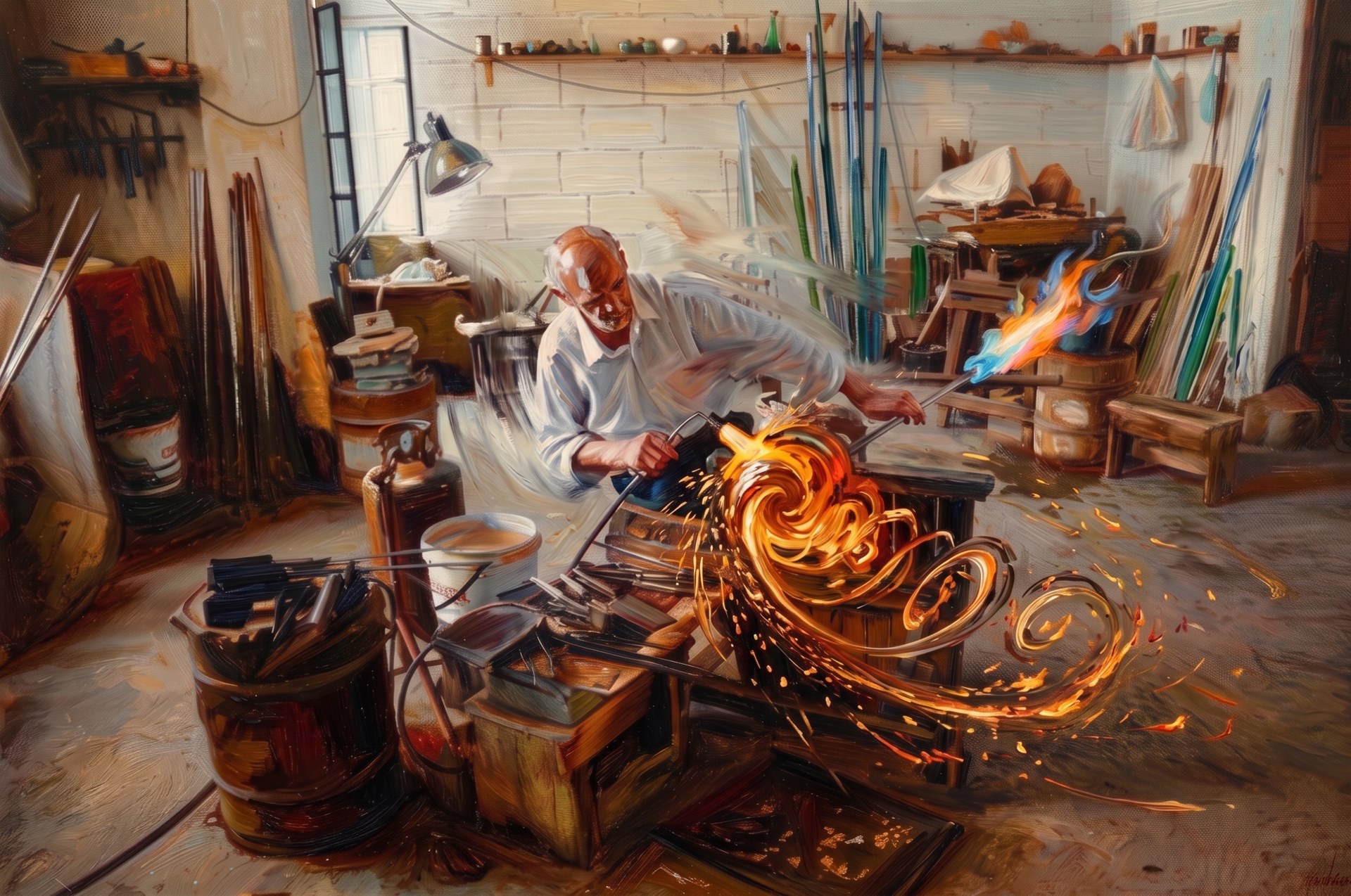
Archimede Seguso — The Virtuoso of Featherweight Lace
The Maestri (The Hands)
Archimede Seguso — The Sovereign of Thread
Maestro Key: Archimede Seguso
- Role: Maestro-Designer / Sculptor (The Virtuoso of Lace)
- Life/Dates: December 17, 1909 – 1999
- Primary Furnaces: Soffieria Barovier Seguso & Ferro (later Seguso Vetri d’Arte, 1933–1942) | Vetreria Archimede Seguso (1947–1999)
- Signature Techniques: Merletto (Lace Glass) | Bullicante / A Bolle Metalliche (Trapped bubbles with metallic deposits) | Piume (Vertically sliced feather canes) | Piton d'Oro (Golden Python) | Grigio Oro Pulegoso Induto (Layered smoke-gold pulegoso) | Filigrana Stellata (Starred filigree) | Spinati and Filigrana a Petali (Spined and petaled filigrees)
- Market Price Tier: High-End Investment Grade (specifically 1952 Merletto vases in deep amethyst or ruby, 1930s gold-powdered massiccio solid animals, and 1957 Piume obelisks) to Mid-Range (Filigrana Stellata vessels, Intarsi Oro bowls, and post-1982 Elsa Peretti collaborations)
- Key Collaborators: Flavio Poli | Vittorio Zecchin | Bruno Saetti | Riccardo Licata | Giuseppe Santomaso | Elsa Peretti | Matteo Thun | Ernesto Seguso | Angelo Seguso | Giampaolo Seguso
Summary:
Discover the secrets to identifying and collecting the magnificent mid-century modern glassware of Archimede Seguso, Murano's premier virtuoso of fire and lace. This collector's guide covers his transition from heavy interwar bullicante cased glass to his paper-thin, weightless post-war masterpieces, including the legendary merletto (lace) and piume (feather) series. Learn how to analyze vibro-engraved base signatures, ground-polished flat bases, and diagnostic thread alignments to confidently spot authentic Seguso treasures and avoid cheap, plagiarized imitations on the secondary market.
Visual Career Timeline
              ┌──────────────────────────────────────────────────────────┐
              │                    ARCHIMEDE SEGUSO                      │
              │                - THE VIRTUOSO OF LACE -                  │
              └──────────────────────────┬───────────────────────────────┘
                                         │
     ┌───────┐                           ▼
     │ 1909  │ ──► Born December 17 into a celebrated 14th-century Muranese lineage.
     └───────┘                           │
     ┌───────┐                           ▼
     │ 1920  │ ──► Apprenticed at Vetreria Artistica Barovier at age eleven as a child prodigy.
     └───────┘                           │
     ┌───────┐                           ▼
     │1931-33│ ──► Establishes Barovier Seguso & Ferro (becomes Seguso Vetri d'Arte in 1937).
     └───────┘                           │
     │                                   ├─► Serves as chief master blower of the furnace floor.
     │                                   └─► Pioneers massive bullicante and gold-powdered solid animals.
     │                                   │
     ┌───────┐                           ▼
     │ 1945  │ ──► Brief post-war independent partnership with master Alfredo Barbini.
     └───────┘                           │
     ┌───────┐                           ▼
     │ 1947  │ ──► Establishes independent furnace, Vetreria Archimede Seguso, at No. 18 Serenella.
     └───────┘                           │
     ┌───────┐                           ▼
     │ 1952  │ ──► Debuts paper-thin merletto (lace glass) at the XXVI Venice Biennale.
     └───────┘                           │
     ┌───────┐                           ▼
     │ 1954  │ ──► Exhibits acclaimed Merletto and Festoni designs at the XXVII Venice Biennale.
     └───────┘                           │
     ┌───────┐                           ▼
     │ 1956  │ ──► Develops piume (feather glass) and blows 10m partition for Cortina Olympics.
     └───────┘                           │
     ┌───────┐                           ▼
     │ 1982  │ ──► Initiates continuous partnership with Tiffany and Company designer Elsa Peretti.
     └───────┘                           │
     ┌───────┐                           ▼
     │ 1990  │ ──► Collaborates with Matteo Thun on limited-edition Foscarina perfume bottles.
     └───────┘                           │
     ┌───────┐                           ▼
     │ 1996  │ ──► Creates La Fenice collection to honor the rebuilt Venice Opera House.
     └───────┘                           │
     ┌───────┐                           ▼
     │ 1999  │ ──► Passes away, having worked before his furnace almost every day of his life.
     └───────┘
1. The Legend & Legacy: The Virtuoso of Fire and Lace
Archimede Seguso was born on December 17, 1909, at No. 108 Fondamenta Vetrai on the historic glassmaking island of Murano. As the second of eight children born to master Antonio Seguso and Maddalena Cattelan, Archimede was heir to a glassmaking pedigree stretching back to the 14th century. His grandfather was the celebrated Giovanni Seguso, nicknamed "Nane Patare," who had served as a primary technician at the legendary Cappellin Venini furnace.
At the exceptionally young age of eleven, Archimede entered the furnace floor of Vetreria Artistica Barovier, where his father was a partner. Under the joint guidance of his father and master glassblower Napoleone Barovier, the young prodigy developed an uncanny, natural command over hot glass. He first distinguished himself by shaping miniature colts and fish entirely freehand, showcasing a refined eye and incredible manual dexterity.
When the Great Depression forced mass layoffs in 1931, Archimede, his father, and his brother Ernesto left Barovier to establish a modest family workshop on the Campo del Cimitero. Within two years, this venture grew into the monumental furnace Artistica Vetreria e Soffieria Barovier Seguso & Ferro (which became Seguso Vetri d'Arte in 1937). Here, Archimede served as the undisputed first master glassblower, collaborating with legendary design director Vittorio Zecchin and subsequently with Flavio Poli. For a decade, Archimede’s hands translated Poli’s massive, sculptural designs into world-renowned showcases at the Venice Biennale and Milan Triennale.
Following the interruption of World War II, Archimede sought complete creative and administrative independence. He briefly partnered with Alfredo Barbini in October 1945, but quickly transitioned back to his family's workshop. Finally, in 1947, he established his own independent enterprise, Vetreria Archimede Seguso, at No. 18 Fondamenta Serenella. For the next fifty years, operating as designer, craftsman, and administrator, Archimede became the most celebrated living glassmaker of Murano. He worked tirelessly at his furnace every single day until his passing in 1999, famously reacting to the tragic burning of the Venice Opera House in 1996 by designing his expressive "La Fenice" (The Phoenix) vase series.
2. Advanced Merletto and Piume Geometries
Archimede Seguso completely re-engineered the post-war aesthetic of Murano by shifting from the heavy, massive forms of the interwar era to the weightless, floating patterns of ancient filigree and latticinio lace-working. Instead of traditional, symmetrical alignments, Seguso designed complex, organic, and mathematically intricate networks of glass threads that floated inside thin clear crystal walls:
- The Geometry of Vetro a Merletto (1951–1952): Developed for the XXVI Venice Biennale, the Merletto (lace) series represents one of the absolute zeniths of 20th-century glassblowing. Rather than using standard linear filigree, merletto features a delicate, regular, but apparently chaotic network of threads suspended in transparent glass. At the Archimede Seguso workshop, this technique is executed using fine lattimo filigree canes known by the private designation garza (gauze). To execute this technique, Seguso prepared two or three separate, pre-blown mezza-filigrana glass cylinders. In a high-temperature tour de force, the master nested these cylinders one inside the other at the furnace mouth, fusing the layers together. He then twisted, expanded, and optically distorted the nested mass, forcing the overlapping parallel threads to shift and shear into complex, lace-like cellular grids. The entire shaping and expansion process was executed entirely by hand, with absolute absence of molds, relying solely on the master's breath, hand tools, and physical manipulation of the hot gather at the blowpipe. The resulting vessel was blown into paper-thin, bubble-like forms where the delicate violet, amethyst, or white garza threads floated as organic webs frozen inside clear glass.
- The Segmented Construction of Vetro a Piume (1956): In his celebrated Piume (feather) series, Seguso created three-dimensional, lifelike feathers that appeared to drift weightlessly inside solid clear glass obelisks and vases. This was achieved through a multi-stage, segmented cane construction. Seguso first blew a multiple-thread zanfirico (retortoli) cane featuring intricate, spiraling white, green, pink, or blue threads. Once cold, this cane was meticulously sliced vertically down the center into two halves, exposing the inner structural core. These split, half-moon cane segments were then laid out in a precise, chevron-like pattern on a flat refractory plate (marmore). The master blower rolled a hot, transparent crystal parison over the plate, picking up the split canes, and subsequently cased the entire parison multiple times in thick, clear crystal. When blown, the sliced canes expanded and splayed, perfectly mimicking the delicate, organic texture of realistic bird feathers suspended within a transparent lens.
- The Structural Spines of Spinati and Filigrana a Petali (1972): Continuing his lifelong exploration of line division, Seguso introduced the Spinati (spined) and Filigrana a Petali (petaled filigree) collections. In these designs, the master blower nested highly complex, multi-colored filigree cylinders and used specialized iron tools to selectively draw and pull the outer glass skin at right angles. This forced the glass threads to deform into sharp, ribbed "spines" or soft, rounded "petals," showcasing a flawless alignment of glass threads across undulating surfaces.
3. The Chemistry of Surface Weathering and Metallurgical Effects
Archimede Seguso was a master colorist and chemist who treated the surface of glass as a reactive canvas, formulating unique mineral batches and exposing hot glass to specialized reduction fumes to achieve rich metallic or weathered textures:
- The Chemistry of Vetro Bullicante (A Bolle Metalliche): Invented by Archimede in the early 1930s, this technique became a signature of Seguso Vetri d'Arte's heavy-walled interwar production. To achieve these perfectly ordered grids of trapped air bubbles, the master blower used a two-part mechanical and chemical process. He first blew a parison of hot, colored glass into a metallic pocket mold lined with rows of small, sharp metal spikes. This left a grid of deep, regular indentations across the glass surface. He then sprinkled the indented parison with a specialized, proprietary mineral oxide powder. When covered with a final, thick outer layer of colorless glass, the trapped air inside each indentation formed a tiny bubble, while the mineral oxides underwent a chemical reaction, depositing a shimmering, metallic sediment on the inner walls of each pocket. This produced a brilliant, golden-flecked, and highly structured grid of bubbles suspended inside the heavy crystal walls.
- The Formulas of Vetro Corroso / Corroso Bugnato: Developed in 1938 with Flavio Poli, this chemical weathering treatment transformed high-gloss hot glass into frosted, tactile skins resembling natural sea-worn stone or ancient glacial ice.
- The Chemical Process: Once the solid-sculpted animal or thick-walled vessel was annealed and cold, its surface was irregularly treated with a protective resist of wax or lacquer applied using a porous sea sponge. The piece was then plunged into lead tubs filled with sawdust or rough wood shavings soaked in hydrofluoric acid. The acid selectively corroded the unprotected silica in varying depths. For Corroso Bugnato, acid was sprinkled directly over wood shavings surrounding the object, causing the wood to absorb the acid and etch the glass in a deeply textured, low-relief pattern. The piece was subsequently reheated in an oxidizing fire to fuse and stabilize the satin-matte, heavily frosted finish.
- The Metallurgy of Vetro Iridato (Iridescent Glass): To give his animal sculptures and post-war vessels a shimmering, mother-of-pearl sheen, Seguso exposed hot glass to metallic vapor reductions. While the completed piece remained at a working temperature on the pontil rod, it was placed in a specialized reducing chamber where tin chloride, arsenic, or bismuth nitrate salts were evaporated under an oxygen-deprived (reducing) atmosphere. This deposited a microscopically thin, tarnish-resistant film of metal oxides on the hot glass. This iridescent layer had a different refractive index than the underlying glass, scattering ambient light waves to create a beautiful, rainbow-colored pearl sheen across the surface.
- The Spontaneity of Grigio Oro Pulegoso Induto: A highly specific technique used for heavy, sculptural pieces. This method utilized successive, contrasting layers: a thin, inner layer of black oxide glass was cased in a thick layer of colorless, highly bubbled pulegoso glass. As the gaffer blew and hand-manipulated the gather, the bubbled pulegoso layer dispersed and separated, creating beautiful, smoky-gold gradations as the dark inner core showed through the fractured outer skin. The vessel was finished with a final outer coating of clear crystal (the induto technique).
4. Famous Collaborations: The Virtuoso and the Designers
Archimede Seguso’s unmatched technical command of hot glass made him the preferred collaborator for some of the 20th century's most demanding designers:
- Flavio Poli and Seguso Vetri d'Arte: As chief master blower until 1942, Archimede physically executed Poli's heavy-walled interwar masterpieces, developing the bullicante animal series and hand-molding the massive opalescent tiles for the historic 1936 Zodiaco mural. (Note: While Seguso Vetri d'Arte won the prestigious Compasso d’oro in 1954 for Poli's sommerso models, those post-war award-winning pieces were physically executed by Archimede's younger brother, Angelo Seguso, as Archimede had already established his own independent furnace in 1947).
- Bruno Saetti: For the historic post-war modern collaborations under the Fucina degli Angeli, Archimede executed Saetti's abstract Scotch Cock II (Gallo scozzese II), fusing heavy blocks of colored glass with gold leaf.
- Riccardo Licata: During the mid-1950s, Archimede collaborated closely with the painter, executing a series of small, transparent crystal vases decorated with highly graphic, intense abstract circles and line clusters.
- Elsa Peretti and Tiffany & Company: From 1982 onward, Archimede collaborated with the legendary jewelry designer to blow highly functional, organic glass forms like cake-stands, decanters, and fishbowls.
- Matteo Thun: In 1990, Archimede executed the limited-edition, circular Foscarina perfume bottles, combining ancient craftsmanship with a modern aesthetic.
- Giuseppe Santomaso: In 1956, Archimede translated Santomaso's abstract concepts into a monumental, ten-meter glass partition panel supported by brass tubes for the Winter Olympic Games in Cortina d’Ampezzo.
5. The Forensic Chronology of Archimede Seguso Markings (1930s–1999)
To confidently identify, date, and authenticate a vessel hand-blown by Archimede Seguso, collectors must understand the precise evolution of base signatures, paper labels, and stamps used by his furnaces across different eras:
I. The Interwar Seguso Vetri d'Arte Years (1933–1942)
- The Unsigned Rule: Wares blown by Archimede during his tenure as chief master of Barovier Seguso & Ferro and Seguso Vetri d'Arte were completely unsigned by Archimede Seguso.
- Diagnostic Labels: Verify these early masterpieces by looking for rectangular paper factory labels reading
A.S.V. BAROVIER SEGUSO & FERRO MURANO(pre-1937) orSEGUSO VETRI D'ARTE / Murano(divided horizontally, under which model numbers were written in blue/black ink). - Early Factory Stamps: Look for a small, two-lined base acid stamp reading
Made in / Italy(introduced in 1936) or the rare script acid stamp of co-founderAntonio Segusoon base rings. All pre-war factory labels and Antonio Seguso acid stamps were permanently discontinued in 1945.
II. The Founding & Early Independent Era (1947–1950)
- The Early Hand-Written Signatures: Upon establishing Vetreria Archimede Seguso in 1947, premium and exhibition pieces were hand-signed on the bottom of the base with a delicate, cursive script reading:
Archimede Seguso / MuranoorArchimede Segusoetched with a fine diamond-point pen. Standard production-line tablewares remained unsigned, carrying only paper tags.
III. The Golden Merletto & Filigree Era (1950–1975)
- The Diamond-Point Cursive Signatures: Premium art glass creations from this golden era are hand-signed with diamond-point cursive signatures reading:
Seguso ArchimedeorArchimede Seguso(frequently carrying a distinctive hand-guided line scored directly underneath). - Special Exhibition Engravings: High-art and exhibition pieces carry unique event engravings, such as
Seguso Archimede / Biennale 1954orSeguso Archimede / Milan 1951written in elegant cursive script. - The Scalloped-Edge Foil Labels: Wares carry a distinctive gold or silver foil label with a highly recognizable scalloped/serrated edge reading:
ARCHIMEDE SEGUSO / MURANO / MADE IN ITALYsurrounding the circular furnace logo in the center. Clerks often wrote chronological model numbers (such as model 7613 or 10025) directly onto these circular tags in cursive black ink. - The Elsa Peretti & Tiffany Marks (Post-1982): Hand-blown organic objects designed by Peretti and executed by Archimede carry a diamond-point engraved dual signature reading:
Elsa Peretti / Archimede Seguso(frequently accompanied byArchimede Seguso for Tiffany & Co.).
IV. The Late-Century & Retrospective Vibro-Engravings (Post-1975)
- The Coarse Vibro-Engraving: In the late 1970s, the workshop began utilizing a mechanical, vibrating engraving pen to mark standard production runs. These signatures are coarser, more blockish, and less fluid than early diamond-point scripts, reading:
Archimede Seguso MuranoorSeguso Archimede - The Retroactive Signature Warning: Since many early post-war masterpieces (such as his 1952 Merletto series) were sold unsigned or carried only fragile paper labels, collectors frequently requested Archimede to sign their pieces retroactively at private gallery retrospectives in the 1980s and 1990s. Thus, an authentic 1952 Merletto vase carrying a coarser, vibro-engraved base signature indicates a retroactive signing, whereas a diamond-point cursive script matching Heiremans' 1952 records represents a period-correct signing.
- Spotting the Forgeries: Modern counterfeits attempting to duplicate his merletto lines often feature clumsy, acid-etched, or modern laser-engraved signatures of
Archimede Seguso. Genuine period signatures are always hand-guided, crisp, and exhibit appropriate micro-wear under magnification.
6. The Collector's Diagnostic Checklist & Market Realities
- Evaluating Thread Alignment and Weight: Authentic Archimede Seguso lace glass stands out by its weightless, paper-thin, bubble-like core and the flawless, mathematical alignment of the glass threads. If the threads look thick, unevenly spaced, or heavily distorted, it is likely an imitation. On genuine Merletto wares, the lack of surface ridges and the organic, thin splayed rims are direct indicators of this unassisted, mold-free hand-blowing process using fine garza canes. The clear outer crystal layer must be completely transparent, presenting a mirror-polished finish with a perfectly flat, ground-and-polished base ring showing appropriate micro-wear.
- Analyzing Pontil Base Finish: On merletto, piume, and filigrana pieces, look for a base featuring an offset, unevenly cut hollow that is entirely ground flat and beautifully hand-polished. Early pieces often feature original rectangular paper labels with typed or handwritten model numbers.
- The No-Repeat Rule: A critical piece of advice for collectors: Archimede Seguso never repeated or re-commercialized a series once its original production run was complete. If you find a "Merletto" vase that looks brand new or is claimed to be a "modern limited-edition remake" authorized by the furnace, it was not hand-blown by Archimede Seguso himself.
- The Price Tiers:
- High-End Investment Grade: Original 1952 Merletto vases in deep violet or amethyst hues (exhibited at the XXVI Venice Biennale); solid-glass animal sculptures from the 1930s (such as his famous "maestro of animals" series featuring elephants, tigers, or bears with gold powder); and original 1957 Piume obelisks.
- Mid-Range: Composizione Lattimo, Intarsi Oro series (1951), Filigrana Stellata (1968), and A Spiraline vases.
- Accessible: Small cased bowls, late-era solid figurines, and everyday glassware produced from the late 1970s through the 1980s.
- Differentiating the Copies: Because Archimede's techniques like merletto and piume were massive critical and financial successes, they were heavily plagiarized by other Murano furnaces who produced cheaper, simplified lookalikes with minor alterations to avoid legal issues. Authentic Archimede Seguso lace glass stands out by its ethereal lightness, an incredibly pure play of light through the crystal walls, and a flawless, mirror-polished finish.
7. Attribution & Authenticity
In the Murano glassmaking tradition, the difference between a fake and a copy rests entirely on intent, origin, and transparent attribution. A fake is a deceptive counterfeit manufactured outside of Murano—often in mass production factories in Asia or Eastern Europe—that utilizes cheap materials and carries forged signatures or illicit trademark stickers to intentionally defraud collectors. Conversely, a copy is a legitimate artistic homage (omaggio) handcrafted by a skilled master using authentic Murano techniques and materials; it serves as a tribute to honor a legendary artisan's legacy and is openly signed by the modern creator, preserving the lineage of Venetian glassblowing rather than exploiting it.
Join Our Facebook Group Identify Your Murano - Murano Glass Animals