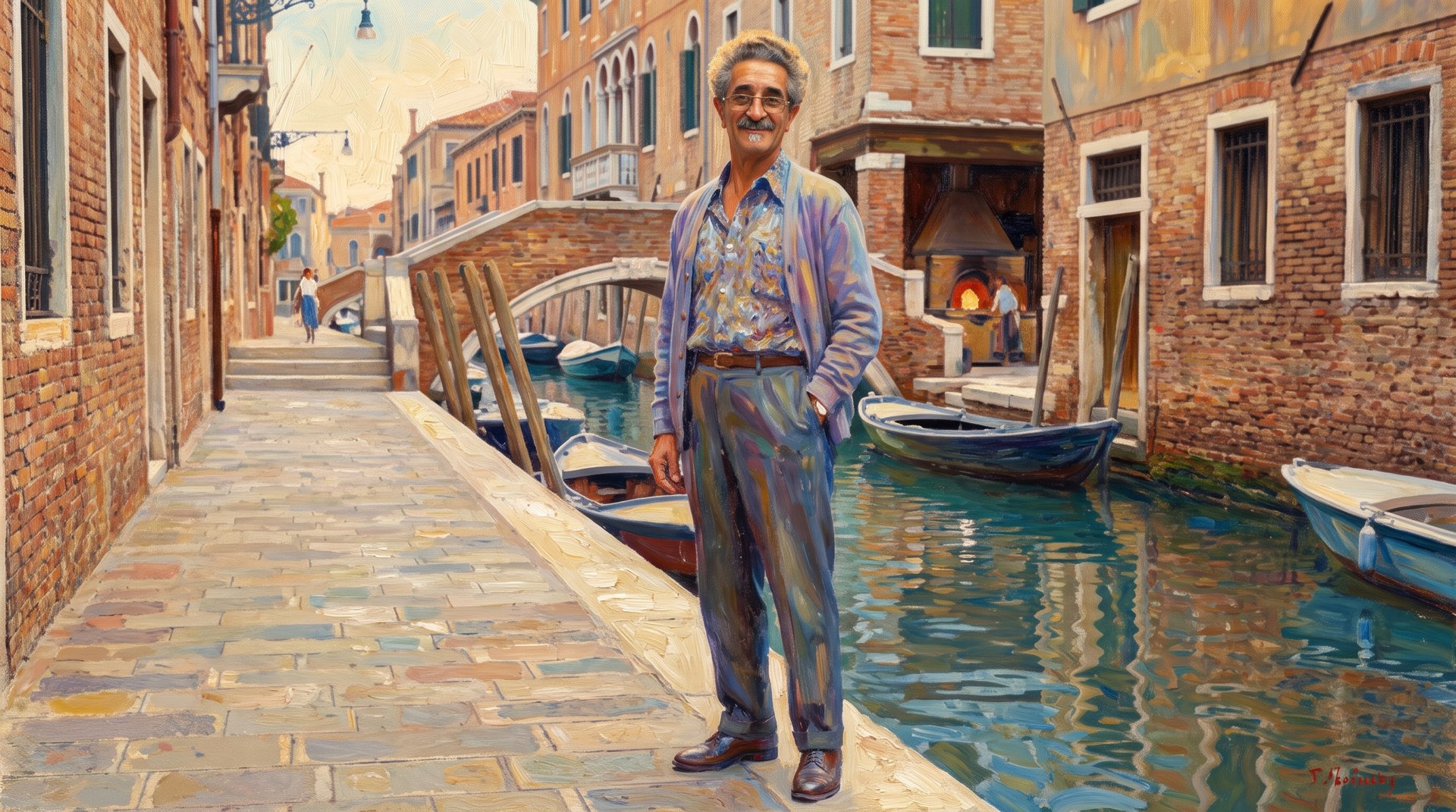
Anzolo Fuga Murano Glass: The Ultimate Masterwork Identification Guide
The Visionary Designers: A Collector's Guide
Anzolo Fuga — The Painter of AVEM’s Mosaic Windows
Artist Key: Anzolo Fuga
- Role: Painter / Stained-Glass Artist / Independent Guest Designer (The Painter of AVEM's Mosaic Windows)
- Life/Dates: Murano, Italy, August 21, 1914 – Murano, Italy, 1998
- Primary Furnaces/Associations: Cristalleria di Venezia e Murano (Designer, 1939–1948) | Anzolo Fuga & C. / Anzolo Fuga e Fratelli (Co-Founder, 1943–1955) | Scuola Serale per Vetrai Abate Zanetti (Director/Teacher, 1949–1972) | A.V.E.M. (Freelance Designer, 1955–1968) | I.V.R. di Mazzega & Domus Vetri d’Arte (Collaborator, late 1950s)
- Signature Techniques: Casting di Tessere (Polychrome cane and mosaic plaque fusions) | Dentellature (Hot-applied, splayed and crimped decorative glass teeth) | Zanfirico Retortoli (Interlocking twisted filigree chain bands) | Pulegoso a Campi (Heavy bubbles trapped in asymmetric, colored fields) | Iridazione (Lustrous, vapor-metallic iridized surfaces) | Smaltatura a Fuoco (Enamel-painted stained glass)
- Market Price Tier: Ultra-Premium Investment Grade (specifically 1955–1968 one-of-a-kind unico sample vases designed by Fuga and executed by Luciano Ferro or Orfeo Compagno, the 1956 Arcobaleno series, 1960 Astrale and Finestre series, and 1962 Transennato series) to High-End (standard production Bandiere plates, A Canne cylinders, and his late-tenure Dentellature vessels)
- Key Collaborators: Guido Balsamo Stella | Giuseppe Fuga (brother) | Giorgio Ferro | Luciano Ferro | Orfeo Compagno | Emilio Nason | Aldo Nason
Summary:
Discover the magnificent legacy and stained-glass brilliance of Anzolo Fuga, Murano’s undisputed pioneer of post-war graphic glass fusions. This expert collector's guide covers his career from his early illustration training under Guido Balsamo Stella to his historic, freelance residency at A.V.E.M. (Arte Vetraria Muranese) (1955–1968) and his legendary furnace partnership with master blowers Luciano Ferro and Orfeo Compagno. Learn how to verify authentic diagnostic markers—including fused cane panels, splayed dentellature teeth, zanfirico filigree chain alignments, and his rare, enamel-painted "F F" lightning bolt signatures—to confidently identify his creations, spot true investment-grade masterworks, and navigate the secondary market.
Visual Career Timeline
              ┌──────────────────────────────────────────────────────────┐
              │                       ANZOLO FUGA                        │
              │             - THE PAINTER OF MOSAIC WINDOWS -            │
              └──────────────────────────┬───────────────────────────────┘
                                         │
     ┌───────┐                           ▼
     │ 1914  │ ──► Born on Murano; named after ancestor Angelo Fuga, who introduced mirror engraving in 1800.
     └───────┘                           │
     ┌───────┐                           ▼
     │1934-37│ ──► Graduates from Venice's Istituto d'Arte Carmini; studies graphics under Balsamo Stella.
     └───────┘                           │
     ┌───────┐                           ▼
     │ 1938  │ ──► Assists Balsamo Stella in establishing the Carmini flat-glass and stained-glass department.
     └───────┘                           │
     │                                   ├─► Collects factory floor blown debris to assemble leaded mosaic panes.
     │                                   └─► Develops a signature style combining copper-wheel engraving and acid etching.
     │                                   │
     ┌───────┐                           ▼
     │ 1943  │ ──► Establishes "Anzolo Fuga & C." with brother Giuseppe, specializing in modern stained glass.
     └───────┘                           │
     ┌───────┐                           ▼
     │ 1949  │ ──► Appointed Director of the Scuola Serale per Vetrai Abate Zanetti, teaching until 1972.
     └───────┘                           │
     ┌───────┐                           ▼
     │ 1955  │ ──► Joins A.V.E.M. as freelance designer following the high-profile exit of Giorgio Ferro.
     └───────┘                           │
     │                                   ├─► Demands direct interaction with master blowers on the active furnace floor.
     │                                   ├─► Becomes the only A.V.E.M. designer to have his initials "A.F." stamped on invoices.
     │                                   └─► Collaborates with chief gaffers Luciano Ferro and Orfeo Compagno.
     │                                   │
     ┌───────┐                           ▼
     │ 1956  │ ──► Exquisite Debut: Presents the ultra-modern "Arcobaleno" series at the 18th Venice Biennale.
     └───────┘                           │
     ┌───────┐                           ▼
     │ 1960  │ ──► Presents the "Astrale" and "Finestre" series, fusing graphic cells with zanfirico retortoli.
     └───────┘                           │
     ┌───────┐                           ▼
     │ 1962  │ ──► Presents the "Transennato" and splayed "Dentellature" collections at the 31st Venice Biennale.
     └───────┘                           │
     ┌───────┐                           ▼
     │ 1968  │ ──► Exhibits at the Venice Biennale for the last time with A.V.E.M., retiring from hollow glass.
     └───────┘                           │
     ┌───────┐                           ▼
     │ 1998  │ ──► Passes away in Murano, leaving a monumental legacy of graphic, hot-assembled glass.
     └───────┘
1. The Legend & Legacy: The Bridge of Stained Glass
In the mid-century pantheon of Murano designers, Anzolo Fuga stands as a towering, singular force: a stained-glass maestro, graphic illustrator, and painter who treated the surface of three-dimensional blown glass as a fluid leaded window. Born on the glassmaking island of Murano on August 21, 1914, Fuga was born into an illustrious lineage; he was named after his ancestor Angelo Fuga, who had introduced the highly specialized art of engraved glass mirrors to Murano in 1800. Fuga’s formal training was not centered at the furnace, but in the rigorous graphic design studios of Venice. He studied book illustration, xylography, lithography, and watercolor at the prestigious Istituto Statale d'Arte dei Carmini under the legendary modern designer Guido Balsamo Stella, graduating with a master’s diploma in 1937. Upon his graduation, Fuga immediately partnered with Balsamo Stella to help establish the institute’s pioneering flat-glass and stained-glass department in 1938.
It was during this interwar academic period that Fuga arrived at his defining artistic breakthrough. Urged by Balsamo Stella, Fuga began visiting Murano's active furnaces to gather colorful, irregular fragments of hot-blown glass—the discarded debris and off-cuts of daily production. Bringing this rich, non-uniform debris back to the institute, Fuga began assembling modern stained-glass windows utilizing hand-leaded lines. These panels were characterized by suggestive chromatic irregularities and varying glass thicknesses that captured and refracted the light in ways industrial sheets never could. To refine his compositions, Fuga utilized acid-etching and copper-wheel engraving across dual-layered fragments, carving through the colored skins to expose the underlying tones. In 1943, he and his brother Giuseppe established the workshop Anzolo Fuga & C. (later trading as Anzolo Fuga e Fratelli) at Fondamenta Venier 47A, winning international acclaim at the Venice Biennales for their vibrant, stylized stained-glass windows.
Fuga’s deep commitment to the future of the craft was formalized in 1949 when he was appointed the Director and Chief Instructor of the Scuola Serale per Vetrai Abate Zanetti (the evening art school for Muranese glass apprentices). He directed the historic institution until 1972, molding generations of master blowers to read modern drawings without losing their ancestral connection to the material. His transition to hollow-glass design began in earnest in 1955, when he was brought into the fold of A.V.E.M. (Arte Vetraria Muranese). This appointment was a major historic moment: Giorgio Ferro—the brilliant designer who had established A.V.E.M.’s post-war identity with his Anse Volanti—had departed the firm. Seeking an elite creative force to fill this aesthetic void, A.V.E.M. turned to Fuga, launching a thirteen-year partnership that produced some of the most extraordinarily modern, graphic, and highly sought-after glass of the twentieth century.
2. The A.V.E.M. Furnace Dynamics: The Non-Glassmaker's Command
Thomas Stearns had to build a non-verbal language with Checco Ongaro, and Dino Martens had to rely on Aureliano Toso's blowers. Anzolo Fuga, by contrast, entered the furnace with a unique, authoritative presence: he was a trained educator, a native Muranese, and an expert in flat-glass chemistry who understood exactly how heat affected molecular fusions. While many designers submitted drawings from distant Milanese studios and remained anonymous, Fuga operated as an active, highly visible facilitator on the furnace floor. Fuga’s creative philosophy was defined by an unorthodox, highly hands-on approach:
- Active Furnace Floor Interaction: Unlike A.V.E.M. partner Aldo Nason—who strongly disliked the presence of non-glassmakers near the active kilns—Fuga insisted on standing directly at the master’s workbench (scagno). He actively interacted with the blowers during the execution of his prototypes, splaying the rims, adjusting the cane alignments, and altering the proportions of the pieces as they were pulled from the fire. Fuga was famously prolific; on a single day, he would experiment with three or four new models, which were often rushed to the showrooms and sold as unique artist proofs before any formal record could be made.
- The "A.A." Invoice Inscription: Fuga possessed a fierce sense of professional dignity. He flatly refused to accept the title of "Artistic Director" of A.V.E.M. or any other furnace, as he valued his absolute creative independence as a freelance artist. However, to guarantee his historical legacy, he demanded absolute public and commercial attribution. He was the only designer in the history of A.V.E.M. whose name and initials (
A.F.orA. Fuga) were explicitly stamped on the factory’s commercial invoices alongside his model numbers, ensuring his designs were never absorbed into the anonymous mass of general production. - The Execution Team: Fuga’s technical drawings—which were highly detailed, color-washed blueprints—were translated into molten glass by A.V.E.M.’s elite gaffers, Luciano Ferro and Orfeo Compagno. Together, they bypassed the factory's standard chronological model registry, executing Fuga’s designs as limited, highly experimental series or one-off samples that could be ordered in any quantity but almost always remained unique in their individual, hot-worked execution.
3. Technical Alchemy: The Fused Panels and Splayed Teeth
Anzolo Fuga's creations are defined by an extraordinary, painterly translation of stained-glass lead lines and glass fragment overlays into hot, fluid assemblies:
- The Bandiere (Flags) Cane Fusion (c. 1956): For his debut A.V.E.M. collection, Fuga designed the Bandiere (or Bandierine) series of vases and wide plates. Rather than gather a single colored mass, the master blowers arranged squared-off sections of opaque white lattimo glass rods and vibrant colored canes on a cold iron plate (marver). Once heated and fused into a single plaque, this multicolored geometric panel was gathered on a parison of clear crystal (cristallo). Reheated and splayed, the fused panel wrapped around the body of the vase, creating sharp, graphic, flag-like blocks of color that appeared to float weightlessly on a transparent water-like core.
- The Arcobaleno (Rainbow) Refraction (1956): Exhibited to massive critical acclaim at the 1956 Venice Biennale, the Arcobaleno series featured thick-walled, highly minimalist vessels blown in deep, saturated transparent tones. The defining feature of this series was a massive, heavy solid-glass conical base. Before gathering the main vessel, a large, concentric multicolored murrina was fused directly into the apex of the clear base. When viewed from above, the heavy, splayed base acted as a magnifying lens, reflecting and splaying the colorful, concentric rings of the murrina throughout the entire body of the vase.
- The Finestre (Windows) Grid (c. 1960): Fuga's masterpiece of graphic division, the Finestre series was a direct translation of leaded glass windows into three-dimensional hollowware. The vessels were composed of dense, opaque white lattimo mosaic cells splayed in a vertical grid. Crucially, these white cell-blocks were bound and connected together by splayed bands of twisted glass filigree (zanfirico retortoli or zanfirico chains) that surrounded and connected them like leaded lines. Localized squares of vibrant yellow, red, or blue transparent glass were inserted into the grid, allowing light to slice through the opaque white walls.
- The Transennato (Grated / Screened) Lattice (c. 1962): Exhibited at the 1962 Venice Biennale, the Transennato series (Model 15108, 15112, 15116) represents his most complex interlocking cane work. The vases feature an intricate, interlocking open lattice grid of colored canes that resemble a classical screen or grating. Fuga achieved this by fusing vertical and horizontal segments of twisted filigree rods into a splayed web, which was then cased and blown into heavy, organic silhouettes.
- The Dentellature crimp (c. 1962): For his Sfumato a canne series, Fuga introduced a highly tactile, aggressive surface treatment. While the white-cane vessel body was white-hot on the pipe, the gaffer applied thick, splayed ribbons of contrasting colored glass vertically along the sides. Using specialized jacks and shears, the master crimped, tooled, and splayed these hot ribbons into sharp, jagged decorative glass "teeth" (dentellature). This treatment splayed the light and gave the vessels a highly dynamic, jagged organic energy.
4. Forensic Chronology of Base Markings & Signatures
To confidently identify, date, and authenticate an original Anzolo Fuga vessel, collectors must inspect the base for his highly distinct, factory-specific and personal signature markings:
I. Standard A.V.E.M. Factory Decals & Labels
Wares executed by Fuga for general A.V.E.M. distribution typically carry the standard showroom paper labels of the period:
- The Rectangular Label: A white rectangular paper sticker with rounded corners, printed in blue ink with red typescript reading:
ARTE VETRARIA MURANESE / VETRAI 33 / MURANO - The Circular Label: A red circular paper sticker with silver lettering reading:
A.V.E.M. / MADE IN ITALY / MURANO
II. The Rare Enamel Signature & Coat-of-Arms
This represents his absolute highest-value, museum-grade exhibition period. High-art vessels designed by Fuga and exhibited at prestigious institutions (such as the Bevilacqua La Masa Foundation or the Milan Triennale) carry an enamel-painted signature on the base. This signature is a masterpiece of historical lineage:
- The Signature Layout: Authentic exhibition pieces are hand-signed on the ground base with a fine brush in black or dark brown enamel, containing:
- The initials of his workshop:
F ForF.F.(standing for Fuga Fratelli or Fuga e Fratelli). - His personal, historic coat-of-arms: a hand-painted bolt of lightning (an arrow splayed in the shape of a lightning bolt).
- The initials of his workshop:
- The Lineage of the Bolt: The Fuga family coat-of-arms (semantically linked to the Italian word fuga, meaning "escape" or "flight") was officially registered in the Golden Book of Murano and was coined on the famous local silver medallions (oselle) by the Magnifica Comunità di Murano as early as 1521, appearing again on the 1702 and 1704 issues. When found on the base of an A.V.E.M. vessel, this enamel lightning bolt and "F F" signature indicates a piece of superior, exhibition-grade standard.
5. The Collector's Diagnostic Checklist & Market Realities
- Evaluating Cane Alignment and Joining: In authentic Anzolo Fuga mosaic vessels, the junctions between the fused canes and lattimo cell-blocks must be flawlessly smooth, perfectly joined, and free of thermal stress cracks. There should be zero color bleeding or messy, jagged overlaps along the zanfirico filigree chains that separate the cells.
- Analyzing Pontil Scars and Base Finishes: Wares from Fuga’s A.V.E.M. collections are never acid-etched or signed on the base with an electric vibrating pen. The underside must show a cleanly ground, polished pontil scar or a flat, fire-polished base ring. A rough, jagged, or unpolished pontil is a clear indicator of a modern Asian or Eastern European counterfeit.
- The Weight-to-Volume Ratio: Fuga's cased vessels, particularly the Arcobaleno and Transennato series, are physically substantial and heavy-bottomed, showing a massive concentration of glass at the base designed to stabilize their off-balance, asymmetric profiles.
- The Price Tiers:
- Ultra-Premium Investment Grade: One-of-a-kind (unico) exhibition masterworks bearing the hand-painted enamel
F Fand lightning bolt signature on the base, or documented Biennale models (such as the Astrale or Transennato). These command high five-figure to six-figure sums at international design auctions. - Mid-Range: Original production versions of the Bandiere splayed plates, Finestre vases (carrying model numbers in the 14000s), and splayed Dentellature vessels.
- Accessible: Miniature A Canne cups, standard table decanters, and simple, post-1965 tableware produced by A.V.E.M. using his basic cane designs.
- Ultra-Premium Investment Grade: One-of-a-kind (unico) exhibition masterworks bearing the hand-painted enamel
6. Attribution & Authenticity
In the Murano glassmaking tradition, the difference between a fake and a copy rests entirely on intent, origin, and transparent attribution. A fake is a deceptive counterfeit manufactured outside of Murano—often in mass production factories in Asia or Eastern Europe—that utilizes cheap materials and carries forged signatures or illicit trademark stickers to intentionally defraud collectors. Conversely, a copy is a legitimate artistic homage (omaggio) handcrafted by a skilled master using authentic Murano techniques and materials; it serves as a tribute to honor a legendary artisan's legacy and is openly signed by the modern creator, preserving the lineage of Venetian glassblowing rather than exploiting it.
Join Our Facebook Group Identify Your Murano - Murano Glass Animals