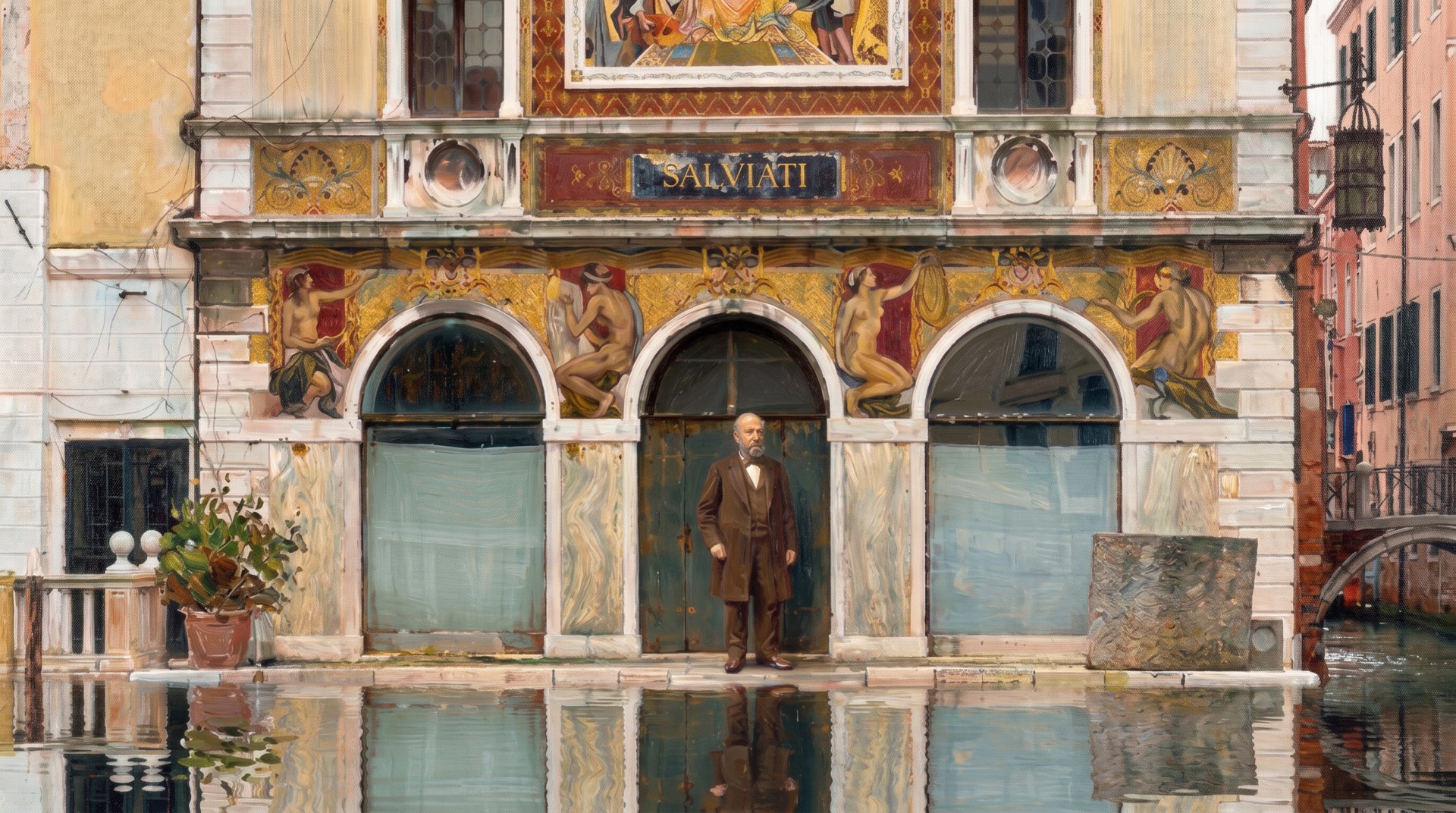
Antonio Salviati Murano Glass: The Ultimate Collector's Historical Guide
The Visionary Facilitators: A Collector's Guide
Antonio Salviati — The Commercial Dynamo of the Murano Revival
Facilitator Key: Antonio Salviati
- Role: Lawyer / Corporate Entrepreneur / Mosaic Pioneer / Marketing Mastermind (The Commercial Dynamo)
- Life/Dates: Vicenza, Italy, May 24, 1816 – Venice, Italy, January 25, 1890
- Primary Furnaces/Associations: Salviati dott. Antonio fu Bartolomeo (San Vio, Founder, 1859–1866) | Salviati & Company Limited (London/Murano, Co-Founder, 1866–1872) | The Venice and Murano Glass and Mosaic Company Limited (CVM) (Co-Founder, 1872–1877) | Vetreria Salviati / Salviati & C. (Independent Founder, 1877–1890)
- Aesthetic/Business Focus: Global brand commercialization | Patent licensing and corporate organization | Reverse-face paper-prefabricated mosaics | High-volume industrial export networks | High-end historicist and archaeological glass replication
- Key Collaborators: Lorenzo Radi | Sir Austen Henry Layard | Sir William Richard Drake | Podestà (Mayor) Antonio Colleoni | Abbot Vincenzo Zanetti | Vincenzo Moretti | Francesco Toso Borella | The Seguso Dynasty (Antonio, Luigi, Giovanni) | The Barovier Dynasty (Antonio, Giovanni, Giuseppe)
Summary:
Discover the historic legacy and technical brilliance of Antonio Salviati, Murano’s undisputed pioneer of global glass commercialization. This expert collector's guide covers his career from his early mosaic firm at San Vio (1859) to his partnership with Sir Austen Henry Layard to found Salviati & Company Limited (1866) and the subsequent Compagnia Venezia Murano (CVM). Learn how to verify authentic diagnostic markers—including organic calcedonio striations, hand-tooled seahorse stems, flawless avventurina thread fusions, and the tripartite base signatures—to confidently identify his creations, spot true investment-grade masterworks, and navigate the secondary market on Murano.
Visual Timeline of the Commercial Empire
              ┌──────────────────────────────────────────────────────────┐
              │                     ANTONIO SALVIATI                     │
              │              - THE COMMERCIAL DYNAMO -                   │
              └──────────────────────────┬───────────────────────────────┘
                                         │
     ┌───────┐                           ▼
     │ 1816  │ ──► Born in Vicenza; graduates in law, moving to Venice to establish his practice.
     └───────┘                           │
     ┌───────┐                           ▼
     │ 1859  │ ──► Abandons law; partners with master Lorenzo Radi to found his first mosaic firm at San Vio.
     └───────┘                           │
     │                                   ├─► Develops prefabricated reverse-face paper-backed mosaics.
     │                                   └─► Slashes costs, securing the restoration rights for St. Mark's Basilica.
     │                                   │
     ┌───────┐                           ▼
     │ 1862  │ ──► Achieves international triumph at the London International Exhibition.
     └───────┘                           │
     │                                   └─► Showcases Radi's revolutionary multicolored chalcedony and gold-glass vessels.
     │                                   │
     ┌───────┐                           ▼
     │ 1866  │ ──► Incorporates "Salviati & Company Limited" in London with British capital.
     └───────┘                           │
     │                                   ├─► Backed by diplomat Sir Austen Henry Layard and Sir William Richard Drake.
     │                                   ├─► Secures monumental commissions for Queen Victoria's Albert Memorial Chapel.
     │                                   └─► Establishes the first modern, large-scale table glass furnace on Murano.
     │                                   │
     ┌───────┐                           ▼
     │ 1872  │ ──► British investors squeeze Salviati out of management; company renamed CVM.
     └───────┘                           │
     │                                   └─► The Venice and Murano Glass and Mosaic Company (Compagnia Venezia Murano).
     │                                   │
     ┌───────┐                           ▼
     │ 1877  │ ──► Bitter, highly publicized corporate divorce between Salviati and CVM.
     └───────┘                           │
     ┌───────┐                           ▼
     │ 1878  │ ──► Launches a rival independent furnace ("Salviati & C."), utilizing his personal name.
     └───────┘                           │
     │                                   ├─► Fuses gold-flecked avventurina and reticello at his new workbench.
     │                                   └─► Battles CVM in a legendary technical duel at the Paris Exposition Universelle.
     │                                   │
     ┌───────┐                           ▼
     │ 1890  │ ──► Passes away in Venice, leaving an immortal dual-furnace legacy of global luxury export.
     └───────┘
1. The Vicentine Lawyer’s Epiphany: The San Vio Foundations (1859)
In the grand nineteenth-century revival of Venetian glassmaking, if Abbot Vincenzo Zanetti was the unyielding intellectual conscience of Murano, Antonio Salviati was its absolute commercial catalyst and global engine. Born in Vicenza in 1816, Salviati did not possess the ancestral lineage of the island’s glassmasters; he was a highly educated lawyer who graduated with a doctoral degree in law and moved to Venice to establish a successful legal practice. However, as he walked the lagoon, Salviati became deeply seduced by the decorative arts and was struck by a profound business realization. He observed that the ongoing public restoration campaigns for the deteriorating medieval mosaics of St. Mark’s Basilica were facing a severe technical bottleneck: Venice lacked the capability to manufacture high-quality, weather-resistant glass enamel tesserae, forcing local restorers to buy inferior, expensive materials from Rome and France.
Salviati recognized that a massive, highly lucrative commercial opportunity was waiting to be unlocked. In 1859, he formally abandoned his legal career and partnered with the legendary, highly secretive Muranese artisan and self-taught chemist Lorenzo Radi. Radi had spent decades working independently to recover the lost Renaissance alchemical formulas for dense, multicolored calcedonio (chalcedony glass) and highly reflective, gold-leaf glass enamels. Together, they established the firm Salviati dott. Antonio fu Bartolomeo, headquartered at the majestic Palazzo Barbarigo at San Vio.
Salviati’s true genius lay in his ability to industrialize Radi's artistic discoveries. Rather than forcing mosaic artists to assemble their works on-site, piece by piece, high up on cold scaffolding, Salviati patented the revolutionary reverse-face paper prefabrication technique. Under this method, the mosaic design was drawn on paper sheets in his Venice workshops, and the glass tesserae were glued face-down onto the paper with water-soluble starch. These pre-assembled paper sheets were then packed into crates and shipped anywhere in the world. On-site, local laborers simply pressed the sheets face-first into wet mortar, washed away the paper and starch with warm water once cured, and exposed the perfectly flat, shimmering glass mosaic beneath. This breakthrough slashed labor costs, eliminated the need for specialized on-site artisans, and allowed Salviati to build a global architectural empire.
2. The London Triumph & The Anglo-Italian Joint-Stock Venture (1866)
The global launching pad for Salviati’s brand arrived in 1862 at the landmark London International Exhibition. There, Salviati’s showcase of Radi’s multicolored chalcedony vases, shimmering gold-leaf mosaics, and historicist tableware stunned British collectors, designers, and critics. The exhibition established Salviati as a premier brand of Victorian luxury, catching the eye of the British cultural and diplomatic elite who resided in Venice.
Despite his massive international success, Salviati was a classic entrepreneur who operated on thin margins, and his rapid expansion soon triggered a severe financial crisis. He had secured monumental commissions to execute the architectural mosaics for the Albert Memorial Chapel in Windsor Castle and the Albert Memorial in Kensington Gardens to honor Queen Victoria's late husband, Prince Albert. However, the immense operating costs required to purchase raw materials, pay daily wages, and maintain workshops in both Venice and Murano exhausted his capital, leaving him unable to execute these prestigious contracts.
Recognizing the need for institutional financing, Salviati partnered with a highly influential consortium of British patrons, art connoisseurs, and politicians. Led by the diplomat and archaeologist Sir Austen Henry Layard and the prominent lawyer Sir William Richard Drake, the group incorporated Salviati & Company Limited in London on December 21, 1866, with a massive injection of British investment capital. This joint-stock company acquired the entire assets, patents, and ongoing contracts of Salviati’s San Vio firm.
The creation of this Anglo-Italian alliance was highly historic: it represented the first time in Muranese history that foreign capital was systematically used to factory-scale a traditional, decentralized craft. Armed with British sterling, the new company established the first modern, large-scale table glass furnace on Murano, systematically recruiting the island's finest glassmasters and chemical technicians to meet the global demand for luxury glass.
3. The Compagnia Venezia Murano (CVM): Technical & Aesthetic Masterpieces
Under the administrative control of the British board, the company entered its most technically brilliant, innovative, and commercially dominant era. However, the relationship between the proud, highly expansionist Italian founder and his conservative British investors was marked by deep, irreconcilable tensions. By 1872, Layard and Drake, seeking to distance the corporate brand from Salviati’s independent, unauthorized solo business ventures, removed Salviati's personal name from the company, officially renaming the firm The Venice and Murano Glass and Mosaic Company Limited—popularly known as the Compagnia Venezia Murano, or CVM.
Despite this corporate friction, the CVM became a global powerhouse of design, successfully blending historical Venetian techniques with bold, avant-garde aesthetic directions:
- The Re-Establishment of Blown Aventurine (Avventurina): One of CVM's most difficult technical achievements was the successful mouth-blowing of avventurina (aventurine glass). Invented in Murano in the seventeenth century, avventurina was a highly unstable, copper-saturated glass that required precise cooling cycles to allow microscopic, metallic copper crystals to precipitate throughout the glass mass. While historically utilized only in cold-carved plaques or beadmaking, CVM's elite masters—led by the chemist and technician Vincenzo Moretti—perfected the art of blowing thin-walled vessel bodies wrapped in shimmering, gold-flecked aventurine threads (fili di avventurina).
- The Archaeological Glass Revolution: Under Layard’s direct archaeological influence, CVM bypassed typical Renaissance historicism to pioneer the revival of ancient Roman, pre-Roman, and Phoenician glass forms. Moretti conducted deep-dive chemical and physical evaluations of Roman archaeological glass fragments excavated at Pompeii and Aquileia. At the 1878 Paris Exposition Universelle, CVM stunned the international design community by exhibiting their newly recovered vetro murrino (murrine glass) and millefiori (thousand-flowers glass) vessels. These pieces faithfully replicated the complex, fused-mosaic patterns of classical antiquity, establishing CVM as the premier research and development furnace in the world.
- The Phoenician-Style (Vetri Fenici) Vessels: In the final quarter of the nineteenth century, CVM introduced the highly original vetri fenici style to the market. Blown using cased, opaque glass bodies, the outer walls were decorated with hot-applied, contrasting colored glass threads that were combed into wave-like, feathered patterns utilizing specialized tools (pettini) before being marvered flat, simulating the rare archaeological perfume bottles of ancient Mediterranean civilizations.
4. The Great Corporate Divorce of 1877 & The Competitive Duels
By the mid-1870s, the administrative and artistic rift between Antonio Salviati and the British board reached a point of absolute, irreversible rupture. Salviati, who valued his status as a heroic savior of the Muranese craft and wanted to maintain complete personal control over his namesake brand, was furious at his marginalization by the English directors. In 1877, after years of intense legal battles, Salviati officially executed a bitter, highly publicized corporate divorce from the company he had helped found.
Under the terms of the legal settlement, Salviati forfeited his shares in the Venice and Murano Glass and Mosaic Company, but successfully secured the rights to use his own name for new corporate ventures. He immediately established a brand-new, fiercely competitive independent furnace, trading as Salviati & C. (later known as Vetreria Salviati). To staff his new hot-workshops, Salviati used his charismatic local standing to recruit several of CVM’s most talented glassmasters, sparking an intense, decade-long industrial rivalry that pushed Murano's technical virtuosity to its absolute historical peak.
This epic rivalry culminated at the landmark 1878 Paris Exposition Universelle, where the two firms competed directly on the global stage.
- The CVM Showcase: The British-led Venice and Murano Glass and Mosaic Company displayed their mathematically perfect, academically researched Roman murrino vessels and classical historicist reproductions.
- The Salviati & C. Showcase: Antonio Salviati's new firm countered with an explosive, highly theatrical exhibition of whimsical, feather-light blown glass. The showcase featured delicate, clear crystal goblets with stems decorated with complex, hot-worked seahorses, dragons, and flower blossoms, alongside heavy calcedonio vases and shimmering filigree wares.
The international jury, unable to declare a single victor, awarded high honors to both establishments, confirming that the rivalry had elevated the entire Muranese craft to a level of global supremacy that completely defeated Bohemian and French industrial glass.
5. The Elite Circle of Craftsmen: The Roster of Geniuses
Antonio Salviati’s phenomenal commercial success was built entirely on his strategic, highly respectful relationship with his glassmasters. He recognized that while his lawyer's mind could secure global capital and contracts, only the master's hand could shape the material. He built an elite circle of geniuses:
- Vincenzo Moretti: The undisputed alchemical genius of the nineteenth-century revival. Serving as CVM’s chief chemist, technician, and glassmaster, Moretti formulated the exact soda-lime chemical compositions needed to reproduce historic colors, single-handedly recovering the secrets of Roman murrine fusions.
- Francesco Toso Borella: The master glass-painter and decorator who specialized in cold-enameling and gilding. Borella hand-painted intricate, historical scenes, portraits of Venetian Doges, and classical motifs on CVM’s historicist beakers and chargers, executing the complex smalto decorations that defined Victorian luxury.
- The Seguso and Barovier Dynasties: Salviati contracted the island's most legendary dynasties to staff his hot benches. Masters like Antonio Seguso, Luigi Seguso, and Giovanni Seguso worked alongside Antonio Barovier, Giovanni Barovier, and Giuseppe Barovier, providing the flawless physical execution, speed, and breath required to pull paper-thin, delicate historicist vessels from the fire.
6. The Collector's Diagnostic Checklist: Salviati vs. CVM Wares
To confidently identify, date, and value original nineteenth-century glassware produced during the Salviati and CVM eras (c. 1860–1900), collectors must utilize the following curatorial criteria:
- Verifying Authentic Chalcedony (Calcedonio) Striations: Authentic chalcedony glass produced by Lorenzo Radi for Salviati or CVM must exhibit deep, highly organic, and non-repetitive multicolored striations that run through the entire thickness of the glass wall, simulating natural hard-stones like agate or jasper. Beware of modern counterfeits where these colorful veins are merely painted on the surface or simulated using cheap, dual-layered enamel transfers.
- Analyzing Seahorse and Dragon Stem Applications: On his iconic historicist goblets, the splayed, hot-worked seahorse and dragon stem decorations must show razor-sharp, hand-tooled execution. The fins, eyes, and spiked scales must be pulled and crimped using traditional hand-jacks (borcelle) while hot on the pipe, resulting in microscopic manual variations. Symmetrical, uniform, or thick-walled molded stems are an immediate indicator of cheap, modern tourist-factory reproductions.
- Inspecting Aventurine (Avventurina) Thread Fusions: Wares decorated with aventurine threads must show a smooth, flawless integration into the main vessel body. Under a magnifying glass, the tiny metallic copper crystals suspended within the amber thread must be uniform in density and brilliant in their refraction, showing no dark, blackened oxidation or thermal stress fractures along the fusion seams.
- The Price Tiers:
- Ultra-Premium Investment Grade: Documented 1878 Paris Exposition pieces, original Lorenzo Radi chalcedony vessels mounted on copper-plated metal frames, and historicist beakers carrying custom enameling signed by Francesco Toso Borella. These represent high-end museum-grade investments, commanding mid-to-high five-figure sums at specialized design auctions.
- Mid-Range: Early production Cappello del Doge historicist goblets, Fenicio perfume bottles, and Spirali bowls carrying early paper labels.
- Accessible: Standard, thin-walled clear crystal table sets, miniature glasses, and later, posthumous wares produced by the CVM retail showroom in the early twentieth century.
7. Forensic Chronology of Base Markings & Showroom Labels
Because Salviati and CVM operated as two highly distinct, rival commercial empires after the 1877 split, collectors must carefully inspect the bases of their wares for the following diagnostic markings:
I. The Early Salviati-CVM Co-Branded Era (1866–1872)
Pieces executed during the brief period when Salviati was backed by British capital but before his name was removed from the firm typically carry a simple, hand-guided cursive engraving reading:
- The Engraving:
Salviati & Co.orSalviati & C. - Veneziaetched into the ground base ring using a diamond-point drill.
II. The Independent Vetreria Salviati Era (1877–1890)
Wares produced by Antonio Salviati's independent, rival furnace carry distinct personal signatures designed to reinforce his brand name against the English-led CVM:
- The Base Engraving: Hand-signed on the ground pontil with a diamond-point drill reading:
Salviati Dr. AntonioorSalviati Dr. A. - The Paper Showroom Labels: Wares originally carried a rectangular paper label printed in red or black ink reading:
SALVIATI Dr. ANTONIO / VENEZIA - SAN VIO
III. The Independent Compagnia Venezia Murano Era (1872–1900)
Wares produced by the English-led Venice and Murano Glass and Mosaic Company carry no personal designer name. Instead, they are authenticated by the standard, corporate marks of the firm:
- The Acid Stamp: A micro-etched, circular mark on the underside of the base ring reading:
COMPAGNIA VENEZIA MURANOorC.V.M. - The Paper Showroom Labels: Wares carried a distinctive, circular paper showroom label printed in blue ink reading:
THE VENICE & MURANO GLASS & MOSAIC CO. / LONDON & VENICEorC.V.M. / VENEZIA
Join Our Facebook Group Identify Your Murano - Murano Glass Animals