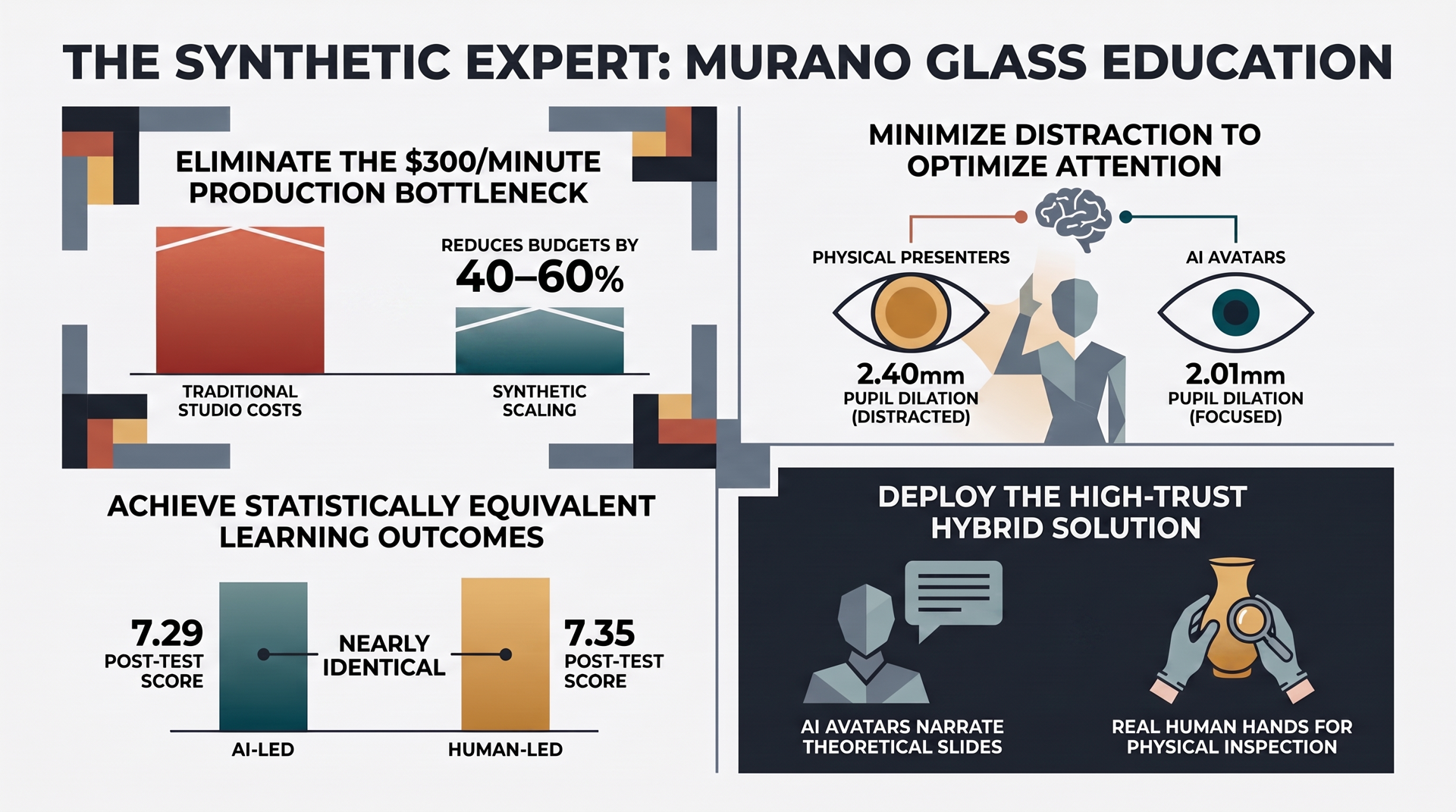
The Synthetic Expert: Why AI-Generated Video Presenters are the Future of Collector Education
Part 1: The Human Bottleneck — Why Traditional Video Fails the Modern Collector and L&D Workflows
For centuries, the world of art glass and antique collecting has relied on exclusive, high-barrier pipelines of knowledge. Becoming a competent collector of Murano glass requires mastering a vast lexicon of historical periods, artisanal lineages, and complex materials science. Historically, this education was delivered through physical lectures, manual catalog reviews, or—more recently—digital video uploads on platforms like YouTube.
However, traditional, human-led video production faces a severe operational bottleneck. Preparing high-quality educational video content is a massive drain on organizational resources: 47% of content presenters spend more than eight hours preparing a single, standard slide presentation. When moving to professional video production, the logistics multiply exponentially, requiring coordinate planning for presenters, booking studio spaces, coordinating filming crews, managing lighting setups, and executing time-consuming post-production editing.
The physical cost of producing a single finished minute of traditional, human-led instructor video can reach approximately $300. This means a standard 40-module educational course on glass connoisseurship easily translates into 40 distinct studio days of filming when accounting for re-shoots, script updates, and wardrobe consistency. For regional museums, small-scale galleries, and independent educational platforms, this high "re-shoot tax" makes the creation and maintenance of a comprehensive video library financially unsustainable.
Furthermore, traditional video suffers from a fatal flaw: inflexibility. In fast-moving or highly specialized fields, a single factual error or a newly discovered archival detail requires a complete re-shoot to maintain credibility. If a lecturer stutters, mispronounces a technical Italian term like canna da soffio or borselle, or presents an outdated valuation metric, correcting that single sentence requires bringing the human presenter back into the studio, resetting the lighting, and re-filming the scene.
For organizations trying to preserve and share the heritage of Murano glass, this operational bottleneck is an existential barrier. It determines which collectors get access to high-quality instruction and which do not. To scale educational outreach and protect the marketplace from sophisticated counterfeits, we must bypass the physical constraints of human-led video and embrace the operational efficiency of AI-generated video presenters.
                     TRADITIONAL FILMED PRODUCTION
           • Cost: ~$300 per finished minute of video
           • Logistics: Studio booking, lighting, crews, re-shoots
           • Turnaround: Days to weeks for minor revisions
                                   │
                                   ▼
                         THE HUMAN BOTTLENECK
              Spreads content gaps and limits scaling
                                   │
                                   ▼
                       AI-GENERATED PRESENTERS
           • Cost: Reduced by roughly 40% to 60%
           • Turnaround: High-fidelity generation in hours
           • Flexibility: Script-to-video edits in minutes
Part 2: The Cognitive Advantage — Why AI Avatars Outperform Human Presenters in Learning Mechanics
The most common weapon wielded by skeptics against AI video presenters is the authenticity argument: "A synthetic character cannot match the educational impact or visual presence of a real human being on camera."
However, this objection is completely dismantled by the cognitive science of video-based learning (VBL). When a collector watches an educational video, their limited working memory is split among multiple competing inputs. According to Cognitive Load Theory (CLT), instructional design must minimize extraneous cognitive load (mental effort wasted on non-essential visual elements) to maximize germane cognitive processing (the mental energy used to construct meaningful knowledge schemas).
   COGNITIVE LOAD DISTRIBUTION IN COLLECTOR EDUCATION

   [Physical Instructor Video] ──► Spontaneous gestures, micro-expressions, visual changes
                                   └──► HIGHEST extraneous cognitive load

   [AI-Generated Presenter]    ──► Predictable, simplified movements, focused visual cues
                                   └──► LOWEST extraneous cognitive load
                                   └──► Fosters germane processing & memory retention
Formal physiological and eye-tracking trials conducted at institutions like Queen Mary University of London have analyzed exactly how learners' eyes and pupils react to different video delivery modes:
- The Distraction of Human Presence: Using pupil dilation as a reliable proxy for cognitive effort, researchers compared three conditions: no instructor presence, physical instructor presence, and avatar-based instructor presence. The data revealed that physical instructor presence induces the highest extraneous cognitive load. Real human presenters constantly display spontaneous, complex non-verbal gestures, facial shifts, and micro-expressions that act as visual distractions, pulling the learner's attention away from the core slide content.
- The Balance of Avatar Presence: Conversely, avatar-based instructor presence effectively balances cognitive demands. Because an AI avatar utilizes simplified, controlled, and purposeful gestures without highly erratic facial movements, it minimizes extraneous visual noise. This allows the collector to focus entirely on the technical material being taught—such as complex diagrams of sommerso glass layering or chemical formulas of calcedonio compounds—without cognitive fatigue.
- The Danger of No Instructor: The complete absence of an instructor (voice-over slides only) actually increases pupil dilation and cognitive strain. Without visual guidance or personal address, learners must expend extra mental effort to navigate the slide content independently, leading to lower retention and only moderate learning gains.
By bridging the gap between the absence of a guide and the cognitive overload of a physical presenter, AI-generated avatars provide a balanced, highly focused learning experience. They keep the collector visually anchored to the instructional content, ensuring that valuable mental energy is spent on mastering the material rather than processing the presenter's physical movements.
Part 3: The Empirical Proof — Why Synthetics Deliver Equivalent Learning Gains
Skeptics frequently assume that because learners may report a subjective preference for human-hosted videos, they must learn better from them. However, rigorous, peer-reviewed educational research has repeatedly demonstrated that the instructor's physical nature has no significant impact on actual academic performance or knowledge retention.
                     ACADEMIC RETENTION & PERFORMANCE TEST
                     (AI-Generated vs. Human Instructor)
     ┌─────────────────────────────────────────────────────────────┐
     │  Human Instructor (Control Group)                           │
     │  Adjusted Posttest Average: 7.35                       │
     └─────────────────────────────────────────────────────────────┘
     ┌─────────────────────────────────────────────────────────────┐
     │  AI-Generated Instructor (Experimental Group)               │
     │  Adjusted Posttest Average: 7.29                       │
     └─────────────────────────────────────────────────────────────┘
     * Statistical analysis reveals NO significant difference (p > .05)
In a randomized, controlled trial evaluating over 250 adult working professionals watching synchronous corporate training videos, researchers compared the performance of synthetic humanlike spokespersons against real, organic human actors. The results were definitive: synthetic avatars matched the effectiveness of human counterparts in all learning scenarios.
- Knowledge Transfer (RQ1): Trainees scored equally well on discrete tests of knowledge retention regardless of whether they watched a real human actor or an AI-generated avatar. Trainees who watched the human presenter scored an average of 54.5%, while those who watched the synthetic avatar scored an average of 51.5%—a difference that was completely statistically insignificant ($p = .47$).
- The "Fake Out" Rate (RQ4): The study proved that modern AI avatar platforms are highly successful at mimicking human delivery. In fact, less than one-third (31.2%) of the participants realized, without being told, that their presenter was an AI-generated avatar. Over half (53.9%) incorrectly believed they were watching an actual, living human speak to them, while another 14.9% were entirely unsure.
These findings were strongly replicated in a 2024 study published in the International Review of Research in Open and Distributed Learning, which compared human and AI-generated instructors across a multi-week university course. Using ANCOVA to control for baseline knowledge, the researchers found no significant difference in academic performance between the human-led and AI-generated groups. While the control group achieved an adjusted average posttest score of 7.35, the AI-avatar group achieved a nearly identical score of 7.29 ($p > .05$).
These studies deliver a profound, liberating truth to content creators and curators: learner success and information retention depend on the quality of the instructional design, not the biological authenticity of the face on the screen. If the script is written clearly and the course is structured with active, self-assessment intervals, an AI presenter will teach your audience just as effectively as a human expert—at a fraction of the cost.
Part 4: The Operational Revolution — Scaling, Speed, and Multilingual Localization
To understand why global organizations are rapidly adopting synthetic video presenters, we must look beyond the classroom to the sheer economics of digital production. In workplace and institutional training environments, implementing AI-driven video platforms delivers a massive boost to operational efficiency, completely transforming the content creation pipeline:
   TRADITIONAL VIDEO PIPELINE
   [Write Script] ──► [Book Studio] ──► [Film Presenter] ──► [Edit Video] ──► [Render File]
   * Time: Weeks of logistics, scheduling, and high manual labor

   AI PRESENTER PIPELINE (Script-to-Video)
   [Write/Edit Script] ──► [Select AI Avatar & Voice] ──► [Render Video]
   * Time: Hours of processing with instant, automated synthesis
- Drastic Time and Cost Savings: Real-world corporate case studies show that AI avatars reduce video production times by 62% and slash overall production costs by 40% to 60%. At Zoom, adopting AI avatars for internal enablement and updates accelerated content production by roughly 90%, saving the company $1,000 to $1,500 per employee in video production expenses.
- Rapid-Fire Course Updates: In specialized fields like Murano glass collecting, details change constantly—valuation trends shift, and new historical documents are translated from the State Archives of Venice. If a change is needed, an educational team does not need to re-book a studio. They simply log into the AI platform, modify the text script directly, and regenerate the finished video file in minutes.
- The Power of Multilingual Localization: For international galleries and museums, reaching global audiences has traditionally required hiring multiple foreign-language voice actors and dealing with awkward, mismatched lip-synchronization. AI video platforms completely eliminate this barrier. A single English script can be instantly translated and rendered into dozens of languages—such as Japanese, French, or Italian—using the same face, same brand identity, and perfectly synchronized lip movements.
By utilizing a "human-in-the-loop" quality control model, the administrative burden on subject matter experts (SMEs) is drastically reduced. The experts do not waste expensive hours sitting in front of cameras or memorizing scripts; instead, they focus their valuable time on writing accurate, authoritative training scripts and reviewing automated outputs. The AI handles the entire production workload, making the deployment of an extensive, global educational library a simple, highly scalable reality.
Part 5: Fostering the Hybrid Balance — Overcoming Skepticism and Disclosing the Future
Despite the undeniable cognitive and operational advantages of AI video presenters, educators must navigate the valid psychological concerns of their audience. For collectors evaluating rare, high-value assets like authentic mid-century Murano glass, building trust is a non-negotiable requirement.
To disarm nay-sayers and successfully integrate AI-generated characters into your curriculum, educational platforms should adopt a structured, highly transparent hybrid framework:
                      THE HYBRID MULTI-MODAL VIDEO
   ┌─────────────────────────────────────────────────────────────┐
   │  SECTION 1: AI Presenter / Narrator                         │
   │  Delivers technical, structural, and historical slides.      │
   │  Minimizes cognitive load & maximizes memory.│
   └──────────────────────────────┬──────────────────────────────┘
                                  ▼
   ┌─────────────────────────────────────────────────────────────┐
   │  SECTION 2: High-Definition Physical B-Roll                 │
   │  Shows a real appraiser's hands physically handling,        │
   │  inspecting, and illuminating the authentic glass piece.    │
   │  Builds material trust, accountability, & clarity.│
   └─────────────────────────────────────────────────────────────┘
- Deploy a Multi-Modal Hybrid Structure: Never use a synthetic talking-head avatar as a continuous, full-screen visual. Instead, utilize the custom AI clone of your expert to deliver the core historical context, slide diagrams, and technical theory. The video should then seamlessly transition to high-definition, live-action B-roll footage showing a real appraiser’s hands physically handling, rotating, and inspecting the glass object. This combines the cognitive benefits of structured AI narration with the visual credibility of real material contact.
- Avoid Low-Tier, Webcam-Trained Stock Models: Cheap, low-fidelity avatars frequently display unnatural, metronomic blinking, rigid head movements, or flat, robotic vocal cadences that trigger the "uncanny valley" effect, inducing discomfort and harming learner trust. To preserve engagement, custom avatars must be trained using several hours of high-definition footage recorded in a professional studio setting with controlled lighting and broadcast-quality audio. This high-fidelity input allows the AI model to capture natural micro-movements, eye-blink patterns, and vocal inflections.
- Establish absolute transparency and upfront disclosure: Trying to "trick" sophisticated collectors into believing an AI presenter is a live recording is a critical risk that leads to refund disputes and severe loss of credibility if detected. Educators should practice clear, forthright disclosure from the very first frame.
By framing your AI presenter openly—for example, by having the avatar open with: "Hi, I’m Noah, the digital curator for our Murano Glass Academy, here to guide you through the chemical history of Venetian glass"—you completely neutralize suspicion. Rather than feeling misled, your audience will appreciate the innovative technology, allowing them to focus entirely on the rich, verified historical content.
The computational future of collector education has arrived. By pairing the efficiency of synthetic video presenters with rigorous, human-expert-approved scripts, educational platforms can finally democratize connoisseurship, protect cultural heritage, and arm the modern collector with a highly accessible, data-driven shield of truth.
Join The Group Facebook Group Leading The Way - Murano Glass Animals