The Space Age Bridge: The Complete Model Registry of Enrico Potz for Vetreria Aureliano Toso (1962–1965)
The artistic energy of Vetri Decorativi Rag. Aureliano Toso did not cease with the gradual winding down of Dino Martens’ legendary tenure. Instead, in June 1962, a new design leader entered the furnace: the Venice-born industrial designer Enrico Potz (b. 1943). Having served as Martens’ personal assistant, Potz acted as an essential aesthetic bridge, successfully guiding the company through a period of rapid modernization.
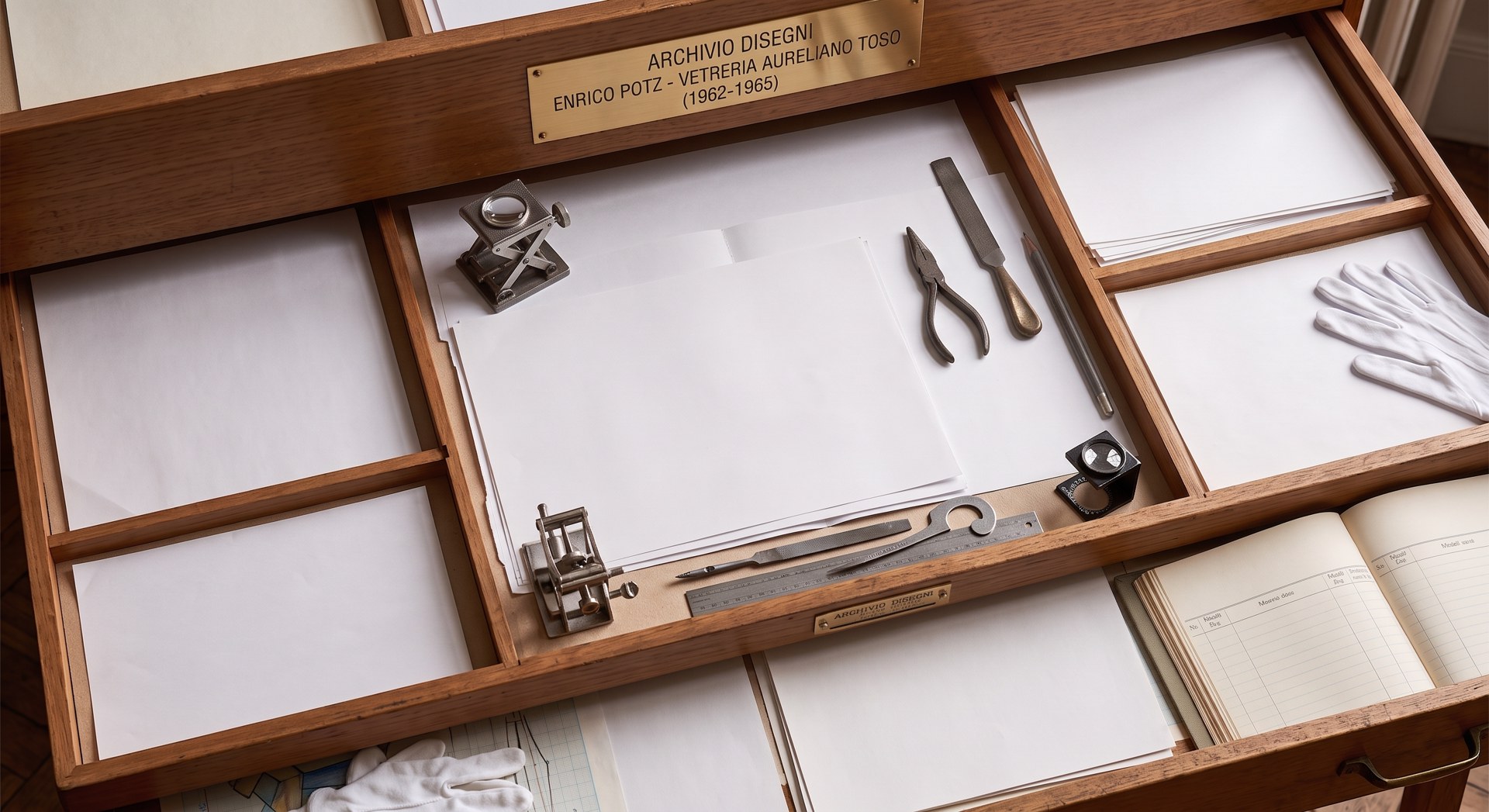
Potz’s primary contribution was to tame the chaotic, expressionist, and "Bohemian" exuberance of the 1950s into the structured, geometric, and linear forms demanded by the emerging "Space Age" aesthetic. Because Potz’s early work showed a strong technical vocabulary inherited from his mentor, their pieces have historically been easily confused. However, the monumental discovery of the Aureliano Toso company archives by glass historian Marc Heiremans has allowed collectors, appraisers, and historians to clearly identify and date Potz’s designs for the very first time.
Below is the definitive chronological and thematic model registry of Enrico Potz’s verified designs for Aureliano Toso, utilizing the official "EP" archival designation.
The Masterwork Vanguard: In-Depth Analyses of Key Flagship Designs
Before exploring the complete catalog, collectors must understand the landmark series that define Potz’s short but highly impactful tenure. These flagship collections are highly prized for their architectural discipline and pure color fields.
The Anodoci Series (1964 Venice Biennale)
- Historical Significance: Designed at the peak of Potz’s directorship, this refined series was selected to represent Aureliano Toso’s modernist evolution at the XXXII Venice Biennale in 1964.
- Aesthetic & Form: The Anodoci series represents a complete departure from the multi-colored, painterly collages of the 1950s. It prioritized simpler, more monolithic forms that relied entirely on the purity and transparency of single color fields. These upright, sculptural vessels are characterized by clean profiles, emphasizing the vertical axis and showcasing a highly disciplined, rationalist approach to post-war Italian design.
The Flat Solid Bicolored Animalier Series (c. 1963)
- Historical Significance: One of the most distinct and whimsical expressions of Potz's biomorphism, this series transformed traditional Muranese animal figurines into stylized, flat-profile modern sculptures.
- Technical Composition: Unlike Dino Martens' cased, three-dimensional blown animals, Potz designed these birds and fish as flat, solid glass bodies (vetro massello) mounted on clear pedestal bases. The designs feature two bold, contrasting blocks of transparent or opaque color fused seamlessly down the center (bicolored). Original drawings for these flagships, such as the Pesce piatto (flat fish) and Uccello piatto (flat bird), are preserved in prestigious private archives.
Soffione (Model 9647 EP) — Bulbous High-Neck Vase
- Historical Significance: A monument of hand-blown execution, this model represents Potz's ability to manipulate scale and vertical geometry while maintaining structural stability.
- Technical Composition: Standing at an impressive 67 cm in height, the Soffione vase features a heavy, bulbous lower body that tapers dramatically into an extremely tall, slender, needle-like neck. It represents a masterclass in balance, utilizing the vertical axis as an architectural column to interact dynamically with mid-century interior spaces.
The Swirling Decanters (Model 6293 EP) — The Transitional "Genie Bottles"
- Historical Significance: Positioned in the early 6000 model range, these stylized, swirling decanters are frequently misattributed to Dino Martens but show the unmistakable simplification of the Potz transition.
- Technical Composition: Typically executed with swirling red and white diagonal patterns, these "Genie bottle" decanters retain the vibrant cane techniques of the 1950s but discipline them into perfectly symmetrical, upright, and geometric silhouettes. They stand as the ultimate physical proof of Potz taming his mentor's expressive asymmetry.
Section 1: The Transition & Overlap Period (Models ~5001 to ~6000)
This model range represents the early 1960s transition. Pieces in this block showcase late-period Martens designs alongside Potz's early collaborative influence, where complex internal "patchworks" began giving way to monolithic colors.
- Model 5980 EP (Variant): "Cicogna" (Stork) – Stylized tall waterbird; c. 1962.
- Model 5981 EP (Variant): "Castello" – Early architectural block vase; c. 1962.
- Model 5982 EP (Variant): "Segredo" – Tapered triangular cased vase; c. 1962.
- Model 5983 EP (Variant): "Martino" – Elongated vertical cased vessel; c. 1962.
- Model 5986 EP (Variant): "Vaso remer" – Symmetrical high-neck vase; c. 1962.
- Model 5987 EP (Variant): "Frescada" – Double-bulbed geometric vase; c. 1962.
Section 2: Space Age Modernism & Geometric Silhouettes (Models 6001 to 7000+ & 9000+)
In this range, Potz's personal aesthetic became fully realized. These models emphasize clean vertical axes, upright symmetry, and simplified color fields designed to harmonize with B2B architectural requirements.
- Model 6293 EP: Swirling "Genie Bottle" decanter with stopper – Features simplified, symmetrical red and white diagonal cane wraps.
- Model 9647 EP: "Soffione" – Bulbous-body vase with an extremely tall, slender vertical neck; Height: 67 cm.
- Unnumbered EP: "Anodoci" Series – Collection of highly structured, monolithic colored vases exhibited at the XXXII Venice Biennale (1964).
Section 3: The Sculptural Fauna & Animals (The Animalier Series)
These flat, solid, two-toned sculptures of birds and fish mounted on bases represent some of the most sought-after and recognizable objects from the Enrico Potz era.
- Drawing 124 EP: "Pesce piatto bicolore" (Flat Bicolored Fish) – Solid, flat-profile bicolored fish sculpture; c. 1963; Height: 19 cm (Berlin Private Archives).
- Drawing 125 EP: "Uccello piatto bicolore" (Flat Bicolored Bird) – Solid, flat-profile bicolored bird sculpture; c. 1963; Width: 23.5 cm (Berlin Private Archives).
- Model 9710 EP: Flat solid bicolored bird sculpture on a clear pedestal base; Height: 27.5 cm.
- Model 9711 EP: Flat solid bicolored fish sculpture on a clear pedestal base; Width: 19.5 cm.
- Model 9712 EP: Flat solid bicolored bird on base - anatra (duck) sculpture; Width: 26.5 cm.
- Model 9713 EP: Flat solid bicolored fish sculpture on a clear pedestal base; Height: 33 cm.
- Model 9714 EP: Flat solid bicolored bird sculpture on a clear pedestal base; Height: 31.5 cm.
Join The Group Facebook Group Leading The Way On Murano Glass Research - Murano Glass Animals