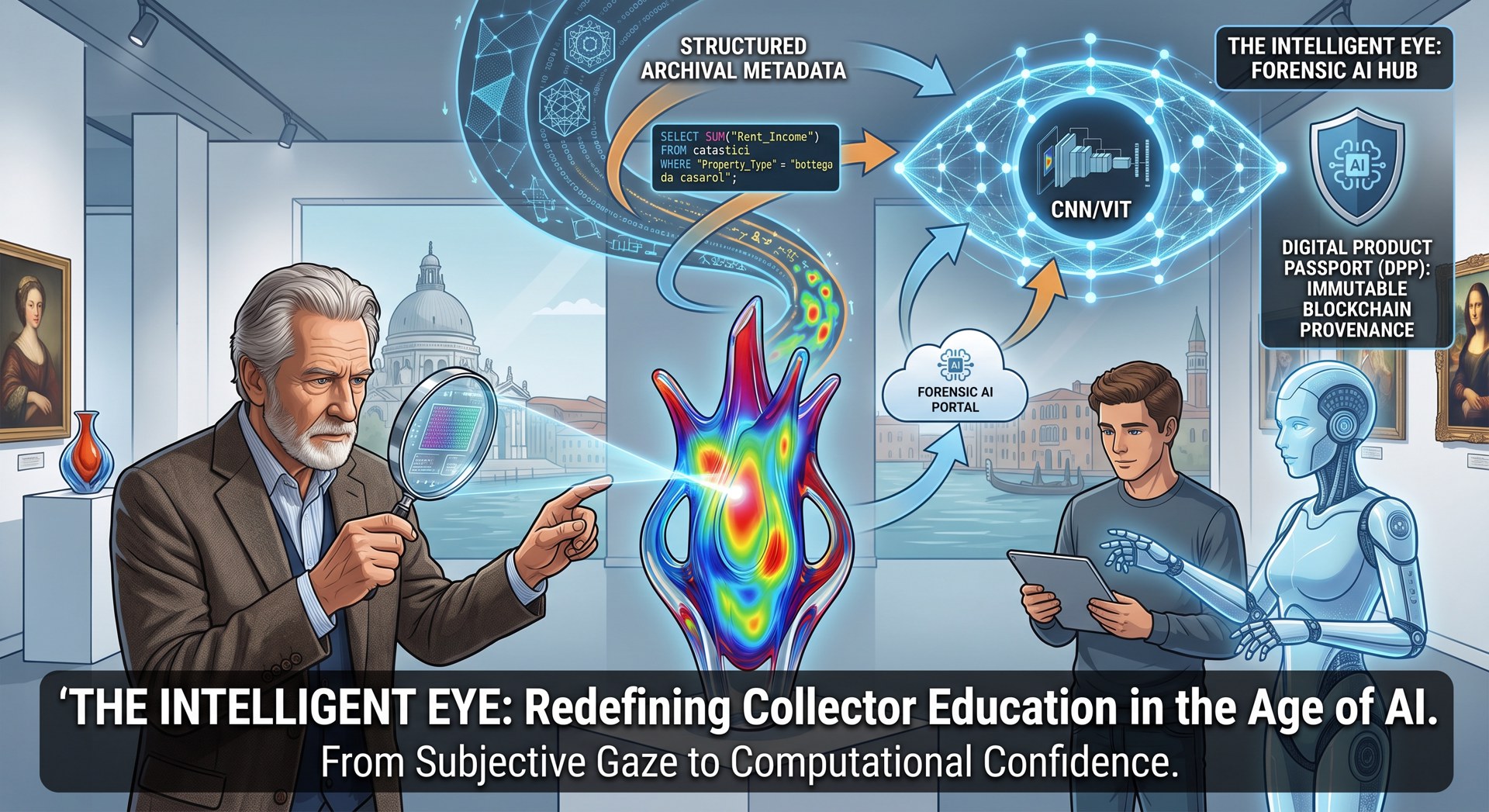
The Intelligent Eye: Redefining Collector Education in the Age of AI
Part 1: The New AI Literacy — Why Collectors Must Understand the Machinery of Attribution
The world of art and antique collecting has long operated on a sacred hierarchy of expertise. For centuries, the ultimate authority on whether a piece of Murano glass, a Renaissance bronze, or an Impressionist canvas was authentic lay in the subjective, cultivated "eye" of the connoisseur. This highly specialized form of tacit knowledge is typically acquired only through decades of physical handling, unguided archival study, and direct, visceral exposure to verified masterworks.
Today, a highly polarizing, boundary-dissolving force has arrived at the gallery gates: Artificial Intelligence.
For many traditional collectors, museum curators, and art historians, the integration of AI into connoisseurship is met with profound resistance. Skeptics routinely point to high-profile failures of general-purpose AI models, arguing that machines are inherently inaccurate, prone to making things up, and completely blind to the intangible, emotional context of artistic expression. They look at the flat, digital outputs of a standard computer screen and conclude that a cold, mathematical algorithm has no place in a world defined by the human soul, historical nuance, and material complexity.
This skepticism, while understandable, is directed at the wrong target. It stems from a profound lack of AI Literacy within the curatorial and collecting communities. Just as contemporary education systems are realizing that teaching students how to critically evaluate, challenge, and interact with AI is a foundational requirement for intellectual survival, art and antique collectors must develop their own AI literacy to protect their collections, verify their investments, and avoid permanent professional obsolescence.
The digital transformation of curatorial practice is not a speculative trend; it is an active baseline. Collectors who refuse to develop AI literacy will find themselves increasingly defenseless against a new era of precision-engineered, technically sophisticated counterfeits that easily slip past the human eye. To survive, the modern collector must unlearn the myths of artificial intelligence and understand the actual machinery of digital attribution.
Dismantling the "Calculator" Fallacy in Collecting
To build a robust, ethical, and practical relationship with computational curatorial tools, collectors must first dismantle a pervasive historical analogy. The introduction of generative AI is frequently compared to the arrival of calculators in mathematics classrooms. Skeptics argue that relying on AI is a form of intellectual shortcut—a passive "crutch" that will lead to cognitive decline and the gradual deskilling of the curatorial profession.
But this analogy is fundamentally wrong. A calculator is a passive, transactional instrument; it requires the user to explicitly define the mathematical parameters, and it never explains its own reasoning.
Generative AI is not a calculator; it is an interactive, conversational collaborator that operates in natural language. It acts not as a passive retrieval engine, but as a cognitive partner capable of organizing unstructured historical metadata, simulating material degradation, and conducting multi-layered stylistic comparisons.
When a collector uses a properly designed AI system, they are not abdicating their professional judgment. Instead, they are engaging in a dynamic dialogue with a digital mentor that can instantly synthesize massive, multi-modal datasets—visual, historical, and chemical—to reveal patterns, anomalies, and stylistic signatures that are physically impossible for a single human mind to hold and compare simultaneously.
To reject this is not a defense of human expertise; it is a form of automated abdication in reverse, choosing to remain blind to data-driven insights out of a mistaken belief that analog isolation equals purity.
                     TRADITIONAL CONNOISSEURSHIP
                     • Subjective "Connoisseur's Eye"
                     • Fragile, Paper-Based Provenance
                     • Destructive Material Testing (Scraped Samples)
                                   │
                                   ▼
                        THE CONCISE CONFLICT
     "AI is inaccurate" vs. "Precision Forgery is standard"
                                   │
                                   ▼
                         THE AI LITERATE COLLECTOR
                     • Interactive Cognitive Mentorship
                     • Non-Invasive Through-Material Spectroscopy
                     • Sub-Pixel Convolutional Feature Mapping
                     • Cryptographic Decentralized Provenance
Specialized Neural Networks vs. The General-Purpose Illusion
The cornerstone of collector AI literacy is understanding the profound difference between free, general-purpose consumer models and specialized, forensic-grade artificial intelligence.
When a skeptic claims that "AI cannot be trusted to identify a masterpiece," they are almost always referring to their experiences with general large language models or basic web search engines. These generic tools are trained on unverified, unstructured internet data. When queried about a rare historical glass sculpture or a complex provenance sequence, they do indeed "hallucinate"—fabricating historical details, confidently misidentifying maker marks, and conflating stylistic periods because they are optimized for conversational fluency, not material science.
Forensic art authentication and advanced connoisseurship utilize an entirely different class of technology:
- Convolutional Neural Networks (CNNs) and Vision Transformers (ViTs): Rather than performing shallow visual matches, specialized platforms deploy CNNs and ViTs specifically trained on closed, verified datasets. These datasets are curated directly from established catalogues raisonnés and undisputed museum holdings.
- Sub-Pixel Feature Extraction: These specialized models evaluate visual data at a microscopic, sub-visual level. In painting authentication, they analyze the microscopic "signatures" of the brushwork—measuring paint application pressure, stroke spacing, and geometry across more than one million dimensions, reducing them to a highly precise, 100-dimensional stylistic "fingerprint".
- Heat-Map Explanation: Rather than outputting a simple "yes" or "no," these forensic networks generate highly detailed "heat maps". These maps visually isolate which exact regions of an object conform to the verified stylistic hand of the master and which regions deviate, allowing human experts to critically evaluate the machine's reasoning.
In controlled, peer-reviewed blind trials, these specialized deep learning models achieved a stylistic identification accuracy of greater than 98% when distinguishing between highly similar master-student hands, such as those of Canaletto and Bernardo Bellotto.
A collector who relies on a generic search engine is using a toy; a collector who understands and applies specialized neural networks is using a microscope.
The Existential Choice
We are living in an era of "precision counterfeiting". Modern counterfeiters are highly sophisticated, technologically advanced, and capable of replicating visual aesthetics, paper certificates, and historical aging patterns with terrifying precision.
For the modern collector, curator, and scholar, maintaining an exclusively analog, subjective approach to connoisseurship is no longer a defense of tradition; it is an open invitation to deception.
AI literacy is the foundational skill of the 21st-century collector. It does not replace the human passion for art, nor does it diminish the visceral joy of handling a physical masterpiece. Instead, it arms the collector with an objective, data-driven shield.
Those who embrace this new literacy will secure their investments, elevate their curatorial rigor, and lead their institutions into a highly verified future. Those who cling to analog nostalgia will spend the next century holding objects they can only hope are real.
Part 2: Democratizing the Connoisseur — Bridging the 'Flipped AI Divide' in Curation
The acquisition, preservation, and curation of historical art and glass have historically been governed by a massive asymmetry of capital and resources. For centuries, the highly specialized scientific and archival resources required to verify and study rare artifacts were concentrated almost exclusively within a tiny handful of elite international auction houses, wealthy foundations, and heavily funded state museums.
This systemic imbalance has created a parallel version of what ethical and educational policymakers call the "flipped AI divide". In general education, this divide describes a structural inequality where wealthy students retain access to human educators, while less-privileged cohorts are "relegated" to automated, AI-mediated interfaces.
In art connoisseurship and curation, the flipped divide is just as damaging: elite institutions maintain a monopoly on direct human expertise and multi-million-dollar physical laboratories, while independent collectors, local galleries, and regional museums are left out in the cold. Denied access to high-end forensic testing, these smaller players are frequently forced to rely on subjective guesswork or generic, free digital tools that are prone to hallucination.
The integration of specialized artificial intelligence and open-access semantic registries is dismantling this hierarchy. By transforming expensive, manual curatorial processes into accessible, digital pipelines, AI is not substituting the human expert—it is democratizing the tools of connoisseurship, allowing independent collectors to verify, study, and curate their acquisitions with institutional-grade scientific rigor.
The Economics of Curatorial Exclusion
To understand how deeply entrenched this divide is, one must look directly at the economics of traditional art authentication. Historically, evaluating a disputed masterwork under the "three-legged stool" framework—provenance, connoisseurship, and material science—required a massive financial investment.
A full, multi-staged physical authentication can cost upwards of thousands of dollars. Broken down, a collector or small museum must expect to pay:
- Substantial fees for physical scientific analysis (including X-ray fluorescence, Raman spectroscopy, or radiocarbon dating);
- Significant costs for advanced computer vision or AI-based style profiling;
- Heavy investments for professional, deep-archive provenance reconstruction.
For a small regional museum or an independent collector, spending nearly ten thousand dollars to authenticate a single acquisition is financially impossible. Furthermore, this does not account for the additional, highly expensive logistics of secure physical transport, customs clearance, and specialized fine-art insurance premiums required to ship a fragile artifact to a centralized laboratory. This financial barrier has effectively functioned as a gatekeeping mechanism, keeping connoisseurship restricted to an elite circle and leaving the broader market vulnerable to sophisticated counterfeits.
The Digital Equalizer: Remote Forensic AI
Specialized, non-destructive computer vision platforms are completely bypassing these physical and financial boundaries. Specialized platforms allow collectors to digitally upload a high-resolution photograph of an artwork directly onto a secure web platform.
   TRADITIONAL AUTHENTICATION PATHWAY (High-Barrier)
   [Disputed Masterwork] ──► [Specialized Fine Art Transit] ──► [Centralized Lab]
                                                                        │
                                                                 (High Cost Barrier)
                                                                        │
                                                                        ▼
                                                             [Physical Chemical/XRF Tests]
                                                             [Subjective Connoisseur Gaze]

   DEMOCRATIZED AI AUTHENTICATION PATHWAY (Low-Barrier)
   [Disputed Masterwork] ──► [High-Res Digital Photograph] ──► [Forensic AI Portal]
                                                                        │
                                                                 (Highly Accessible)
                                                                        │
                                                                        ▼
                                                             [Deep Learning CNN Analysis]
                                                             [Verifiable "Heat Map" Reasoning]
By utilizing proprietary Convolutional Neural Networks (CNNs) trained on verified, high-fidelity datasets (such as undisputed museum holdings and official catalogues raisonnés), the AI analyzes sub-pixel stylistic structures remotely. In a matter of days, the collector receives a highly objective, purely data-driven authentication report.
This digital-first approach delivers several massive advantages:
- Elimination of Transit Risks: The artwork never leaves the collector’s wall or the museum vault, completely eliminating the risk of damage, loss, and the exorbitant cost of fine-art transit and insurance.
- Objective Evaluation: The analysis is entirely quantitative and free from the unconscious biases, reputational conflicts of interest, or political pressures that often complicate traditional expert committees.
- Visual Transparency: Rather than delivering an opaque "yes or no" verdict, these systems generate detailed, color-coded "heat maps". These maps visually isolate exactly which regions of the object conform to the master’s established stylistic hand and which areas deviate.
This democratization of forensic-grade stylistic analysis is already a market reality: numerous prominent art insurance firms, private collectors, and museum professionals currently utilize these remote, data-driven frameworks to secure valuation and ensure market integrity.
Open-Access Knowledge and the Semantic Twin
True curatorial democratization requires more than just testing tools; it requires open access to the tacit, physical, and historical knowledge of how these masterpieces were created. Historically, this context was buried in centuries-old guild archives or passed down in secret, oral traditions within exclusive glassblowing or artistic dynasties.
To bridge this educational gap, advanced digital humanities projects have constructed structured, multi-modal semantic schemas to digitize and preserve both the tangible and intangible dimensions of craft history. For collectors and scholars, this repository acts as an interactive, virtual academy structured around three core elements:
- The Fabula: A detailed, digital chronicle representing the historical events, causal dependencies, and socioeconomic narratives that define a craft or artwork's historical trajectory.
- Media Objects: A rich, multidimensional archive containing high-resolution photographs, 3D laser scans, and precise motion-capture data of historical master gestures.
- The Reference Function: The digital, semantic links that connect specific physical points on a 3D model directly to corresponding historical documentation or chemical recipes within the fabula.
                     OPEN CRAFT ONLINE PLATFORM
     ┌──────────────────────────────────────────────────────────┐
     │                       THE FABULA                         │
     │ Deliberations • Raw Material Ledgers • Dynasty Recipes   │
     └───────────────────────────▲──────────────────────────────┘
                                 │
                     (The Reference Function)
                                 │
     ┌──────────────────────────────────────────────────────────┐
     │                     MEDIA OBJECTS                        │
     │   3D Laser Scans • High-Res Photos • MoCap Coordinates   │
     └──────────────────────────────────────────────────────────┘
Using this architecture, a collector or scholar studying a rare object can "reverse engineer" its production. By clicking on a specific part of a high-resolution 3D scan, the system displays the exact, digitized movements, tool-handling angles, and historical context required to create that exact physical form. This transforms the object from a passive, decorative item into a rich, interactive educational portal, making advanced material history accessible to any collector with an internet connection.
Fostering the Relational Connoisseur
This computational democratization must not be misunderstood as a drive toward total automation. As critics and art historians rightfully argue, a purely machine-driven approach to art risk-management risks reducing visual culture to a sterile, formalistic exercise.
To address this, pioneers in the field have developed frameworks for the Responsible Use of AI in Art Authentication. This framework establishes that AI must function as a cognitive scaffold, enhancing rather than replacing human expertise. It ensures transparency, accountability, and continuous scientific peer-review.
This aligns directly with modern pedagogical and ethical principles: high-quality learning and connoisseurship are fundamentally relational. Humans learn best with and from other humans.
By utilizing specialized AI to automate repetitive data parsing, image-matching, and pattern recognition, we are not pushing human curators out. We are freeing them from administrative and logistical burdens. The AI handles the heavy statistical lifting of sub-pixel pattern detection; the human expert brings the critical, contextual, and cultural interpretation.
This hybrid, collaborative model is the true future of curation. Collectors and curators who partner with these computational mentors will operate with an unprecedented level of material confidence and scholarly depth. Those who cling to an exclusively analog, high-barrier framework will find themselves structurally isolated—holding physical assets they can neither scientifically verify nor economically secure.
Part 3: The Personalized Syllabus — Adaptive Cognitive Scaffolding for Connoisseurship
The secondary challenge raised by curatorial traditionalists is the training pipeline: "Even if specialized AI tools exist, mastering the interdisciplinary domains of connoisseurship—archival research, stylistic parsing, and materials science—takes a lifetime of unguided, manual exposure. No machine can shortcut the decades of experience required to develop a true connoisseur's eye."
This argument is correct in its diagnosis of the challenge, but incorrect in its rejection of the solution.
Connoisseurship is indeed an exceptionally complex intellectual discipline. To confidently attribute a work, a collector must navigate centuries of historical documents, master stylistic nuances, and comprehend advanced chemistry—such as how specific oxides like lead, potassium, and barium dictate a material’s physical properties. Historically, compiling this multi-faceted curriculum was a highly unstructured, manual, and overwhelming process for the independent collector.
However, modern educational theory and computational learning architectures have completely redefined this paradigm. By moving beyond linear, "one-size-fits-all" textbooks and adopting generative, AI-driven personalized learning platforms, we can systematically scaffold the acquisition of complex curatorial expertise. Applying these adaptive educational frameworks directly to collector training does not replace the human expert; instead, it provides a powerful cognitive accelerator that ensures those who leverage these adaptive systems will master the field at an unprecedented rate.
The Cognitive Load Crisis in Art History
To understand why traditional collector training is highly inefficient, we must look to Cognitive Load Theory (CLT). In unguided learning environments, a novice collector attempting to analyze an unverified artwork is hit with an overwhelming amount of raw data:
$$\text{Total Cognitive Load} = \text{Intrinsic Load} + \text{Extraneous Load} + \text{Germane Load}$$
Without structured guidance, a student’s limited working memory is entirely consumed by extraneous load—struggling to locate relevant reference materials, decipher obscure terminology, and organize unstructured data. Under the educational theory of connectivism, knowledge in the digital age is distributed across vast, complex networks, but unguided search forces the learner to spend their mental energy simply building basic maps rather than digesting core insights.
Generative AI platforms act as a dynamic, personalized scaffold that actively manages this cognitive load. In peer-reviewed, empirical studies evaluating AI-driven personalized learning systems, students utilizing adaptive cognitive platforms experienced a massive drop in measured cognitive load points compared to the traditional control group.
By offloading the search, retrieval, and structural organization of data to an intelligent agent, the student’s working memory is freed to focus purely on germane load: deep stylistic comparison, critical historical analysis, and the actual synthesis of expert knowledge.
The Architecture of an Art-Glass Tutor
To build a highly reliable, adaptive educational platform for collectors, developers utilize a structured, three-tier framework:
                     COLLECTOR EDUCATION PORTAL
   ┌────────────────────────────────────────────────────────────┐
   │                        DATA LAYER                          │
   │ Curated Knowledge Graphs (20k+ Art Historical Concepts)    │
   │  • Primary Historical Source Archives (Digitized Censuses) │
   │  • Multi-Modal Repositories (3D Scans, Style-Case Files)   │
   └─────────────────────────────┬──────────────────────────────┘
                                 ▼
   ┌────────────────────────────────────────────────────────────┐
   │                     ALGORITHM LAYER                        │
   │ • NLP semantic parsing for user query interpretation       │
   │ • Reinforcement learning (DQN) path customization          │
   └─────────────────────────────┬──────────────────────────────┘
                                 ▼
   ┌────────────────────────────────────────────────────────────┐
   │                     INTERFACE LAYER                        │
   │  • Flipped-classroom modules (asynchronous prep)           │
   │  • Self-monitoring dashboards & auto-corrected quizzes     │
   └────────────────────────────────────────────────────────────┘
- The Data Layer: This layer integrates an extensive art historical knowledge graph (containing over 20,000 interlinked concepts) with highly specialized database repositories. This includes primary historical cadastral surveys, multi-spectral materials-science databases, and high-resolution 3D reconstructions of masterwork collections.
- The Algorithm Layer: Utilizing a hybrid approach, the platform pairs natural language processing (NLP) to parse user inputs with reinforcement learning algorithms—such as Deep Q-Networks (DQN)—to model the user's current knowledge boundaries. The system continuously tracks the student's progress against the material, dynamically adjusting the complexity, vocabulary, and conceptual density of the lessons.
- The Interface Layer: Collectors interact with a web-based portal featuring self-paced learning units. Complex topics are introduced via a "flipped-classroom" model—where core theory is consolidated asynchronously through interactive diagrams and auto-corrected quizzes before the user participates in active curatorial workshops or physical viewings.
The Triadic Reciprocal Pathway to Collector Mastery
The efficacy of this personalized pedagogical model has been heavily validated in longitudinal studies of student performance and engagement, revealing a powerful three-dimensional pathway of behavioral engagement, emotional experience, and academic performance.
The empirical correlation coefficients ($r$) of students using personalized AI tutoring systems versus traditional unguided methods demonstrate an undeniable performance shift across every major educational metric:
| Educational Metric | AI-Augmented Platform ($r$) | Traditional Unguided Learning ($r$) |
|---|---|---|
| Self-Directed Study Duration | 0.261 | 0.045 |
| Volumetric Reading Behavior | 0.409 | 0.027 |
| Emotional Engagement | 0.312 | 0.109 |
| Self-Assessment Accuracy | 0.271 | 0.171 |
1. Time-Quality Decoupling & The 50-Minute Threshold
Skeptics frequently believe that simply spending more hours reading unstructured texts will yield expertise. However, quadratic regression analyses of study behaviors revealed a strict "time-quality decoupling" effect: beyond 50 minutes per day of unguided reading, learning gains completely plateaued.
This proves that unguided, long-duration study is highly inefficient. Autonomous time investment only correlates with deep mastery when paired with the structured, task-specific focus provided by an adaptive AI guide.
2. Minimizing Diagnostic Errors
By utilizing a self-monitoring dashboard, students can visualize their learning trajectory in real time, tracking their mastery of different artists, eras, and material techniques. This continuous, data-driven self-assessment has been shown to reduce diagnostic and analytical errors by 34%, aligning perfectly with classic theories of triadic reciprocal determinism.
Scaffolding Specialized Connoisseurship
To see this personalized syllabus in action, consider how a collector would master a highly technical, interdisciplinary field like Venetian Art Glass.
Instead of forcing a novice collector to memorize a massive materials-science paper on chemical composition, or study centuries of raw historical property records, the AI tutor sequences their journey through the Zone of Proximal Development (ZPD)—the optimal learning band between what a student can do unassisted and what they cannot do at all:
   LEVEL 1: Procedural Foundation (Intangible Craft Heritage)
   Learn the vocabulary and core workshop gestures (blocking, marvering, punty transfer)
   by interacting with 3D semantic models and first-person video records.
                            │
                            ▼
   LEVEL 2: Historical & Archival Anchors (Semantic Data Mappings)
   Query digitized historical documents using natural language,
   analyzing the socio-economic networks of historical glass dynasties.
                            │
                            ▼
   LEVEL 3: Advanced Material Forensics (Physics-Informed Modeling)
   Master the chemical signatures of authenticity. Study composition vectors
   and Random Forest classifiers of weathered vs. non-weathered glass.
- Step 1: The Material Foundation. The platform begins by building a strong spatial and procedural vocabulary. Using interactive multi-modal archives, the student studies the physical steps of creating a blown-glass vessel. They view 3D reconstructions of workshop tools (like jacks and blowpipes) and watch close-up, first-person video records of the master's precise physical gestures (blocking, marvering, and punty transfer). This builds a deep, respectful appreciation of the physical effort and craft required to shape molten glass.
- Step 2: The Historical Context. Once the material vocabulary is mastered, the platform shifts to historical networks. The student interacts with spatial LLM agents to browse centuries of Venetian cadastral surveys and guild deliberations from historical archives. Rather than struggling with manual cursive transcription, they query the database in natural language to track historical glassmaking dynasties, specific raw material transactions, and workshop distributions across centuries.
- Step 3: Materials-Science Forensics. Finally, the collector is introduced to chemical forensics. Having mastered the historical and visual context, they learn to analyze chemical composition data. The AI scaffolds their understanding of how Random Forest machine learning models process composition vectors—such as the precise weight percentages of silicon, lead, potassium, and barium oxides—to classify glass types and predict weathering states.
The Cognitive Renaissance
The true power of personalized AI education is that it transforms the collector from a passive consumer of historical narratives into an active, analytical connoisseur. It bridges the "flipped AI divide," giving independent collectors and regional curators the same structured, multi-dimensional cognitive training once reserved for elite, multi-million-dollar international institutions.
The message for curatorial communities is uncompromising: expertise is no longer a monopoly of time and capital. Those who utilize adaptive AI to accelerate their learning will develop a highly verified, scientifically rigorous eye in a fraction of the time. Those who rely on slow, unguided analog exposure will spend their lives trying to catch up.
Part 4: The Verifiable Trace — Overcoming the Hallucination Crisis through Explainable AI (XAI)
For the art collector, museum curator, and glass scholar, the most formidable barrier to accepting artificial intelligence is a single, deep-seated fear: the hallucination crisis. Skeptics in connoisseurship and curation routinely argue that AI cannot be trusted because "black-box" large language models are notorious for fabricating facts, inventing provenance records, and hallucinating artistic attributions out of thin air. When an analog error in an archive can compromise a multi-million-dollar investment, relying on a system that generates plausible-sounding fiction is not just an active operational risk—it is a form of professional abdication.
This skepticism is entirely justified when directed at general-purpose conversational chatbots. However, the future of collector education and database navigation does not belong to opaque, unguided oracles. A profound paradigm shift is occurring through the development of Explainable AI (XAI) protocols and Text-to-Program database architectures.
By translating natural language questions into explicit, executable computer programs (such as SQL or Python) rather than direct text responses, AI-driven education systems can now provide collectors with a transparent, auditable trail of reasoning. This architecture anchors every output directly in verified archival data, allowing collectors to verify the exact data points contributing to any historical conclusion down to the individual database row.
The Archival Challenge: Unstructured "Long Data"
To understand how Explainable AI functions as an educational tool for collectors, one must examine the raw material of historical connoisseurship. Much of our shared cultural heritage resides in massive, unstructured "Long Data" repositories. A prime example is the State Archives of Venice, which houses over 25 million pages of records documenting centuries of glassmaker guild deliberations, trade ledgers, and raw material transactions.
Historically, navigating these records was a manual, paleographic bottleneck. Diachronic linguistic shifts, spelling inconsistencies, and orthographic variations across centuries made systematic searching nearly impossible for independent collectors.
To bridge this historical divide, digital humanities initiatives train deep learning models on sample manuscript pages prepared by expert paleographers. These models perform Optical Character Recognition (OCR) and text segmentation to convert centuries-old cursive scripts into searchable digital metadata.
However, presenting this dense, multi-modal cadastral data to a collector still requires an interface that is both highly flexible and mathematically precise. This is where the dual strategies of Text-to-SQL and Text-to-Python agents come into play.
The SQL Agent: Precise Database Browsing
When a collector or curator seeks to browse highly structured, explicit historical records—such as ownership registries, property locations, or historical rental incomes—a Text-to-SQL agent provides a highly accurate, deterministic solution.
Consider a simplified digital database representing Venice's 1740 Catastici (a textual property survey managed by regional authorities to administer a property tax). This table is structured around seven precise columns:
$$\text{Table: catastici} \rightarrow [\text{ID}, \text{Owner_ID}, \text{Owner_First_Name}, \text{Owner_Family_Name}, \text{Property_Type}, \text{Rent_Income}, \text{Property_Location}]$$
When a student queries this database using natural language (e.g., "What is the total rent revenue generated from properties of the 'bottega da casarol' variety?"), the SQL agent does not "guess" the answer. Instead, it utilizes a text-to-SQL model to convert the question directly into a structured database query:
SELECT SUM("Rent_Income") FROM catastici WHERE "Property_Type" = 'bottega da casarol';
This SQL query is executed directly against the database using standard relational database engines to retrieve the exact, mathematically correct answer.
In peer-reviewed evaluations of specialized text-to-SQL models performing on expert-designed browsing tasks on historical cadastral datasets, the system achieved an exact match accuracy of 79% in a three-shot setting—meaning the generated code perfectly matched manually annotated ground-truth queries. Crucially, across all trials, zero SQL runtime errors were observed. This demonstrates that structured code generation bypasses the vocabulary limits and fluid inaccuracies of standard large language models, providing collectors with a highly reliable, error-free browsing tool.
The Coding Agent: Multi-Dataset Spatial and Temporal Reasoning
While SQL is ideal for structured lookups, collectors frequently ask open-ended, complex historical questions that require integrating external datasets, spatial reasoning, or statistical correlation. To solve these prompting challenges, Explainable AI frameworks utilize a multi-agent text-to-Python "coding agent".
This agent coordinates a dynamic dialogue among three specialized components:
   NATURAL LANGUAGE QUERY ──► [ ENTITY EXTRACTOR ] ──► [ PLANNER ] ──► [ CODER ] ──► EXECUTABLE CODE
                                    │                     │             │
                             Identifies Columns    Deconstructs   Translates Plan
                             & Specific Values     into Actions   into Python Code
- The Entity Extractor: This agent uses a Retrieval-Augmented Generation (RAG) approach to align natural language phrases in the query with specific database columns. It then runs a three-tier search—utilizing exact matching (e.g., matching historical spelling), fuzzy matching (capturing minor transcription variations), and semantic search (finding conceptually related terms) to isolate the relevant rows.
- The Planner: Inspired by advanced prompting paradigms, this agent constructs a detailed, step-by-step analytical strategy based on dataset metadata, extracted entities, and the expected answer format.
- The Coder: The coder translates this natural language plan into highly optimized, executable Python code (utilizing robust data libraries like Pandas and Numpy). The code is run in a secure, controlled execution environment; if a runtime error occurs, the system automatically feeds the console traceback back to the coder for iterative debugging up to a pre-set retry limit.
This text-to-Python framework allows the agent to seamlessly integrate multiple heterogeneous datasets. For instance, it can cross-reference the textual historical land registers with a Landmarks dataset of semi-persistent urban features (such as churches and squares extracted from geographic databases).
By using stable historical landmarks as spatial anchors, the AI can compute complex physical distances and density correlations across different centuries. It can mathematically answer advanced queries, such as calculating the correlation between historical rent prices and their proximity to the nearest public square, or running statistical tests of independence to determine if family names correlated with specific professions in the 18th century.
Verifying the AI's "Eye": Execution Consistency
To measure the reliability and stability of these code-generating systems, computer scientists evaluate Execution Consistency (EC). EC is defined as the proportion of identical outputs obtained when executing the exact same natural language query multiple times under different random seeds.
This consistency analysis reveals a clear pattern:
- Categorical Stability: Queries regarding personal information and property functions achieve the highest consistency (~95% EC, representing perfect consistency across runs). This is followed by spatial queries (~85%) and temporal comparison queries (~80%).
- Format Determinism: Answer formatting strongly dictates reliability. Simple yes/no and single numerical responses demonstrate high consistency, whereas queries requiring multi-step entity name extractions have slightly higher variance due to the complexity of data filtering across runs.
Ultimately, the primary advantage of the Explainable AI (XAI) framework is that the code itself acts as the explanation.
When a collector asks an AI system to analyze a complex provenance pattern, they are no longer forced to rely on blind belief. They do not receive an opaque, authoritative paragraph of text with a high risk of hidden hallucinations. Instead, the system presents the exact Python script it generated.
A trained, AI-literate collector can read the code blocks, examine the data filters, and audit the mathematical operations. The "black box" is shattered. By transforming the generative process from a natural language guess into an auditable program, XAI provides the art market with an unshielded, verifiable lens into historical truth, ensuring that curatorial decisions remain strictly anchored in the physical reality of the records.
Part 5: Co-Designing Curation — The Hybrid Future of Human-AI Collaboration
The integration of computational science into the art and antique market is often met with the ultimate romantic defense: "A machine can analyze pixels and chemical oxides, but it cannot feel the soul of a masterpiece. It threatens to sever the visceral, tactile relationship between the connoisseur and the material."
This objection, while deeply felt, is based on a false dichotomy that pits human intuition against digital computation. Modern connoisseurship is not an either-or choice between raw human feeling and cold algorithmic automation. Instead, we are entering the era of human-machine co-design—a hybrid model of collaboration where specialized artificial intelligence serves as a cognitive scaffold, enhancing the collector’s physical perception rather than replacing it.
Empirical research from formal vocational studies demonstrates that when collectors and curators are trained using structured, hybrid digital frameworks, their connection to the physical material is not diluted; it is profoundly sharpened. AI is not an oracle to be blindly believed, but a digital mentor that manages our cognitive limitations, maps historical context at scale, and unlocks molecular truth. Collectors who master this hybrid relationship will operate with an unprecedented level of scholarly depth and financial security, while those who remain isolated in analog denial will find themselves holding a slowly compromised legacy.
The Preservation of the Material Relationship (RTM)
The fear of "digital dispossession"—the anxiety that virtual tools will alienate the learner from the physical artifact—was a central theme investigated during formal, long-term educational studies at leading research and training institutions. Curators and apprentices were exposed to an array of advanced digital tools, including virtual reality, 3D parametric modeling, and e-learning registries.
The qualitative results of these studies yielded a vital truth for the curatorial community:
- No Diminishment of Material Attachment: The qualitative indicator representing the "Relationship with the Material" (RTM) appeared with equal frequency across both the digitally augmented and traditional analog cohorts.
- A Professional Life Choice: Participants articulated clearly that their physical, sensory attachment to the material was a non-negotiable professional life choice. They did not view digital tools as a substitute for handling physical objects, but as a practical, task-specific toolbox that enabled them to enter the physical space with their cognitive load fully managed.
In collector education, this means that virtual simulators and digital archives do not replace the hands-on experience of the gallery or workshop. Instead, they act as a safe pre-exposure mechanism—building vocabulary, training spatial layout, and establishing procedural structures before a collector ever handles a fragile, highly valuable masterpiece.
The "Get Informed – Model – Practice" Cycle for Collectors
To operationalize this hybrid collaboration, elite educational programs deploy a structured, three-phase pedagogical sequence known as the "Get Informed – Model – Practice" cycle:
                       1. GET INFORMED
             Asynchronous E-Learning & Theory Prep
         (Archival Records • Materials Chemistry • Provenance)
                                │
                                ▼
                           2. MODEL
                  Digital Curatorial Design
         (3D Spatial Mock-Ups • Virtual Gallery Layouts)
                                │
                                ▼
                          3. PRACTICE
           Physical Connoisseurship & Material Inspection
        (Non-Invasive Spectroscopy • High-Res Micro-Scans)
- I Get Informed: Collectors utilize an asynchronous, semantic e-learning platform to consolidate foundational theory, raw materials chemistry, and historical records. This manages cognitive load by ensuring that complex taxonomy and historical timelines are fully understood before physical inspection begins.
- I Model: Before acquiring or exhibiting an object, collectors "model" their curatorial frameworks digitally. Using organic VR design tools, parametric 3D CAD, and virtual gallery layouts, they test spatial relationships, lighting interactions, and structural arrangements without moving a single physical display.
- I Practice: Armed with structured digital preparation, the collector enters the physical gallery or museum. Here, they execute hands-on connoisseurship, using mobile AR displays, micro-imaging sensors, and non-destructive testing tools in the field. They spend their physical hours refining their critical judgment, not guessing basic material properties or struggling to verify elementary documentation.
Tracking the Ancestral Fabric through Long Data
This hybrid model is made possible by the revolution of "Long Data"—the quantitative, document-driven reconstruction of historical records across deep temporal reaches. Through paleographic deep learning models, massive unstructured repositories—such as historical archives housing tens of millions of pages of historic guild deliberations and family recipes—are transcribed and converted into standardized, searchable semantic metadata.
Rather than treating these archives as static texts, AI structures this history into temporal multi-layer networks. This mathematical network connects historical document nodes—such as ancient guild records—directly to the artisans who made the objects, the workshops they operated, and the historical trade routes they supplied.
To make this immense web of history accessible, collectors can deploy spatial Large Language Model (LLM) agents. By utilizing a Text-to-Program (SQL or Python) architecture to eliminate hallucinations, these agents translate simple queries into executable, auditable code.
Crucially, the system uses semi-persistent physical landmarks—such as historical churches and squares extracted from public geographical databases—as spatial anchors. Although the physical buildings may have changed, their coordinates remain stable. This allows a collector to execute complex spatial-temporal queries, tracing the exact geographic, socioeconomic, and genealogical fabric of an artwork's origin directly to its contemporary physical coordinate.
The Molecular and Cryptographic Shield
The final, unyielding line of defense for the modern collector lies in the absolute marriage of optical physics, predictive machine learning, and decentralized ledger technology.
- Molecular Autographs: Using advanced through-bottle near-infrared (NIR) fluorescence spectroscopy, scientists can now capture the chemical auto-fluorescence of materials through unopened, dark glass containers. By shaping a laser beam into an axicon-guided annular cone, the system focuses a bright excitation spot deep inside the material, collecting the emission back through the "dark center" of the ring and completely evading container interference.
- Predictive Classifiers: This non-destructive chemical signature is fed into Random Forest machine learning models. Utilizing precise composition vectors of key chemical oxides, the classifier identifies material types and weathering states with a global accuracy of 96.3%.
- Cryptographic Provenance: Once verified, this forensic profile is linked to an unalterable Digital Product Passport (DPP) minted on an immutable, decentralized blockchain ledger. Any subsequent physical transaction, ownership transfer, or conservation activity is permanently documented on the chain, establishing an unbroken, self-auditing chain of custody.
     PHYSICAL ARTWORK             SPECTROSCOPIC TEST              DECENTRALIZED LEDGER
  [Micro-Texture Profile]  ──►  [NIR through-bottle focus]  ──►  [Blockchain DPP Minted]
  [Holographic Fingerprint]     [Random Forest Classifier]       [Self-Auditing Custody Chain]
The Unyielding Ultimatum
We are living in an era of precision counterfeits, shifting markets, and rapid cultural digitization. Holding onto an exclusively analog, unguided approach to collecting is no longer a defense of tradition; it is a critical vulnerability.
AI is not here to replace the connoisseur’s eye, the curator's passion, or the scholar’s deep historical empathy. It is here to provide them with a computational shield.
The galleries, museums, and private collectors who embrace this co-design framework—partnering with Explainable AI databases, adaptive learning paths, and spectroscopic-cryptographic verifications—will secure their investments and preserve historical truth with absolute, data-driven certainty. Those who cling to analog nostalgia will find their certificates of authenticity increasingly suspect, their collections vulnerable, and their legacies left forever catching up in a highly verified digital world.
Join The Group Facebook Group Leading The Way - Murano Glass Animals