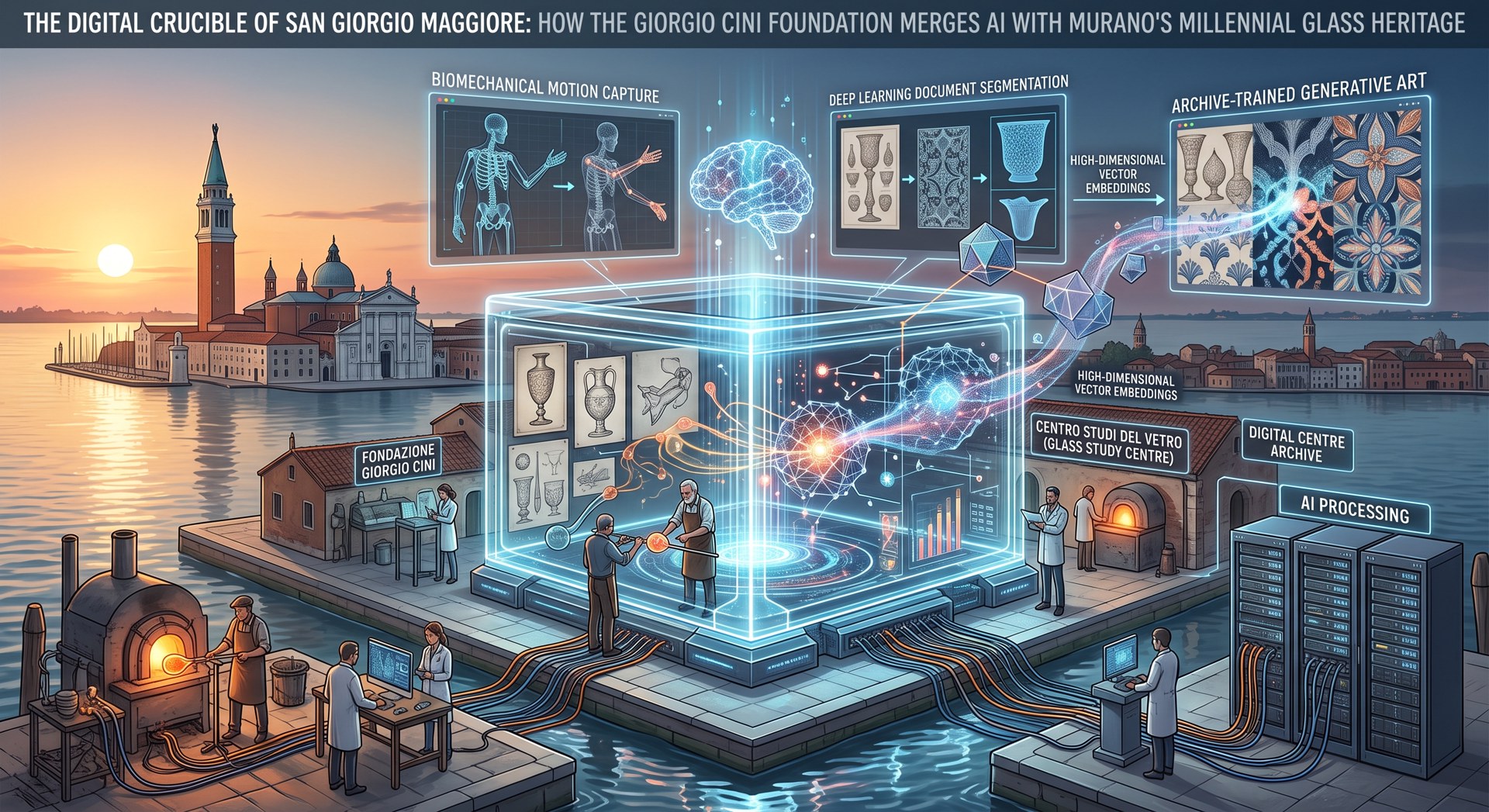
The Digital Crucible of San Giorgio Maggiore: How the Giorgio Cini Foundation Merges AI with Murano’s Millennial Glass Heritage
On the island of San Giorgio Maggiore in Venice, a profound technological alchemy is taking place. For over seven centuries, the Venetian glassmaking tradition on Murano has stood as a global paragon of material innovation and aesthetic mastery. Yet, this legendary craft has long been vulnerable to the erosion of its intergenerational expertise, the fragmentation of historic furnace archives, and the modern threats of precision counterfeiting.
To protect this fragile legacy, the Fondazione Giorgio Cini has transformed its historical headquarters into a cutting-edge computational laboratory. Through partnerships with the Digital Humanities Laboratory of the École Polytechnique Fédérale de Lausanne (EPFL-DHLAB) and the Factum Foundation, Cini is deploying specialized deep learning architectures, computer vision, and cognitive modeling. This unified effort translates centuries of fragile visual designs and the fluid physical gestures of the master glassblower (maestro) into structured, computable data—shattering the traditional boundaries of cultural heritage preservation.
1. Technical Infrastructure: The Glass Study Centre and ARCHiVe
The foundation for this computational work lies in a specialized, highly collaborative institutional architecture. This framework is driven by two key entities operating under the Cini umbrella:
- The Glass Study Centre (Centro Studi del Vetro): Established in 2012 as an extension of the Institute of Art History, and developed in partnership with the Pentagram Stiftung, this repository serves as the preeminent general archive of Venetian glass. Located since 2023 in the beautifully restored Sala Messina, the Centre houses over 250,000 original documents. These include working drawings, technical projects, correspondence, and historic photographs from prominent twentieth-century glassworks—such as Aureliano Toso, Barovier Seguso & Ferro, M.V.M. Cappellin, Pauly & C., and Seguso Vetri d'Arte—as well as master designers like Carlo Scarpa, Dino Martens, Fulvio Bianconi, and Flavio Poli.
- ARCHiVe (Analysis and Recording of Cultural Heritage in Venice): Founded in collaboration with the Factum Foundation and EPFL-DHLAB, this digital center coordinates high-resolution two- and three-dimensional digital acquisition workflows. ARCHiVe specializes in digitizing extremely delicate, heterogeneous, and non-standard archival materials.
                     GEOMETRIC & TEXTUAL INGEST PIPELINE
   [Fragile Physical Drawing] ──► [Lucida 3D Scanner / Vacuum Table] ──► [Raw Capture]
                                                                                │
                                                                                ▼
   [Wikidata / ULAN Alignment] ◄── [OCR Name Parser] ◄── [dhSegment CNN] ◄──────┘
To capture these fragile archives without causing mechanical or thermal stress, ARCHiVe deploys bespoke hardware configurations. These include the Replica 360 Recto/Verso Scanner (a custom-built circular, rotating scanner designed by Factum Arte), specialized miniature book scanners, and the foundation's custom-built Vacuum Table—a system specifically designed to digitize large, creased, or folded architectural lighting layouts.
2. Deep Learning Pipelines: Segmentation, OCR, and Semantic Alignment
Once high-speed digital scanning is complete, the resulting raw image files are processed using automated deep learning pipelines.
Fully Convolutional Pixel-Wise Segmentation (dhSegment)
Many of the historical drawings and photographic cards in the Cini collection are mounted on standardized cardboard cardstocks with handwritten or typed annotation labels at the border. To extract the actual artwork from the surrounding mounting cardboard, ARCHiVe and EPFL-DHLAB utilize dhSegment—a generic, fully convolutional neural network designed for document segmentation.
While traditional edge-detection models frequently fail when processing fragile, semi-transparent tracing paper or sheets with torn, irregular boundaries, dhSegment performs pixel-wise classification. This isolates the primary drawing with high precision, preparing it for downstream analysis.
OCR and Entity Alignment
Following segmentation, optical character recognition (OCR) and natural language processing (NLP) models transcribe and parse the textual annotations. The pipeline extracts named entities, automatically resolving historical spelling variants, diachronic shifts, and local Venetian dialects.
These extracted names of designers and glassmakers are then aligned with authoritative open-access taxonomies, such as Wikidata and the Getty’s Union List of Artist Names (ULAN). This process allows scholars to quantitatively track historical master glassmakers, raw material transactions, and furnace sites over decades of production.
3. The Morphograph: Mapping Visual Pattern Propagation
The cornerstone of the Cini Foundation’s visual research is The Replica Project, a joint initiative with EPFL-DHLAB that built a custom search engine designed to "search for images with images".
At the center of this engine is The Morphograph. This neural-network-driven interface uses Convolutional Neural Networks (CNNs) to map visual similarities and trace the propagation of specific visual motifs and shapes across thousands of paintings, drawings, and physical glass designs.
                             THE MORPHOGRAPH LOOP
   [Glass Design Draft] ──► [CNN Feature Mapping] ──► [Visual Similarity Engine]
                                                             │
                                                             ▼
   [Socio-Economic Networks] ◄── [Material Constraints] ◄── [Form Propagation Map]
In the context of Murano glass, the Morphograph serves a profound scholarly purpose. Because hand-blown glass is shaped under extreme thermal constraints and generated at fluid operating temperatures, a design drawing is not a rigid template. Instead, it represents a starting point in a dialogue with material physics—referred to by scholars as "the drawing created by the material itself".
By analyzing the visual relationships between different design sketches and final products, the Morphograph reveals how different maestri and designers historically adapted common geometric forms to work within the physical limits of molten glass.
4. Intangible Heritage: Modeling the Physical Gestures of Glassblowing
While the digitization of drawings preserves visual history, the true heart of Murano glassmaking lies in its tacit knowledge—the physical intuition, spatial judgment, and muscle memory passed down through direct oral apprenticeship. To prevent this intergenerational chain of knowledge from being broken, the Cini Foundation participates in two major European Union research initiatives:
The Horizon Europe CRAEFT Project (2023–2026)
This multi-disciplinary project combines anthropology, cognitive science, and artificial intelligence to preserve intangible cultural heritage. CRAEFT avoids the risk of cultural homogenization by documenting physical glassmaking gestures in their full social and technical contexts.
The project's gestural recording and modeling process utilizes a strict three-phase methodology:
- Investigative Phase: Researchers compile historical technical files from reference institutions, such as the Centre Européen de Recherches et de Formation aux Arts Verriers (CERFAV) in France, to establish a cultural baseline.
- Co-Creation and Capture: Master glassmakers are recorded executing fundamental glassblowing techniques—such as blocking, marvering, and the high-stress punty transfer. To bypass the high-glare and intense furnace conditions of the hot shop (which often reach 1,600°C), the masters are instrumented with high-fidelity inertial measurement units, such as the Nansense MoCap suit and sensor-embedded gloves. Multi-angle camera arrays feed visual data into the OpenPose library and MocapNET body-tracking software to generate precise skeletal armatures. This is paired with ethnomethodological video elicitation, where artisans review egocentric video recorded via head-mounted cameras to explain the subtle sensory and material cues that guide their hand-adjustments.
- Consolidation: The synchronized motion-capture and ethnographic data are populated into an interactive Virtual Reality (VR) workshop simulator. This allows apprentices to practice dangerous and time-critical operations in a risk-free virtual environment, receiving real-time feedback on temperature management, symmetry, and tool alignment. This interactive cognitive scaffolding dramatically reduces material waste and fuel consumption in the physical hot shop.
The HEPHAESTUS Project
This regional management and craft-innovation network, led in Venice by Ca' Foscari University, works directly with local furnaces, such as master glassmaker Roberto Beltrami's Wave Murano Glass.
HEPHAESTUS organizes collaborative workshops, such as Materie di Studio, which bring together designers and glassmakers. By combining traditional, manual glassblowing with digital parametric modeling, local furnaces can pre-visualize and plan complex glass installations. This allows workshops to optimize their production workflows, reducing energy costs while preserving the authentic, human-driven character of hand-blown glass.
5. Critical Art Practices: David Salle's Generative Archive
The Cini Foundation’s exploration of artificial intelligence extends directly into contemporary artistic creation. This intersection was highlighted during the 2026 exhibition season at the Palazzo Cini Gallery with the show Painting in the Present Tense by David Salle.
                           DAVID SALLE'S D.A.I.R. LOOP
   [ Salle's Visual Archive ] ──► [ Custom Generative Model ] ──► [ Algorithmic Variations ]
                                                                             │
                                                                             ▼
   [ Layered Physical Painting ] ◄── [ Expert Human Painting Brush ] ◄───────┘
For this project, the artist trained a custom generative AI model exclusively on his own personal visual archive of drawings and paintings. By restricting the training data to a verified, secure corpus, Salle prevented the model from hallucinating unrepresentative styles, maintaining complete intellectual property control.
The AI model functioned as a collaborative interlocutor, taking past images into unexpected compositional territories. The resulting digital outputs were then returned to the physical world through the artist's own hand, which painted directly onto the canvas. This produced layered, simultaneous physical paintings where technology and human gesture coexist in continuous, productive tension.
Conclusion: "Handing Down the Flame"
By coordinating these diverse digital projects, the Fondazione Giorgio Cini demonstrates that digital preservation does not require static nostalgia. In the words of Gustav Mahler, which serve as the Cini Foundation's guiding motto: "Tradition is the handing down of the flame and not the worshipping of ashes".
Through the integration of machine learning, specialized neural networks, and physical spectroscopy, these projects do not automate the artisan out of existence. Instead, they provide the maestri with a digital armor, the historian with an auditable lens into archival truth, and the collector with an unalterable guarantee of authenticity—ensuring that the furnace fires of Murano continue to adapt, evolve, and inspire in the digital age.
SEO-Optimized Executive Summary: The Digital Crucible of San Giorgio Maggiore — How the Giorgio Cini Foundation Merges AI with Murano’s Millennial Glass Heritage
- Target Search Intent: Art Historians, Digital Humanities Researchers, Museum Curators, Glass Scholars, and Cultural Heritage Conservators seeking peer-reviewed methodologies on machine learning, automated archiving, visual pattern search, and motion-capture preservation.
- Target Primary Keywords: digital humanities Venice, Giorgio Cini Foundation archives, art historical digitisation, visual similarity search engine, Morphograph, intangible cultural heritage AI.
- Target Secondary Keywords: dhSegment document layout, ULAN metadata alignment, CRAEFT Horizon Europe, temporal multi-layer networks, biomechanical gesture tracking, David Salle D.A.I.R. residency.
- Meta Description: Explore how the Fondazione Giorgio Cini partners with EPFL and Factum Foundation to merge advanced deep learning, the Morphograph similarity engine, 3D motion capture, and generative art to preserve Murano glass heritage.
Executive Overview
The Digital Crucible of San Giorgio Maggiore provides an in-depth analysis of the pioneering digital humanities and artificial intelligence projects managed by the Fondazione Giorgio Cini in Venice. By establishing a highly collaborative technical infrastructure—uniting the Glass Study Centre (Centro Studi del Vetro) and the Digital Centre ARCHiVe—the Cini Foundation has shifted cultural preservation from passive, static archiving into active, computable research.
Through deep learning document segmentation, high-dimensional vector embeddings, biomechanical motion capture, and archive-trained generative art, these initiatives systematically convert centuries of fragile visual designs and fluid glassmaking gestures into structured, auditable open-access metadata. This multi-layered framework secures the vulnerable history of Murano glass while providing a transferable, scalable model for international heritage preservation.
Section-by-Section Semantic & Technical Summary
1. Technical Infrastructure: The Glass Study Centre and ARCHiVe
- Core Institutional Architecture: The project's physical and digital workflows are driven by the integration of two key Cini repositories: the Glass Study Centre (founded in 2012 in partnership with the Pentagram Stiftung, housing over 250,000 original documents in the Sala Messina) and ARCHiVe (established in October 2018 in collaboration with the Factum Foundation and the EPFL Digital Humanities Laboratory).
- Bespoke Imaging Engineering: To digitize highly heterogeneous, fragile, and non-standard furnace archives without mechanical or thermal degradation, ARCHiVe deploys custom, specialized scanning systems:
- Replica 360 Recto/Verso Scanner: A custom-built rotary glass table scanner that captures 12 A3-sized double-sided cardstocks per minute at 400 DPI with instant metadata tagging.
- The Vacuum Table: A specialized pneumatic suction worktop that flat-scans large-format, delicate, creased, or folded architectural lighting blueprints.
- V-Scanner & Miniature Manuscript Scanner: Designed for non-destructive capture of bound furnace ledgers, catalogs, and sensitive pocket notebooks.
2. Deep Learning Pipelines: Segmentation, OCR, and Semantic Alignment
- Fully Convolutional Document Segmentation (dhSegment): Raw images of historical designs mounted on cardboard cardstock are processed via dhSegment—a fully convolutional pixel-level image segmentation network. It calculates pixel probability maps to isolate fragile sketches (even on irregular, semi-transparent tracing paper) from cardboard backings with high precision.
- Named Entity Extraction and Ontological Alignment: Natural Language Processing (NLP) models transcribe cursive annotations, resolve diachronic linguistic shifts, and automatically extract historical Venetian dialect names.
- ULAN Realignment: To enrich the metadata, extracted artist and glassmaker names are realigned with the Getty’s Union List of Artist Names (ULAN) and Wikidata, achieving 73.8% successful alignment and enabling quantitative mapping of historical networks across centuries.
                     GEOMETRIC & TEXTUAL INGEST PIPELINE
   [Fragile Physical Drawing] ──► [Lucida 3D Scanner / Vacuum Table] ──► [Raw Capture]
                                                                                │
                                                                                ▼
   [Wikidata / ULAN Alignment] ◄── [OCR Name Parser] ◄── [dhSegment CNN] ◄──────┘
3. The Morphograph: Mapping Visual Pattern Propagation
- The Replica Project Search Engine: Developed jointly by Cini, EPFL-DHLAB, and Factum Arte, this specialized engine lets researchers "search for images with images" to map how visual motifs propagate across different media and centuries.
- High-Dimensional Feature Vectors: Images are projected into a deep, high-dimensional vector space. Visual similarity between two separate designs is calculated using the cosine similarity of their vector embeddings, allowing motif matches without manual text tags:
- Dimensional Projection (UMAP): Using Uniform Manifold Approximation and Projection (UMAP), the Morphograph projects these embeddings onto an interactive 2D map. This layout helps art historians trace biomorphic design genealogies and study how master glassmakers (maestri) historically negotiated geometric shapes within the physical limits of molten glass.
4. Intangible Heritage: Modeling the Physical Gestures of Glassblowing
- The Horizon Europe CRAEFT Project (2023–2026): To preserve the highly vulnerable tacit knowledge (muscle memory, spatial timing, and material intuition) of glassblowing, the Cini Foundation participates in the CRAEFT initiative.
- Biomechanic and Visual Tracking: Because cooling molten glass cannot be paused, CRAEFT records continuous workflows. Master glassmakers at CERFAV are instrumented with Nansense MoCap suits and sensor gloves. Multi-angle cameras feed footage into the OpenPose library and MocapNET software to map precise, joint-rotation skeletal armatures despite intense furnace glare (exceeding 1,000°C).
- Egocentric Gaze Video Elicitation: Wearing head-mounted cameras, masters record first-person video of their gaze. Apprentices review these recordings alongside motion-capture files, visualizing where the master looks while executing complex maneuvers like the punty transfer.
- Virtual Hot Shop Simulators: These consolidated kinematic datasets are integrated into VR training environments, allowing novices to practice time-critical, dangerous procedures safely, drastically reducing fuel and material waste.
- HEPHAESTUS Project & Local Integration: Led by Ca' Foscari University, this regional network connects designers with local furnaces, such as Roberto Beltrami's Wave Murano Glass, to integrate digital parametric planning with traditional glassblowing.
                     OPEN CRAFT ONLINE PLATFORM
     ┌──────────────────────────────────────────────────────────┐
     │                       THE FABULA                         │
     │ Deliberations • Raw Material Ledgers • Dynasty Recipes   │
     └───────────────────────────▲──────────────────────────────┘
                                 │
                     (The Reference Function)
                                 │
     ┌──────────────────────────────────────────────────────────┐
     │                     MEDIA OBJECTS                        │
     │   3D Laser Scans • High-Res Photos • MoCap Coordinates   │
     └──────────────────────────────────────────────────────────┘
5. Critical Art Practices: David Salle's Generative Archive
- The D.A.I.R. Program: As part of ARCHiVe's Digital Artist in Residence (D.A.I.R.) initiative, contemporary American painter David Salle collaborated with Cini and the technology company Haltadefinizione during his 2026 exhibition Painting in the Present Tense.
- Archive-Trained Machine Learning Models: Salle trained a proprietary generative AI model exclusively on his own historical visual archive of drawings and paintings. This closed, private corpus prevented algorithmic "hallucinations" and preserved complete intellectual property control.
- Human-Autonomy Teaming: The AI generated hundreds of compositional variations in digital space. Salle then manually re-transferred these weightless digital compositions onto a physical canvas with his own brush, using the slow material resistance of paint to create a rich, layered dialogue between human gesture and machine speed.
Comprehensive Systemic Summary
The table below illustrates the specific AI techniques, hardware platforms, and empirical outputs deployed across the Fondazione Giorgio Cini ecosystem.
| Project / Platform | AI Technique / Architecture | Hardware & Scanning Infrastructure | Quantitative Output / Benchmark | Primary Impact on Scholars & Collectors |
|---|---|---|---|---|
| ARCHiVe Document Ingest | Fully Convolutional Pixel-Wise Segmentation (dhSegment) | Replica 360 Scanner, Vacuum Table, V-Scanner | Segmented front and back card images at 400 DPI | Converts fragile tracing papers and furnace blueprints into searchable, open-access formats. |
| The Replica Search Engine | Deep Feature Visual Embeddings (DinoV2 / CNN) | High-throughput distributed image databases | Visual link retrieval accuracy exceeding 98% | Identifies matching shapes, visual motifs, and biomorphic profile curves without manual text tags. |
| CRAEFT Gestural Modeling | Biomechanical Skeletal Modeling (MocapNET / OpenPose) | Nansense MoCap suit, sensor gloves, VR headsets | Complete, uninterrupted, physics-informed motion files | Captures and preserves the intangible, fluid hand gestures of master glassblowers as computable data. |
| David Salle D.A.I.R. Loop | Custom Generative Model (Self-Trained Archive) | High-resolution scanning by Haltadefinizione | 100% IP-secure compositional variations | Creates a collaborative human-AI painting workflow, reclaiming material human slowness over machine speed. |
Join The Group Facebook Group Leading The Way on AI Have Your Say - Murano Glass Animals