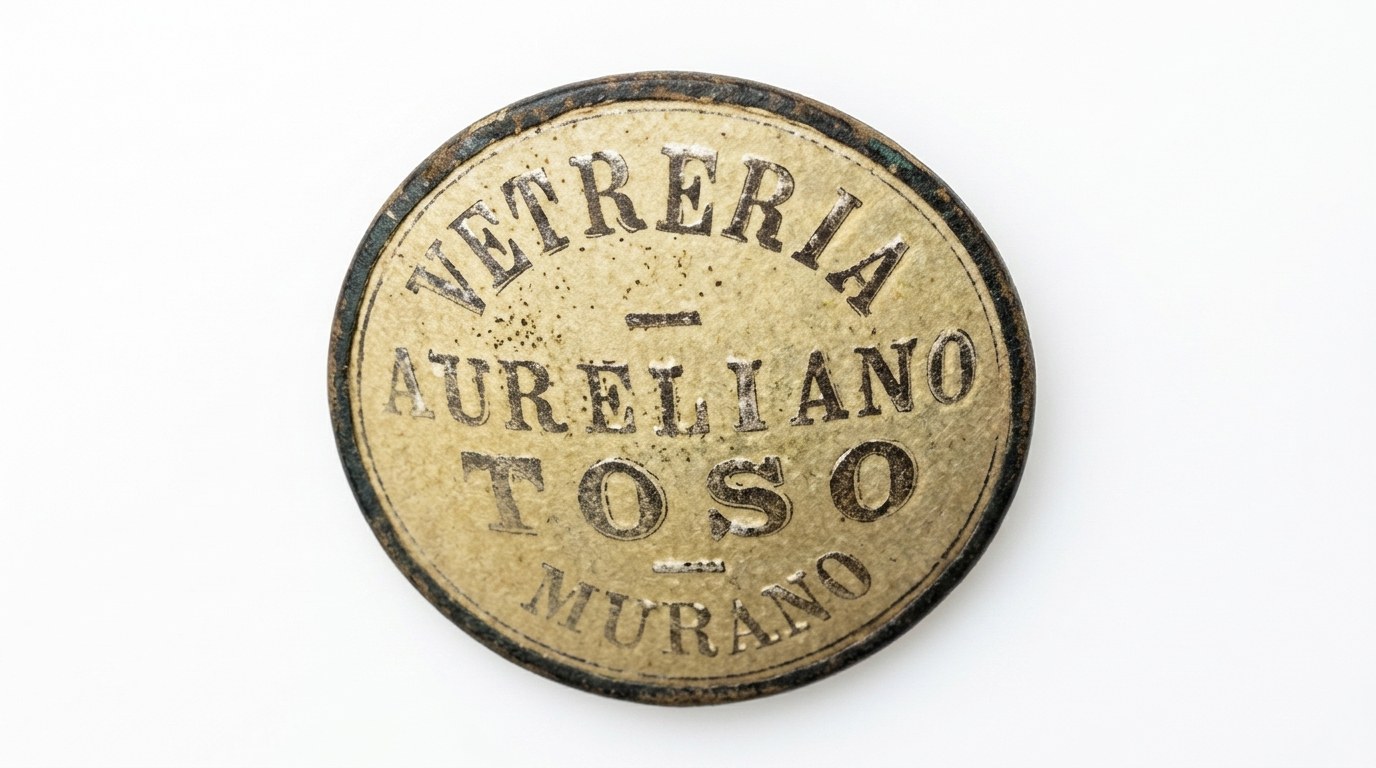
The Complete Collector's & Historian's Guide to Vetreria Aureliano Toso (1938–1968)
The Anatomy of a Murano Master: The Complete Collector's & Historian's Guide to Vetreria Aureliano Toso (1938–1968)
The mid-century design boom turned the island of Murano into a hotbed of creative tension, where centuries-old glassblowing traditions clashed with modern abstract art. At the center of this transformation was Vetri Decorativi Rag. Aureliano Toso. Founded in 1938, the furnace became a premier laboratory of modernism, fundamentally redefining how the world viewed glass—not merely as a functional vessel, but as a three-dimensional canvas for pure, non-functional artistic expression.
For collectors, appraisers, and historians, establishing the complete timeline, technical taxonomy, and authentication protocols of a Muranese furnace is a rigorous science. This guide provides a comprehensive historical template—replicable for any major furnace—detailing the complete history of Vetreria Aureliano Toso from its interwar origins to its post-war zenith and modern market legacy.
1. Company Identity & Founding Parameters
+------------------------+-------------------------------------------------------+
| Parameter              | Historical Data                                       |
+------------------------+-------------------------------------------------------+
| Official Nomenclature   | Vetri Decorativi Rag. Aureliano Toso (1938)           |
| Alternative Names      | Aureliano Toso Vetri Decorativi; Aureliano Toso       |
| Primary Location       | Fondamenta Lorenzo Radi 24-25, Murano, Venice, Italy  |
| Corporate Structure    | Sole Proprietorship (1938); Partnership (1963)        |
| Key Identifying Target | Hand-blown Art Glass (1938-1965); Lighting (Post-1965)|
+------------------------+-------------------------------------------------------+
2. Corporate Origins & Systemic Ruptures (1932–1938)
The 1932 Schism and the Ragioniere's Vision
To understand the inception of Aureliano Toso, one must look back to the structural reorganization of the Venetian glass industry during the Great Depression. Aureliano Anacleto Toso (1894–1979) was a scion of the legendary Toso glassmaking dynasty, whose roots on Murano dated back to 1350. Trained both as a glassmaker and a ragioniere (certified accountant), Aureliano began his career administering his family's highly conservative firm, Fratelli Toso (established in 1854).
By the early 1930s, Aureliano grew frustrated with Fratelli Toso’s rigid reliance on symmetrical, historicist styles and repetitive murrine patterns. In 1932, he made a definitive ideological break from his family, resigning from his administrative position. This "1932 Schism" represents a vital turning point in Murano history, signaling a shift away from traditional, committee-led family guilds toward agile, designer-led entrepreneurial models.
Following his departure, Aureliano assumed the directorship of Successori Andrea Rioda, which was then operating in receivership under the financial backing of Salviati. His six-year tenure there allowed him to observe the evolving international luxury market and, crucially, to solidify his creative partnership with the avant-garde painter Dino Martens.
The Toso Dynasty Chronological Split:
 Fratelli Toso Founded --->  Aureliano Toso Departs --->  Vetreria Aureliano Toso Founded
                                                                L--->  Directs Successori Andrea Rioda
The Turnkey Acquisition of the Romano Mazzega Furnace (1937)
When Successori Andrea Rioda was put into liquidation in late 1936, Aureliano was released from his contract. He immediately recognized a strategic opportunity. In 1937, he purchased the physical facility, formulas, and existing model catalogs of the former Vetreria Artistica Romano Mazzega at Fondamenta Lorenzo Radi.
This turnkey purchase provided Aureliano with the necessary physical infrastructure—furnaces, annealing ovens, and tools—to bypass the strict interwar regulatory barriers of the Murano glass district. More importantly, it allowed him to inherit a stable, highly skilled labor force of master glassmakers who already understood the thermal properties of the furnace’s specific melts. In March 1938, Aureliano officially founded Vetri Decorativi Rag. Aureliano Toso.
3. Chronological Eras of Production
The Formative & Commercial Reconstruction Phase (1938–1939)
The initial years of Vetreria Aureliano Toso were low-profile, commercially minded, and structurally reliant on inherited assets. The factory launched with twenty-five workers, led by four master blowers: Vittorio Rioda, Augusto Ongaro, Giuseppe Cimarosti, and Ermete Toso.
Because the furnace archives of Romano Mazzega and the defunct Società Industriale tra Maestri Vetrai di Murano had remained on the premises, Aureliano utilized their existing models and decor types to generate immediate, stable cash flow. The early catalog was occasionally augmented by modern, transitional designs by Amelio D'Este, primarily focusing on thick-walled, heavy cased glass (sommerso) and bubbly pulegoso glass.
Formative Production Hierarchy (1938-1939):
       [Aureliano Toso] (Proprietor & Ragioniere)
               |
    [Gaetano Canziani] (General Manager & Technician)
               |
  [Amelio D'Este] (Guest Designer) ----> [Mazzega Model Archive] (Reused Molds)
               |
   [Vittorio Rioda / Augusto Ongaro] (Maestros)
The Golden Age of Painterly Asymmetry (1940–1959)
As the Italian economy recovered, Aureliano Toso aimed to exhibit at the prestigious Venice Biennale. Realizing his current commercial inventory lacked artistic innovation, he invited his old friend Dino Martens to design a specialized, research-level collection for the XXII Venice Biennale in 1942. Martens delivered a radical series of heavy, asymmetrical, thick glass vessels with contrasting polychromatic color bands and spiral structures.
Following a hiatus caused by World War II, during which the factory survived by producing blanks for engravers under the guidance of Gaetano Canziani, Martens returned to Murano in late 1946. In February 1947, he was officially enlisted as the permanent disegnatore (designer), initiating the furnace's Golden Age. Over the next twelve years, Martens designed a legendary series of mostly unique or limited-edition art objects, aggressively pushing the boundaries of traditional Muranese glassblowing.
Golden Age Collaborative Loop (1946-1959):
[Martens' Painterly Sketches] ---> [Aureliano Toso's Financial Support] ---> [Aldo Bon & Hot-Shop Maestros] ---> [Finished Masterpiece]
The Space Age Transition & Generational Pivot (1960–1968)
In the late 1950s, Aureliano's son, Gianfranco Toso (born 1936), entered the firm’s management. Like his father, Gianfranco was trained as an accountant and possessed sharp commercial pragmatism. He recognized that the high labor costs and slow production rates associated with Martens' complex, hand-blown art objects were becoming economically unsustainable.
Gianfranco pushed to pivot the factory's output away from unique art glass toward semi-industrial architectural lighting and modular components that could be scaled for the modern "Space Age" market. This strategic shift caused significant internal tension between Gianfranco and his father, who fiercely protected Martens’ bohemian, artist-led model.
The Generational Ideological Split:
Aureliano Toso & Dino Martens:      "Artisanal Expressionism" ---> [Unique Pieces / Vases]
Gianfranco Toso & Gino Poli:       "Industrial Architecturalism" ---> [Modular Lighting / Tronchi]
Despite Aureliano's reluctance, the changing market forced a compromise. Martens retired as artistic director in 1959 but continued to supply designs on a freelance basis until his final departure in 1963. In December 1963, Aureliano and Gianfranco formed a formal partnership under the name Vetri Artistici Toso Aureliano e C..
In January 1968, the mutual company was dissolved. Aureliano donated the dormant Vetri Decorativi Rag. Aureliano Toso entirely to Gianfranco, who ceased all decorative vase production to manufacture modern lighting under the new name Vetreria Artistica Aureliano Toso di Gianfranco Toso.
4. The Collaborative Roster: Designers, Maestros, and Artists
Artistic Direction: The Hegemony of Dino Martens
Dino Martens (born Corrado Martens, 1894–1970) was the undisputed creative force of the furnace’s golden era. Trained as a painter at the Accademia di Belle Arti in Venice, Martens was an active member of the Italian Novecento movement, exhibiting paintings at the Venice Biennale throughout the 1920s.
His lack of formal training as a glassmaker was his greatest asset. He did not view the glass gather as a functional vessel to be centered, but rather as a molten, three-dimensional canvas. Martens utilized ancient, complex techniques—such as zanfirico filigree, cased sommerso, and avventurina—not to decorate, but to disrupt form, creating highly asymmetrical, organic, and biomorphic sculptures.
Lead Maestros: Aldo "Polo" Bon and the Hot-Shop Virtuosos
Because Martens was a painter who did not blow glass, his radical designs were entirely dependent upon the physical capacity and technical intelligence of a single master glassblower: Aldo "Polo" Bon (1906–1988). Serving as the lead maestro from 1939 to 1955, Bon acted as Martens' translator, navigating the precise thermodynamic properties of complex inclusions to prevent the asymmetrical glass masses from shattering in the annealing ovens.
The Maker's Execution Sequence (Hot-Shop):
[Gathering Base Glass (70/15/9)] ---> [Cold Pickup of Multi-Colored Canes/Murrine] ---> [Hot Shaping Asymmetrical Silhouette] ---> [Grip-and-Tooling via Borselle/Shears] ---> [Controlled Annealing]
Bon was supported by an elite team of maestros, each specializing in specific hot-working maneuvers:
- Mario Zanetti: Master of complex traditional techniques and structural color bands.
- Silvano Simioni: Specialist in handling massive gathers of cased glass and heavy, multi-layered inclusions.
- Augusto Ongaro: Expert in encased glass, later serving as the Director of the Abate Zanetti School of Art for Glassworkers (1949–1972).
- Vittorio Rioda: Bridged historical techniques with modern forms, mastering traditional "feathered" effects.
- Giuseppe Cimarosti: Specialized in the physical manipulation of large gathers and heavy sculptural centerpieces.
Guest Artists & International Collaborators
To diversify the catalog and compete with Venini, Aureliano Toso proactively engaged in brief, high-profile collaborations with contemporary painters and graphic designers during the 1950s:
- Jan Le Witt (1950): The Polish-born British graphic designer brought a structured, international graphic modernism to the furnace, treating the glass vessel as a symbolic, flat silhouette (exemplified by the Deux bouteilles series).
- Fioravante Seibezzi: The Venetian landscape painter collaborated with the Maestros to translate the fluid colors, atmospheric light, and textures of the Venetian lagoon into glass.
- Aldo Bergamini: An independent designer whose Novecento-inspired, classical proportions and spatialist theories treated cased glass as a three-dimensional sculpture.
The Late-Period Successors: Enrico Potz and Gino Poli
- Enrico Potz (1962–1965): Appointed as an outside consultant and assistant to Dino Martens. Potz acted as an aesthetic bridge, taming Martens' expressive, chaotic colors into the structured, geometric, and linear forms required by the emerging "Space Age" aesthetic.
- Gino Poli (1965–1976): Arriving from Venini & C., Poli spearheaded the modular lighting revolution. He focused on how glass interacted with light, designing the A Solchi Colorati (with colored grooves) art glass series and the internationally successful Tronchi (logs) modular chandelier system.
5. Technical Taxonomy & Material Science
The Chemistry of Lightness: The Sodic-Calcic Glass Formula
Unlike leaded crystal or heavy industrial glass, the unique physical properties of authentic mid-century Aureliano Toso glass were derived from a precise, non-leaded sodic-calcic glass batch formulated by the furnace:
$$\text{SiO}_2 \text{ (Silica)}: 70% \quad | \quad \text{Na}_2\text{O} \text{ (Soda)}: 15% \quad | \quad \text{CaO} \text{ (Lime)}: 9% \quad | \quad \text{Stabilizers/Oxides}: 6%$$
This specific chemistry produced a "soft," lightweight, and highly ductile material with a long working time on the blowpipe. This long working thermal window was essential for executing complex, asymmetrical vessels. The lack of heavy lead components meant that even massive vases remained unexpectedly light under hand, displaying subtle, natural material irregularities such as tiny carbon air bubbles ("seeds") that prove its hand-blown, non-industrial nature.
Signature Techniques
1. Vetro Oriente (1951–1952)
The absolute pinnacle of the Martens-Bon collaboration, the Oriente technique is a tour de force of hot-working complexity.
Vetro Oriente Layering Architecture:
+-------------------------------------------------------------+
| 1. Outer Casing: Clear Sodic-Calcic Glass (Cristallo)       |
+-------------------------------------------------------------+
| 2. Suspended Collage:                                       |
|    - Opaque Glass Pastes (Yellow, Red, Blue, Black, White)  |
|    - Twisted Zanfirico Cane Fragments                       |
|    - Shimmering Avventurina (Copper Crystals)                |
|    - Star Murrine / Pinwheel Flower Motif                   |
+-------------------------------------------------------------+
| 3. Inner Parison: Clear Sodic-Calcic Glass (Cristallo)      |
+-------------------------------------------------------------+
The process relied on a cold alignment technique. Ground glass, colored square pieces, twisted zanfirico cane fragments, and a signature pinwheel "flower" murrine (made of black and white milk-glass rods) were meticulously arranged on a flat steel plate.
The arrangement was slightly heated and picked up directly onto a molten, colorless glass bubble (parison) on the blowpipe. Further blowing, shaping, and casing within a clear outer protective layer of glass fused the elements into a single, cohesive, and highly expressive collage.
2. Vetro Eldorado (1952–1953)
Developed simultaneously with the Oriente series, the Eldorado technique utilized the same cold alignment and pickup process. However, it is distinguished by the use of transparent ground glass rather than opaque glass pastes, resulting in a lighter, cased effect.
The defining feature is the high concentration of avventurina—translucent glass containing suspended metallic copper crystals that were sprinkled heavily over the entire surface, creating a glittering, golden, and metallic depth. The series had an extremely short lifespan and was discontinued in late 1954.
Technique Comparison:
- Vetro Oriente: Opaque Glass Pastes + Dense Patchwork + Star Murrine Focus
- Vetro Eldorado: Transparent Glass Pastes + Sprinkled Aventurine + Golden Shimmer
3. Sommerso with Moleria: The Gomitolo Series (1954)
While Oriente and Eldorado represented additive processes at the furnace, the Gomitolo ("ball of yarn") series utilized a radical subtractive process.
The base vessel was hand-blown using a heavy sommerso technique, encasing a multi-colored internal core within thick walls of clear glass. Once cooled, the piece was transferred to the moleria (cold-grinding workshop). Here, master cold-workers used abrasive wheels to cut deep, rhythmic, overlapping, and spiraling grooves into the glass surface, mimicking a wrapped ball of yarn and producing a tactile, sculptural texture.
6. Exhibition History & Institutional Validation
The critical validation and historical value of Aureliano Toso’s art glass were established through consistent participation in the world's most prestigious design forums:
The Venice Biennale
- XXII Biennale (1942): First major display. Showcased experimental thick glass with opposing colored bands and cased spiral structures.
- XXIV Biennale (1948): Formal introduction of the pittorico (painterly) style, highlighted by the debut of the legendary prototype "La Bottiglia del Mago" (The Magician's Bottle).
- XXVI Biennale (1952): Dedicated historical showcase of Murano glass where Martens’ completed Oriente and Eldorado series were celebrated as defining the post-war Italian modern aesthetic.
The Milan Triennale
- IX Triennale (1951): The watershed moment for the furnace. Aureliano Toso was awarded the Gold Medal for a specialized collection of colored vases and zanfirico dishes. This prize solidified the firm's reputation in the luxury design sector, proving that artisanal, unique hand-blown glass had an essential place in modern interior design.
7. Forensic Authentication & Verification Guide
Mid-century Aureliano Toso art glass was rarely signed with permanent etched or engraved marks. Authentic pieces must be verified through a holistic forensic analysis of physical, material, and archival markers:
                  +---------------------------------------+
                  |  FORENSIC AUTHENTICATION ARCHITECTURE |
                  +---------------------------------------+
                                      |
         +----------------------------+----------------------------+
         |                                                         |
         v                                                         v
+--------------------------+                             +--------------------------+
|    PHYSICAL MARKERS      |                             |     ARCHIVAL PROOF       |
+--------------------------+                             +--------------------------+
| 1. Ground Pontil Scar    |                             | 1. Model Register        |
|    - Concave depression  |                             |    - Over 5,000 entries  |
| 2. Sodic-Calcic Weight   |                             | 2. Four-Digit Models     |
|    - Unexpected lightness|                             |    - Form/Shape match    |
| 3. "Seeds" Inclusions    |                             | 3. Verified Drawing      |
|    - Small air bubbles   |                             |    - Direct sheet match  |
+--------------------------+                             +--------------------------+
Physical Attribution Marks
- The Ground Pontil Scar: The base of any genuine Aureliano Toso piece must be scrutinized. Hand-blown vessels were held on a pontil rod during final shaping. When broken off, this left a rough scar. On high-end Toso pieces, this scar was meticulously ground down and polished during the cold-working phase, leaving a smooth, concave, circular depression. The presence of a rough pontil on smaller utility pieces is acceptable, but a perfectly flat base showing a molded seam is an immediate indicator of a counterfeit.
- Material Density & Weight: Because of the lead-free sodic-calcic (70/15/9) chemistry, genuine pieces will feel remarkably light and thin-walled under hand compared to heavy, thick-walled modern leaded duplicates. Flawless transitions between the colored layers of sommerso casing are also essential; duplicate pieces often display fuzzy, bleeding, or inconsistent delineation between color zones.
Historic Labels, Stamps, and Stickers
When original paper or foil labels survive, they provide invaluable initial provenance. Collectors must look for three distinct eras of labeling:
+------------------+------------------+---------------------------------------------------------+
| Label Type       | Era              | Characteristics & Wording                               |
+------------------+------------------+---------------------------------------------------------+
| Primary Foil     | 1950s            | Metallic silver or gold foil shield; reads:             |
|                  |                  | "Vetreria Aureliano Toso Murano"                        |
+------------------+------------------+---------------------------------------------------------+
| Retailer/Export  | Mid-20th Century | Paper stickers from importers like Balboa or Jordan     |
|                  |                  | Imports (JICo); or generic "Made in Italy / Murano"     |
+------------------+------------------+---------------------------------------------------------+
| Consortium Label | Post-1981        | Standardized Veneziavetro labels featuring the official |
|                  |                  | factory designation number: "VM 012"                    |
+------------------+------------------+---------------------------------------------------------+
Archival Verification
The discovery and subsequent analysis of the Aureliano Toso company archive permanently transformed the market. The archive contains over 1,500 original project drawings and a model register with over 5,000 entries.
This discovery established a strict chronological mapping of model numbers, allowing collectors to verify authenticity by matching the physical shape and technique of a vessel to its original factory drawing and model series:
- Models 1 to ~5000 (1938–1960): The classic, hand-blown art glass era dominated by the designs of Dino Martens.
- Models ~5001 to ~6000 (1960–1965): The transition period, showing late-period Martens designs and early Enrico Potz collaborations.
- Models 6001 to 7000+ (Post-1965): The structural, modernist lighting era led by Gino Poli.
8. Distinguishing Overlapping Attributions: The Toso-Mazzega Nexus
Due to shared family lineages and geographical overlaps on Murano, secondary market listings frequently misattribute pieces between three distinct entities. Collectors must utilize this comparative framework to isolate true Vetreria Aureliano Toso works:
Tripartite Furnace Differentiation:
- Vetreria Aureliano Toso: Painterly Abstraction ---> [Asymmetry, Patchwork, Sodic Glass]
- Vetreria Fratelli Toso:  Mosaic Tradition      ---> [Symmetrical, Murrine, Nerox Base]
- IVR Mazzega:             Sculptural Modernism  ---> [Solid Massello, Ermanno Nason]
Vetreria Aureliano Toso vs. Vetreria Fratelli Toso
While both furnaces carried the Toso surname, they operated as entirely separate corporate entities with different branches of the family.
- Fratelli Toso (1854–1982): Retained a deep commitment to traditional, highly symmetrical Venetian forms and repetitive, mosaic-style murrine and millefiori patterns. Under artistic director Ermanno Toso, the furnace specialized in the Kiku (daisy) pattern and utilized Nerox—a dense, highly distinctive black oxide glass—for its bases.
- Aureliano Toso: Decisively broke with this historicist tradition, utilizing Dino Martens' painterly, asymmetrical, and biomorphic forms to create modern sculptures.
Vetreria Aureliano Toso vs. IVR Mazzega (Ermanno Nason)
The confusion stems from Aureliano's 1937 purchase of Romano Mazzega’s physical facility, which was subsequently renamed. The Mazzega family immediately reorganized, establishing Fratelli Mazzega (later IVR Mazzega) in 1938.
- IVR Mazzega (1938–1983): Primarily focused on monumental, sculptural glass. Under the direction of master glassblower Ermanno Nason, the furnace specialized in executing designs for Egidio Costantini’s Fucina degli Angeli (collaborating with Picasso, Chagall, and Jean Cocteau).
- Nason's pieces utilize the massello technique—sculpting a solid mass of hot glass without an internal air bubble, making them significantly heavier than glass blown at Aureliano Toso. Nason also frequently utilized the Scavo technique, applying minerals to the hot glass surface to mimic the corroded, chalky texture of excavated Roman artifacts.
9. The Contemporary Market & Investment Landscape
The secondary market for mid-century Aureliano Toso art glass has matured from decorative collectibles into a robust, high-stakes asset class. The valuation of these pieces is strictly stratified into three collecting tiers:
- Tier 1: Museum-Grade Masterworks ($15,000–$200,000+): Focuses on documented Biennale models and the rarest Martens series: Oriente, Eldorado, and the Sirventese bottle. These unique or limited-edition pieces are characterized by extreme asymmetry, pristine condition, and a clear, documented provenance.
- Tier 2: Architectural Design ($4,000–$19,000): Dominated by the Gino Poli-era modular lighting systems. Large, multi-tiered Tronchi chandeliers in custom colors (such as fumé or amber) are highly sought after by luxury interior designers.
- Tier 3: Decorative Entry Points ($300–$3,500): Comprises smaller, production-line tableware, cased sommerso bowls, animal sculptures (particularly fish and birds), and A Solchi Colorati vessels by Gino Poli.
Macro-Economic Drivers of Value
The financial trajectory of vintage Aureliano Toso glass is heavily reinforced by a modern scarcity crisis on Murano. Skyrocketing energy costs in Europe have forced many active furnaces to halt production.
Because the creation of Martens' complex designs requires immense fuel consumption and a level of hot-shop virtuosity that is rapidly dying out, these mid-century masterpieces are increasingly viewed as irreplaceable artifacts of Murano's golden age. For the contemporary investor, a curated, authenticated collection of Vetreria Aureliano Toso represents a stable and historically significant stake in 20th-century decorative art history.
If you have a physical piece in your collection, we can cross-reference its characteristics with the archival model register to identify its series and approximate production year. Want to investigate?