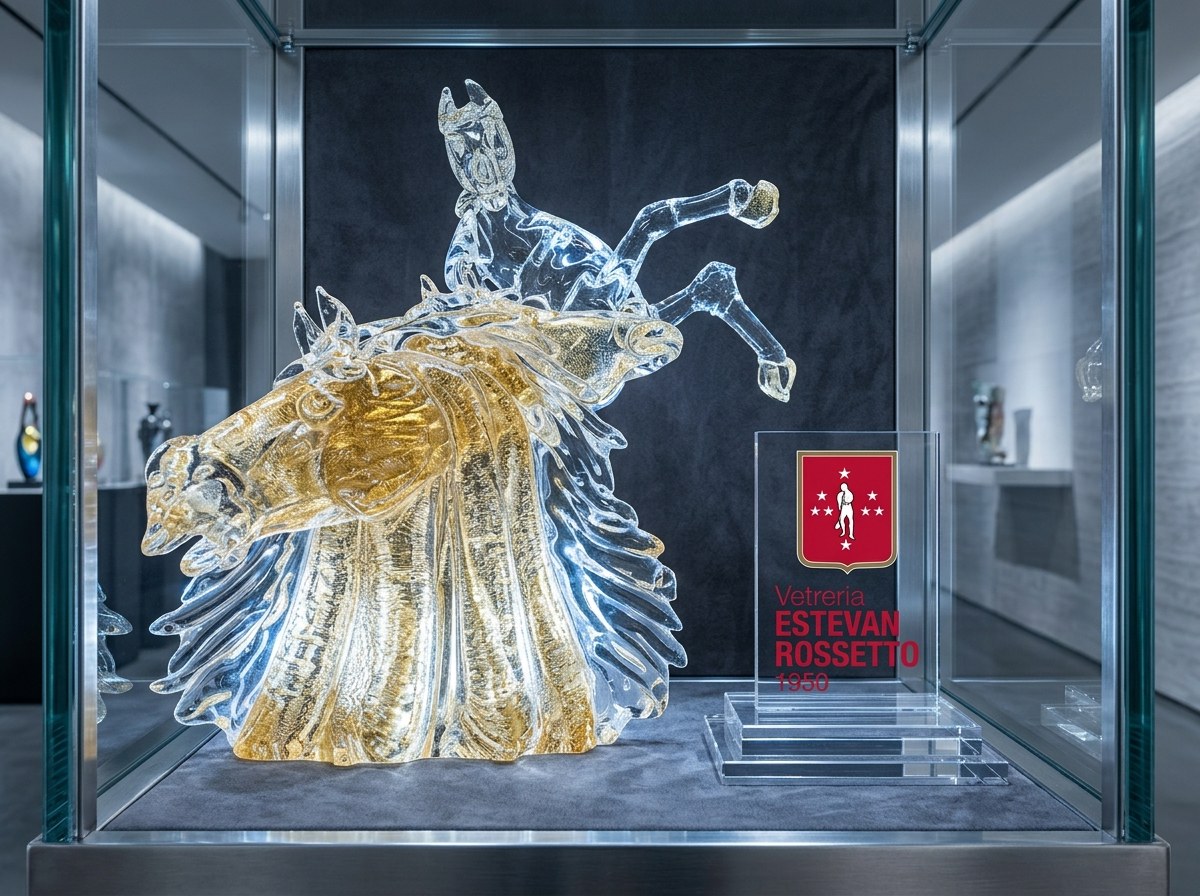
The Alchemy of Collaboration: A Connoisseur’s Guide to Vetraria Estevan Rossetto
Furnace Profile
| Registry Parameter | Archival & Operational Details |
|---|---|
| Founder | Maestro Estevan Rossetto (Furnace established in 1950) |
| Re-Incorporation | March 16, 2012 (As Vetreria Estevan Rossetto 1950 S.r.l.) |
| Regional Base | Fondamenta Andrea Navagero 50, Murano, Venice, Italy |
| Key Historic & Contemporary Personnel | * Estevan Rossetto (Founder, Master Glassblower & Sculptor) * Enzo Laggia "Neno" (Chief Grinding & Cold-Working Master, 1950s–1960s) * Maestro Giovanni Nicola (Collaborating Master Glassmaker, 2012–2024; d. 2024) |
| Historic Commercial Partnerships | * Seguso Vetri d'Arte (Blank Supplier, 1958–1965) * Venini (Post-bankruptcy inventory sourcing, 1970s) |
| Primary Signature & Provenance Markers | 1. Scribed diamond-point or acid-etched signature: "Estevan Rossetto" on the polished base 2. Silver foil labels on the upper body of mid-century figurines 3. Circular paper labels on the polished base 4. Modern Certificate of Authenticity (COA) issued by Rossetto S.r.l. |
The Alchemy of Collaboration: A Connoisseur’s Guide to Vetraria Estevan Rossetto
For collectors, appraisers, and scholars of mid-century Venetian decorative arts, the lineage of Vetraria Estevan Rossetto offers a compelling study of how traditional, highly guarded glassmaking guilds transitioned into modern collaborative and corporate business models. Rather than operating as an isolated hot-shop, the Rossetto workshop established a pioneer paradigm that bridged ancestral glassmaking secrets with an innovative, network-driven approach to design, finishing, and retail distribution.
Understanding the history of this furnace requires analyzing the shifting economic, artistic, and physical landscapes of the Venetian lagoon—from the strict trade regulations of the medieval Republic to its modern corporate renaissance.
The Venetian Legacy: Guild Foundations and the Golden Book of Murano
The structural evolution of Vetraria Estevan Rossetto is rooted in the unique socio-legal and geographic framework of the Venetian lagoon. In 1291, responding to the catastrophic threat of fire posed by wooden furnaces in Venice proper, the Venetian Republic mandated the relocation of all glassmaking operations to the island of Murano. This strategic move served a dual purpose: it isolated a significant industrial hazard and facilitated the strict surveillance of glassmaking secrets by the state.
Glassmakers were granted extraordinary statutory privileges, including immunity from certain prosecutions and the right to marry their daughters into noble Venetian families; however, they were legally forbidden from leaving the lagoon under penalty of imprisonment or state-sanctioned reprisal. To regulate this elite class of artisans, the Republic compiled the Libro d'Oro ("Golden Book") of Murano, registering the dominant families who formed the independent local government and managed the trade guilds.
The founder of Vetreria Estevan Rossetto descended directly from one of these historic dynasties registered in the Libro d'Oro, inheriting both the ancestral technical secrets and the social prestige required to establish an independent furnace on the island.
                [ Murano Libro d'Oro Guild Lineage ]
                               │
                ┌──────────────┴──────────────┐
         [ C. Maschio ]              [ Barovier & Toso ]
         (Early 1930s)                (Late 1930s–1940s)
                │                              │
                └──────────────┬───────────────┘
                               ▼
                [ Estevan Rossetto (Founder) ]
                    Furnace Opened: 1950
               Fondamenta Andrea Navagero 50
The Biographical Trajectory of Maestro Estevan Rossetto
Estevan Rossetto’s career as a master glassblower and sculptor spanned a period of profound artistic transition in Murano, bridging the classical revivalism of the early 20th century with the bold, sculptural modernism of the post-war era.
- The Early 1930s (The C. Maschio Apprenticeship): Rossetto was employed as a master glassblower by the newly established firm C. Maschio. Founded in 1932 by the entrepreneur Cirillo Maschio and the prominent painter Giuseppe Chiacig, who served as art director, the C. Maschio firm achieved notable success during the 1930s by integrating fine-art principles into traditional glasswares. Under Chiacig’s stylistic influence, Rossetto developed a deep appreciation for the interaction of light, color, and geometric form.
- The Late 1930s (The Barovier & Toso Phase): Rossetto subsequently refined his sculptural sensibilities when he joined the historic furnace of Barovier & Toso. Here, he specialized in the execution of complex hot-modeled sculptures. During this highly productive phase of his career, Rossetto participated in numerous prestigious international exhibitions and performed public glassmaking demonstrations on specialized stages. These demonstrations served as vital marketing and cultural diplomacy events, solidifying his reputation as an elite master glassblower (maestro vetraio).
- The 1940s Restructuring: The geopolitical and economic challenges of the 1940s forced Rossetto to restructure his professional activities. He ceased active blowing and pivoted into commercial marketing, successfully opening several retail sales points across Murano to leverage the emerging post-war tourist market.
- The 1950 Founding: This commercial foundation culminated in 1950 with the establishment of his own dedicated furnace and decorating studio, Vetreria Estevan Rossetto, located at Fondamenta Andrea Navagero 50.
The Art of the Shared Canvas: The Seguso Blank Alliance
During its primary period of operations in the 1950s and 1960s, Vetreria Estevan Rossetto adopted an innovative operational structure that integrated external manufacturing partnerships with in-house specialized finishing.
┌────────────────────────┐      B2B Blanks      ┌───────────────────────────┐
│  Seguso Vetri d'Arte   ├─────────────────────►│ Vetreria Estevan Rossetto │
│ (Hot Glass Production) │     (1958–1965)      │ (Specialized Cold-Cutting)│
└────────────────────────┘                      └─────┬─────────────────────┘
                                                      │
                                                      ▼
                                              [ Enzo Laggia ("Neno") ]
                                               Master of Battuto Cut
Rather than relying entirely on its own furnaces to blow large decorative vessels, the Rossetto brothers purchased original, semi-finished glass blanks directly from Seguso Vetri d'Arte between 1958 and 1965. These blanks—often featuring complex internal casing (incamiciato) or submerged layers of colored glass (sommerso)—were then brought to the Rossetto workshops for specialized cold-working, cutting, and engraving.
The Grinding Master: Enzo Laggia ("Neno")
The artistic mastermind behind these cold-worked masterpieces was the grinding and cutting master Enzo Laggia, widely known by his nickname "Neno". Born in 1938, Laggia possessed a remarkably diverse technical background, entering the glass industry at a very young age:
- At age eleven (1949), he entered the glass industry as a strisaòr (furnace stoker and oven guard) at the Cenedese glassworks.
- He subsequently trained as a cutter and trimmer at the Marsiglio workshop.
- He worked as a grinder at the Vincenzo Nason glassworks.
- He completed his training as a garzonetto (master's helper) under Seguso De Fortuna.
Employed by the Rossetto brothers, Neno utilized his advanced knowledge of grinding wheels to carve intricate geometric patterns, textured relief work (battuto), and expressive figurative engravings directly into the heavy glass blanks sourced from Seguso Vetri d'Arte.
Because the completed, engraved vessels were sold exclusively through the Rossetto brothers' proprietary retail boutiques, they were signed with the "Estevan Rossetto" signature and labeled with the company’s brand markers. This strategic division of labor allowed both enterprises to maximize their core strengths: Seguso Vetri d'Arte provided flawless hot-glass canvases, Neno executed world-class cold engravings, and Estevan Rossetto managed the elite commercial presentation and retail distribution.
Insolvency, Succession, and the Rise of Vetreria Venier
The delicate balance of Murano's post-war export market was severely disrupted in the 1970s, leading to the financial collapse and bankruptcy of Vetreria Estevan Rossetto. Following the insolvency of the company, the remaining assets, unsold inventory, and commercial contracts were fractured. During this transitional period, existing stock was supplemented by purchases of finished pieces from Venini, as well as direct acquisitions from the independent grinding workshop operated by Enzo Laggia ("Neno").
Having established his own trading company, Muranese Export, in 1969, Laggia capitalized on the bankruptcy of his former employer. In 1975, he purchased the historic headquarters and physical plant of the defunct Estevan Rossetto glassworks at Fondamenta Andrea Navagero. Laggia renamed the facility Vetreria Venier, transforming the former Rossetto premises into a major production center. Over the subsequent decades, Vetreria Venier expanded into adjacent properties, ultimately creating an elite exhibition showroom spanning over 2,500 square meters.
The 21st Century Renaissance: Corporate Re-Emergence
While the original physical furnace site was absorbed by Vetreria Venier, the brand identity, family heritage, and intellectual property of Estevan Rossetto were preserved by the founder's descendants. On March 16, 2012, the family formally re-incorporated the business as Vetreria Estevan Rossetto 1950 S.r.l., registering its corporate headquarters back at Fondamenta Andrea Navagero 50.
Under the administrative leadership of the founder's daughter, Doriana Rossetto, and her relative Roberto Rossetto, the modern enterprise has re-established itself as a highly profitable luxury glass brand. By 2024, the company recorded an annual turnover of over €11 million, employing 63 highly skilled workers in 2026 to manage its global retail, wholesale, and demonstration operations.
A central mission of the modern Rossetto family is the preservation of authentic Venetian glassblowing. The company actively uses its historic showroom to educate international buyers on the differences between genuine, hand-blown Murano glass and the cheap, industrial counterfeits imported from China and Brazil.
[ ARCHIVAL GENEALOGY OF THE HISTORIC SITE ]

     1950-1975: VETRARIA ESTEVAN ROSSETTO
     (Founders of Navagero 50 Site)
                   │
                   ▼ (1975 Bankruptcy)
     1975-Present: VETRERIA VENIER
     (Physical Site Successor under Enzo Laggia)
                   │
                   ▼ (2012 Brand Resurrection)
     2012-Present: VETRERIA ESTEVAN ROSSETTO 1950 S.R.L.
     (Corporate Brand Return to Navagero 50)
The Passing of a Legend: Maestro Giovanni Nicola (1965–2024)
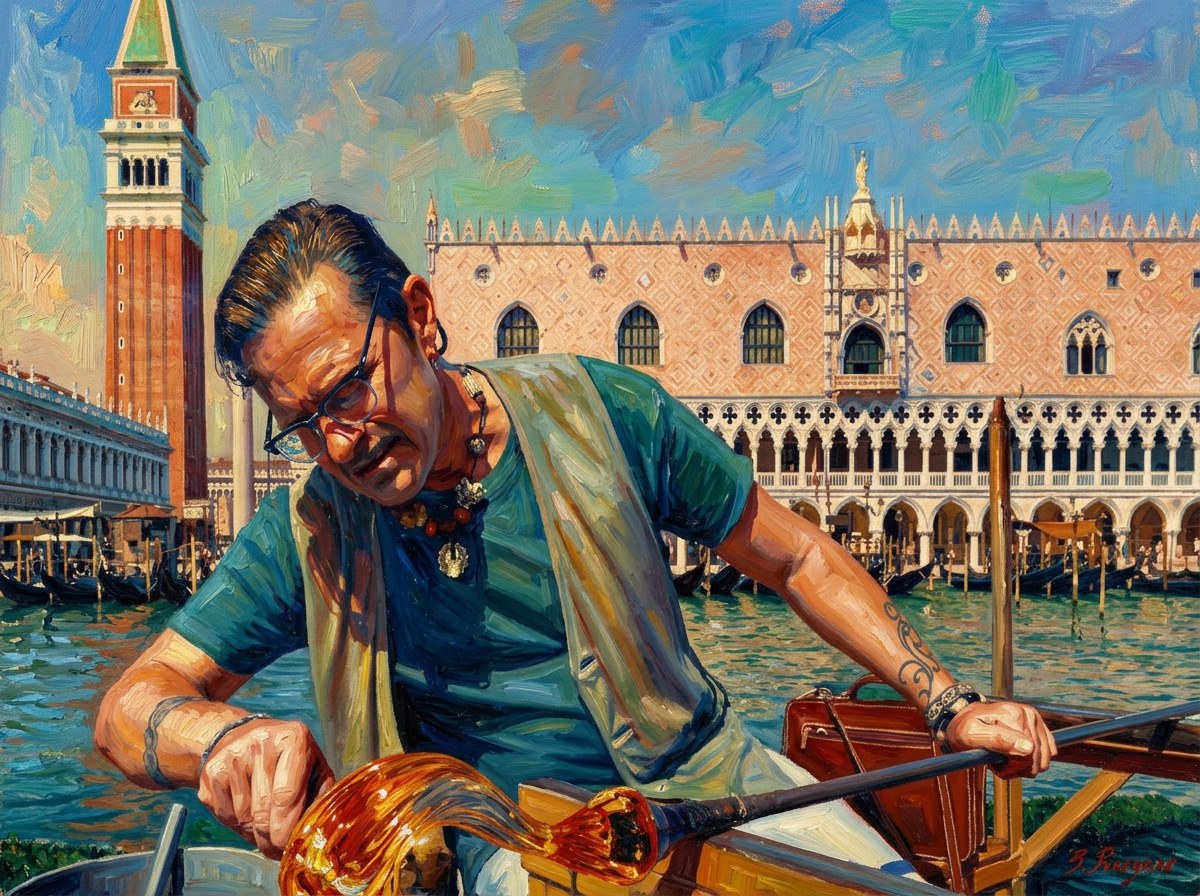
To maintain the rigorous artistic standards of their heritage and combat counterfeits, Vetreria Estevan Rossetto 1950 S.r.l. entered a historic collaboration with Maestro Giovanni Nicola. Giovanni Nicola's professional lineage represented the elite technical standard of the island's mid-century masters:
- Born in Venice in 1965, Nicola entered the furnace at age twelve (1977) as an apprentice at the Giulio Ferro glassworks in Sacca Serenella.
- In the 1980s, he worked with his father Carlo as a serventino (apprentice/server) within the great Master Mario Badioli's piazza.
- He subsequently joined the workshop of Archimede Seguso, working side-by-side with the legendary master until Seguso’s death in the 1990s. Nicola's father had initially resisted his entry into this hard trade, but after recognizing his passion and talent, sent him to the great Archimede Seguso, advising him that to grow, he had to learn from the greatest. Giovanni learned from this experience the crucial lesson of "respecting the glass".
- At only 22 years of age (1987), Nicola was awarded the Master's scagno (the master's working seat) by Archimede and his brother Angelo Seguso, designating him as the leader of the furnace's main production line (piazza).
- Since 2015, Nicola served as the chief master glassblower at the Scuola del Vetro Abate Zanetti.
The Murano glass world was shocked and saddened by the sudden passing of Maestro Giovanni Nicola in 2024. Taken far too early, Nicola was widely revered as the last keeper of the secrets of Archimede Seguso. With his passing, the legendary technical secrets of the Seguso family—passed down from generation to generation within the dynasty, to Archimede, and finally to Giovanni—were lost to the physical world. This has created a tremendous vacancy of cumulative knowledge that may never be replaced on the island. His collaboration with Vetreria Estevan Rossetto 1950 S.r.l. from 2012 to 2024 represents a finite, highly valuable, and poignant final chapter in his career, leaving these late sculptural works as modern monuments to his genius.
The Diagnostic Index: Notable Historical and Contemporary Creations
The historical and contemporary output of Vetraria Estevan Rossetto is characterized by an uncompromising mastery of complex chemical formulations and physical manipulation. The following catalog documents specific reference pieces that exemplify the technical capabilities of the furnace across its history.
- The Water Carrier (1955): This monumental mid-century sculpture, measuring 14.5 inches in height, is a showcase of the furnace's mastery of internal color casing and hot-modeled application. The figure is constructed of internally decorated glass embedded with genuine gold leaf inclusions, which are blown and stretched to create a shimmering, textured skin. Secondary figurative details—such as the water vessels and limbs—were hand-modeled a caldo (while hot at the furnace) and fused directly to the central body. A prime example of this piece was sold at the Wright Art + Design auction in April 2021, illustrating its high status among collectors of post-war Italian design.
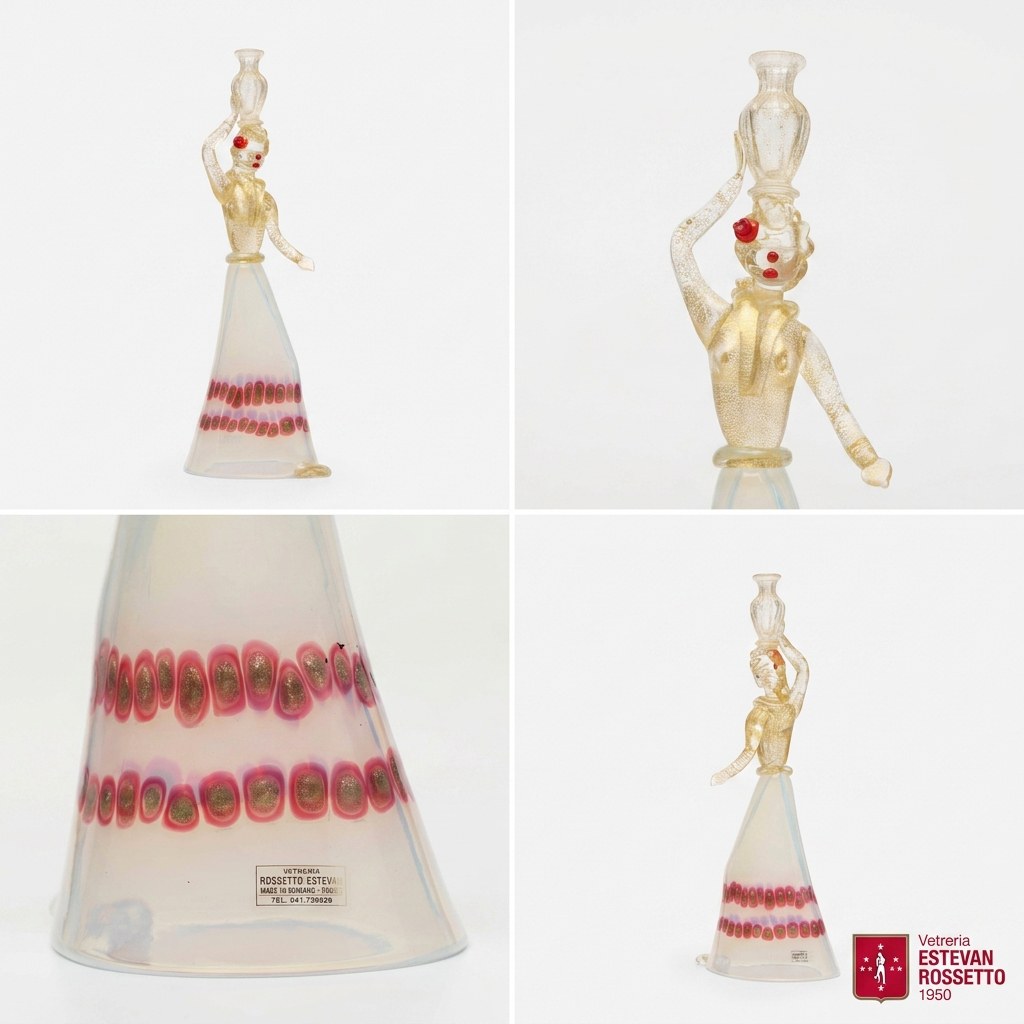
Wright Auctions The Water Carrier (1955)
- Male Dandy Figure (c. 1960): This 7.75-inch figurine represents the post-war "Rococo-retro" style that was highly popular among international collectors. This figure is identified by dual labeling: a silver foil label on the top side of the base and an original paper label affixed to the underside of the circular base.
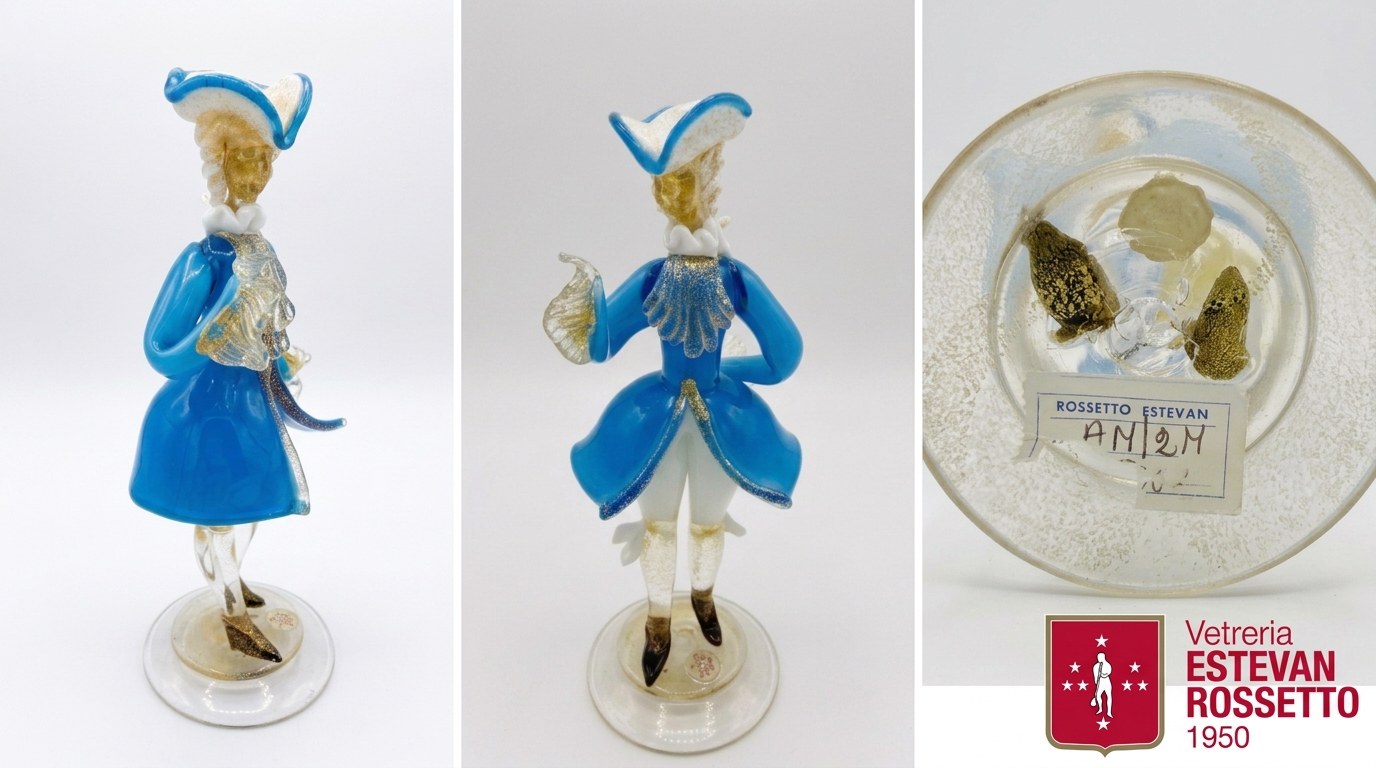
Male Dandy Figure - Vetraria Estevan Rossetto
- Seguso-Rossetto Battuto Vases (1958–1965): These collaborative vases represent the pinnacle of Neno’s (Enzo Laggia) grinding work on glass blanks blown at Seguso Vetri d'Arte. Standing between 34.5 and 37.5 centimeters high, these heavy vessels typically utilize the incamiciato (cased) technique to layer contrasting colors of glass. Neno then subjected the cooled exterior to the battuto (beaten) technique, using specialized wheels to grind thousands of tiny, irregular facets into the surface, mimicking the appearance of hand-hammered metal. These rare, signed pieces command high prices in European decorative arts galleries.
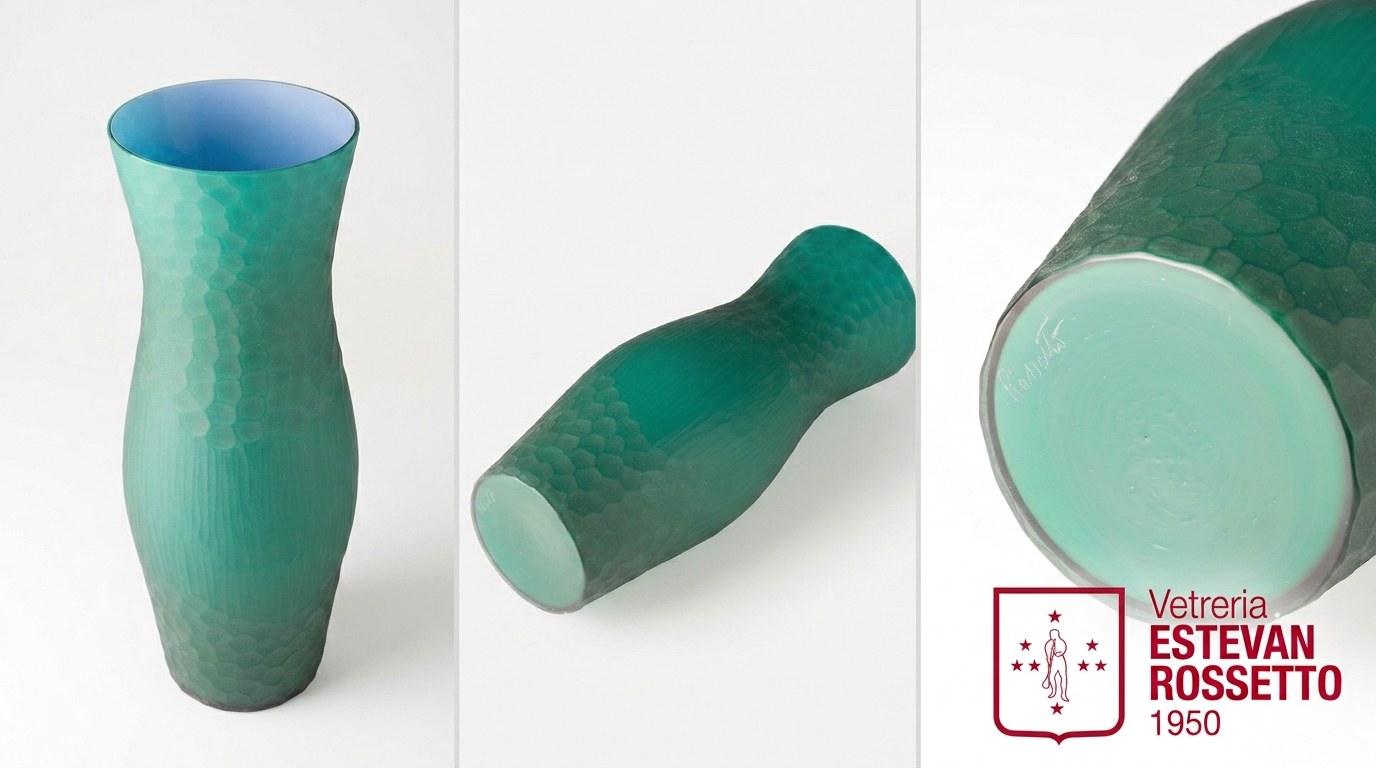
Seguso-Rossetto Battuto Vases (1958–1965)
- Green and Silvered Decanter Set (1950s): A superb example of Rossetto’s functional tableware, this set features a globular-bodied green glass decanter (20 centimeters tall) with a matching stopper and six rounded shot glasses (5 centimeters tall). The set is decorated with hand-applied silver overlay detailing that was fired onto the glass to create a raised, lustrous metallic contrast against the emerald-green base glass. The base of the decanter retains the original paper label of Estevan Rossetto.
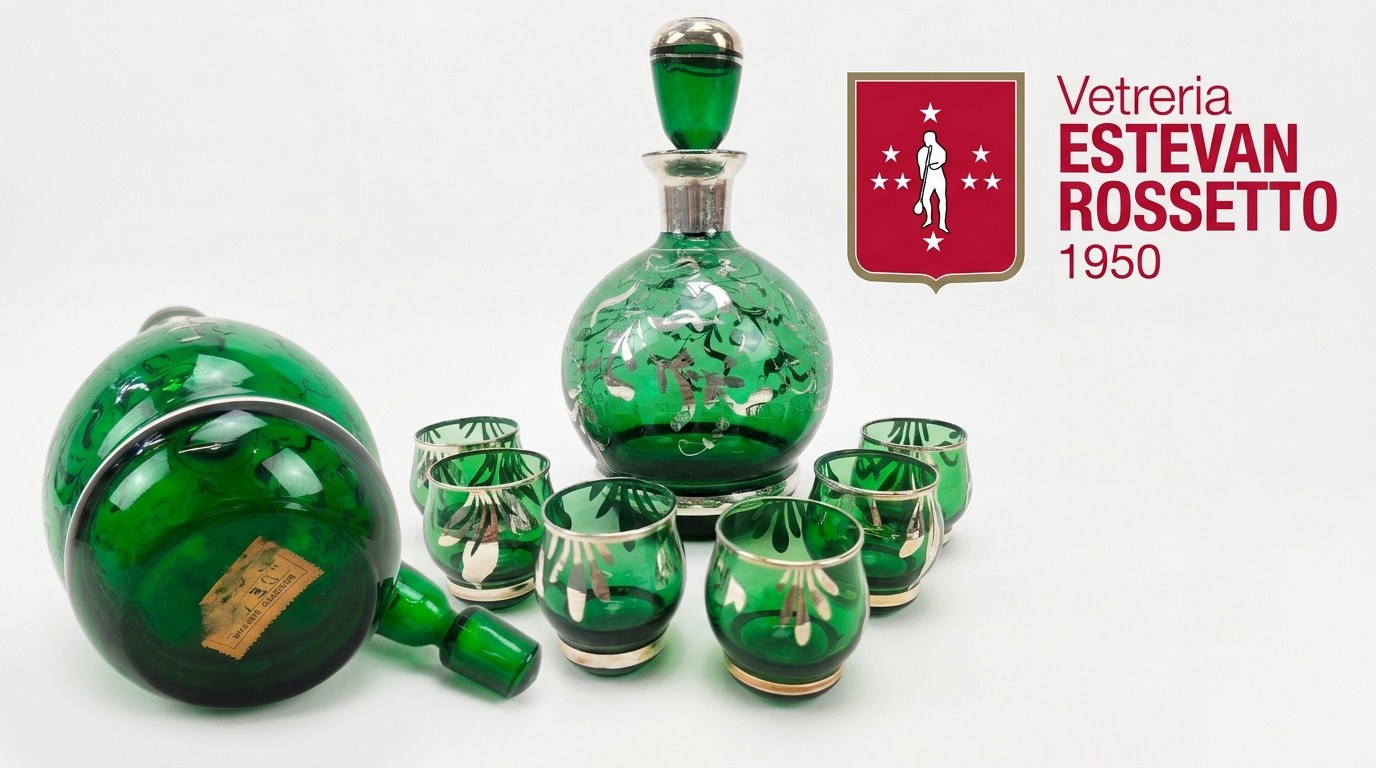
Green and Silvered Decanter Set (1950s) Vetreria Estevan Rossetto
The Collector's Archive: Registry & Chronological Taxonomy
To assist appraisers, scholars, and collectors in cataloging and verifying authentic creations, the historic parameters and operational timelines of the furnace have been organized into a standardized archival reference.
Archival Reference Taxonomy
| Technical Category | Historical Registry Details |
|---|---|
| Official Nomenclature | Historic: Vetreria Estevan Rossetto (1950) Modern: Vetreria Estevan Rossetto 1950 S.r.l. (Re-incorporated March 16, 2012) |
| Alternative Names | Estevan Rossetto; Fornace Estevan Rossetto; Rossetto S.r.l. |
| Primary Location | Fondamenta Andrea Navagero 50, Murano, Venice, Italy (Historically and Currently) |
| Corporate Structure | Sole Proprietorship / Family-Held Furnace (1950–1970s); Bankrupt/Insolvent (1970s); S.r.l. (Società a responsabilità limitata) / Private Family-Held Corporation (2012–Present) |
| Key Identifying Target | Historic Era (1950–1975): Hand-blown art glass, hot-modeled gold-leaf figurines, cased (incamiciato) or submerged (sommerso) vessels, and hand-wheel carved battuto textures. Modern Era (2012–Present): High-end contemporary blown glass, Lagoon-themed sculptures, luxury tablewares, and custom hotel chandeliers. |
Chronological Production Timeline
- 1950 – Early 1970s (Primary Historic Production): Active hot furnace blowing and decorating studio operations at Fondamenta Andrea Navagero 50. High-value sculptural and hand-carved pieces were produced in-house and through collaborative B2B channels.
- 1958 – 1965 (The Collaborative Golden Age): The specific operational window of the Seguso Vetri d'Arte blank partnership. This represents the prime era for heavy, cold-worked battuto and cased (incamiciato) vases hand-carved by Enzo Laggia ("Neno").
- Early 1970s – 1975 (Transitional Insolvency Period): Following the furnace's financial collapse, hot-blowing operations ceased. The company operated as a trading entity, selling off remaining stock, sourced Venini pieces, and cold-worked pieces from Enzo Laggia's independent grinding workshop.
- 1975 – 2012 (Brand Dormancy): The physical plant at Fondamenta Andrea Navagero was acquired by Enzo Laggia and operated as Vetreria Venier. The "Estevan Rossetto" brand identity and intellectual property were preserved in a dormant state by the founder's family.
- March 16, 2012 – 2024 (The Modern Collaborative Era): Production re-established under Vetreria Estevan Rossetto 1950 S.r.l. back at the historic Navagero 50 location. The brand utilized their premier contemporary master partnership with Maestro Giovanni Nicola (of the Scuola del Vetro Abate Zanetti) to produce elite, highly sought-after contemporary blown glass, marine-themed sculptures, and custom lighting.
- 2024 – Present (Post-Nicola Era): Following the tragic and sudden passing of Maestro Giovanni Nicola, the company continues its luxury retail operations under Doriana and Roberto Rossetto, navigating the immense loss of technical knowledge on the island while protecting his legacy and authentic Murano craftsmanship.
The Network of Influence: Historic and Modern Alliances
To contextualize Vetraria Estevan Rossetto's place within the wider Murano ecosystem, the following matrix maps the key institutional, corporate, and retail relationships that shaped the furnace's commercial footprint:
- C. Maschio (Employer): Active in the early 1930s. Estevan Rossetto worked as master glassblower under the artistic direction of painter Giuseppe Chiacig.
- Barovier & Toso (Employer): Active in the late 1930s. Estevan Rossetto worked as master glassblower and sculptor, executing high-end pieces and performing public demonstrations.
- Seguso Vetri d'Arte (B2B Sourcing Partner): Active 1958–1965. Supplied high-quality, hot-blown glass blanks to the Rossetto brothers for cold-working.
- Enzo Laggia ("Neno") (Key Employee / Artist): Active 1950s–1960s. Acted as the chief grinding and cold-carving master, executing the engraving on Seguso-sourced blanks.
- Venini (B2B Sourcing Partner): Active in the 1970s. Supplied finished inventory to the Rossetto brand during the operational transition following the company's financial collapse.
- Muranese Export (Corporate Successor / Parent): Founded in 1969 by Enzo Laggia. Served as the corporate vehicle used to acquire the bankrupt Estevan Rossetto furnace in 1975.
- Vetreria Venier (Corporate Successor / Physical): Active 1975–Present. Direct successor occupying and expanding the former Rossetto physical plant on Fondamenta Andrea Navagero.
- TheMusicHouse.Com (Retail Commission Client): Active late 20th Century. Commissioned custom sets of high-end, hand-sculpted glass musician figurines for upscale US retail.
- Sally Antiques (Antique Retailer): Contemporary. Houses and documents original 1950s green-and-silver decanter sets, preserving physical provenance.
- Scuola del Vetro Abate Zanetti (Educational & Talent Partner): Active 2015–2024. Direct relationship via Maestro Giovanni Nicola, who served as the school's chief master while collaborating with Rossetto S.r.l..
- Archimede Seguso (Technical Lineage Link): Historic. Archimede Seguso trained Giovanni Nicola, who became the final keeper of the Seguso family secrets.
Academic and Physical Proximity: The Museo del Vetro
While the original physical furnace site transitioned into Vetreria Venier—today celebrated as one of the largest and best-supplied glassmaking centers in Murano—the surrounding geographic area remains an active center of global glass preservation.
The original Rossetto workshops at Fondamenta Andrea Navagero are situated a mere 140 meters from the Museo del Vetro (Murano Glass Museum) located in the Palazzo Giustinian. This world-famous museum houses a comprehensive collection documenting the technical and artistic evolution of Venetian glass from Egyptian times through the contemporary era, providing an immediate academic and physical context for the mid-century and modern creations of the Estevan Rossetto workshop.
By understanding this rich geographic and collaborative tapestry, collectors and scholars can appreciate not just the aesthetic beauty of Rossetto glass, but the complex, deeply intertwined socio-economic history carved into every piece.
Identify Your Murano Glass Animals Join Murano Glass Animals