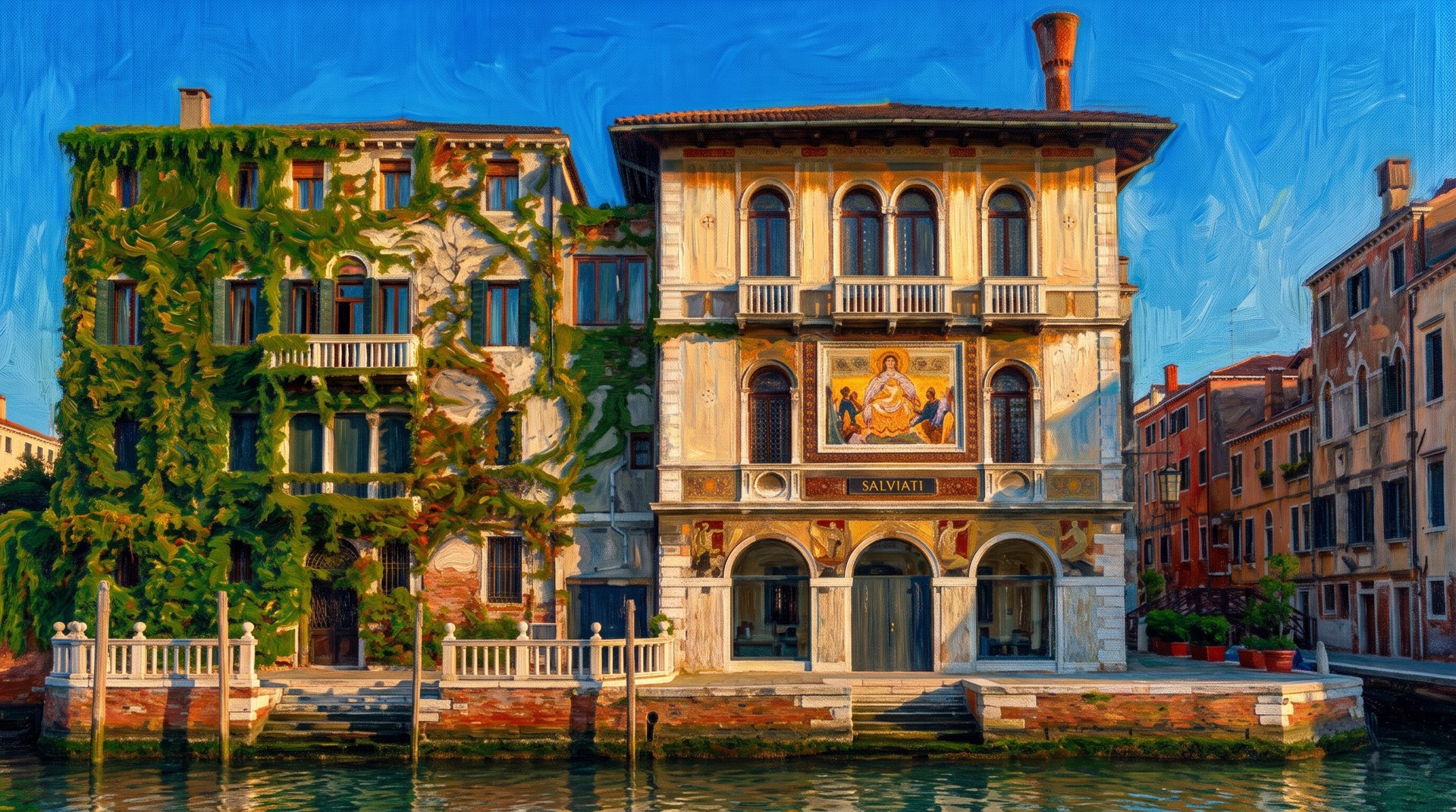
Salviati Murano Glass: The Ultimate 19th-Century Furnace Identification Guide
The Fire of the Kilns (The Furnaces)
Salviati & C. — The Historicist Empire
Furnace Key: Salviati & C.
- Type/Role: Commercial and Industrial Art Glasshouse / Mosaic Foundry
- Active Kiln Dates: 1859–1920s (prior to the Gaetano Ceschina showroom mergers)
- Principal Founders: Dr. Antonio Salviati | Enrico Podio | Lorenzo Radi | Sir Austen Henry Layard | Sir William Richard Drake
- Proprietary/Signature Techniques: Prefabricated Architectural Mosaic Tiles | Swirling Calcedonio (Chalcedony) | Blown Avventurina (Aventurine) | Decoro Fenicio (combed "graffito a fiamma") | Tartan Reticello & Zanfirico | Enameled Classical Soffiati
- Market Price Tier: Investment Grade Historical Artifacts (especially early 1866–1877 exhibition pieces, signed C.V.M. specimens, 1878 Paris Exposition murrine and gold-leaf cameos, and 1881 British Museum-inspired Roman murrine plates)
Summary:
Discover the magnificent history and alchemical triumphs of Salviati & C. and the Compagnia di Venezia e Murano (C.V.M.), the legendary furnaces that single-handedly rescued Murano glassmaking from 19th-century decline. This expert collector's guide covers the early partnership between Dr. Antonio Salviati and Lorenzo Radi, the historic 1866 British-capital expansion with Sir Austen Henry Layard, and the dramatic 1877 split that birthed two rival glassmaking empires. Learn how to verify authentic diagnostic markers—including feather-light blown glass walls, rough unpolished pontil scars, secret gold-shimmer aventurine, and initial-bearing base VM or S murrine—to confidently identify their creations and navigate the antique market.
Furnace Corporate Lineage Map
┌────────────────────────────────────────────────────────────────────────┐
│                       FURNACE CORPORATE LINEAGE                        │
│                      - THE SALVIATI GLASS KILNS -                      │
└───────────────────────────────────┬────────────────────────────────────┘
                                    │
                                    ▼
                          Salviati Dott. Antonio
                         (Venice Mosaic Workshop)
                                    │
                                    ▼
                          Salviati & Company Ltd.
                       (Hollow-ware, Palazzo Da Mula)
                                    │
                    ┌───────────────┴───────────────┐
                    │ [1872 Restructuring]          │
                    ▼                               ▼
               C.V.M.                      Salviati dott. Antonio
       (Compagnia di Venezia e Murano)     (Giovanni & Giuseppe Barovier)
                    │                               │
                    │                               ▼
                    │                        Artisti Barovier
                    │                    (Furnace Leased in 1883)
                    │                               │
                    ▼                               ▼
               C.V.M. Wares                 Barovier & Toso
         (Vincenzo Moretti & Segusos)       (Independent in 1895)
                    │                               │
                    └───────────────┬───────────────┘
                                    │ [1919/1920 Showroom Mergers]
                                    ▼
                      Pauly & C. - C.V.M. - Salviati
                     (Gaetano Ceschina Luxury Cartel)
                                    │
                                    ▼
                         Salviati S.p.A.
                    (Post-War Modernist Design House)
Visual Timeline of the Historicist Empire
              ┌──────────────────────────────────────────────────────────┐
              │                      SALVIATI & C.                       │
              │               - HISTORICAL TIMELINE -                    │
              └──────────────────────────┬───────────────────────────────┘
                                         │
     ┌───────┐                           ▼
     │ 1859  │ ──► Founded in Venice by Antonio Salviati and Lorenzo Radi.
     └───────┘                           │
                                         ▼
     ┌───────┐                           ▼
     │ 1866  │ ──► Sir Henry Layard joins; "Salviati & Company Ltd." formed.
     └───────┘                           │
                                         ▼
     ┌───────┐                           ▼
     │ 1867  │ ──► Aerial "soffiati" win international acclaim in Paris.
     └───────┘                           │
                                         ▼
     ┌───────┐                           ▼
     │ 1872  │ ──► Rebranded as the \"Compagnia di Venezia e Murano\" (C.V.M.).
     └───────┘                           │
                                         ▼
     ┌───────┐                           ▼
     │ 1877  │ ──► The Great Schism splits Salviati and C.V.M. into rivals.
     └───────┘                           │
                                         ▼
     ┌───────┐                           ▼
     │ 1883  │ ──► Salviati leases Murano factory to the Barovier cooperative.
     └───────┘                           │
                                         ▼
     ┌───────┐                           ▼
     │ 1919  │ ──► Showrooms merge under Pauly & C. and Gaetano Ceschina.
     └───────┘
1. The Lawyer and the Chemist: The Birth of Palazzo Barbarigo (1859–1866)
The modern resurrection of Murano glassmaking is not an organic tale of industrial survival, but a calculated masterpiece of entrepreneurship and alchemical recovery. By the middle of the nineteenth century, Murano was a silent, economically devastated island, its ancient guild secrets buried under decades of Austrian tariffs, Austrian neglect, and the suffocating fashion for heavy Bohemian and English cut crystal. The turning point arrived in 1859 with the arrival of Dr. Antonio Salviati. Born in Vicenza in 1816, Salviati was a highly cultured, strategic lawyer who recognized that Venice’s impending architectural restorations—specifically the monumental, crumbling mosaics of St. Mark's Basilica—represented an extraordinary commercial opportunity.
Salviati established a specialized workshop under the name Salviati Dott. Antonio fu Bartolomeo at Palazzo Barbarigo, San Vio, Dorsoduro 730. To achieve his vision, Salviati formed a crucial partnership with Lorenzo Radi (1803–1874), a brilliant Muranese chemist and glassmaster who had spent decades independently conducting secret crucible trials to recover lost medieval and Renaissance glassmaking formulas.
Radi had successfully rediscovered the formula for calcedonio (chalcedony glass) in 1856 and, more importantly, had perfected a highly brilliant, tarnish-resistant gold mosaic tile that utilized a thin protective layer of transparent glass over pure gold leaf.
Leveraging Radi's alchemical genius and the mosaicist Enrico Podio, Salviati’s workshop won the major restoration contracts for St. Mark's, Ravenna, and Monreale. Salviati’s true entrepreneurial genius, however, lay in his invention of the prefabricated mosaic technique. Rather than setting thousands of tiny glass tiles (tesserae) directly onto soft cement on-site (the tedious "Ravenna style"), Salviati had mosaicists glue the glass tiles face-down onto paper cartoons in his Venice workshop.
The completed paper sections were packed, shipped globally, pressed directly into fresh mortar on architectural walls, and the backing paper washed away. This revolutionary process drastically slashed installation times and costs, allowing Salviati to build a massive global brand that exported monumental mosaics to decorate civic and royal buildings across Europe and North America.
2. The Anglo-Italian Alliance: The Fondamenta dei Vetrai Expansion (1866–1872)
While the mosaic workshop at Palazzo Barbarigo flourished, Dr. Antonio Salviati recognized that the global elite’s growing obsession with historical luxury represented an even larger market for hand-blown art glass (soffiate). In February 1866, Salviati traveled to London with a collection of thin-blown experimental pieces crafted by the Fratelli Toso furnace and wrote back a legendary telegram: "the business of blown glass is a big and sure thing."
Lacking the massive capital required to establish an independent hot-furnace, Salviati partnered with prominent British diplomats, archaeologists, and scholars, including Sir Henry Austen Layard and Sir William Richard Drake. In December 1866, they incorporated Salviati & Company Limited in London, backed by English capital.
The Murano branch of this newly formed joint-stock company moved into rooms adjacent to the fifteenth-century Palazzo Da Mula on the Fondamenta dei Vetrai. The furnace initially operated with only two active workbenches (mute), but Salviati strategically staffed them with the island's absolute finest master craftsmen: one workbench was led by Antonio Seguso (1829–1903) and the other by Giovanni Barovier (1839–1908), while Vincenzo Moretti (1835–1901) was appointed as chief glass chemist and technician.
This small, elite group of masters laid the foundation for the historic revival of Renaissance thin-blown glass. To ensure their output remained faithful to Venice's noble heritage, Salviati and Layard strictly required all of their masters and apprentices to attend Compulsory Drawing Classes held in the factory and at the newly founded Murano Civic Glass Museum under the personal supervision of Abbot Vincenzo Zanetti.
At the 1867 Paris Universal Exhibition, Salviati & Co. presented over 600 spectacular exhibits replicating classical glass. The display achieved a staggering global success; French critics praised the vessels' "aerial lightness" (légèreté aérienne), and both Antonio Seguso and Giovanni Barovier were awarded Honorable Mentions, permanently cementing Murano's return to the world stage.
3. The Great Schism of 1877: C.V.M. vs. Salviati Dr. Antonio
By 1872, to satisfy the demands of its British financial backers, the company underwent a corporate restructuring, changing its legal name to The Venice and Murano Glass and Mosaic Company Limited (Compagnia Venezia Murano - C.V.M.). Under this new British-led administration, the celebrated Roman jewelers and antiquarians Augusto and Alessandro Castellani were appointed as Managing Directors, driving the furnace to focus heavily on archaeological Greek, Roman, and Byzantine glass reproductions.
However, severe policy and strategic disagreements quickly developed between Antonio Salviati and his English partners. Salviati wished to expand commercial retail operations and cater to the wealthy tourist trade, while the British investors favored museum-grade archaeological accuracy.
In 1877, this friction resulted in a bitter, high-profile corporate divorce. Salviati withdrew entirely from C.V.M., leaving his original firm—including the lucrative Fondamenta dei Vetrai factory, the secret chemical recipes of Vincenzo Moretti, and the C.V.M. trademark—entirely in the hands of the British consortium.
Demonstrating his unyielding resilience, Salviati immediately established two brand-new independent operations in Murano and Venice: Salviati Dott. Antonio for blown glass and Salviati & C. for mosaics, operating from Campo Santa Maria del Giglio on the Grand Canal. This corporate split divided the elite craftsmen of the lagoon into two fiercely competitive camps:
- The C.V.M. Camp: Master chemist Vincenzo Moretti, the master blower Antonio Seguso, and his sons remained loyal to the British-led Compagnia di Venezia e Murano. Backed by Moretti's metallurgical research, C.V.M. continued its absolute dominance in archaeological-style glassware, successfully resurrecting ancient Roman murrine and gold-leaf cameos for the 1878 Paris Exhibition.
- The Salviati Camp: Chief master glassblower Giovanni Barovier and his young, highly talented nephews Giuseppe, Benvenuto, and Benedetto Barovier chose to follow Antonio Salviati into his new company. Supported by the Barovier dynasty's manual virtuosity, Salviati’s new furnace specialized in producing hyper-elegant, historically inspired Venetian soffiati characterized by refined proportions and bold, dramatic colorways.
4. Technical Triumphs: From Imperial Mosaics to Roman Murrine
During the peak decades of this historicist competition (1866–1890), the furnaces of Salviati & Co. and C.V.M. served as the premier laboratories for recovering ancient glass chemistry and furnace methods. Together, they introduced some of the most complex, sought-after techniques in glassmaking history:
- Vetro Calcedonio (Chalcedony): Bypassing standard transparent pots, the Salviati and C.V.M. furnaces utilized Lorenzo Radi's chemical formulas to melt a highly dense, opaque vitreous paste marbled with multicolored veins of brown, green, and blue. Achievement of this agate-like texture required adding precise quantities of silver, iron, and cobalt oxides to the molten batch at highly specific intervals without allowing them to fully homogenize.
- Blown Avventurina (Aventurine): Historically, aventurine glass containing dense suspended crystals of metallic copper was only cast in flat slabs because reheating the highly reactive mixture threatened to dissolve the copper back into the clear matrix. Salviati & Co. was the first furnace in history to successfully blow aventurine glass into thin-walled vessels. The gaffers fused rods of aventurine hot at the glory hole, applying them as spiraling threads (fili di avventurina) or handles onto classical pitchers.
- Decoro Fenicio (Phoenician Combing): Perfected on the Salviati furnace floor in 1868 (where it was originally called graffito a fiamma), this technique cased the vessel in a feathered, wavy pattern of contrasting colored threads. While hot, a continuous spiral of lattimo (milk glass) and aventurine threads was wrapped around a transparent core, combed vertically at regular intervals with a specialized multi-toothed tool (borselle da pissegar), and cased in clear crystal.
- Resurrection of the Roman Murrina (1871): Working under Layard's direct curatorial influence at C.V.M., the master glass chemist Vincenzo Moretti conducted thousands of experiments to recover the lost ancient Roman mosaic glass technique. In 1871, Moretti successfully fused section slices of multicolored concentric and floral glass canes (murrine) on a clay-covered metal plate (bronzin) in the kiln, picking up the hot mosaic canvas on a blowpipe to blow complex, narrow-mouthed vessels. Moretti's murrino wares won the Gold Medal at the 1878 Paris Exposition, cementing C.V.M.'s technical supremacy.
5. The Barovier Lease & Legacy (1883–1890)
As Antonio Salviati entered his golden years, he sought to transition away from direct furnace administration to focus exclusively on his global sales showrooms and retail outlets. In 1883, Salviati executed a highly historic, strategic lease agreement with Giovanni Barovier and Antonio Camozzo (the furnace's long-serving director).
Under this landmark contract, Salviati leased his entire Murano glass factory directly to the Barovier brothers, who reorganized the team as an independent cooperative called Fratelli Barovier (renamed Artisti Barovier in 1886).
The terms of the lease were highly strict and protective:
- The cooperative agreed to manufacture high-end blown glass exclusively for Salviati’s retail galleries in Venice and London.
- The furnace continued to stamp and market its creations under the established trade name Salviati Dott. Antonio to ensure the public believed there had been no change in the brand's prestigious essence.
This arrangement proved to be an extraordinary commercial success, allowing Giuseppe Barovier to design his first brilliant floral murrine plates and twisted filigrana stemware. Following Antonio Salviati's death in 1890, his children Giulio and Silvio Salviati inherited the company, continuing the exclusive partnership with Artisti Barovier until 1895, when the cooperative officially began producing for other high-end global distributors, launching the Barovier family on their independent path to modern fame.
6. The Collector's Diagnostic Checklist: Salviati & C. / C.V.M. Wares
To confidently identify, date, and value original 19th-century glass objects produced by Salviati & Co., Salviati Dr. Antonio, or the Compagnia di Venezia e Murano (C.V.M.) (c. 1859–1910), collectors must utilize the following diagnostic criteria:
- Evaluating Weight and Wall Thickness: Genuine 19th-century Salviati soffiati are characterized by their extraordinary, feather-light, and paper-thin wall execution. If a historicist goblet or dragon-stem vase feels heavy, clumsy, or has thick, uneven crystal walls, it is likely a cheap, modern tourist reproduction rather than an authentic revival-era masterwork.
- Analyzing Pontil Scars: Unlike modern factory reproductions which feature perfectly ground, flat-ground base rings, authentic 19th-century Salviati and C.V.M. vessels must exhibit a rough, slightly splayed, and completely unpolished circular pontil scar on the underside of the base. This mark, where the vessel was broken off the pontil rod at the furnace, was deliberately left unground in the 19th century to prove its hand-blown authenticity.
- Checking Aventurine Quality: Look closely at the aventurine glass elements. Authentic 19th-century Salviati pieces feature microscopic, densely packed suspended copper flakes of an intense, golden-orange shimmer. Fakes often use cheap, commercial gold-stone pastes which appear muddy, brown, or have large, unevenly dispersed glitter-flakes.
- Verifying Lattimo Colorways: Opaque white lattimo glass produced by Salviati & Co. or C.V.M. during this era has a warm, rich, and slightly creamy, ivory-like tone. A harsh, sterile, or chalky "paper-white" appearance is a classic indicator of modern, low-quality glass compositions.
- The Price Tiers:
- Ultra-Premium Investment Grade: Original 1866–1877 pieces designed for the Paris or London exhibitions, signed C.V.M. specimens carrying early St. James Street labels, 1878 Paris Exposition murrine vases, and 1881 British Museum-inspired Roman murrine plates by Giuseppe Barovier. These command high five-figure to six-figure sums at specialized international design auctions.
- Mid-Range: Unsigned 1880s fenicio pitchers and vases with multi-colored feathered combed-threads, early zanfirico patchwork cups, and gold-leaf cased soffiatissimo dragon stemwares.
- Accessible: 19th-century standard table services, simple ribbed finger bowls carrying unpolished pontils, and early 20th-century commercial showroom souvenirs.
7. Forensic Chronology of Base Markings & Signatures
Because the Salviati and C.V.M. furnaces operated across multiple historical transitions, their creations carry highly distinct, chronologically clear markings that determine their value on the collector's market:
I. The C.V.M. St. James's Street Export Label (1868–1880s)
Wares exported to the British and global markets by the Compagnia di Venezia e Murano carried a highly distinct circular or rectangular paper label:
- The Label: A thin, cream-colored paper label printed in black ink reading:
Comp.ia di Venezia e Murano / 30 St. James's Street S.W.often accompanied by a hand-written archive or stock number in iron-gall ink (e.g.,1061.62).
II. The In-Glass Murrine Initials (Post-1877)
To combat the rising threat of competitive copyists, the rival firms began inserting tiny, fused glass murrine containing their initials directly into the bases of high-art vessels:
- The C.V.M. Mark: A tiny, circular cane section containing the white letters
VM(Venezia Murano) fused directly into the ground base of the goblet. - The Salviati Mark: Following his 1877 departure, Salviati began inserting a tiny amber murrina containing the white letter
S(Salviati) into the bases of his vessels.
III. The Modern Retail Stamps (Post-1920)
Following the 1919 merger with Pauly & C. under Gaetano Ceschina, the retail galleries utilized sandblasted and acid-etched stamps:
- The Stamps: An oval or circular acid-stamp reading:
D.A. SALVIATI / VENEZIAorSALVIATI & C. / VENICE / MADE IN ITALY.
Maestro Key (Active Gaffers & Bench Dates)
| Maestro | Role / Specialization | Active Window | Historical Context & Focus |
|---|---|---|---|
| Giovanni Barovier | Chief Master Blower | 1866–1883 | Led early hollow-ware workbench; followed Salviati in 1877 split. |
| Antonio Seguso | Chief Master Blower | 1866–1877 | Led original second workbench; remained with C.V.M. after schism. |
| Vincenzo Moretti | Master Chemist & Composer | 1866–1877 | Developed C.V.M. specialized color batches and ancient Roman mosaic canes. |
Designer Key (Active Minds & Design Dates)
| Designer | Role / Aesthetic Style | Active Window | Historical Context & Focus |
|---|---|---|---|
| Lorenzo Radi | Alchemical Designer | 1859–1874 | Pioneer who rediscovered calcedonio and tarnish-resistant gold mosaic tile. |
| Giuseppe Barovier | Designer / Master Gaffer | 1877–1883 | Crafted first modern floral murrine plates and twisted filigrana stemware. |
Bridges Key (Active Facilitators & Strategic Dates)
| Facilitator | Role / Strategic Contribution | Active Window | Historical Context & Focus |
|---|---|---|---|
| Sir Henry Austen Layard | British Diplomat & Envoy | 1866–1877 | Secured English capital, established joint-stock corporate structures. |
| Sir William Richard Drake | Legal & Corporate Patron | 1866–1880s | Structured global retail distribution, export agreements, London showrooms. |
| Abbot Vincenzo Zanetti | Educational Director | 1862–1880s | Supervised Compulsory Drawing Classes at the Civic Glass Museum. |
| Gaetano Ceschina | Milanese Industrialist | 1919–1920 | Consolidated Venice luxury showrooms, merging C.V.M. with Pauly & C. |
Consortiums Key (Associated Alliances & Membership Dates)
| Consortium / Guild | Strategic Shield / Cartel Type | Membership Window | Historical Context & Focus |
|---|---|---|---|
| L'Arte dei Vetrai | Historical Glassmakers' Guild | 1866–1871 | Monitored traditional labor structures prior to modern industrial transition. |
| C.V.M. Ltd. | Anglo-Italian Corporate Alliance | 1872–1877 | Joint-stock historicist cartel before the great corporate split. |
Dynasty Key (Bloodline Connections)
| Dynasty | Bloodline Role | Connection Window | Family Contributions & Mergers |
|---|---|---|---|
| The Barovier Dynasty | Historical Master Glassmakers | 1866–1883 | Seated chief master Giovanni Barovier and his nephews; led to 1883 lease. |
| The Seguso Dynasty | Master Blowers | 1866–1877 | Seated master Antonio Seguso, establishing C.V.M.'s gaffing dominance. |
| The Radi Dynasty | Alchemical & Chemical Experts | 1859–1874 | Seated Lorenzo Radi, providing St. Mark's mosaic restorations. |
Alchemical Key (Material & Chemical Formulas)
| Formula Name | Material Type | First Melt Date | Chemical Composition & Visual Effect |
|---|---|---|---|
| Vetro Calcedonio | Formula 104 (Agate Glass) | 1856 (Lorenzo Radi) | Marbled silver nitrate, iron, and cobalt oxides to simulate natural agate. |
| Blown Avventurina | Formula 108 (Aventurine) | 1866 (Salviati & Co.) | Suspended copper flakes blown into thin-walled vessels for the first time. |
| Gold Leaf Prefabricated Tesserae | Formula 101 (Mosaic Tile) | 1840s (Lorenzo Radi) | Micro-thin protective layer of transparent glass over pure gold leaf. |
Curatorial Footprint Key (Exhibition & Provenance Registry)
| Exhibition / Institution | Location | Years Exhibited | Catalog Focus & Provenance Wares |
|---|---|---|---|
| Paris Universal Exhibition | Paris, France | 1867, 1878 | Awarded Honorable Mention (1867) and Gold Medal (1878) for C.V.M. murrine. |
| Milan Industrial Exhibition | Milan, Italy | 1881 | Debuted classical Roman plates and floral murrine by Giuseppe Barovier. |
| Murano Civic Glass Museum | Murano, Italy | Permanent Exhibit | Standardizing classical models in Stanzas III & IV curated by Vincenzo Zanetti. |
8. Attribution & Authenticity
In the Murano glassmaking tradition, the difference between a fake and a copy rests entirely on intent, origin, and transparent attribution. A fake is a deceptive counterfeit manufactured outside of Murano—often in mass production factories in Asia or Eastern Europe—that utilizes cheap materials and carries forged signatures or illicit trademark stickers to intentionally defraud collectors. Conversely, a copy is a legitimate artistic homage (omaggio) handcrafted by a skilled master using authentic Murano techniques and materials; it serves as a tribute to honor a legendary artisan's legacy and is openly signed by the modern creator, preserving the lineage of Venetian glassblowing rather than exploiting it.
Join Our Facebook Group Identify Your Murano - Murano Glass Animals