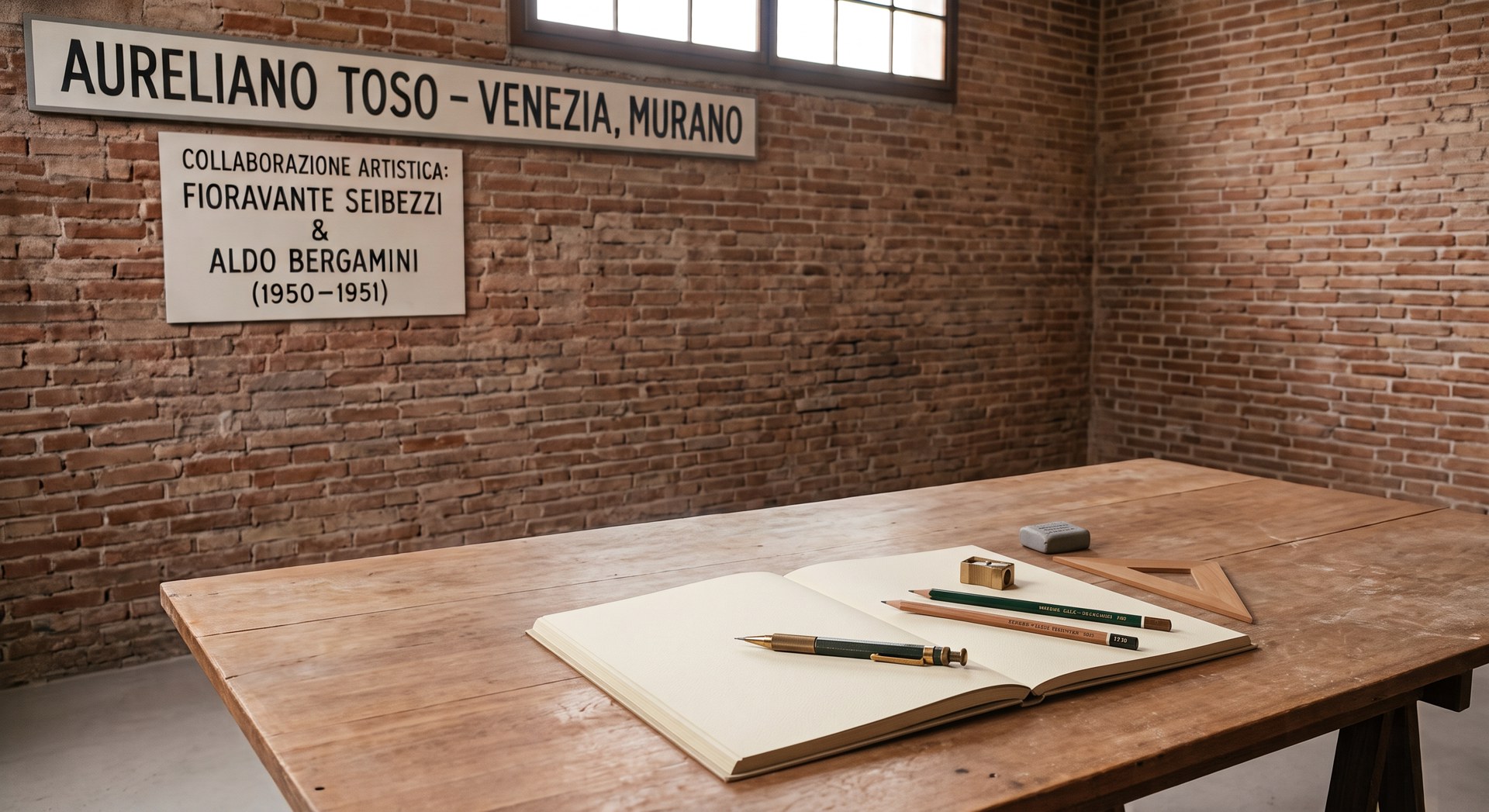
Painting with Light: The Unsung Collaborations of Fioravante Seibezzi and Aldo Bergamini Aureliano Toso (1950–1951)
The mid-twentieth century was a period of profound, systemic transformation for the glassmaking industry on the island of Murano. It was a golden era in which centuries-old glassblowing traditions, long tethered to historical revivalism and the reproduction of antique tableware, clashed directly with the bold, non-figurative currents of modern abstract art.
At the absolute center of this creative storm was Vetri Decorativi Rag. Aureliano Toso. Founded in 1938 at Fondamenta Lorenzo Radi, the furnace emerged as a premier avant-garde laboratory, fundamentally redefining how the art world perceived the glass medium—not merely as a utilitarian vessel, but as a three-dimensional canvas for pure, non-functional artistic expression.
           THE POST-WAR ARTISTIC CONVERGENCE AT AURELIANO TOSO

     +-------------------------------------------------------------+
     |                    THE RAGIONIERE'S CAPITAL                  |
     |  Aureliano Toso's systematic bookkeeping & fiscal rigor     |
     +------------------------------+------------------------------+
                                    |
                                    v
     +-------------------------------------------------------------+
     |                     THE VITREOUS CANVAS                     |
     |    molten glass as a three-dimensional sculptural medium   |
     +---------+--------------------+--------------------+---------+
               |                    |                    |
               v                    v                    v
     +-------------------+   +--------------+   +------------------+
     |   DINO MARTENS    |   |  JAN LE WITT |   |  GUEST ARTISTS   |
     | Overarching style |   | Graphic form |   |  Local painters  |
     |   (1946-1960)     |   |   (1950)     |   |   (1950-1951)    |
     +-------------------+   +--------------+   +--------+---------+
                                                         |
                                 +-----------------------+-------+
                                 |                               |
                                 v                               v
                     +-----------------------+       +-----------------------+
                     |  FIORAVANTE SEIBEZZI  |       |    ALDO BERGAMINI     |
                     |  Lagoon landscapes,   |       |   Novecento ideals,   |
                     |   atmospheric light   |       |  structural symmetry  |
                     +-----------------------+       +-----------------------+
While the revolutionary, painterly direction of Dino Martens provided the overarching aesthetic narrative for the factory’s post-war production, the early 1950s witnessed a highly strategic and intellectually rigorous experiment. To diversify its catalog and compete directly with elite houses like Venini and Barovier & Toso, the firm proactively engaged in brief, concentrated collaborations with prominent fine artists.
Among these partnerships, the "brief but vital" 1950–1951 collaborations with the Venetian landscape painter Fioravante Seibezzi and the Spatialist designer-sculptor Aldo Bergamini represent a supreme, unsung milestone in Murano history.
Rather than working as long-term commercial consultants, these guest artists treated the furnace floor as an experimental fine-art laboratory. Guided by the hands of legendary Lead Maestro Aldo "Polo" Bon, they pushed traditional hot-shop techniques—such as sommerso, incamiciato, and pulegoso—to their absolute limits.
This is the untold story of how a painter and a sculptor stepped into the furnace to paint with molten light, leaving behind a body of work that remains among the rarest and most intellectually stimulating in the history of glass design.
Part I: The Patronage of Precision — How Bookkeeping Enabled Art
To appreciate how these radical collaborations were physically possible, one must look past the glowing glory of the furnace to the cold, systematic ledger books of the front office. The glass industry of Murano was historically prone to brutal economic volatility; luxury furnaces frequently collapsed under the immense overhead of fuel costs, specialized raw materials like cobalt and gold leaf, and the high failure rate of complex experimental prototypes.
The structural resilience of Vetri Decorativi Rag. Aureliano Toso was fueled by the unique professional background of its founder. Aureliano Toso (1884–1979) was a descendant of the legendary Toso glassmaking dynasty, but unlike his relatives who focused entirely on the bench, Aureliano was a certified bookkeeper or ragioniere.
                THE DUAL ARCHITECTURE OF THE TOSO FURNACE

        [ TECHNICAL EXCELLENCE ]             [ ADMINISTRATIVE RIGOR ]
         Aldo Bon's virtuosity                Aureliano's bookkeeping
          with molten glass                     & scientific precision
                 |                                      |
                 +------------------+-------------------+
                                    |
                                    v
                        [ HIGH-RISK PROTOTYPING ]
                          Sustained R&D budget
                        for fine-art guest runs
By including his professional title, "Rag.," directly in the company's branding, Toso projected an unconventional image of modern industrial management and absolute financial transparency to a luxury market accustomed to intuitive, family-based governance.
This bookkeeping background was the indispensable engine that allowed guest artists to experiment without compromise. High-art glass prototyping is notoriously expensive, but Aureliano's fiscal discipline built a stable, agile company capable of absorbing these astronomical R&D costs.
By balancing the high-risk, unique art glass runs (pezzi unici) with structured, commercially viable catalogs, the ragioniere provided the "substantial means" and technical infrastructure necessary to host some of the most radical fine-art experiments of the post-war era.
Part II: Fioravante Seibezzi — Transposing the Venetian Lagoon to the Furnace
In 1950, when the Venetian painter Fioravante Seibezzi (1906–1974) stepped into the Aureliano Toso furnace, he did so not as a designer seeking to make decorative home accessories, but as a landscape artist seeking to solve a fundamental problem of his medium.
                SEIBEZZI'S LANDSCAPE TRANSFORMATION

     [ TWO-DIMENSIONAL CANVAS ]           [ THREE-DIMENSIONAL GLASS ]
      Lagoon sunrises & mists              Cased sommerso & pulegoso
      represented via opaque oil           refracting real light through
      paint pigments on canvas             colored glass paste layers
Seibezzi was a prominent figure in the local Venetian art scene, celebrated for his atmospheric, poetic depictions of the lagoons, lake views, and seascapes of the Veneto region. For decades, his creative obsession had been the ephemeral, constantly shifting qualities of light scattering across the damp Venetian air and water.
He recognized that while paint on canvas could brilliantly approximate the diffuse luminosity of a lagoon sunrise, it was ultimately a static, reflective surface. Glass, with its unique refractive index and internal transparency, offered him a three-dimensional medium where light could be physically captured, suspended, and manipulated in space.
The Technical Translation: Sommerso and Macchie
To translate Seibezzi’s painterly vision into molten glass, the hot-shop team had to discard the sharp, graphic, high-contrast patchworks favored by Dino Martens. Seibezzi’s aesthetic demanded soft, blending color transitions that mirrored the fluid vistas of his paintings. The answer lay in the sophisticated combination of the sommerso (submerged) and macchia (spotting) techniques.
- The Macchia Base: The master glassblower began by blowing a parison of clear cristallo and picking up irregular, soft patches of colored glass pastes—such as muddy blues, soft mineral ambers, and dusty grays—off the marver.
- The Sommerso Encapsulation: Once these macchia color zones were applied, the entire hot gather was submerged deep into a pot of thick, transparent clear glass. This created a heavy, protective outer shell that trapped the colors inside.
- The Optical Depth: As the vessel was blown and expanded, the internal color layers stretched, causing their edges to bleed and soften into one another. The thick outer layer of clear glass acted as a three-dimensional magnifying lens, creating an immense, watery optical depth that changed dramatically depending on the angle of the viewer and the direction of the ambient light.
Softening the Light: Pulegoso Integration
In his quest to replicate the misty, atmospheric quality of the Venetian canals, Seibezzi made brilliant use of pulegoso glass. Originally devised in the late 1920s, pulegoso glass is formulated by adding chemical agents—such as bicarbonate of soda—to the molten batch, inducing the release of carbon dioxide and trapping thousands of microscopic air bubbles inside the glass wall.
                     Pulegoso Light Scattering

    Direct Ambient Light -------> [ Pulegoso Glass Wall ] -------> Velvety, Soft Glow
                                  (Thousands of trapped            (Lagoon Mist effect)
                                   micro-bubbles disperse
                                   the light rays)
For Seibezzi, the trapped micro-bubbles acted as tiny, three-dimensional prisms. Instead of allowing light to pass directly through the vessel, the bubbles scattered and dispersed the light rays in every direction. This completely softened the silhouette of the piece, bathing the cased colors in a velvety, nostalgic, and atmospheric glow that effortlessly mimicked the damp, sun-drenched mists of the lagoon.
These collaborative vessels moved Aureliano Toso's portfolio away from the high-energy "pop" aesthetics of the late 1940s toward a more contemplative, atmospheric elegance that deeply resonated with international collectors. Seibezzi’s brief run at the furnace successfully proved that a landscape painter could use a glass furnace as a three-dimensional easel to paint with the sunset itself.
Part III: Aldo Bergamini — Sculpture, Spatialism, and the Novecento Ideal
While Seibezzi approached the furnace floor with the eye of a painter seeking to capture atmosphere, the independent designer and sculptor Aldo Bergamini (1903–1980) entered Vetreria Aureliano Toso with the analytical, formalist mind of an architect.
Bergamini was an immensely influential figure in post-war Murano design. Having worked extensively with multiple prestigious houses—including I.V.R. Mazzega and A.V.E.M.—he was one of the founders of the Centro Studio Pittori nell'Arte del Vetro in 1950, the celebrated collective that would later find its continuation in Egidio Costantini’s legendary Fucina degli Angeli.
               BERGAMINI'S SPATIALIST CLASSICISM

      [ NOVECENTO FORMALISM ]              [ SPATIALIST MODERNISM ]
      Recovery of heavy classical          Treating the glass vessel as a
      proportions, stable bases,           three-dimensional sculpture that
      and architectural symmetry           actively interacts with space
Bergamini’s artistic philosophy was deeply rooted in two competing, yet harmonious, intellectual movements of the post-war era:
- The Novecento Movement: An aesthetic philosophy that sought to recover classical proportions, monumental weight, and clean, dignified forms within a modern context.
- Spatialism: A contemporary movement led by artists like Lucio Fontana, Vinicio Vianello, and Ezio Rizzetto, which treated the artwork not as a static object, but as a spatial entity that actively interacted with, pierced, and defined the empty space surrounding it.
Restoring Structural Logic to Asymmetry
Bergamini’s collaboration with Aureliano Toso in the early 1950s occurred at a critical moment when the factory was heavily experimenting with "extreme asymmetrical shapes" under Dino Martens. While Martens’ work was celebrated for its wild, "Bohemian" asymmetry and whimsical disregard for traditional form, Bergamini recognized that too much asymmetry risked descending into structural instability.
Bergamini introduced a vital, formalist, and architectural logic to the Toso catalog. His designs utilized classical, robust proportions, anchoring the vessels with heavy, stable bases and clean, sweeping profiles. Where Martens’ asymmetrical vases felt fluid and kinetic, Bergamini’s works possessed a deliberate, sculptural weight.
Master of the Incamiciato (Cased Color) Technique
To realize his spatialist theories, Bergamini was deeply interested in the incamiciato (shirted or cased) technique. Rather than splashing colors onto the glass surface, incamiciato requires the master glassmaker to blow a vessel composed of multiple, separate, nested layers of contrasting colored glass:
                  Incamiciato Layering Detail
+-----------------------------------------------------------------+
| Outer Layer: Thick, pristine, transparent clear cristallo glass  |
+-----------------------------------------------------------------+
| Middle Layer: High-saturation, opaque color (e.g., milk-white)  |
+-----------------------------------------------------------------+
| Inner Layer: Contrasting colored glass paste                    |
+-----------------------------------------------------------------+
By "shirting" these layers together, Bergamini created a finished vessel that appeared simultaneously solid and transparent. The saturated color fields were completely suspended inside the thick, pristine walls of clear glass. When viewed in space, the cased colors did not just decorate the vase; they defined its internal volume, creating a highly sophisticated play of light, shadow, and depth.
By treating the glass vessel as a three-dimensional spatial sculpture, Bergamini helped Aureliano Toso achieve a level of high-art sophistication that transcended the decorative arts. His works proved that Murano glass could stand proudly alongside the most important contemporary sculptures of the era, leading to the triumphant exhibition of Toso's creations at the landmark 1954 Venice Biennale.
Part IV: The Crucible of the Furnace — Aldo "Polo" Bon's Masterful Hand
The bold, fine-art visions of Fioravante Seibezzi and Aldo Bergamini would have remained forever trapped as flat sketches on paper if not for the physical and technical virtuosity of a single master glassblower: Aldo "Polo" Bon (1906–1988).
                 THE ALCHEMICAL TRANSMISSION PIPELINE

   [ FINE ARTISTS' SKETCHES ]          [ ALDO BON'S VIRTUOSITY ]
   2D drawings from Seibezzi,          Mastery of thermodynamic
   Bergamini, Le Witt, & Picasso       behavior, cane-work, & casing
               |                                      |
               +------------------+-------------------+
                                  |
                                  v
                      [ THE molten GLASS MASS ]
                       Finished 3D Masterpiece
Born into a family of esteemed Muranese glassmakers, Bon served as Aureliano Toso’s Lead Maestro (Maestro Principal) during the furnace's peak creative era. Bon was a rare breed of craftsman—a "technical conductor" who possessed an intuitive, almost alchemical understanding of how molten glass behaved under stress. He was uniquely capable of translating the complex, painterly, and often physically "impossible" designs of contemporary artists into the permanent reality of glass.
To execute these guest collaborations, Bon had to negotiate the extreme thermodynamic challenges of Toso's specialized glass batch. Aureliano Toso utilized a signature, non-leaded sodic-calcic glass formula (70% Silica, 15% Soda, 9% Lime). This specific chemistry gave the glass a very long working thermal window, allowing it to remain highly ductile and plastic at lower temperatures.
However, this "soft" glass formula was highly volatile when incorporating multiple different techniques. When blowing Seibezzi's sommerso pieces or Bergamini's thick incamiciato vessels, Bon had to fuse layers of colored glass pastes, pulegoso bubbles, and thick clear glass together. Each of these materials had a slightly different rate of thermal expansion and contraction. If the layers cooled at uneven rates, the entire piece would violently shatter on the blowpipe or inside the annealing oven.
Bon's extraordinary manual dexterity and spatial awareness allowed him to keep the cooling parison perfectly balanced on the pipe, constantly reheating and tooling the glass on the bench to maintain uniform wall thickness and prevent thermal shock.
His technical triumphs with these guest artists did not go unnoticed. Bon’s unparalleled ability to translate fine art into glass made him the primary, sought-after master glassblower for Egidio Costantini’s Fucina degli Angeli.
In subsequent years, it was Aldo Bon's hands that successfully translated a dozen flat sketches hand-signed by Pablo Picasso (including the famous Gufo and Flamenco sculptures), Jean Cocteau, and Max Ernst into three-dimensional masterworks of glass. His virtuosity permanently bridged the gap between fine art and ancient craftsmanship, securing his legacy as one of the most formidable technical giants in Murano history.
Part V: The Collector’s Forensic Guide — Identifying and Verifying Guest Artist Pieces
Because the collaborations with Fioravante Seibezzi and Aldo Bergamini were highly concentrated, brief guest runs conducted between 1950 and 1951, these works were produced in extremely limited, semi-prototype quantities. Consequently, they are among the rarest, most highly prized, and most valuable post-war Murano glass pieces in the world today.
However, because these works were rarely signed with permanent etched signatures, they are frequently misattributed to Dino Martens or other contemporary furnaces. To protect your investment, serious collectors and appraisers must utilize a strict, multi-step forensic verification protocol:
                  +-----------------------------------------+
                  |    GUEST ARTIST FORENSIC FLOWPATH       |
                  +-----------------------------------------+
                                       |
         +-----------------------------+-----------------------------+
         |                                                           |
         v                                                           v
+--------------------------+                               +--------------------------+
|  THE WEIGHT & FEEL TEST  |                               |   optical color edges    |
+--------------------------+                               +--------------------------+
| Check density. Toso's    |                               | Spot bleeding edges (FS) |
| sodic-calcic glass is    |                               | or cleanly-nested,       |
| surprisingly light but   |                               | saturated cased layers   |
| dense and uniform.       |                               | of incamiciato (AB).     |
+--------------------------+                               +--------------------------+
1. The Sodic-Calcic "Feel" and Density Test
Chinese and Eastern European counterfeits of mid-century Murano pieces are invariably blown with modern, cheap, lead-heavy glass formulas. Authentic Aureliano Toso guest pieces must be evaluated using a "feel test":
- The Weight: Due to the lead-free sodic-calcic formula (70% Silica, 15% Soda, 9% Lime), these vessels will feel unexpectedly lightweight and delicate in your palm compared to their substantial physical size.
- The Density: Despite their light weight, the glass walls must feel consistently dense, smooth, and uniform to the touch, lacking the crude thickness or erratic internal stress fractures seen in cheap fakes.
2. Base and Pontil Finery
Examine the underside of the vessel's base. Because these pieces were highly prestigious, exhibition-grade collaborations, they received the highest level of cold-shop finish in Toso's moleria:
- The Concave Scar: Look for a meticulously ground, highly polished, slightly concave circular pontil mark where the bird or vase was cracked off the blowpipe. The dip should be optically clear and completely smooth to the touch, without any raw, sharp, or semi-polished edges.
- Underbelly Convergence: In cased pieces, the internal macchia layers or incamiciato borders must converge cleanly and symmetrically around this central polished base point.
3. Deconstructing the Optical Color Boundaries
Distinguishing a guest artist masterpiece from the overarching Dino Martens style requires a careful visual analysis of the color boundaries inside the glass wall:
- The Fioravante Seibezzi Signature: Look for soft, bleeding, and blurred color boundaries (macchia) suspended deep inside thick clear cristallo. The presence of uniform, tiny pulegoso bubbles that scatter light and soften the overall profile of the vase is a strong indicator of Seibezzi’s atmospheric lagoon influence.
- The Aldo Bergamini Signature: Look for clean, sharp, nested layers of cased color (incamiciato) that show an architectural, sculptural discipline. There should be no chaotic, messy paint splashes or gold dust; instead, the colored zones should be cleanly structured and framed by thick, uniform walls of clear glass.
4. Cross-Referencing Archival Registries
The absolute gold standard for authentication is matching the physical object to the recovered factory registries compiled by Marc Heiremans. Check the reconstructed model registers to cross-reference the exact physical height, technique, and silhouette with the 1950–1951 production runs.
Historical Summary: The 1950–1951 Guest Artist Portfolio
+------------------+----------------------------------+------------------------------------+
| Attribute        | Fioravante Seibezzi              | Aldo Bergamini                     |
+------------------+----------------------------------+------------------------------------+
| Primary Medium   | Landscape Painting               | Independent Design / Sculpture     |
| Collaboration    | Early 1950s (1950–1951)          | Mid-1950s (1950–1955)              |
| Principal Techs  | Sommerso, Macchia, Pulegoso      | Incamiciato, Asymmetrical Blown    |
| Visual Aesthetic | Soft, bleeding color edges, mist | Saturated cased color fields,      |
|                  | effects, diffuse light play      | spatialist geometric logic         |
| Primary Maestro  | Aldo "Polo" Bon                  | Aldo "Polo" Bon                    |
| Exhibition Proof | IX Milan Triennale (1951)        | XXVII Venice Biennale (1954)       |
| Archival Prefix  | FS (Archival Model Registry)     | AB (Archival Model Registry)       |
+------------------+----------------------------------+------------------------------------+
These "brief but vital" post-war collaborations at Aureliano Toso permanently shattered the division between the fine arts and Murano’s furnace floor. By forcing a direct, intellectual dialogue between Venetian landscape painting, Spatialist sculpture, and the peerless technical virtuosity of Aldo "Polo" Bon, these guest artists produced three-dimensional masterpieces of light that remain among the most sought-after treasures of 20th-century decorative art.
Unlike Dino Martens, Enrico Potz, Gino Poli, or Jan Le Witt, the highly concentrated post-war collaborations of Fioravante Seibezzi and Aldo Bergamini from 1950–1951 were not assigned standard model numbers or serial prefixes in Vetreria Aureliano Toso’s commercial registries . In Murano scholarship, there are several key reasons for this lack of numbering, which actually enhances the rarity and intrigue of these pieces for collectors:
- Conceived as Pezzi Unici (Unique Artworks) While Dino Martens designed thousands of models to be repeated by the furnace for commercial distribution , Seibezzi and Bergamini worked as true "guest artists" . Their experimental creations were hand-blown on-the-spot by Lead Maestro Aldo "Polo" Bon as exhibition-grade prototypes or unique works (pezzi unici) . Because they were never intended for serial factory production or standard wholesale catalogs, the front office did not log them into Toso's standard commercial model registers .
- Built for Prestigious Exhibitions These pieces were executed specifically to showcase Muranese modernism at elite international arenas, such as the IX Milan Triennale (1951) and the XXVII Venice Biennale (1954) . In these cases, the pieces were cataloged by the exhibition committees under descriptive titles rather than serial model numbers.
- What This Means for Collectors & Appraisers Because there are no serial numbers to reference, you must utilize a strict, descriptive provenance and forensic protocol to identify and authenticate these pieces: For Seibezzi: Look for soft, bleeding, water-like color zones (macchia) suspended in heavy clear glass . The presence of fine, diffuse pulegoso bubbles designed to scatter lagoon-like light is Seibezzi's primary aesthetic fingerprint. For Bergamini: Look for structured, formalist, and architectural geometric silhouettes with heavy bases and clean, nested layers of incamiciato (cased) color . Provenance Match: Seek out historic display photographs and catalogs from the 1951 Milan Triennale or 1954 Venice Biennale to visually match the organic silhouettes . This lack of serial cataloging makes these collaborative pieces the ultimate "treasure hunt" of post-war Murano collecting—they are identified strictly by their physical mastery, technical fingerprints, and exhibition histories rather than a ledger entry.
Join The Group Facebook Group Leading The Way On Murano Glass Research - Murano Glass Animals