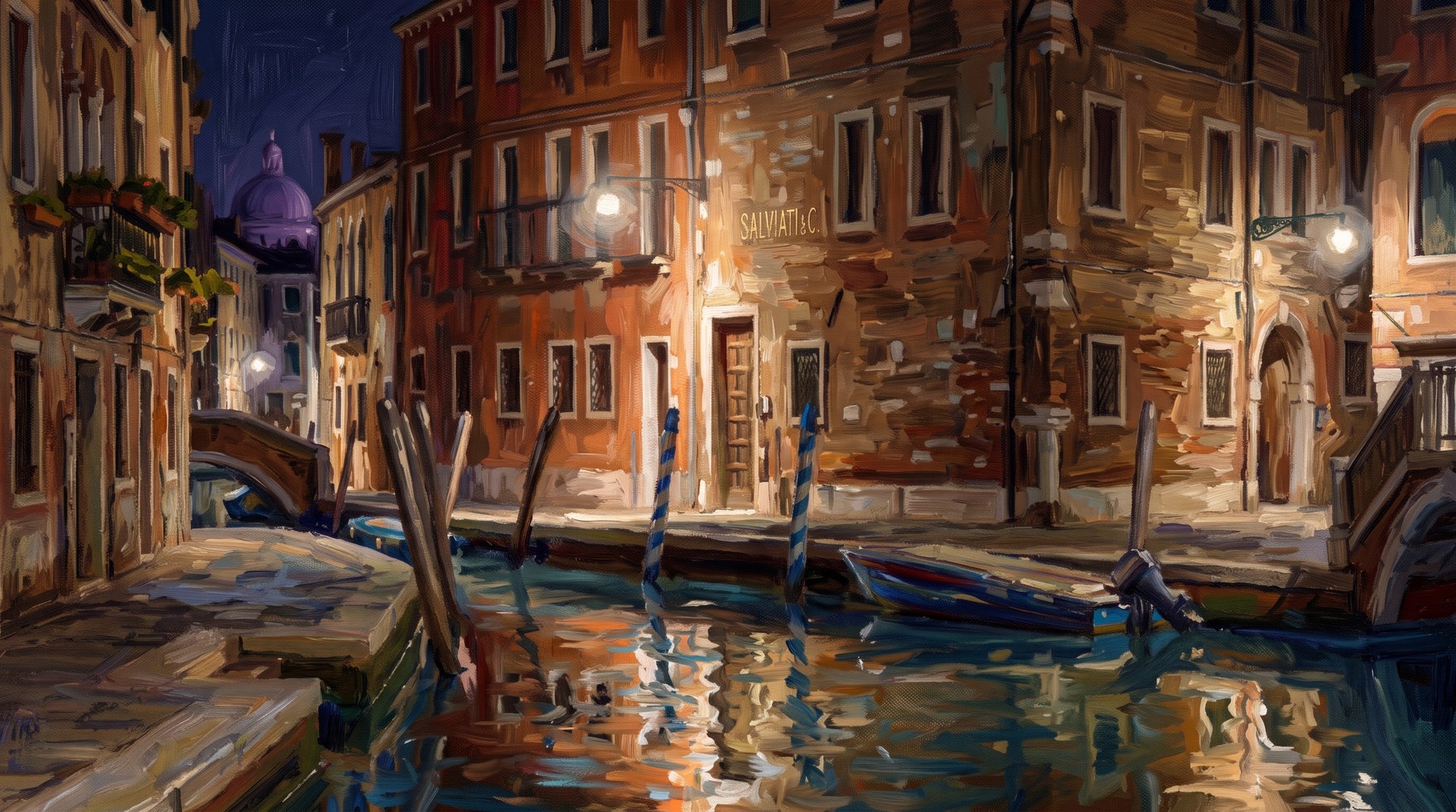
Modern Salviati Murano Glass: The Post-War Furnace Identification Guide
The Fire of the Kilns (The Furnaces)
Salviati & C. s.p.a. — The Post-War Design House
Furnace Key: Salviati & C. s.p.a.
- Type/Role: Post-War Design House, Active Hot-Glass Kiln, and Avant-Garde Design Laboratory
- Active Kiln Dates: 1920–1988 (reorganized as Salviati & C. in 1920; operated as a high-end design showroom until reopening its own physical hot-glass furnace in Murano from 1959 to 1988, after which the factory was closed and production transitioned to other furnaces under Venini management)
- Principal Founders and Directors: Maurizio Camerino | Mario Camerino | Renzo Camerino (Cavaliere del Lavoro) | Luciano Gaspari | Heinz Oestergaard
- Proprietary and Signature Techniques: Molded Sommerso (Multi-Layered Submerged Glass) | Heavy Textured Piastra Sculptures | Incalmo (Hot-Welded Joints) | Fine Ground and Cold-Carved Satin Finishes
- Market Price Tier: Investment Grade Contemporary Glass (especially verified 1961 Sergio Asti "Marco" Compasso d'Oro vases, and early Luciano Gaspari sommerso vessels blown by Livio Seguso)
Summary:
Discover the magnificent post-war history and design breakthroughs of the reborn Salviati & C. s.p.a. furnace, the modern Murano powerhouse that redefined mid-century and contemporary glass. This expert collector's guide covers the interwar collaborations with Dino Martens and Successori Andrea Rioda, the post-war appointment of painter Luciano Gaspari as Art Director, the reopening of their physical hot-glass kiln in 1959, and their legendary collaborations with Livio Seguso, Sergio Asti, Romano Chirivi, and Loredano Rosin. Learn how to verify authentic diagnostic markers—including molded sommerso casing layers, sandblasted Salviati s.p.a. acid stamps, Sergio Asti's award-winning Marco series and other avant-garde design masterpieces to navigate the contemporary glass market with total curatorial confidence.
Furnace Corporate Lineage Map
┌────────────────────────────────────────────────────────────────────────┐
│                       FURNACE CORPORATE LINEAGE                        │
│                   - SALVIATI & C. POST-WAR FURNACE -                   │
└───────────────────────────────────┬────────────────────────────────────┘
                                    │
                                    ▼
                      Giulio & Silvio Salviati Partner
                         with Maurizio Camerino
                                    │
                                    ▼
                        Erede dott. A. Salviati & C.
                        (Giulio dies 1898, Silvio 1920)
                                    │
                                    ▼
                         Salviati & C. (Venice)
                    (Maurizio Camerino Sole Owner, 1920)
                                    │
                    ┌───────────────┴───────────────┐
                    │ [1938 Rioda Liquidation]      │
                    ▼                               ▼
               Showrooms Only              Successori Andrea Rioda
         (Mario & Renzo Camerino)          (Dino Martens Designs)
                    │                               │
                    └───────────────┬───────────────┘
                                    │ [1945 Post-War Reconstruction]
                                    ▼
                        Salviati & C. (Showrooms)
                       (Luciano Gaspari Art Director)
                                    │
                    ┌───────────────┴───────────────┐
                    │ [Early 1950s Partners]        │
                    ▼                               ▼
               Fratelli Toso               Alfredo Barbini
         (Rented Hot Workbenches)          (Execution of Sommerso)
                    │                               │
                    └───────────────┬───────────────┘
                                    │ [1959 Purchase of Physical Murano Furnace]
                                    ▼
                        Salviati & C. Hot Furnace
                       (Chief Blower: Livio Seguso)
                                    │
                    ┌───────────────┴───────────────┐
                    │ [1965 Reorganization]         │
                    ▼                               ▼
               Salviati & C. s.p.a.        Loredano Rosin
         (Renzo Camerino President)        (Chief Blower 1968-74)
                    │                               │
                    └───────────────┬───────────────┘
                                    │ [1987/1988 Gardini and Ferruzzi Acquisition]
                                    ▼
                         Salviati & C. s.p.a.
                     (1988 Factory Closed; Brand Only)
                                    │
                                    ▼
                        Production by Venini & Others
                     (Johansson & Oestergaard Designs)
Visual Timeline of the Post-War Design House
              ┌──────────────────────────────────────────────────────────┐
              │                   SALVIATI MODERN ERA                    │
              │               - HISTORICAL TIMELINE -                    │
              └──────────────────────────┬───────────────────────────────┘
                                         │
     ┌───────┐                           ▼
     │ 1920  │ ──► Silvio Salviati withdraws; Maurizio Camerino takes sole
     └───────┘     ownership, reorganizing the firm as Salviati & C.
                                         │
                                         ▼
     ┌───────┐                           ▼
     │ 1932  │ ──► Dino Martens designs avant-garde olive-green glasswares
     └───────┘     for Salviati, shown at the Venice Biennale.
                                         │
                                         ▼
     ┌───────┐                           ▼
     │ 1950  │ ──► Painter Luciano Gaspari appointed as Art Director,
     └───────┘     guiding the post-war transition to abstract design.
                                         │
                                         ▼
     ┌───────┐                           ▼
     │ 1959  │ ──► Salviati buys physical Murano furnace; Livio Seguso
     └───────┘     hired as chief master blower for Gaspari's sommerso.
                                         │
                                         ▼
     ┌───────┐                           ▼
     │ 1962  │ ──► Sergio Asti's "Marco" vases win the Compasso d'Oro,
     └───────┘     securing the firm's global modernist footprint.
                                         │
                                         ▼
     ┌───────┐                           ▼
     │ 1965  │ ──► Reorganized as Salviati & C. s.p.a. under the
     └───────┘     presidency of Cavaliere Renzo Camerino.
                                         │
                                         ▼
     ┌───────┐                           ▼
     │ 1987  │ ──► Firm acquired by the Ferruzzi group; the physical
     └───────┘     furnace on Murano is closed the following year in 1988.
1. The Interwar Twilight and the Rioda Crossovers (1920–1938)
The transition of the Salviati name from its nineteenth-century historicist roots into the modern design era was shaped by the strategic stewardship of the Camerino family. Following the death of Dr. Antonio Salviati in 1890, the firm was managed by his children Giulio and Silvio Salviati alongside their business partner, Maurizio Camerino. By 1894, the original family partnership was dissolved, and Giulio and Silvio separately partnered with Camerino to continue their commercial activity in the glass sector. Following Giulio's death in 1898 and Silvio's withdrawal in 1920, Maurizio Camerino became the sole owner of the prestigious retail showrooms and mosaic studios, reorganizing the entire firm under the streamlined trade name Salviati & C.
Lacking an active, independent hot-glass furnace during the interwar years, Salviati & C. operated strictly as an elite design house and global distributor. To execute their high-end art glass designs, Maurizio Camerino negotiated a long-term production contract with Successori Andrea Rioda, a prominent Murano furnace specialized in high-quality hollow-ware.
This corporate crossover yielded some of the earliest avant-garde glass designs of the interwar era. At the 1932 Venice Biennale, Salviati & C. presented a highly celebrated series of art glass designed by the young futurist painter Dino Martens. Under Martens’s creative direction, the gaffers of Successori Andrea Rioda executed a series of heavy, olive-green glass vessels decorated with spiraling emerald stripes, alongside a delicate glass nightingale and a cornucopia containing hot-applied grapes. These pieces, which departed from the paper-thin historicist models of the previous century, demonstrated Salviati's early commitment to sculptural modernism.
Following Maurizio Camerino's death, the firm was inherited by his children Mario, Renzo, and Olga Camerino, who maintained the retail galleries at Campo Santa Maria del Giglio and Palazzo Barbarigo. However, the precarious economic climate of the late 1930s led to the liquidation of Successori Andrea Rioda in 1938, temporarily leaving Salviati without its primary manufacturing partner.
2. Post-War Reconstruction and the Toso Workspace (1945–1958)
The devastation of World War II severely impacted Salviati’s Venetian showrooms, which were requisitioned and partially damaged. In the immediate post-war years, Renzo Camerino took charge of the firm’s administrative and strategic reconstruction. Camerino recognized that to compete with the rising modernist forces of Venini and Seguso Vetri d'Arte, Salviati required a strong artistic guide. In the early 1950s (with sources indicating either 1950 or 1955 as his official appointment date), he appointed the prominent Venetian painter Luciano Gaspari as the company's chief Art Director, establishing an artistic partnership that would span over three decades.
Gaspari faced a major structural challenge: Salviati still did not own an active hot-furnace. To execute Gaspari's fluid, painterly designs, Renzo Camerino negotiated an exclusive contract in the early 1950s to permanently rent two active workbenches directly on the furnace floor of Vetreria Fratelli Toso.
This arrangement established a unique, highly successful industrial symbiosis. Under the terms of the contract:
- The master blowers of Fratelli Toso executed Gaspari's high-end modernist designs exclusively for Salviati’s showrooms.
- In turn, during the peak summer tourist season, Fratelli Toso operated a small demonstration furnace directly on Salviati’s canal-front premises in Venice to capture the tourist trade and market their collaborated wares.
At these rented workbenches, Gaspari began conducting his first successful experiments with thick-walled, layered sommerso glass. However, as Gaspari’s designs grew increasingly complex, utilizing organic, asymmetrical contours and dense metallic powder inclusions, it became clear that Salviati required absolute control over its own hot-kiln operations.
3. The 1959 Rebirth of the Hot-Glass Furnace
The historical turning point arrived in 1958/1959 when Renzo Camerino executed a bold expansion, purchasing a physical factory building on Murano from the former Aziende Chimiche Barbini company. For the first time in nearly fifty years, Salviati & C. officially reopened its own active hot-glass furnace on the island of Murano.
To lead this newly resurrected furnace, Gaspari and Camerino recruited some of the lagoon's absolute finest master craftsmen. They hired the legendary Livio Seguso as chief master blower (maestro di prima piazza). Seguso, who had trained under Alfredo Barbini, possessed an extraordinary physical virtuosity and a deep, intuitive understanding of heavy, sculptural glass masses.
From 1959 until 1968, Livio Seguso served as the primary hand executing Luciano Gaspari's post-war masterpieces. Together, Gaspari and Seguso perfected the technique of molded colored sommerso. These pieces featured smooth, outer casings of colorless crystal enclosing multiple, suspended layers of contrasting colored glass (such as rich amethyst, warm amber, and deep cobalt blue) that were shaped while hot using specialized wooden paddles. Under Seguso's masterful execution, Salviati’s sommerso wares captured the fluid, light-refracting qualities of the Venetian lagoon, earning critical acclaim at the Venice Biennales of 1960 and 1964.
4. The Compasso d'Oro and the Avant-Garde Wave (1960–1974)
During this golden era of furnace production, Salviati & C. became a premier laboratory for international avant-garde designers, architects, and sculptors, who were drawn to the exceptional technical capability of their workshop:
- Sergio Asti and the Compasso d'Oro (1961–1962): In 1961, the celebrated Italian architect and industrial designer Sergio Asti partnered with Salviati to create the "Marco" series. These vases and lidded boxes were characterized by their strict, minimalist silhouettes, monochromatic colors, and thick, satin-finished surfaces. At the 1962 Milan Triennale, Asti's "Marco" series was awarded the prestigious Compasso d'Oro prize, instantly securing Salviati's position at the absolute forefront of modern industrial design.
- Romano Chirivi (1960–1968): Chirivi designed clean, essential, and highly elegant blown glassware that utilized subtle asymmetrical rims and delicate, hot-applied glass ribbons, emphasizing the purity of transparent glass.
- The Sarasin Sculptures (1963–1968): The Swiss sculptor Betha Sarasin-Baumberger and her husband Teff Sarasin collaborated directly with Livio Seguso on the furnace floor to produce a series of whimsical, heavy solid-glass sculptures and architectural lighting elements shown at the 1964 and 1968 Venice Biennales.
- Claire Falkenstein (1972): Famed for her monumental wire and glass sculptures, Falkenstein worked with Salviati’s gaffers to blow hot glass directly into pre-formed, interlocking copper and steel mesh frames, creating a striking, organic tension between metal and glass.
In 1965, following the retirement of Mario Camerino, the company restructured, renaming itself Salviati & C. s.p.a. under the presidency of Renzo Camerino, who was awarded the title of Cavaliere del Lavoro in 1966 for his extraordinary contributions to the Italian glass industry. Following Livio Seguso's departure in 1968 to open his own independent studio, Salviati appointed the master gaffer Loredano Rosin as chief master blower. Rosin, celebrated for his mastery of heavy, solid-glass sculptural forms (vetro massiccio), continued to execute Gaspari's increasingly ambitious, large-scale glass plaques and abstract sculptures until 1974.
5. The Ferruzzi Era and late-Century Design (1987–1995)
In 1987, to navigate the increasingly competitive global luxury market, the venerable Salviati & C. s.p.a. was purchased by the prominent Italian industrial conglomerate Gardini and Ferruzzi (which also held a controlling stake in Venini). Under this new corporate administration, managed by Andrea Boscaro in 1988, a major structural reorganization took place: the physical Salviati furnace building on Murano was officially closed in 1988. While the Salviati company continued to operate as an elite luxury brand and global distributor, actual glassblowing production was transferred directly to Venini and other leading Muranese workshops.
During this late-century transitional era, the Salviati brand focused heavily on high-art, limited-edition collections designed by prominent international figures. Chief among these was the German fashion icon Heinz Oestergaard (collaborating from 1985 and continuing past 1995) and the Swedish designer Berit Johansson, whose contemporary, organic, and highly colorful vases and bowls revitalized Salviati's catalog in the early 1990s. Renzo Camerino's daughter, Francesca Camerino, also contributed modern designs under the pseudonym Studio Effe starting in 1977.
6. The Collector's Diagnostic Checklist: Post-War Salviati Wares
To identify, date, and value original post-war glass produced by Salviati & C. and Salviati & C. s.p.a. (c. 1950–1995), collectors must utilize the following diagnostic criteria:
- Evaluating Weight and Casing Layers: Genuine Gaspari-era sommerso vases designed for Salviati are characterized by their extraordinary physical weight and perfectly defined, razor-sharp casing boundaries. If the boundaries between the colored layers appear fuzzy, bleeding, or if the colorless crystal outer jacket contains heavy striations or yellowing, the piece is likely a low-quality imitation.
- Checking Surface Quality on Satin Wares: Sergio Asti's "Marco" series features a uniform, micro-fine, and completely smooth acid-etched or sandblasted satin finish. Genuine pieces show no uneven shiny spots, heavy scratches, or rough grinding marks along the shoulders or base.
- Verifying Cold-Work on Satin Wares: Asti's satin-finished "Marco" series must exhibit a perfectly uniform, micro-fine velvet texture. Under magnification, the surface must be completely free of shiny spots, uneven acid patches, or rough grinding marks along the shoulders or base ring.
- The Price Tiers:
- Ultra-Premium Investment Grade: Original 1961 Sergio Asti "Marco" vases carrying early Compasso d'Oro labels, and 1950s/1960s Luciano Gaspari sommerso vessels hand-blown by Livio Seguso. These command high five-figure sums at specialized international design auctions.
- Mid-Range: Unsigned 1960s Gaspari sommerso vases in standard colorways, Romano Chirivi blown pitchers, and Heinz Oestergaard limited-edition bowls.
- Accessible: Post-1980 commercial showroom tumblers, signed Studio Effe (Francesco Camerino) retail wares, and modern catalogued production stemwares.
7. Forensic Chronology of Base Markings & Signatures
Because the modern Salviati firm underwent multiple corporate and ownership transitions, their creations carry highly distinct, chronologically clear markings that determine their value on the collector's market:
I. The Successori Andrea Rioda Labels (1920–1938)
Wares executed for Salviati by the Rioda furnace carried a fragile paper label or a hand-written mark:
- The Mark: A thin, circular paper label reading:
SUCCESSORI ANDREA RIODA / MURANOsometimes accompanied by a stamped catalog or inventory number.
II. The Salviati & C. Acid Stamps (1950–1965)
High-end creations, particularly Gaspari's early sommerso series, carry a sandblasted or acid-etched stamp:
- The Stamp: An oval or circular acid-stamp reading:
SALVIATI & C. / VENEZIAorSALVIATI / MURANO / MADE IN ITALY.
III. The Salviati & C. s.p.a. Stamps (1965–1987)
Following the 1965 corporate renaming, the sandblasted stamps were modernized:
- The Stamp: A sharp, linear sandblasted stamp reading:
SALVIATI & C. s.p.a. / MURANOorSALVIATI & C. / MADE IN ITALY.
IV. The Ferruzzi and Contemporary Etchings (Post-1987)
Following the factory closure, limited-edition collections carry sandblasted or hand-engraved signatures:
- The Signature: A hand-engraved, linear signature reading:
Salviati / [Year]orSalviati / Heinz Oestergaardoften accompanied by individual registration numbers for limited editions.
Maestro Key (Active Gaffers & Bench Dates)
| Maestro | Role / Specialization | Active Window | Historical Context & Focus |
|---|---|---|---|
| Livio Seguso | Chief Master Blower | 1959–1968 | Led Salviati's reborn physical furnace; primary blower for Gaspari's sommerso. |
| Loredano Rosin | Chief Master Blower | 1968–1974 | Specialized in heavy, solid-glass sculptural masses (vetro massiccio) for Gaspari. |
| Alfredo Barbini | Master Glassblower | 1950–1955 | Independent master who executed Gaspari's early post-war sommerso designs before 1959. |
Designer Key (Active Minds & Design Dates)
| Designer | Role / Aesthetic Style | Active Window | Historical Context & Focus |
|---|---|---|---|
| Luciano Gaspari | Art Director / Painter | 1950–1985 | Guided Salviati's post-war transition from historicism to fluid, abstract sommerso. |
| Sergio Asti | Architect & Designer | 1961–1966 | Designed the "Marco" series, awarded the Compasso d'Oro in 1962. |
| Romano Chirivi | Architect & Designer | 1960–1968 | Designed clean, essential blown glasswares with delicate applied ribbons. |
| Heinz Oestergaard | Fashion Designer | 1985–1995 | German fashion icon who designed limited-edition contemporary glasswares for Salviati. |
| Betha Sarasin-Baumberger | Sculptor / Designer | 1963–1968 | Basel sculptor who crafted heavy solid-glass architectural lighting. |
Bridges Key (Active Facilitators & Strategic Dates)
| Facilitator | Role / Strategic Contribution | Active Window | Historical Context & Focus |
|---|---|---|---|
| Renzo Camerino | President & Shareholder | 1945–1987 | Rebuilt post-war galleries; reopened Murano hot furnace; awarded Cavaliere del Lavoro (1966). |
| Mario Camerino | Co-Director / Co-Owner | 1920–1965 | Co-managed post-war reconstruction prior to his 1965 departure. |
| Maurizio Camerino | Managing Director | 1920–1930s | Acquired sole ownership of Salviati retail shops in 1920; structured Rioda crossovers. |
| Andrea Boscaro | Corporate Administrator | 1988–1992 | Managed Salviati's limited-edition designer lines following the Ferruzzi acquisition. |
Consortiums Key (Associated Alliances & Membership Dates)
| Consortium / Guild | Strategic Shield / Cartel Type | Membership Window | Historical Context & Focus |
|---|---|---|---|
| Salviati & C. s.p.a. | Reorganized Design Joint-Stock | 1965–1987 | Rebranded corporate alliance formed to manage global modern design retail. |
| Gardini & Ferruzzi Group | Industrial Luxury Syndicate | 1987–1995 | Corporate acquisition group that positioned Salviati as a high-art brand. |
Dynasty Key (Bloodline Connections)
| Dynasty | Bloodline Role | Connection Window | Family Contributions & Mergers |
|---|---|---|---|
| The Camerino Dynasty | Corporate & Financial Directors | 1920–1987 | Maintained exclusive ownership of the Salviati showrooms, shops, and post-war kiln. |
| The Seguso Dynasty | Master Gaffers & Sculptors | 1959–1968 | Seated chief gaffer Livio Seguso, establishing Salviati's post-war sommerso dominance. |
Alchemical Key (Material & Chemical Formulas)
| Formula Name | Material Type | First Melt Date | Chemical Composition & Visual Effect |
|---|---|---|---|
| Molded Sommerso | Formula 301 (Cased Sommerso) | 1959 (Luciano Gaspari) | Multi-layered cased glass of rich amethyst and amber enclosed in thick crystal. |
| Satin Finishes | Formula 305 (Satin Finish) | 1961 (Sergio Asti) | Clean acid-etched or sandblasted surfaces creating a soft, non-reflective matte finish. |
Curatorial Footprint Key (Exhibition & Provenance Registry)
| Exhibition / Institution | Location | Years Exhibited | Catalog Focus & Provenance Wares |
|---|---|---|---|
| Venice Biennale d'Arte | Venice, Italy | 1932, 1960, 1964, 1968 | Debuted Martens Rioda wares (1932), Gaspari sommerso (1960), and Sarasin sculptures (1968). |
| Milan Triennale d'Arte | Milan, Italy | 1962 | Awarded Sergio Asti's monochromatic "Marco" series the Compasso d'Oro in 1962. |
| Corning Museum of Glass | Corning, USA | Permanent Exhibit | Houses major collections of post-war Salviati, including Gaspari sommerso and Asti's "Marco" series. |
8. Attribution & Authenticity
In the Murano glassmaking tradition, the difference between a fake and a copy rests entirely on intent, origin, and transparent attribution. A fake is a deceptive counterfeit manufactured outside of Murano—often in mass production factories in Asia or Eastern Europe—that utilizes cheap materials and carries forged signatures or illicit trademark stickers to intentionally defraud collectors. Conversely, a copy is a legitimate artistic homage (omaggio) handcrafted by a skilled master using authentic Murano techniques and materials; it serves as a tribute to honor a legendary artisan's legacy and is openly signed by the modern creator, preserving the lineage of Venetian glassblowing rather than exploiting it.
Join Our Facebook Group Identify Your Murano - Murano Glass Animals