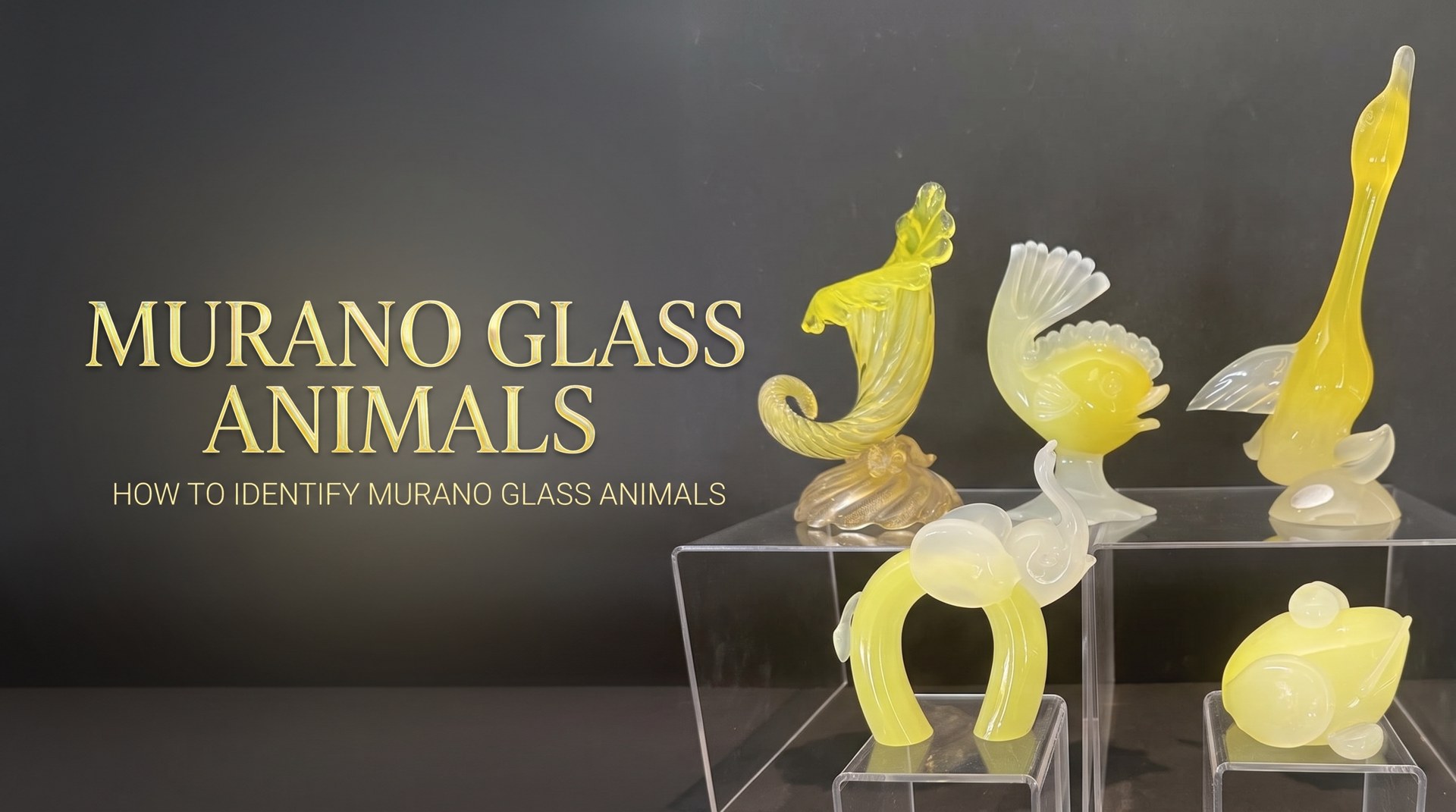
How To Identify Murano Glass Animals
How to Identify Murano Glass Animals: Makers, Labels, Signatures & Authenticity
Have a glass duck, fish, cat, elephant or another beautiful mystery animal? Discover the clues that can help reveal where it came from and who may have made it.
Your glass animal has a story. Let's discover it.
Maybe you found it in an antique shop. Perhaps it belonged to someone in your family, or you simply fell in love with its colour and character. Now you want to know: Is it Murano glass? Who made it? How old is it? And could it be valuable?
You are in the right place. Murano Glass Animals (MGA) brings together a community of collectors and an extraordinary reference library of 382 albums for comparing animal shapes, glassmaking techniques, makers, historic labels and signatures. This guide shows you how to use those clues to make a more informed identification.
Want another pair of eyes on your animal? Join Murano Glass Animals on Facebook and share your photographs with the community.
What are Murano glass animals?
Murano glass animals are decorative glass figurines and sculptures made on the island of Murano in the Venetian lagoon, Italy. They range from small, delicate lampworked figures to substantial, sculptural animals shaped from hot glass in a furnace. Some are playful and brightly coloured; others are elegant, restrained and remarkably lifelike.
Collectors encounter ducks, swans, parrots, fish, cats, dogs, horses, elephants, lions, penguins, turtles and countless other creatures. Some have clearly documented makers. Others are still mysteries waiting for the right comparison or surviving piece of evidence.
The place of manufacture is important: a glass animal is not automatically Murano glass because it is colourful, handmade or sold as Venetian. Identifying its origin takes more than a quick glance.
How do I identify my Murano glass animal?
Begin with what you can see, then follow the evidence. These six steps can turn a mystery figurine into a much more informed attribution.
1. Identify the animal and its distinctive shape
Start with the species, but look beyond the obvious. Is your bird a duck or a swan? Is the fish perched on a clear base or free-standing? Are the legs pulled from the body or attached separately? Notice the proportions, expression, eyes, feet, ears, wings and tail.
Compare your piece with MGA's species albums, such as Murano glass ducks, swans, elephants, horses and fish.
Look for a combination of matching features, not simply the same animal. Two glass ducks can share a silhouette while coming from entirely different workshops.
2. Study the colours and the way the glass was made
Is the colour solid, transparent, layered or swirled? Can you see air bubbles, internal coloured canes, metallic flecks, controlled patterns or a clear outer layer? Are the details worked with a small flame or shaped while the glass was gathered hot?
These observations may help narrow the type of work and suggest worthwhile comparisons, but no technique on its own proves a particular maker.
3. Turn the animal over and examine its base
The underside is often one of the most useful places to look. Is it flat and polished, ground, rough, recessed, signed or finished with a pontil mark? Has a label survived? Is it standing on an applied base?
Photograph the base clearly. A maker's documented base finishing can sometimes be more informative than an animal's overall shape, although different makers can use similar finishes.
4. Check for labels, signatures and marks
Look for paper labels, foil stickers, acid-etched marks, engraved signatures and any accompanying paperwork. Capture the exact wording, not just the colour or shape of the label.
A signature or label can be a valuable lead, but authenticity depends on whether the mark is appropriate to the maker, period and object. Stickers can be lost, moved or reproduced, and many genuine older pieces have no surviving mark at all.
Start comparing with MGA's authentic labels reference album and the labels, techniques and research section.
5. Compare with documented glassmakers and furnaces
Once you have identified the form, colour, base and any marks, explore maker-specific albums. You may find strong comparisons among the work of particular Murano furnaces and artists.
For example, MGA includes separate Archimede Seguso reference albums and many other glassmaker collections. A convincing attribution should consider multiple details together, ideally supported by labels, catalogues, archive material or other traceable references.
6. Ask the MGA community to help narrow the possibilities
When you post your animal, include at least three clear photos: front, side and base, plus close-ups of labels or signatures. Give the height, length and width, and mention anything known about where it came from. A neutral background and natural light make comparisons easier; avoid hands, props and flash where possible.
Join the Murano Glass Animals Facebook group to ask for help and explore the examples shared by other collectors.
What types of Murano glass animals are most popular?
There is no single definitive list of the most collected subjects, but birds, fish and mammals make wonderful starting points for identification. MGA's library lets you go straight to the subject you own.
- Birds: ducks, swans and parrots, as well as owls, pheasants and more.
- Land animals: elephants, horses and a wide range of familiar and exotic mammals.
- Marine animals: fish, seahorses and other sea creatures.
- Unusual species: reptiles, amphibians, insects, invertebrates and mythical creatures, including specialist collections you may never expect to find in glass.
Explore all 382 reference albums by subject and maker.
How are Murano glass animals made? Techniques to recognise
The skill of Murano's glassmakers can be seen in the details. Knowing a few glassmaking terms helps you describe your animal and search more effectively.
Lampworking (lavorazione a lume)
Glass is heated and manipulated in a flame, allowing the maker to form small animals and finely detailed features. Delicate legs, antennae and eyes may be shaped this way. Lampworking is not unique to Murano, so the technique alone cannot establish origin.
Furnace-worked and free-formed glass
A gather of hot glass is shaped with tools, movement and practiced handwork. Many heavier animal sculptures are made in this way, sometimes with applied details or bases. Similar methods are used in glassmaking centres worldwide.
Sommerso glass
Layers of differently coloured glass create a sense of depth within the sculpture. Look for colour seemingly enclosed beneath a clear or contrasting outer layer. Sommerso is important in Murano glass history, but its presence is not a signature of one maker.
Millefiori and murrine
Small patterned glass elements, often made from sliced canes, can produce flowers, stars and intricate mosaics inside glass. The exact arrangement, technique and style may be useful when comparing documented examples.
Gold and silver inclusions
Some glass animals incorporate gold- or silver-coloured leaf and other metallic-looking decoration. Do not assume an inclusion is genuine gold, a specific purity or evidence of age without supporting documentation.
Bullicante and controlled bubbles
Deliberate, often regularly spaced bubbles can form part of the design. Their placement and relationship to colour layers can provide useful comparison details.
How can you tell whether a Murano glass animal is authentic?
Authenticity is a question of origin and evidence, not just appearance. There is no reliable single visual test that proves every glass animal was made on Murano.
A stronger case may combine a traceable label or mark, a documented maker's design, matching construction details, provenance, historical catalogues and reliable archive comparisons. A beautiful handmade animal without those clues might still be genuine Murano glass, but it should not automatically receive a confident attribution.
Be cautious of vague claims such as “Murano style”, “Italian art glass” or “in the style of Seguso”. They can describe appearance without proving where the piece was made.
What is the Vetro Artistico Murano trademark?
Vetro Artistico Murano is a protected regional trademark associated with authorised producers on Murano. The Veneto Region explains that only approved concessionaires are authorised to use the mark on qualifying products. This makes an appropriate, verifiable trademark label an important clue for eligible modern production.
It is not a universal certificate for every authentic Murano object ever made. Many vintage animals predate this scheme, and the absence of the trademark does not make an older piece inauthentic. Likewise, a printed sticker should never be treated as conclusive proof without checking its details and context.
For the official scheme, see the Veneto Region's Vetro Artistico Murano information and authorised manufacturers. MGA's dedicated registration and label albums offer useful comparisons, but a registration reference must not be mistaken for proof of an individual animal's maker.
Who made my Murano glass animal?
This is often the most exciting question, and sometimes the hardest. Murano has a long history of workshops, designers, master glassmakers, collaborations and changing business names. Similar subjects can occur across different producers and periods.
The most helpful approach is to compare your exact animal with documented examples, rather than selecting the best-known name that made similar work. Explore MGA's glassmakers, artists and furnaces albums, along with the historic VM and VAM manufacturer reference albums.
A carefully described “possibly by” or “attributed to” can be much more useful than a confident but unsupported name. In glass research, following the evidence is part of the adventure.
How much are Murano glass animals worth?
The value of a Murano glass animal depends on the individual piece, not a standard price for the species. A small unsigned figure, a documented vintage design and a substantial signed sculpture may have very different markets.
Useful factors include the maker and strength of attribution, age, rarity, design quality, size, condition, provenance, original labels and comparable completed sales. Chips, repairs and restoration can matter significantly. Asking prices in online shops are not the same as achieved auction or resale prices.
If you are researching value, begin by identifying the animal and maker as accurately as possible. Then compare genuinely similar pieces in comparable condition, using recent sold results where available. The MGA albums are identification references, not a price guide or valuation service.
Where can I find Murano glass animals?
You can encounter Murano glass animals in specialist glass galleries, antique centres, auctions, second-hand markets, online marketplaces and family collections. Modern pieces may be sold through contemporary Murano glassmakers or reputable retailers. Vintage examples often require more detective work.
Before you buy, check the photographs, dimensions, condition, base, labels and seller's evidence for the claimed attribution. Ask for close-ups, and compare the piece with independent references rather than relying on a sales description alone.
For learning, start with MGA's complete album library. To exchange discoveries and seek identification help, visit Murano Glass Animals on Facebook.
Frequently asked questions about Murano glass animals
Are all Murano glass animals signed?
No. Many genuine pieces are unsigned, and paper labels can be lost over time. The absence of a signature does not establish that an animal is not Murano glass. Compare its design, construction, base and any surviving evidence.
Does a sticker saying “Murano” prove authenticity?
Not by itself. Check the precise wording, label style, maker or registration details, and whether they are appropriate to the claimed date and workshop. Generic stickers are not substitutes for corroborating evidence.
How do I identify a Murano glass duck or swan?
Begin with the beak, neck, tail, eye treatment, colour layers, base finish and overall proportions. Compare the Duck and Swan albums, then examine makers with similar documented designs.
Can Murano glass animals be valuable?
Yes, some are highly sought after, but many are modestly priced. An attractive shape alone does not determine value. Credible attribution, condition, rarity and completed-sale comparisons are more informative.
Can MGA identify my animal from pictures?
Good photographs can support a useful comparison and sometimes an identification, but not every piece can be attributed confidently. Include the front, side and base, labels or signatures, and height, length and width. The group can help you explore possible makers and relevant evidence.
Ready to discover your animal's story?
Whether you own one little glass bird or a cabinet full of colourful creatures, your next discovery could begin with a single comparison.
Explore the MGA reference library: 382 linked albums, organised by species, makers, historic references and specialist research. Or join Murano Glass Animals on Facebook and show the community what you have found.
References for the authenticity guidance: Regione del Veneto, Murano Artistic Glass; Regione del Veneto, Concessionaires.