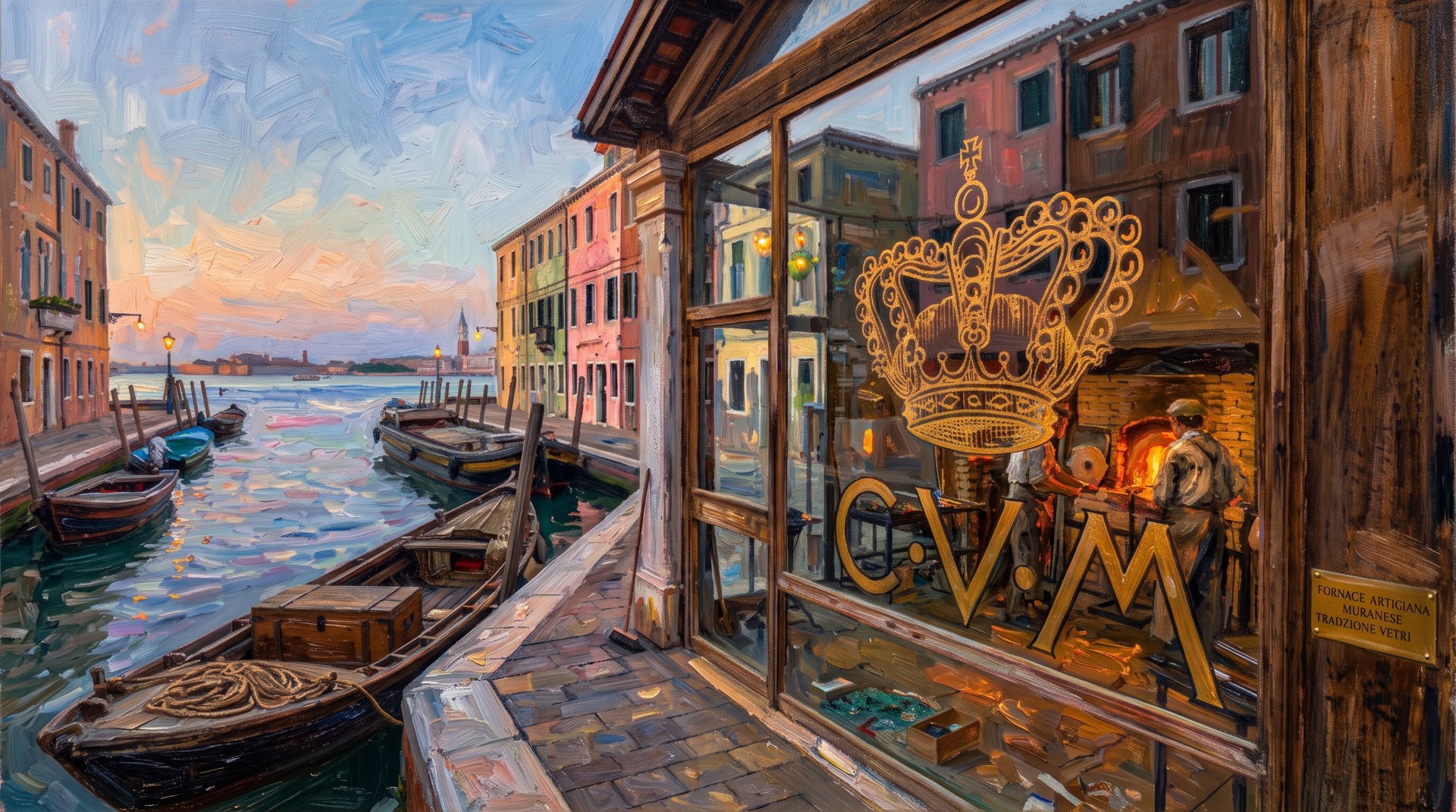
Compagnia di Venezia e Murano: The Ultimate Archaeological C.V.M. Glass Guide
The Fire of the Kilns (The Furnaces)
Compagnia di Venezia e Murano (C.V.M.) — The Archaeological Crucible
Furnace Key: C.V.M.
- Type/Role: Anglo-Italian Joint-Stock Artistic Glasshouse, Mosaic Studio, and Archaeological Laboratory
- Active Kiln Dates: 1872–1910 (as an active independent furnace on the Fondamenta dei Vetrai, prior to the 1910 closure and subsequent transition to a showroom retail trademark)
- Principal Founders: Sir Austen Henry Layard | Sir William Richard Drake | Augusto Castellani | Alessandro Castellani | Vincenzo Moretti | Antonio Seguso
- Proprietary/Signature Techniques: Ancient Roman Mosaic Glass (Murrina Romane) | Vetri Fenici (Phoenician Combed Wares) | Two-Tone Aventurine and Ruby Flat Canes | Enameled Renaissance Revivals | Fine Cameo Glass
- Market Price Tier: Ultra-Premium Investment Grade (especially early Vincenzo Moretti murrine vessels shown at the 1878 Paris Exposition, signed VM cameo-glass wares from the 1890s, and 1881 Vienna MAK exhibition pieces)
Summary:
Discover the history and alchemical masterpieces of the Compagnia di Venezia e Murano (C.V.M.), the legendary furnace that set the global standard for archaeological and classical glass fusions. This collector's guide covers C.V.M.'s 1872 British-capital restructuring, the dramatic 1877 Schism that separated Antonio Salviati from his partners, and the alchemical genius of Vincenzo Moretti as he recovered lost ancient Roman murrina and combed vetri fenici techniques. Learn how to verify authentic C.V.M. diagnostic markers including unpolished base pontils, highly splayed VM in glass murrine markings, Spaccarelli cameo carvings, and later Gaetano Ceschina showrooms—to navigate the antique market with complete curatorial confidence.
Furnace Corporate Lineage Map
┌────────────────────────────────────────────────────────────────────────┐
│                       FURNACE CORPORATE LINEAGE                        │
│                - COMPAGNIA DI VENEZIA E MURANO (C.V.M.) -              │
└───────────────────────────────────┬────────────────────────────────────┘
                                    │
                                    ▼
                          Salviati & Company Ltd.
                   (Joint-Stock, London & Palazzo Da Mula)
                                    │
                                    ▼
                      Compagnia di Venezia e Murano
                      (Anglo-Italian Restructuring)
                                    │
                    ┌───────────────┴───────────────┐
                    │ [1877 Great Schism]           │
                    ▼                               ▼
               C.V.M. Wares                Salviati dott. Antonio
       (Moretti & Antonio Seguso)       (Giovanni & Giuseppe Barovier)
                    │                               │
                    └───────────────┬───────────────┘
                                    │ [1919/1920 Gaetano Ceschina Consolidation]
                                    ▼
                      Pauly & C. - C.V.M. - Salviati
                       (Palazzo Barbarigo Showrooms)
                                    │
                                    ▼
                         Pauly & C. - C.V.M. S.p.A.
                   (Acquisition of M.V.M. Cappellin, 1933)
Visual Timeline of the Historicist Empire
              ┌──────────────────────────────────────────────────────────┐
              │             COMPAGNIA DI VENEZIA E MURANO                │
              │               - HISTORICAL TIMELINE -                    │
              └──────────────────────────┬───────────────────────────────┘
                                         │
     ┌───────┐                           ▼
     │ 1872  │ ──► Salviati & Co. Ltd. reorganizes as the Compagnia di Venezia
     └───────┘     e Murano (C.V.M.) under British management.
                                         │
                                         ▼
     ┌───────┐                           ▼
     │ 1877  │ ──► The Great Schism: Salviati departs; Moretti and Antonio Seguso
     └───────┘     remain to lead C.V.M.'s technical revival.
                                         │
                                         ▼
     ┌───────┐                           ▼
     │ 1878  │ ──► Moretti's ancient Roman murrine fusions debut to global
     └───────┘     acclaim at the Paris Exposition Universelle.
                                         │
                                         ▼
     ┌───────┐                           ▼
     │ 1881  │ ──► C.V.M. introduces vetro fenici and two-tone aventurine
     └───────┘     flat canes at the Milan and Vienna exhibitions.
                                         │
                                         ▼
     ┌───────┐                           ▼
     │ 1900  │ ──► Spaccarelli's signed "VM" cameo-glass and Toso Borella's
     └───────┘     enamels secure the firm's late-century curatorial footprint.
                                         │
                                         ▼
     ┌───────┐                           ▼
     │ 1910  │ ──► Physical furnaces close on the Fondamenta dei Vetrai;
     └───────┘     transition to an elite retail brand under Testolini.
                                         │
                                         ▼
     ┌───────┐                           ▼
     │ 1919  │ ──► Post-WWI merger with Pauly & C. under Gaetano Ceschina,
     └───────┘     consolidating Venice's luxury retail trade.
1. The British Boardroom and the Roman Jeweler: The Restructuring (1872–1877)
The corporate transition of the Salviati glassworks into the Compagnia di Venezia e Murano (C.V.M.) represents a landmark moment where raw Venetian craftsmanship collided with late-Victorian archaeological rigor and joint-stock capitalization. By 1872, Dr. Antonio Salviati's spectacular mosaic installations across Great Britain—such as the Westminster Abbey restorations—had stretched his personal financial reserves to their absolute limit. Desperately requiring massive liquidity to sustain both his monumental architectural contracts and his newly expanded blown art glass factory at Palazzo Da Mula, Salviati negotiated a historic alliance with a powerful consortium of British diplomats, scholars, and antiquarians.
This restructuring resulted in the formal incorporation of Salviati & Company Limited in London, which legally transformed in 1872 into The Venice and Murano Glass and Mosaic Company Limited, universally recognized in the lagoon as the Compagnia Venezia Murano, or C.V.M. Backed by the immense political and cultural leverage of Sir Henry Austen Layard—a prominent British diplomat, Assyriologist, and member of Parliament—the newly restructured firm enjoyed an economic solvency far superior to any other furnace on the island of Murano.
Rather than catering merely to the passing tourist trade, C.V.M.'s British board of directors sought to establish an absolute monopoly over museum-grade historical accuracy. To guide this high-minded aesthetic mission, the company engaged the celebrated Roman goldsmiths, antiquarians, and art collectors Augusto and Alessandro Castellani as design consultants and managing directors. The Castellani brothers, famed for their masterly revival of Etruscan and classical Roman jewelry, brought a strict curatorial philosophy to the furnace floor. Under their influence, C.V.M. turned away from the increasingly complex, whimsical designs of standard 19th-century Muranese glassmaking, committing its furnaces entirely to reproducing the noble, austere geometries of Greek, Roman, Byzantine, and Renaissance archaeological glass.
2. The Great Schism of 1877 and the Battle of the Kilns
This rigid curatorial direction quickly generated severe, irreconcilable policy disagreements within C.V.M.'s administrative offices. Dr. Antonio Salviati, a pragmatist with a brilliant sense of commercial retail strategy, recognized that the growing global middle class and wealthy tourists visiting Venice represented an extraordinarily lucrative market. Salviati argued for expanding retail galleries, lowering production costs, and introducing lighter, more colorful, and highly stylized traditional Venetian table service. The British directors and the Castellani brothers, conversely, fiercely opposed any dilution of their museum-grade standards, viewing commercial souvenirs as a vulgar desecration of their artistic mission.
In 1877, this administrative friction exploded into a high-profile corporate divorce. Antonio Salviati officially withdrew from C.V.M., relinquishing his entire equity stake, his original Fondamenta dei Vetrai factory, the secret chemical registers of Vincenzo Moretti, and the firm’s globally established trademarks. Salviati immediately founded a rival independent operation, Salviati Dott. Antonio, setting off a fierce, decadelong rivalry that split Murano’s absolute finest artisans into two competitive camps:
- The Salviati Camp: Led by chief master blower Giovanni Barovier and his extraordinarily talented nephews Giuseppe, Benvenuto, and Benedetto Barovier. Operating under Salviati's commercial guidance, they specialized in the manual virtuosity of thin-blown, whimsical, and hyper-elegant traditional Venetian soffiati.
- The C.V.M. Camp: Retained the furnace's master glass chemist and composer, Vincenzo Moretti, alongside the legendary master blower Antonio Seguso and his sons. Backed by C.V.M.’s massive capital reserves, this group dedicated their workbenches entirely to the demanding, high-risk chemistry of archaeological glass fusions, aiming for nothing less than the systematic recovery of lost ancient Roman, Phoenician, and Byzantine glassmaking methods.
3. Vincenzo Moretti’s Alchemical Breakthroughs: The Roman Murrina Rediscovered
With Antonio Salviati's departure, the burden of C.V.M.'s technical supremacy fell squarely upon the shoulders of Vincenzo Moretti. Born in 1835, Moretti was a completely self-taught chemist, glassmaker, and technical genius who possessed an intuitive, unmatched understanding of molten metallurgy. Working in his laboratory adjacent to the Palazzo Da Mula, Moretti set out to recover the lost classical techniques of hot-worked mosaic glass, which had been abandoned since the classical era of Alexandria and the early Roman Empire.
Moretti's alchemical trials focused on the recreation of the ancient Roman murrina—a term historically used to denote precious, naturally banded gemstones like agate and fluorite, as well as the classical glass vessels crafted to imitate them. Moretti realized that ancient Roman mosaic glass was not blown from a single gathering of molten glass, but compiled cold and fused under heat. Moretti’s painstaking process required multiple, delicate steps:
First, he composed vertical glass rods containing complex internal concentric or floral patterns. These rods were cooled and sliced into tiny, flat disks or tiles (murrine). Moretti then arranged these sliced sections next to each other on a flat metal plate (bronzin) covered in a protective layer of clay. The plate was placed into the furnace at approximately 700 degrees Celsius, where the intense heat caused the individual tiles to fuse into a single, cohesive, flat polychrome glass plate. While still hot, this mosaic plate was either slumped into a mold to form a shallow dish or picked up on a blowing iron, closed into a hot cylinder, and blown into a three-dimensional vessel.
Moretti's masterly fusions represented a technical feat that stunned the glassmaking world. At the 1878 Paris Exposition Universelle, C.V.M.'s vitrine debuted Moretti's archaeological murrine bowls and a monumental cinerary urn imitating natural agate. The display achieved a monumental triumph; international curators and critics declared that C.V.M.'s mosaic glass was indistinguishable from the priceless classical fragments excavated from Pompeii and Rome. La Voce di Murano and the global press celebrated Moretti for single-handedly recovering a lost artistic heritage, cementing C.V.M.'s technical supremacy over its rivals.
4. Technical Virtuosity: Phoenician Combing, Two-Tone Aventurine, and Cameo Glass
Following the triumph of 1878, Moretti and C.V.M.'s master gaffers continued to expand their technological repertoire, recovering several other historically elusive glass styles:
- Vetri Fenici (Phoenician-Style Glass): In 1881, Moretti successfully modified the classical combed-thread (decoro fenicio) technique to reproduce ancient Mediterranean core-formed glass. C.V.M.'s vetri fenici featured opaque, dark bodies wrapped in wave-like, combed ribbons of contrasting lattimo (milk glass) and silver-infused threads, creating an ancient, satiny luster.
- Two-Tone Aventurine and Ruby Flat Canes: Reheating highly reactive aventurine glass (containing suspended metallic copper flakes) next to a copper-ruby batch had historically been considered impossible because the copper flakes would dissolve and discolor the red glass. C.V.M. perfected a secret, highly delicate process to pull flat canes consisting of ruby red on the outside and pure aventurine on the inside (and vice versa). These flat canes were subsequently fused side-by-side and mold-blown into ribbed bowls, stands, and ewers, exhibiting an extraordinary shimmering, two-tone metallic effect.
- Cameo Glass (The VM Monogram Wares): To demonstrate their mastery of ancient Roman cameo-cutting techniques, C.V.M. partnered with master engravers like Attilio Spaccarelli. Gaffers cased an inner vessel of dark cobalt or ruby glass with a thick outer layer of opaque white lattimo. Spaccarelli then hand-carved classical figures and satyrs in relief through the white layer down to the dark core, creating magnificent classical cameo vessels carrying the splayed "VM" hallmark.
- Enameled Renaissance Reproductions: C.V.M. also dominated the reproduction of Renaissance enameled wares. Working with the master decorator Francesco Toso Borella, C.V.M. produced classical goblets decorated with detailed historical portraits, elaborate coats of arms (such as the coat of arms of Doge Niccolò da Ponte), and delicate fire-enameled scrollwork.
5. Gaetano Ceschina and the Pauly Merger: Showrooms of Luxury (1919–1933)
As the nineteenth century drew to a close, C.V.M.'s demanding, museum-grade production methods, combined with high operational overhead, began to take a heavy toll on the firm’s financial stability. The company operated sporadically throughout the first decade of the twentieth century. Following the death of key figures like Layard, and under the stewardship of Lady Enid Layard, the decision was made to close the hot-manufacturing furnaces in 1910. The company was then operated strictly as an elite showroom retail brand by Venetian merchant Marco Testolini, before its assets were acquired in 1919 by Sanitaria S.A., a Milanese investment firm that had also purchased the prestigious Venice showroom Pauly & C.
In 1920, the Milanese industrialist Gaetano Ceschina acquired both firms. Recognizing the extraordinary global prestige of both names, Ceschina merged their retail operations, establishing the consolidated brand Pauly & C. - C.V.M. Operating from the magnificent Palazzo Barbarigo and Palazzo Trevisan Cappello, Ceschina transformed C.V.M. from an active production kiln into a legendary retail house of luxury, sourcing high-end glass exclusively from Murano's premier independent furnaces.
In 1933, Ceschina executed another major strategic coup by acquiring the entire design archive, master model catalogs, and physical collection of the bankrupt Maestri Vetrai Muranesi (M.V.M.) Cappellin & C. furnace (formerly Palazzo Da Mula). This acquisition added the entire modernist legacy of Vittorio Zecchin and the young architect Carlo Scarpa directly to the Pauly & C. - C.V.M. portfolio. C.V.M.'s master blowers, who had performed live demonstrations at major international events—such as the 1933 Chicago World's Fair—ensured that the historical and modern designs of C.V.M. remained globally famous until its eventual sale to Luciano Barbon in 1963.
6. The Collector's Diagnostic Checklist: C.V.M. Wares
To confidently identify, date, and value original historicist glass objects produced by the Compagnia di Venezia e Murano (C.V.M.) (c. 1872–1910), collectors must utilize the following diagnostic criteria:
- Evaluating Glass Weight and Surface Luster: Genuine 19th-century C.V.M. blown glass exhibits a paper-thin, feather-light wall thickness and a highly refined, satiny surface finish. Many archaeological reproduction vessels were treated with selective acid-etching or mineral oxides to replicate the soft, matte, and slightly iridescent patina of excavated Roman glass.
- Analyzing Aventurine Flake Density: Authentic C.V.M. aventurine elements (especially their two-tone flat canes) feature exceptionally dense, microscopic copper flakes that shimmer with an intense, warm golden-orange brilliance when viewed under magnification. If the aventurine appears sparse, muddy, or green, it is a sign of a cheap modern reproduction.
- Checking Murrine Alignment and Fusion Seams: Vincenzo Moretti's 19th-century murrina and millefiori vessels feature hand-drawn, slightly irregular cane slices that show natural variation in size and alignment. The edges where the tiles fused show distinct, organic seams and occasional tiny, trapped air bubbles. Perfectly uniform, machine-sliced, and flawlessly straight murrine patterns are classic hallmarks of modern, automated manufacturing.
- The Price Tiers:
- Ultra-Premium Investment Grade: Original Vincenzo Moretti exhibition pieces (such as the 1878 Paris Exposition murrine lidded urns or 1880 mosaic bowls), signed Spaccarelli cameo vessels, and 1881 Vienna MAK museum-provenance pieces. These regularly command high five-figure sums at specialized international auctions.
- Mid-Range: Attributable C.V.M. two-tone aventurine flat cane vases, vetri fenici ewers, and late 19th-century enameled goblets with splayed unpolished pontil scars.
- Accessible: Standard Ceschina-era table services (post-1920) and small, unsigned Pauly & C. - C.V.M. export wares.
7. Forensic Chronology of Base Markings & Signatures
Because C.V.M. operated across multiple corporate transitions, their creations carry highly distinct, chronologically clear markings that determine their value on the collector's market:
I. The C.V.M. Export Label (1872–1880s)
Wares exported to the British and global markets carried a highly distinct circular or rectangular paper label:
- The Label: A thin, cream-colored paper label printed in black ink reading:
The Venice & Murano Glass and Mosaic Co. / 30 St. James's Street S.W.often accompanied by a hand-written stock or inventory number in iron-gall ink.
II. The Fused "VM" In-Glass Murrina (c. 1877–1890s)
Following their split from Antonio Salviati, C.V.M. began inserting a tiny, circular fused glass murrina cane directly into the base of high-art vessels to protect their designs:
- The Mark: A tiny cane section containing the white letters
VM(Venezia Murano) fused directly into the rough, unpolished pontil scar or underside of the foot.
III. The Spaccarelli Cameo Mark (c. 1890s)
Cameo-glass vessels carved by Attilio Spaccarelli carry a highly specific monogram:
- The Mark: A hand-engraved or acid-etched monogram consisting of the interlocking letters
VM, occasionally accompanied by the artist's full signature or initials.
IV. The Ceschina Era Acid Stamps (Post-1920)
Following the showroom consolidations under Gaetano Ceschina, the retail galleries utilized sandblasted and acid-etched stamps:
- The Stamps: An oval or circular acid-stamp reading:
PAULY & C. / VENEZIAorC.V.M. / VENICE / MADE IN ITALY.
Maestro Key (Active Gaffers & Bench Dates)
| Maestro | Role / Specialization | Active Window | Historical Context & Focus |
|---|---|---|---|
| Antonio Seguso | Chief Master Blower | 1872–1877 | Led C.V.M.'s prime hollow-ware bench; stayed with C.V.M. after the split. |
| Vincenzo Moretti | Master Chemist & Composer | 1872–1900 | Recovered Roman mosaic and enameled glass chemistry; founded independent workshop in 1900. |
| Andrea Rioda | Master Blower / Director | 1890s–1911 | Maintained traditional thin-blown soffiati; later acquired C.V.M.'s former factory in 1911. |
Designer Key (Active Minds & Design Dates)
| Designer | Role / Aesthetic Style | Active Window | Historical Context & Focus |
|---|---|---|---|
| Augusto Castellani | Archaeological Consultant | 1872–1880s | Famed Roman jeweler who guided C.V.M.'s Greek and Roman replicas. |
| Alessandro Castellani | Archaeological Consultant | 1872–1883 | Guided C.V.M.'s antique color research and mosaic fusions. |
| Francesco Toso Borella | Master Enamel Decorator | 1880s–1900 | Fused Renaissance enameled motifs onto classical C.V.M. soffiati. |
| Attilio Spaccarelli | Master Cameo Engraver | 1880s–1890s | Carved classical cameo relief figures through multi-layered white-cased glass. |
Bridges Key (Active Facilitators & Strategic Dates)
| Facilitator | Role / Strategic Contribution | Active Window | Historical Context & Focus |
|---|---|---|---|
| Sir Austen Henry Layard | British Diplomat & Director | 1872–1877 | Formed joint-stock alliance; directed C.V.M.'s museum-grade target focus. |
| Sir William Richard Drake | British Corporate Director | 1872–1880s | Structured London export networks, showroom dockets, and global sales. |
| Gaetano Ceschina | Milanese Industrialist | 1919–1950s | Merged C.V.M. with Pauly & C.; acquired M.V.M. Cappellin archives. |
Consortiums Key (Associated Alliances & Membership Dates)
| Consortium / Guild | Strategic Shield / Cartel Type | Membership Window | Historical Context & Focus |
|---|---|---|---|
| The Venice and Murano Glass Co. | Anglo-Italian Joint-Stock Cartel | 1872–1877 | Unified historicist alliance before the great corporate split. |
| Sanitaria S.A. | Milanese Investment Group | 1919–1920 | Acquired both C.V.M. and Pauly & C. assets for postwar commercial restructuring. |
Dynasty Key (Bloodline Connections)
| Dynasty | Bloodline Role | Connection Window | Family Contributions & Mergers |
|---|---|---|---|
| The Seguso Dynasty | Master Gaffers | 1872–1877 | Seated master Antonio Seguso, establishing C.V.M.'s early blowing dominance. |
| The Moretti Dynasty | Chemists & Technicians | 1872–1900 | Seated Vincenzo Moretti, providing the absolute foundation for mosaic glass. |
Alchemical Key (Material & Chemical Formulas)
| Formula Name | Material Type | First Melt Date | Chemical Composition & Visual Effect |
|---|---|---|---|
| Ancient Roman Mosaic Murrina | Formula 201 (Mosaic Glass) | 1871 (Vincenzo Moretti) | Multicolored concentric or floral canes sliced, arranged, and fused at 700°C. |
| Aventurine/Ruby Flat Canes | Formula 208 (Two-Tone Cane) | 1880 (C.V.M. Chemists) | Flat canes consisting of ruby red on the outside and pure aventurine on the inside. |
| Phoenician Thread-Combing | Formula 205 (Vetri Fenici) | 1881 (Vincenzo Moretti) | Opaque core glass cased in combed wave ribbons of lattimo and silver. |
Curatorial Footprint Key (Exhibition & Provenance Registry)
| Exhibition / Institution | Location | Years Exhibited | Catalog Focus & Provenance Wares |
|---|---|---|---|
| Naples Esposizione Marittima | Naples, Italy | 1871 | Debuted Moretti's initial Roman mosaic glass and cane experiments. |
| Paris Universal Exposition | Paris, France | 1878 | Awarded C.V.M. maximum acclaim for Moretti's Roman mosaic urns. |
| Vienna Museum of Applied Arts | Vienna, Austria | 1881 | Exhibited C.V.M. combed Phoenician ewers and reticello vases (GL series). |
8. Attribution & Authenticity
In the Murano glassmaking tradition, the difference between a fake and a copy rests entirely on intent, origin, and transparent attribution. A fake is a deceptive counterfeit manufactured outside of Murano—often in mass production factories in Asia or Eastern Europe—that utilizes cheap materials and carries forged signatures or illicit trademark stickers to intentionally defraud collectors. Conversely, a copy is a legitimate artistic homage (omaggio) handcrafted by a skilled master using authentic Murano techniques and materials; it serves as a tribute to honor a legendary artisan's legacy and is openly signed by the modern creator, preserving the lineage of Venetian glassblowing rather than exploiting it.
Join Our Facebook Group Identify Your Murano - Murano Glass Animals